As an Amazon Associate I earn from qualifying purchases.
Portable power stations have become much more capable in recent years. A 1,000Wh battery station is no longer limited to charging phones and laptops. Many models can now power refrigerators, camping equipment, workstations, small appliances, and essential electronics during a power outage.
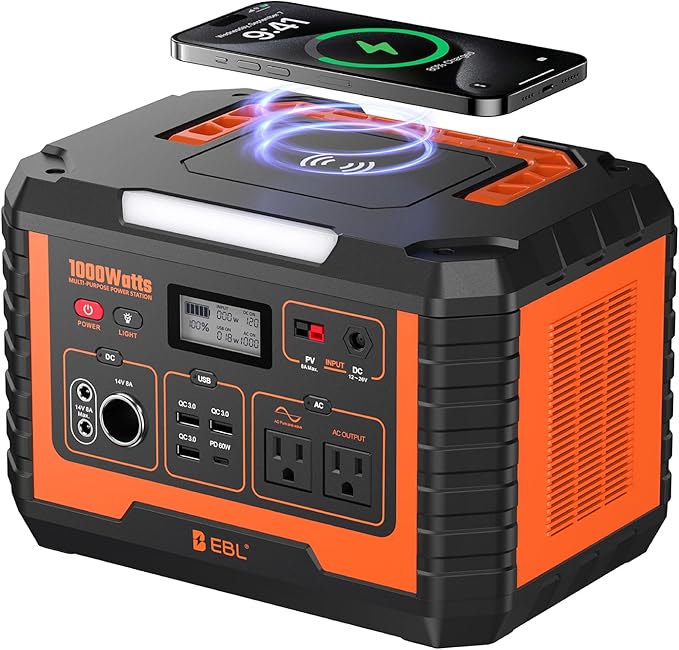
The EBL Voyager 1000 Portable Power Station (MP1000) remains an interesting option in this category. It combines a 999Wh battery, 1,000W rated output, pure sine wave AC power, multiple USB and DC connections, solar charging, and a 10W wireless charging pad in a portable design.
However, there is an important consideration in 2026: newer competitors increasingly use LiFePO4 batteries and offer faster charging and higher output. The Voyager 1000 uses an NCM lithium battery, so its strengths are more about portability, versatility, and potentially lower pricing than having the newest battery technology.
Check Amazon Price Click Here!
EBL Voyager 1000 Specifications
| Feature | EBL Voyager 1000 |
|---|---|
| Model | MP1000 |
| Battery Capacity | 999Wh |
| Battery Type | NCM Lithium |
| Rated Output | 1,000W |
| AC Output | Pure Sine Wave |
| AC Voltage | 110V ±10%, 60Hz |
| USB-A Output | Up to 18W |
| USB-C Output | Up to 60W |
| Wireless Charging | 10W |
| DC Output | Up to 8A |
| Car Socket | Up to 8A |
| Maximum Input Power | 155W |
| Solar Input | 12–26V, 8A max |
| Charging Methods | AC, solar, car |
| Net Weight | Approximately 18.7 lbs |
| Dimensions | 11.5 × 7.95 × 7.95 inches |
| Warranty | 12 months |
EBL’s current product listing identifies the MP1000 as a 999Wh NCM lithium power station with a 1,000W rated output, pure sine wave AC output, 60W USB-C PD, 10W wireless charging, and maximum input power of 155W.
What Is the EBL Voyager 1000?
The EBL Voyager 1000 is a portable power station designed to store electricity in a large internal battery and make that energy available through AC, USB, and DC outputs.
Unlike a gasoline generator, it doesn’t have an internal combustion engine. That means there is no gasoline to store, no engine exhaust during operation, and no engine noise from a combustion motor.
You can recharge the Voyager 1000 from a standard AC outlet, a compatible solar panel, or a vehicle.
Its 999Wh capacity places it in the popular 1kWh portable power station category.
That’s enough capacity for many common electronics and smaller appliances, but actual runtime depends on the power consumption of whatever you connect.
EBL itself estimates runtime using approximately:
999Wh × 0.85 ÷ device wattage
The 0.85 factor accounts for power conversion losses and provides a more realistic starting point than simply dividing 999Wh by the appliance’s wattage.
1,000W Continuous Output for Everyday Equipment
One of the main reasons to consider the Voyager 1000 is its 1,000W rated output.
That gives it considerably more capability than smaller 300Wh or 500Wh portable batteries.
The pure sine wave AC output is suitable for many types of electronics, including laptops, monitors, televisions, chargers, lights, fans, and other compatible equipment.
However, it’s important to understand that 1,000W is the maximum rated output, not the amount of energy stored in the battery.
For example, a device consuming 500W doesn’t get 500W for many hours simply because the power station is rated at 1,000W. A 500W load can consume a large portion of a 999Wh battery in a relatively short period.
EBL specifies overload protection at approximately 1,100W ±80W, so the Voyager 1000 should not be treated as a 2,000W power station.
Multiple Charging Ports for Different Devices
The Voyager 1000 is particularly versatile when it comes to connecting smaller electronics.
Its output options include:
- AC outlets
- USB-A charging
- A 60W USB-C PD port
- Two DC outputs
- A vehicle-style 12V output
- 10W wireless charging
The 60W USB-C port is useful for compatible laptops, tablets, phones, cameras, and other USB-C devices.
The USB-A outputs are better suited to phones, lights, cameras, power banks, and other smaller electronics.
The DC outputs can be useful for compatible 12V equipment, while the vehicle-style socket allows you to connect certain automotive accessories.
This variety is one of the Voyager 1000’s strongest practical features. You don’t have to rely on the AC outlets for every device.
10W Wireless Charging Is a Useful Convenience
The wireless charging pad is one of the features that makes the Voyager 1000 different from many basic power stations.
You can place a compatible smartphone on the charging surface instead of using a USB cable.
EBL specifies the wireless charger at 10W.
It’s not a replacement for the faster wired charging options, but it can be convenient when you’re camping, working outdoors, or simply don’t want another cable connected to the power station.
It’s also useful when multiple people are sharing the station and the USB ports are already occupied.
Solar, AC, and Car Charging
The Voyager 1000 can be recharged in three different ways.
AC Charging
The included wall adapter allows you to recharge the power station from a standard household outlet.
This is the most convenient option when you’re at home and want to prepare the battery before a trip or possible power outage.
Solar Charging
The Voyager 1000 supports solar input through its DC/PV connection.
EBL lists the solar input at 12–26V and up to 8A, with a maximum overall input specification of 155W on the current product listing.
That makes solar charging useful for camping and off-grid situations, but it also highlights one of the Voyager 1000’s biggest weaknesses in 2026.
Many newer power stations can accept substantially more solar input.
So while the Voyager 1000 can be recharged from the sun, it isn’t designed to take advantage of a very large solar array.
Car Charging
You can also recharge the unit from a compatible vehicle connection.
This can be useful during road trips or when you’re away from electrical outlets for several days.
How Long Does the EBL Voyager 1000 Last?
The answer depends entirely on the device you’re powering.
A simple way to estimate runtime is:
Estimated runtime = 999Wh × 0.85 ÷ device wattage
Using that formula:
| Device Power | Approximate Runtime |
|---|---|
| 10W | 84.9 hours |
| 25W | 34 hours |
| 50W | 17 hours |
| 100W | 8.5 hours |
| 200W | 4.2 hours |
| 500W | 1.7 hours |
| 800W | 1.1 hours |
These numbers are estimates rather than guaranteed runtimes.
Real-world performance can vary because of inverter losses, the device’s efficiency, battery condition, temperature, and how much power the equipment actually consumes.
EBL itself notes that actual operating time can differ from laboratory figures depending on the efficiency of the connected appliance.
What Can the EBL Voyager 1000 Power?
The Voyager 1000 is best suited to electronics and moderate-power appliances.
Laptops and Monitors
A laptop consumes considerably less than 1,000W, so the Voyager 1000 can provide useful backup power for remote work.
You can also connect a monitor and other low-power equipment as long as the combined load stays within the station’s limits.
Phones and Tablets
This is one of the easiest applications.
You can charge multiple small devices simultaneously using the USB and wireless charging options.
Camping Lights and Fans
LED lighting, small fans, camera equipment, and other camping electronics are a good match for the Voyager 1000.
Small Refrigerators
A compatible mini refrigerator can potentially be powered by the Voyager 1000.
However, refrigerators have compressors that cycle on and off, so you should look at the refrigerator’s actual energy consumption rather than assuming a fixed number of operating hours.
CPAP Machines
The Voyager 1000 can potentially serve as a backup power source for compatible CPAP equipment.
However, anyone purchasing it specifically for this purpose should calculate the expected overnight energy consumption first.
Heated humidifiers can substantially increase power consumption, so the battery capacity required may be considerably higher than the CPAP machine’s basic wattage suggests.
Portable Design for Camping and Travel
Portability is another major advantage.
EBL currently lists the net weight at approximately 8.5 kg, or about 18.7 pounds, with a product size of approximately 11.5 × 7.95 × 7.95 inches.
That’s manageable for camping, road trips, tailgating, and emergency storage.
It’s also significantly easier to move than a conventional gasoline generator with a similar power rating.
The folding handle makes carrying the unit between a vehicle, campsite, garage, or storage area more convenient.
One thing to keep in mind is that older reviews and listings may show different weights and dimensions. For example, an older hands-on review listed the MP1000 at 23.1 pounds, while EBL’s current product page lists the newer published net weight at approximately 18.7 pounds.
For a current buying decision, I would use EBL’s current specification rather than an older third-party listing.
NCM Lithium Battery: The Biggest 2026 Consideration
The battery chemistry deserves special attention.
The Voyager 1000 uses an NCM lithium battery rather than LiFePO4. EBL’s current specification explicitly identifies the battery type as NCM lithium.
That’s not automatically a reason to reject the power station.
NCM batteries have been widely used in portable power products because they can provide good energy density without making the unit excessively heavy.
The problem is that the market has moved forward.
In 2026, many newer 1,000Wh-class power stations use LiFePO4 batteries, which are generally marketed with substantially longer cycle lives.
For example, the current Jackery Explorer 1000 v2 offers 1,070Wh, 1,500W output, a LiFePO4 battery, and a stated cycle life of 4,000 cycles to at least 70% capacity.
That doesn’t mean the Voyager 1000 won’t last.
It means buyers who plan to charge and discharge their power station frequently should pay closer attention to battery chemistry instead of comparing products based only on watt-hours.
Battery Safety and Protection
The Voyager 1000 incorporates protection features intended to prevent damage when the unit encounters excessive loads or unsuitable operating conditions.
EBL specifies overload protection at approximately 1,100W ±80W and provides temperature operating ranges for charging and discharging.
The unit also has automatic power-saving behavior.
According to EBL, when the connected device is drawing less than 5W for an extended period, the power station can enter a sleep state to reduce unnecessary battery consumption.
As with any lithium battery power station, users should follow the manufacturer’s charging, storage, temperature, and operating instructions.
Can You Use the EBL Voyager 1000 While Charging?
Yes.
EBL states that the Voyager 1000 supports pass-through charging, meaning it can supply power to connected devices while the station itself is receiving power.
However, EBL recommends using the unit after charging rather than relying on pass-through operation as the normal way to use it.
For emergency backup, this feature can still be useful when you want a device to remain powered while the battery station is connected to a charging source.
What Comes in the Box?
The current EBL listing includes:
- EBL Voyager 1000 Portable Power Station
- 100–240V AC wall adapter
- 12V car charging cable
- MC4 connector cable
- User manual
The standard power-station package does not necessarily include a solar panel.
EBL also sells Voyager 1000 bundles with solar panels, so buyers should check which package they are purchasing before assuming a panel is included.
That’s an important distinction because a solar-compatible power station and a complete solar generator kit are not necessarily the same thing.
Pros of the EBL Voyager 1000
The Voyager 1000 still has several worthwhile characteristics.
999Wh Capacity
The nearly 1kWh battery provides considerably more energy than small portable battery packs.
1,000W Rated Output
The 1,000W inverter is enough for many electronics and moderate-power appliances.
Pure Sine Wave AC
Pure sine wave output makes the AC side appropriate for many sensitive electronic devices.
Multiple Output Options
AC, USB-A, USB-C, DC, vehicle and wireless charging give you plenty of flexibility.
Compact Size
The relatively compact design makes the station easier to transport and store.
Solar Charging
Solar compatibility provides an additional way to recharge when you’re away from the electrical grid.
Wireless Charging
The 10W wireless pad is convenient for compatible smartphones.
Cons of the EBL Voyager 1000
The Voyager 1000 also has some clear limitations.
NCM Battery
The NCM battery is one of the biggest differences between the Voyager and many newer LiFePO4 competitors.
Limited Input Power
The current EBL specification lists maximum input power at 155W.
That is modest compared with newer power stations that can accept several hundred watts of solar or much faster AC charging.
60W USB-C
The 60W USB-C PD output is useful, but some newer power stations now offer 100W USB-C outputs.
No Need to Expect 2,000W Continuous Power
Some older product descriptions and third-party listings may refer to 2,000W peak or surge capability.
However, EBL’s current official specification identifies the unit as a 1,000W rated power station with overload protection around 1,100W ±80W.
For that reason, the safest way to describe its capability is as a 1,000W-class power station rather than presenting 2,000W as a standard operating output.
EBL Voyager 1000 vs. Newer 1,000Wh Power Stations
This is where the buying decision gets more interesting in 2026.
The Voyager 1000 is still competitive in terms of its basic 999Wh capacity and 1,000W output, but newer models have pushed the category further.
For example, the Jackery Explorer 1000 v2 currently offers 1,070Wh, 1,500W rated output, LiFePO4 chemistry, 4,000 cycles to 70% capacity, and AC charging in approximately 1.58 hours. Its maximum solar input can reach 400W under the specified configuration.
That illustrates how quickly the 1,000Wh category has evolved.
The Voyager 1000 therefore makes more sense when its price is significantly lower than newer models or when its particular combination of portability and ports matches your needs.
If the prices are close, the newer specifications become much more relevant.
EBL Voyager 1000 for Camping
Camping is one of the strongest use cases for the Voyager 1000.
You can use it to recharge:
- Smartphones
- Tablets
- Cameras
- Drone batteries
- Laptops
- LED lights
- Small fans
- Portable electronics
Because it doesn’t rely on gasoline, there’s no need to carry fuel or deal with engine exhaust at the campsite.
The ability to recharge through solar also makes it useful for longer trips away from electrical outlets.
The main consideration is solar charging speed. With a maximum input around 155W, replenishing a depleted 999Wh battery from solar can take considerably longer than with newer high-input models.
EBL Voyager 1000 for Emergency Backup
The Voyager 1000 can also serve as a useful short-term backup battery during a power outage.
It can keep important low-power equipment operating, such as:
- Phones
- Wi-Fi routers
- Laptops
- LED lights
- Small fans
- Cameras
- Certain medical equipment
- Small electronics
But it shouldn’t be confused with a whole-home backup system.
A 999Wh battery cannot realistically power an entire house for an extended outage.
High-consumption devices such as electric heaters, central air conditioning, electric stoves, large water heaters, and other major appliances can drain a portable 1kWh battery very quickly.
For those applications, a larger expandable battery system or a permanently installed standby generator is more appropriate.
Who Is the EBL Voyager 1000 Best For?
The Voyager 1000 is worth considering if you want:
- Around 1kWh of portable battery capacity
- 1,000W of AC power
- Pure sine wave output
- Multiple USB and DC connections
- Wireless smartphone charging
- Solar charging capability
- A relatively compact power station
- Emergency backup for smaller loads
- A camping power source
- A portable workstation battery
It is especially interesting when you find the Voyager 1000 at a significantly lower price than newer LiFePO4 alternatives.
Who Should Consider a Newer Model?
A newer power station may make more sense if you specifically want:
- LiFePO4 battery chemistry
- A higher cycle-life rating
- 1,500W or more of AC output
- Faster AC charging
- Higher solar input
- 100W USB-C charging
- Expandable battery capacity
- App connectivity
- More advanced backup-power features
These features have become increasingly common in the current 1,000Wh-class market.
Final Verdict: Is the EBL Voyager 1000 Worth Buying in 2026?
The EBL Voyager 1000 is still a capable portable power station, but its value in 2026 depends heavily on its price.
Its 999Wh battery, 1,000W rated output, pure sine wave AC power, multiple ports, wireless charging, solar compatibility, and portable design give it a useful combination of features.
The main drawback is that the underlying platform is no longer as modern as some of its competitors.
The NCM lithium battery, relatively low 155W maximum input, and slower charging capability stand out when compared with newer LiFePO4 power stations. Current competitors such as the Jackery Explorer 1000 v2 now offer 1,070Wh, 1,500W output, LiFePO4 cells, 4,000-cycle longevity, and much faster charging.
That doesn’t make the Voyager 1000 irrelevant.
For camping, road trips, remote work, electronics, and occasional power outages, it can still be a practical 1kWh power station, especially when discounted.
For buyers who expect to cycle the battery frequently or want the latest charging and battery technology, it’s worth comparing newer models before purchasing.
In other words, the EBL Voyager 1000 is no longer a product that should be presented as the most advanced option in its class. Its real selling point in 2026 is the combination of useful capacity, portability, versatile outputs, and potentially attractive pricing.
Check Amazon Price Click Here!