As an Amazon Associate I earn from qualifying purchases.
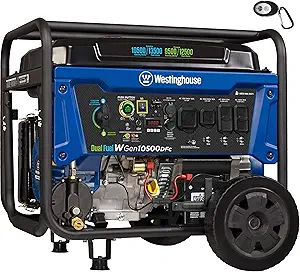
If you’re looking for a portable generator that can provide substantial backup power during an outage without moving all the way up to a permanently installed standby system, the Westinghouse WGen10500DFc is worth a closer look.
This dual-fuel generator produces up to 13,500 peak watts and 10,500 running watts on gasoline, or 12,500 peak watts and 9,500 running watts on propane. It also includes electric start, a wireless remote key fob, a 50-amp outlet, transfer-switch-ready connections, a CO sensor, and a 9.5-gallon fuel tank.
Those numbers make the WGen10500DFc considerably more capable than the smaller portable generators commonly used for a refrigerator, lights, and a few essential appliances. At the same time, its size and 230-pound dry weight mean this is not a lightweight generator designed for casual portability.
So, is the WGen10500DFc a good choice for home backup power in 2026?
The answer depends largely on how much power you actually need, whether you want gasoline and propane flexibility, and whether you’re comfortable with the trade-offs of a large conventional open-frame generator.
Check the current Amazon listing for the Westinghouse WGen10500DFc
Westinghouse WGen10500DFc at a Glance
The WGen10500DFc is designed primarily for buyers who need more power than a typical 7,000- or 9,000-watt portable generator can provide.
Its main attraction is the combination of 10,500 running watts, dual-fuel capability, remote electric start, and 120/240V output. Westinghouse lists a 500cc 4-stroke OHV engine with a cast-iron sleeve and a maximum gasoline runtime of up to 19 hours at 25% load.
The generator also includes a CO sensor with automatic shutdown, low-oil protection, GFCI outlets, a fuel gauge, and a VFT display that reports voltage, frequency, and lifetime operating hours.
Westinghouse WGen10500DFc Specifications
| Specification | WGen10500DFc |
|---|---|
| Generator type | Conventional portable generator |
| Fuel | Gasoline and propane |
| Starting watts, gasoline | 13,500W |
| Running watts, gasoline | 10,500W |
| Starting watts, propane | 12,500W |
| Running watts, propane | 9,500W |
| Engine | 500cc 4-stroke OHV |
| Engine sleeve | Cast iron |
| Fuel tank | 9.5 gallons |
| Gasoline runtime | Up to 19 hours at 25% load |
| Gasoline runtime | About 9.5 hours at 50% load |
| Propane runtime | Up to 7 hours with a 20-lb tank |
| Voltage | 120/240V |
| Frequency | 60Hz |
| Starting system | Electric, remote, and recoil |
| Remote start | Yes |
| CO sensor | Yes |
| GFCI outlets | Yes |
| 50A outlet | Yes |
| Transfer-switch ready | Yes |
| USB ports | 2 |
| Display | VFT |
| Noise level | As low as 74 dBA |
| Dry weight | About 230 lb |
| Warranty | 3-year limited warranty |
Specifications are based primarily on current Westinghouse documentation and current retailer listings.
How Much Power Does the WGen10500DFc Produce?
Power output is the main reason to consider this generator.
On gasoline, the WGen10500DFc produces 10,500 running watts and up to 13,500 starting watts. Switching to propane reduces the output to 9,500 running watts and 12,500 starting watts.
The distinction between running watts and starting watts is important.
Running watts represent the electricity an appliance generally needs while operating. Starting watts provide additional short-term capacity for equipment with motors or compressors that require extra power when they start.
That means the WGen10500DFc can be useful for a combination of refrigerators, freezers, lighting, networking equipment, kitchen appliances, pumps, tools, and other household circuits.
However, you should not assume that 10,500 running watts automatically means it can power every appliance in a home simultaneously. Central air conditioners, well pumps, electric water heaters, electric dryers, ranges, and other large loads can consume substantial amounts of electricity.
Before connecting the generator to a home’s electrical system, calculate the expected running load and account for startup requirements.
Gasoline vs. Propane
One of the biggest advantages of the WGen10500DFc is its dual-fuel design.
You can run it on gasoline when maximum output and long runtime from the built-in tank are priorities, or use propane when fuel-storage convenience is more important.
Gasoline
Gasoline provides the generator’s highest rated output:
- 13,500 peak watts
- 10,500 running watts
- 9.5-gallon fuel tank
- Up to 19 hours at 25% load
- About 9.5 hours at 50% load
The 19-hour figure should not be interpreted as a normal full-load runtime. It is based on a relatively light 25% load. As the electrical load increases, fuel consumption also increases.
Propane
Propane provides:
- 12,500 peak watts
- 9,500 running watts
- Up to approximately 7 hours with a 20-pound propane cylinder
The lower output compared with gasoline is worth remembering if you’re planning to operate several large loads simultaneously.
The advantage is that propane can be convenient to store for emergency preparedness, particularly for homeowners who already keep propane cylinders available for grills or other equipment.
Remote and Electric Start
Starting a large portable generator manually isn’t something most people look forward to during a nighttime power outage.
The WGen10500DFc addresses this with push-button electric start and a wireless remote key fob, while also retaining recoil starting as a backup.
The remote is particularly useful when the generator is positioned outside and you don’t want to walk over to the control panel every time you need to start it.
Like any electric-start generator, however, the battery and starting system still need to be maintained. A remote start feature isn’t a substitute for periodically testing the generator before storm season or another period when you may actually need it.
Runtime: What Can You Really Expect?
Runtime is one of the strongest features of this model, but the load percentage matters.
Westinghouse advertises up to 19 hours at 25% load using the 9.5-gallon gasoline tank. At approximately 50% load, published specifications indicate around 9.5 hours.
That makes the generator particularly interesting for extended outages where you don’t want to refuel every few hours.
The important point is that these are load-dependent figures. A generator operating at a relatively light load will consume less fuel than one powering several high-draw appliances continuously.
For that reason, it makes sense to prioritize essential circuits during a long outage rather than attempting to run every electrical device in the house at once.
Is the WGen10500DFc Quiet?
This is not the right generator to buy if low noise is your top priority.
Westinghouse lists operating volume as low as 74 dBA, which is fairly typical of a large conventional open-frame generator but considerably louder than many smaller inverter generators.
The sound level becomes particularly relevant when the generator is used close to a house, patio, RV, or neighboring property.
Its large engine and high power output come with a corresponding noise trade-off. If quiet nighttime operation is your priority, a smaller inverter generator may be a better fit if its output is sufficient for your needs.
Is the WGen10500DFc an Inverter Generator?
No.
The WGen10500DFc is a conventional portable generator rather than an inverter generator.
This distinction matters because shoppers sometimes assume that a large generator with modern electronics and a digital display is automatically an inverter model.
It isn’t.
Westinghouse lists the WGen10500DFc with THD below 23%. The manufacturer also describes it as suitable for electronics, but buyers who specifically need very clean power for sensitive equipment should understand that this is not the same electrical architecture as a low-THD inverter generator.
For ordinary household loads such as refrigerators, lights, pumps, appliances, and many chargers, the generator’s specifications may be adequate. For unusually sensitive equipment, verify the equipment manufacturer’s power requirements before relying on any portable generator.
Outlets and Home Backup Connections
The WGen10500DFc is equipped with several useful connection options.
The control panel includes:
- Two 120V 20A GFCI household receptacles
- One 120/240V 30A L14-30R outlet
- One 120/240V 50A 14-50R outlet
- Two USB ports
- Rubber outlet covers
The 14-50R outlet is particularly useful when a properly configured 50-amp connection is required, while the L14-30R provides another option for transfer-switch or other compatible connections.
The generator is described as transfer-switch ready, which makes it a practical candidate for home backup applications.
That does not mean you should connect it directly to a home’s electrical panel using an improvised cable.
A qualified electrician should install the appropriate transfer switch or approved interlock equipment and verify that the home’s electrical system is compatible with the generator.
Never backfeed a house through a standard wall outlet. That can create a serious electrical hazard for occupants and utility workers.
CO Sensor and Other Safety Features
The WGen10500DFc includes several safety-oriented features.
The built-in carbon monoxide sensor can automatically shut down the generator when dangerous CO conditions are detected. It also includes automatic low-oil shutdown and GFCI-protected household outlets.
These features are useful, but they don’t eliminate the need for correct generator placement.
A portable gasoline or propane generator should always be operated outdoors in a properly ventilated location, away from doors, windows, and other openings into the home.
Carbon monoxide can accumulate quickly and is impossible to detect using smell alone.
The generator’s safety systems should be treated as additional protection, not as permission to operate it inside a garage, basement, shed, or other enclosed space.
Portability: The 230-Pound Reality
The word “portable” can be misleading with a generator this large.
The WGen10500DFc has wheels, a handle, and a lift bracket, so it can be moved around a property when the equipment is already on the ground. But the generator itself weighs approximately 230 pounds dry, before adding fuel and other operating fluids.
In practical terms, this is a generator that benefits from being positioned strategically before an emergency.
If you expect to move it frequently between a garage, truck, campsite, and jobsite, its weight should be part of your buying decision.
For home backup, however, the size is easier to justify because the generator can remain in a prepared location and be moved only when necessary.
What I Like About the WGen10500DFc
High power output
The 10,500 running watts on gasoline gives this generator considerably more capacity than many conventional portable models.
Dual-fuel flexibility
Having gasoline and propane available gives you more options during a prolonged outage.
Long gasoline runtime
The 19-hour maximum runtime at 25% load is useful for overnight operation and extended outages when reducing refueling frequency matters.
Remote start
The included key fob makes starting the generator more convenient, particularly when it is positioned away from the house.
120/240V capability
The 120/240V output and 50A connection make the generator suitable for more demanding home-backup applications when the electrical installation is properly configured.
Useful monitoring
The VFT display provides voltage, frequency, and lifetime-hour information, which is useful for monitoring operation and maintenance intervals.
What I Don’t Like
It’s heavy
At approximately 230 pounds dry, this isn’t a generator most people will want to move alone.
It’s not particularly quiet
A rated operating volume as low as 74 dBA is reasonable for a generator in this class, but it isn’t a quiet option compared with many inverter generators.
It’s not an inverter
If your priority is inverter-style power quality and low THD, this isn’t the type of generator to focus on.
Propane reduces output
Switching from gasoline to propane reduces rated output from 10,500 to 9,500 running watts. That’s still substantial power, but the difference can matter when several large appliances are operating at once.
Fuel consumption depends heavily on load
The advertised 19-hour runtime is based on only 25% load. Buyers should not expect that runtime while operating the generator close to its maximum capacity.
Is the Westinghouse WGen10500DFc Good for Home Backup?
For the right home, yes, it can make sense as a high-output portable backup generator.
Its combination of 10,500 running watts, 120/240V output, dual-fuel operation, remote start, and transfer-switch-ready connections makes it much more capable than a small emergency generator.
It can potentially support a substantial group of household circuits, but the exact load depends on the appliances in your home.
A house with a refrigerator, freezer, lights, internet equipment, sump pump, microwave, and selected HVAC equipment may have very different requirements from a home with electric heating, an electric water heater, a large central air conditioner, a well pump, an electric range, and a dryer.
Before purchasing, add up the running watts and identify the largest starting loads.
That calculation is more useful than simply choosing a generator based on its peak-watt number.
Is It Good for an RV or Jobsite?
It can be useful in these environments because of its substantial output and 120/240V capability, but its size needs to be considered.
At 230 pounds dry, this is not an especially convenient generator for frequent transportation.
For a stationary jobsite or property where multiple tools need substantial power, the output can be more important than portability.
For RV owners, the 14-50R connection can be useful, but you should verify your RV’s electrical requirements and the generator’s compatibility before purchase.
Important California Buyers: Check CARB Compliance
This is one of the most important details missing from the original article.
Current Lowe’s specifications list the WGen10500DFc as not CARB compliant.
That matters for California buyers because emissions regulations can affect which portable generators can legally be sold or used in the state.
If you live in California, don’t rely solely on a retailer’s generic product title. Confirm the exact model’s current emissions certification and California availability before ordering.
This is also a good reason to verify the exact model number. The Westinghouse lineup contains similar-looking generators, including newer tri-fuel models, and the specifications are not necessarily interchangeable.
WGen10500DFc vs. the Newer Westinghouse Models
The WGen10500DFc also deserves to be viewed in the context of Westinghouse’s newer lineup.
For example, current retailer listings show the WGen11500DFc with higher output and low-THD positioning, while the WGen11500TFc adds tri-fuel capability.
That means the WGen10500DFc makes the most sense for someone specifically looking for a gasoline-and-propane generator with this level of output.
If natural gas is important to you, or if low THD is a major requirement, it is worth comparing the newer models before purchasing.
The important thing is not to assume that a higher model number is automatically better for every application. Fuel type, electrical output, power quality, price, availability, and installation requirements all matter.
WGen10500DFc: Who Should Buy It?
The WGen10500DFc makes the most sense for buyers who:
- Need around 10,000 watts of continuous portable power.
- Want both gasoline and propane capability.
- Need 120/240V output.
- Want remote and electric starting.
- Are preparing for extended power outages.
- Want a generator that can be connected to a properly installed home transfer system.
- Don’t mind a large, heavy open-frame generator.
- Prefer substantial output over low noise.
Who Should Consider Something Else?
You may want a different generator if:
- You need something lightweight enough to move frequently.
- Low noise is a top priority.
- You specifically want an inverter generator.
- You require very low THD for particular sensitive equipment.
- You need natural gas capability from the factory.
- You live in California and require a CARB-compliant portable generator.
- Your home’s actual electrical requirements are much lower and you don’t need 10,500 running watts.
Final Verdict: Westinghouse WGen10500DFc Review 2026
The Westinghouse WGen10500DFc is best understood as a high-output conventional portable generator designed for serious backup-power applications.
Its strongest features are easy to identify: 10,500 running watts on gasoline, 9,500 running watts on propane, dual-fuel flexibility, remote electric start, 120/240V output, a 50A connection, long gasoline runtime, and built-in CO protection.
The trade-offs are just as important.
This is a 230-pound generator, it can reach approximately 74 dBA, it is not an inverter model, and its advertised 19-hour runtime applies to a relatively light 25% load.
There is also an important emissions consideration for California buyers, where current Lowe’s specifications identify the model as not CARB compliant.
For homeowners who need substantial portable backup power and value the ability to switch between gasoline and propane, the WGen10500DFc has a strong feature set. But it should be purchased based on your actual electrical load rather than the 13,500-watt peak number alone.
If your priority is maximum portable output and fuel flexibility, this model belongs on your comparison list. If your priorities are quiet operation, inverter-style power quality, lower weight, or natural-gas capability, compare it with other generators before making a final decision.
Check the current Amazon price and availability for the WGen10500DFc