As an Amazon Associate I earn from qualifying purchases.
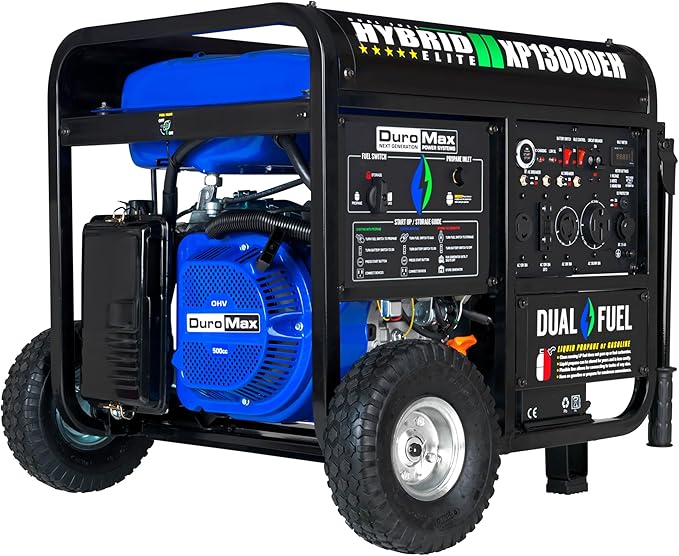
A 13,000-watt portable generator can provide substantial backup power for a home, job site, RV, or emergency setup, but choosing the right model requires more than looking at the highest wattage number on the box.
For 2026, several high-output portable generators combine gasoline and propane operation, while tri-fuel models add natural gas as a third option. This gives homeowners and contractors more flexibility when fuel availability changes during a prolonged outage.
One important detail is the difference between running watts and peak watts. Running watts describe the power a generator can continuously produce, while peak or surge watts provide additional short-term capacity for equipment with higher starting demands. Air conditioners, refrigerators, sump pumps, and other motor-driven appliances can require significantly more power when they start.
The models below focus on high-output portable generators in and around the 13,000-watt class, including dual-fuel and tri-fuel options from DuroMax, DuroStar, and Westinghouse.
Featured 13,000-Watt Generator Comparison
| Generator Model | Fuel Type | Peak Watts | Running Watts | Notable Features |
|---|---|---|---|---|
| DuroMax XP13000HX | Gasoline / Propane | 13,000 / 12,500 | 10,500 / 10,000 | CO shutdown, copper windings, electric start |
| DuroStar DS13000MX | Gasoline / Propane | 13,000 / 12,350 | 10,500 / 9,975 | CO shutdown, remote control, 50A outlet |
| Westinghouse WGen10500DFc | Gasoline / Propane | 13,500 / 12,500 | 10,500 / 9,500 | Remote start, CO sensor, transfer-switch ready |
| Westinghouse WGen10500TFc | Gasoline / Propane / Natural Gas | 13,500 / 12,500 / 10,000 | 10,500 / 9,500 / 8,500 | Tri-fuel, remote start, CO sensor |
| DuroMax XP13000HXT | Gasoline / Propane / Natural Gas | 13,000 / 12,000 / 11,000 | 10,500 / 9,500 / 8,500 | Tri-fuel, remote start, CO shutdown |
Amazon links from the original article:
- DuroMax XP13000EH: Check Amazon Price
- DuroMax XP13000HX: Check Amazon Price
- DuroStar DS13000MX: Check Amazon Price
- Westinghouse 13500 Peak Dual Fuel: Check Amazon Price
- Westinghouse 13500 Peak Tri-Fuel: Check Amazon Price
Check each Amazon listing before publishing to make sure the affiliate URL points to the exact model named in the article.
Why Choose a 13,000-Watt Generator?
A generator in the 13,000-watt class can provide considerably more capacity than smaller portable generators. Depending on the home’s electrical load, it may be capable of running several essential appliances at the same time, including refrigerators, lighting, sump pumps, selected HVAC equipment, and other household circuits.
However, the most important number is not always the peak wattage.
For example, a generator rated at 13,000 peak watts may have approximately 10,000 to 10,500 running watts on gasoline. The difference matters because running wattage determines how much continuous electrical load the generator can support.
Before buying, add the running wattage of the equipment you expect to use and account for appliances with significant startup demands. A generator that has enough peak capacity but insufficient running capacity may not be suitable for a particular combination of household loads.
Dual Fuel vs. Tri-Fuel
Dual fuel generators normally operate on gasoline and propane. This gives users two fuel options without requiring a completely different generator.
Tri-fuel generators add natural gas to gasoline and propane. Natural gas can be useful for homeowners who have an appropriate residential gas connection and want an alternative to storing gasoline or propane.
The important point is that power output can change depending on the fuel being used. A generator rated at 13,500 peak watts on gasoline may produce less power when operating on propane or natural gas.
1. DuroMax XP13000HX – High-Output Dual Fuel Power
The DuroMax XP13000HX is a 13,000-watt-class dual-fuel portable generator designed for demanding backup-power applications. It can operate on gasoline or propane, giving homeowners more than one fuel option during an outage.
On gasoline, the XP13000HX produces 13,000 peak watts and 10,500 running watts. On propane, output is rated at 12,500 peak watts and 10,000 running watts.
The generator uses a 500cc four-stroke OHV engine and features electric push-button starting with recoil backup. DuroMax also lists 100% copper windings, GFCI outlets, automatic low-oil shutdown, a digital volt meter, and CO sensor shutdown.
Another useful specification is the generator’s less-than-5% total harmonic distortion, although users should still follow the requirements of individual electronics and appliances.
The XP13000HX has an 8.3-gallon gasoline tank and is rated for up to 8.5 hours at 50% load on gasoline. At 25% load, the listed gasoline runtime is up to 17 hours.
One important limitation for shoppers is emissions compliance. The current manufacturer specifications list the XP13000HX as EPA certified but not CARB certified and not 50-state compliant. Buyers in California should therefore verify availability and applicable emissions requirements before purchasing.
XP13000HX Key Specifications
| Specification | Gasoline | Propane |
|---|---|---|
| Peak Output | 13,000W | 12,500W |
| Running Output | 10,500W | 10,000W |
| Runtime at 25% Load | Up to 17 hours | Up to 13 hours |
| Runtime at 50% Load | Up to 8.5 hours | Up to 6.5 hours |
| Fuel Tank | 8.3 gallons | — |
| Engine | 500cc OHV | 500cc OHV |
| Starting | Electric + recoil | Electric + recoil |
The XP13000HX is particularly relevant for buyers who want a high-output dual-fuel generator with copper windings and CO shutdown without moving into a larger 14,000- or 15,000-watt generator class.
2. DuroStar DS13000MX – 13,000-Watt Dual Fuel Generator
The DuroStar DS13000MX provides another 13,000-watt dual-fuel option. It operates on gasoline or propane and is designed for home backup, job-site use, and RV applications.
On gasoline, the DS13000MX produces 13,000 peak watts and 10,500 running watts. Propane output is rated at 12,350 peak watts and 9,975 running watts.
The generator uses a 500cc OHV engine and includes push-button electric start, recoil backup, and remote control. A CO sensor shutdown system is also included.
The control panel includes a 50-amp 14-50R outlet, an L14-30R outlet, GFCI household outlets, a digital volt meter, and an hour meter. This makes the generator suitable for applications where a higher-capacity connection is needed, although the exact electrical installation should always follow the generator’s instructions and local requirements.
The DS13000MX has an 8.3-gallon gasoline tank and is rated for up to 17 hours at 25% load or about 8.5 hours at 50% load when operating on gasoline.
DS13000MX Key Specifications
| Specification | Gasoline | Propane |
|---|---|---|
| Peak Output | 13,000W | 12,350W |
| Running Output | 10,500W | 9,975W |
| Runtime at 25% Load | Up to 17 hours | Up to 13 hours |
| Runtime at 50% Load | Up to 8.5 hours | Up to 6.5 hours |
| Engine | 500cc OHV | 500cc OHV |
| Starting | Electric + recoil + remote control | Electric + recoil + remote control |
| Tank Capacity | 8.3 gallons | — |
The DS13000MX is also listed as not available for sale in California because of its current emissions certification status, so California buyers should verify local availability before ordering.
3. Westinghouse WGen10500DFc – 13,500 Peak-Watt Dual Fuel Generator
The Westinghouse WGen10500DFc is a strong option for shoppers specifically looking for a dual-fuel generator with slightly more peak output than the 13,000-watt models above.
On gasoline, it produces 13,500 peak watts and 10,500 running watts. When operating on propane, the output is 12,500 peak watts and 9,500 running watts.
The WGen10500DFc uses a 500cc four-stroke OHV engine and has a 9.5-gallon fuel tank. Westinghouse lists a maximum gasoline runtime of up to 19 hours at 25% load.
Starting options include push-button electric start, remote key-fob start, and emergency recoil start.
The generator also includes a CO sensor with automatic shutdown, GFCI outlets, a transfer-switch-ready L14-30R outlet, and a 120/240V 14-50R outlet.
A VFT display provides information about voltage, frequency, and accumulated operating hours.
For homeowners planning to use a portable generator for backup power, the transfer-switch-ready design can be useful. However, connecting a portable generator to a home’s electrical system should be done using an appropriate transfer switch or approved interlock arrangement and in accordance with local electrical requirements.
4. Westinghouse WGen10500TFc – Tri-Fuel Flexibility
The Westinghouse WGen10500TFc expands on the dual-fuel concept by adding natural gas.
It can operate on gasoline, propane, or natural gas, but its output changes depending on the fuel.
Gasoline output is rated at 13,500 peak watts and 10,500 running watts.
Propane output is 12,500 peak watts and 9,500 running watts.
Natural gas output is 10,000 peak watts and 8,500 running watts.
That difference is important when sizing the generator for a home. A buyer should not assume that the generator will provide 13,500 peak watts regardless of the fuel selected.
The WGen10500TFc uses a 500cc four-stroke OHV engine and has a 9.5-gallon gasoline tank. Westinghouse lists up to 19 hours of runtime at 25% load on gasoline.
The generator also features electric start, remote key-fob starting, recoil backup, a CO sensor with automatic shutdown, GFCI protection, and transfer-switch-ready connections.
For homeowners who already have access to natural gas, the tri-fuel design can reduce reliance on stored gasoline or propane during an extended outage.
5. DuroMax XP13000HXT – 13,000-Watt Tri-Fuel Generator
The DuroMax XP13000HXT is another option for shoppers who specifically want gasoline, propane, and natural gas capability.
On gasoline, it produces 13,000 peak watts and 10,500 running watts.
On propane, output is 12,000 peak watts and 9,500 running watts.
On natural gas, output drops to 11,000 peak watts and 8,500 running watts.
The XP13000HXT uses a 500cc OHV engine and includes electric and recoil starting plus remote start. It also has CO sensor shutdown, GFCI outlets, 100% copper windings, a digital meter, and an 8.3-gallon gasoline tank.
The manufacturer lists runtime of up to 17 hours at 25% load on gasoline, 13 hours on propane, and different output characteristics when using natural gas.
A useful feature for homeowners is the included natural gas hose. However, natural gas installation and connection requirements should always be checked before operation.
XP13000HXT Key Specifications
| Fuel | Peak Watts | Running Watts |
|---|---|---|
| Gasoline | 13,000W | 10,500W |
| Propane | 12,000W | 9,500W |
| Natural Gas | 11,000W | 8,500W |
What to Look for in a 13,000-Watt Generator
1. Running Wattage
Running wattage is one of the most important specifications because it represents the generator’s continuous output.
Do not size a generator based only on its peak wattage.
Make a list of the appliances and tools you expect to operate simultaneously and add their running wattages. Then consider the startup requirements of equipment with electric motors.
2. Peak or Surge Wattage
Peak wattage provides temporary additional capacity for starting certain appliances.
Refrigerators, well pumps, sump pumps, air conditioners, and power tools may have startup demands that are higher than their normal running requirements.
A generator with a higher peak rating can therefore handle some startup loads more effectively, but peak wattage should never be treated as continuous capacity.
3. Dual Fuel or Tri-Fuel Operation
For many buyers, fuel flexibility is one of the main reasons to choose this category.
Gasoline is widely available and usually provides the generator’s highest output.
Propane can be stored for longer periods when handled properly and gives users another fuel option.
Natural gas can be convenient for homes with an appropriate gas connection, but tri-fuel generators typically produce less power on natural gas than they do on gasoline.
4. Electric and Remote Start
Electric start makes a large portable generator much easier to start than relying solely on a recoil mechanism.
Remote start can be even more convenient when the generator is positioned outside the home.
However, remote starting does not change the requirement to operate the generator outdoors in a safe location.
5. Transfer-Switch Compatibility
If the generator is intended for home backup, look for a model with the appropriate connection for the planned transfer switch or interlock system.
A transfer-switch-ready outlet does not mean that the generator can simply be connected to a household electrical panel without proper equipment.
The installation should follow the manufacturer’s instructions and applicable electrical codes. When required, have the connection installed or inspected by a qualified electrician.
6. CO Detection and Automatic Shutdown
Carbon monoxide is one of the most serious hazards associated with portable generators.
Several models in this guide include a CO sensor that can automatically shut the generator down when dangerous CO conditions are detected.
This is an important safety feature, but it is not a substitute for proper placement.
Never operate a portable gasoline or propane generator inside a house, garage, basement, shed, or other enclosed or partially enclosed area.
Keep the generator outdoors and away from doors, windows, and ventilation openings according to the manufacturer’s safety instructions.
7. Runtime
Generator runtime depends on several factors, including:
- Fuel type
- Fuel tank size
- Electrical load
- Engine efficiency
- Operating conditions
When comparing advertised runtimes, always check the stated load percentage.
For example, a generator advertised to run for 17 or 19 hours at 25% load will not normally achieve that same runtime when operating near its maximum continuous output.
Who Is a 13,000-Watt Generator For?
Homeowners
A high-output portable generator can provide substantial backup capacity for homes during power outages.
It may be suitable for refrigerators, lighting, pumps, selected HVAC equipment, and other essential circuits, depending on the home’s electrical requirements.
Before purchasing, calculate the actual load rather than assuming that a 13,000-watt generator will automatically power every appliance in the house simultaneously.
Contractors
Contractors can benefit from the combination of high output and portability.
A generator in this class can support multiple tools and equipment on jobsites where utility power is unavailable, provided the combined load remains within the generator’s rated capacity.
Emergency Preparedness
Dual-fuel and tri-fuel generators provide additional fuel flexibility during extended outages.
Instead of depending entirely on gasoline, users can switch to propane when appropriate. Tri-fuel models add natural gas as another option.
RV Owners
Some 13,000-watt generators include 50-amp connections and can provide substantial power for larger RV setups.
However, RV owners should confirm the generator’s outlet configuration, grounding requirements, RV electrical system, and total load before purchase.
Maintenance and Safe-Use Tips
Follow the maintenance schedule in the owner’s manual for your exact generator model.
Basic practices include:
- Check the engine oil before operation and at the intervals specified by the manufacturer.
- Use the recommended oil grade for the operating temperature and model.
- Inspect fuel lines, electrical connections, wheels, and cables periodically.
- Store gasoline according to local fire-safety requirements and use fuel stabilizer when recommended.
- Store propane cylinders according to applicable safety requirements.
- Test the generator periodically according to the manufacturer’s instructions.
- Keep the generator clean and dry when it is not operating.
- Never operate the generator in an enclosed or partially enclosed area.
- Keep the exhaust directed away from buildings, windows, doors, and ventilation openings.
- Allow the generator to cool before refueling.
- Never connect a portable generator directly to a household outlet.
A protective cover can be useful during storage, but a normal weatherproof storage cover should never be left over a running generator unless it is specifically designed and approved for operation.
Final Thoughts on 13,000-Watt Generators in 2026
A 13,000-watt-class portable generator offers a substantial amount of backup power without necessarily moving into the much larger and more expensive generator categories.
The biggest decision is not simply choosing the generator with the highest peak wattage. Buyers should compare running watts, fuel type, runtime, starting system, CO protection, outlet configuration, transfer-switch compatibility, emissions certification, and the actual electrical loads they need to support.
The DuroMax XP13000HX focuses on high-output dual-fuel operation, copper windings, CO shutdown, and a 10,500-watt gasoline running capacity.
The DuroStar DS13000MX combines 13,000 peak watts with dual-fuel operation, remote control, CO shutdown, and a 50-amp connection.
The Westinghouse WGen10500DFc provides 13,500 peak watts on gasoline and adds remote starting and dual-fuel flexibility.
For buyers who want natural gas as an additional fuel source, the Westinghouse WGen10500TFc and DuroMax XP13000HXT provide tri-fuel operation. Both models reduce their rated output when operating on natural gas, so that difference should be included when calculating the required generator capacity.
Ultimately, the right generator depends on your home’s electrical load, fuel availability, intended use, and local installation requirements. A careful wattage calculation and attention to manufacturer safety instructions are more important than choosing a generator based solely on its headline peak-wattage number.