As an Amazon Associate I earn from qualifying purchases.
If you need a portable generator that can handle more than a basic camping setup without stepping up to a large conventional generator, a 4500 watt inverter generator is one of the most useful sizes to consider in 2026.
These generators offer enough power for many RV air conditioners, refrigerators, sump pumps, power tools, appliances, and essential home backup loads while generally producing cleaner and quieter electricity than traditional open-frame generators.
However, not every 4500-watt inverter generator is the same. Some are gasoline-only, while others run on gasoline and propane. Some prioritize quiet operation, others portability, and some offer electric or remote starting, RV-ready outlets, or longer runtime.
In this guide, we compare several popular options, including Champion, WEN, Westinghouse, ERAYAK, and AMERISUN, and explain which type makes the most sense for RV use, home backup, camping, and general portable power.
Quick Comparison: Best 4500 Watt Inverter Generators for 2026
| Generator | Peak Watts | Running Watts | Fuel | Noise | Weight | Best For |
|---|---|---|---|---|---|---|
| Champion 4500W Inverter | 4,500W | 3,500W | Gasoline | 61 dBA | 92.2 lb | RVs and reliable general backup |
| WEN DF451i | 4,500W | 3,500W gas / 3,150W propane | Dual fuel | 58 dBA | ~100 lb | RV and dual-fuel flexibility |
| Westinghouse iGen5000DFc | 5,000W gas / 4,500W propane | 3,900W gas / 3,500W propane | Dual fuel | 52 dBA | 105.8 lb | Best overall power and runtime |
| ERAYAK 4500P | 4,500W | 3,500W | Gasoline | ~60.5 dBA | ~55 lb | Lightweight portability |
| AMERISUN AL5040C | 4,500W | 3,600W | Gasoline | Not consistently published | 61.3 lb | Budget-oriented buyers |
Specifications can vary by model revision and listing. Always verify the current Amazon listing and manufacturer documentation before purchasing.
1. Champion Power Equipment 4500 Watt Inverter Generator
Buy it now on Amazon at the best price!
Click here to shop now!
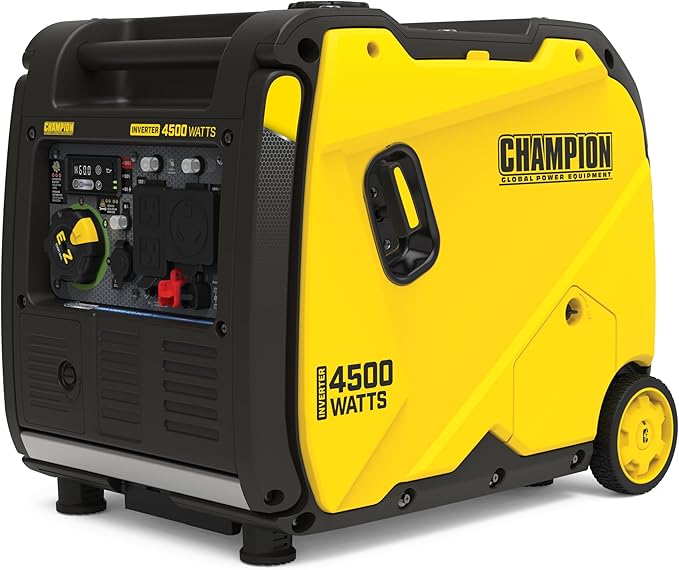
The Champion 4500-watt inverter generator is a straightforward option for buyers who want a proven gasoline-powered inverter generator with an RV-ready outlet and a strong balance between output, runtime, and features.
The current Champion 4500W inverter model delivers 4,500 starting watts and 3,500 running watts from a 212cc engine. Champion rates the unit at 61 dBA from 23 feet and up to 14 hours of runtime at 25% load with its approximately 2.25-gallon fuel tank.
Key Specifications
- Starting Watts: 4,500W
- Running Watts: 3,500W
- Engine: 212cc 4-stroke
- Fuel: Gasoline
- Fuel Capacity: Approximately 2.25 gallons
- Runtime: Up to 14 hours at 25% load
- Noise Level: 61 dBA
- Weight: 92.2 lb
- Voltage: 120V
- RV Outlet: 120V 30A TT-30R
- Starting System: Recoil
- CO Protection: CO Shield
- Parallel Capable: Yes
- Warranty: 3-year limited warranty with lifetime technical support
One important correction from older versions of this article: the current 4500W Champion model should not automatically be described as an electric-start or remote-start generator. Champion lists the current model with recoil starting.
Why Choose the Champion 4500W?
The biggest advantage is simplicity. You get 3,500 watts of continuous 120V power, a 30A RV connection, inverter technology, Economy Mode, and CO Shield without moving into a much larger generator.
It’s a particularly sensible choice for an RV owner who wants a generator capable of handling common 120V loads and for homeowners who need to keep selected appliances operating during an outage.
The generator also supports parallel operation with compatible Champion inverter generators using the appropriate kit.
Best for: RV owners, camping, tailgating, and essential home backup.
2. WEN DF451i 4500-Watt Dual Fuel Inverter Generator
Buy it now on Amazon at the best price!
Click here to shop now!
If fuel flexibility is important, the WEN DF451i is one of the more interesting choices in this category.
It can operate on either gasoline or propane, giving you more options when gasoline is difficult to obtain or when you prefer to store propane for emergency use.
The DF451i produces 4,500 surge watts and 3,500 rated watts on gasoline. On propane, output drops to 3,150 running watts while peak output remains 4,500 watts according to WEN’s specifications.
Key Specifications
- Starting Watts: 4,500W
- Running Watts: 3,500W gasoline / 3,150W propane
- Engine: 212cc OHV
- Fuel: Gasoline and propane
- Fuel Tank: 2.2 gallons
- Runtime: Up to approximately 8.5 hours at 50% load on gasoline
- Noise Level: 58 dBA at 25% load from 22 feet
- Weight: Approximately 100 lb
- Start: Electric start plus recoil backup
- RV Outlet: 120V 30A TT-30R
- Fuel Shutoff: Yes
- Parallel Capable: Yes
- Warranty: 3-year limited warranty
The 58 dBA rating is one of its strongest selling points. WEN also uses variable engine speed through its Eco Mode, which can reduce fuel consumption and noise when the electrical demand is lower.
Another useful feature is the fuel shutoff system, which helps empty fuel from the carburetor before shutdown and can make long-term storage easier.
Clean Power for Electronics
WEN states that the DF451i produces inverter power with total harmonic distortion below 1.2% at full load, making it appropriate for sensitive electronics such as laptops, televisions, monitors, and other electronic equipment when used according to the manufacturer’s instructions.
One Thing to Consider
At roughly 100 pounds, this is not a lightweight generator. The wheels and handle help, but you should not confuse “portable” with “easy for one person to lift repeatedly.”
Best for: RV owners and homeowners who want gasoline/propane flexibility and quiet operation.
3. Westinghouse iGen5000DFc Dual Fuel Inverter Generator
The Westinghouse iGen5000DFc is particularly interesting because it sits slightly above the traditional 4500-watt class on gasoline.
It produces 5,000 peak watts and 3,900 running watts on gasoline, while propane provides 4,500 peak watts and 3,500 running watts. That extra running capacity can make a meaningful difference when several appliances are operating at the same time.
Key Specifications
- Gasoline Peak: 5,000W
- Gasoline Running: 3,900W
- Propane Peak: 4,500W
- Propane Running: 3,500W
- Engine: 224cc OHV
- Fuel: Gasoline and propane
- Fuel Tank: 3.4 gallons
- Gasoline Runtime: Up to 18 hours at 25% load
- Propane Runtime: Up to 22 hours at 25% load
- Noise Level: 52 dBA
- Weight: 105.8 lb
- Start: Electric, remote, and recoil
- RV Outlet: 120V 30A TT-30R
- CO Sensor: Yes
- Parallel Capable: Yes
- Warranty: 3-year limited residential warranty
Why the Westinghouse Stands Out
The combination of higher output, dual-fuel operation, remote start, and long runtime makes the iGen5000DFc a strong choice for buyers who want one generator that can cover a broad range of portable-power situations.
The 3.4-gallon gasoline tank is also significantly larger than the tank on some smaller inverter generators.
Westinghouse rates the generator at 52 dBA, but noise specifications should not be treated as a perfect laboratory comparison between brands because manufacturers may use different test conditions, loads, and measurement distances.
Who Should Buy It?
This is arguably the most capable generator in this comparison if your priority is having more continuous output without jumping to a much larger conventional generator.
It is particularly attractive for:
- RV air conditioning
- Refrigerator and freezer backup
- Sump pumps
- Selected home appliances
- Emergency backup
- Camping and tailgating
- Longer-duration outages
Best for: Buyers who want the strongest overall combination of power, runtime, fuel flexibility, and convenience.
4. ERAYAK 4500W Inverter Generator
ERAYAK has become an interesting competitor in the portable inverter-generator market because some of its 4500W models are considerably lighter than many established competitors.
The current gasoline-powered ERAYAK 4500P is rated for 4,500 peak watts and 3,500 running watts and weighs roughly 55 pounds, depending on the exact version. ERAYAK also offers 4500P dual-fuel variants.
Key Specifications for the ERAYAK 4500P
- Peak Power: 4,500W
- Running Power: 3,500W
- Fuel: Gasoline
- Voltage: 120V
- Fuel Tank: 2.25 gallons
- Noise: Approximately 60.5 dBA
- Weight: Approximately 55 lb
- 30A Outlet: L5-30R
- 20A Outlets: Two
- USB: USB-A and USB-C
- Parallel Capable: Yes
- Starting System: Recoil
- Inverter Output: Pure sine wave
- THD: Advertised below 1.2%
ERAYAK also has a dual-fuel 4500PD series that provides gasoline and propane operation, with gasoline output of 4,500 peak/3,500 running watts and propane output of 4,050 peak/3,150 running watts.
The Big Advantage: Weight
A 55-pound 4500-watt-class inverter generator is a very different proposition from a 100-plus-pound machine.
That makes ERAYAK particularly interesting for people who frequently transport their generator in an SUV, pickup, trailer, or RV.
The trade-off is that buyers should pay close attention to the exact model number, starting system, fuel type, outlet configuration, warranty terms, and current listing because ERAYAK sells multiple generators with similar names.
Best for: Buyers who prioritize portability and want 4500-watt-class output without a 100-pound generator.
5. AMERISUN 4500W Portable Inverter Generator
AMERISUN is another budget-oriented option worth considering if price and basic 120V inverter power are more important than premium features.
One current AMERISUN 4500W model, the AL5040C, is listed with 4,500 starting watts and 3,600 running watts, along with a 120V 30A outlet, two 120V 20A outlets, and a 12V DC outlet. Its listed weight is approximately 61.3 pounds.
Key Specifications
- Starting Watts: 4,500W
- Running Watts: 3,600W
- Fuel: Gasoline
- Voltage: 120V
- Weight: Approximately 61.3 lb
- RV/30A Outlet: Yes
- 120V 20A Outlets: Two
- CO Protection: Available on current AL5040C versions
- Inverter Technology: Yes
Who Should Consider AMERISUN?
AMERISUN makes the most sense for a buyer who wants to spend less while still getting inverter technology and roughly 4,500-watt peak capacity.
However, because specifications and Amazon listings can change, this is one category where I would pay particular attention to the exact model number and current warranty/support information before ordering.
Best for: Budget-conscious buyers who want basic 4500-watt-class inverter capability.
4500 Watt Inverter Generator Comparison
| Feature | Champion 4500W | WEN DF451i | Westinghouse iGen5000DFc | ERAYAK 4500P | AMERISUN AL5040C |
|---|---|---|---|---|---|
| Peak Power | 4,500W | 4,500W | 5,000W gas / 4,500W propane | 4,500W | 4,500W |
| Running Power | 3,500W | 3,500W gas / 3,150W propane | 3,900W gas / 3,500W propane | 3,500W | 3,600W |
| Fuel | Gas | Dual Fuel | Dual Fuel | Gas | Gas |
| Noise | 61 dBA | 58 dBA | 52 dBA | ~60.5 dBA | Varies by listing |
| Weight | 92.2 lb | ~100 lb | 105.8 lb | ~55 lb | 61.3 lb |
| RV Ready | Yes | Yes | Yes | Yes | Yes |
| Electric Start | No | Yes | Yes | Depends on version | Depends on model |
| Remote Start | No | No | Yes | Depends on version | No |
| Parallel Capable | Yes | Yes | Yes | Yes | Model dependent |
| CO Protection | CO Shield | CO protection | CO sensor | Model dependent | CO Protect on AL5040C |
| Best Feature | Simple, proven design | Dual fuel + quiet operation | Power + runtime | Lightweight design | Budget appeal |
What Can a 4500 Watt Inverter Generator Run?
A generator’s running watts matter more than its advertised peak wattage when deciding what it can power continuously.
For example, a generator rated at 4,500 starting watts and 3,500 running watts should be evaluated primarily as a 3,500-watt continuous-power machine.
Starting watts provide additional short-term capacity for appliances with motors or compressors.
Typical loads that may be suitable for a 4500-watt inverter generator include:
- Refrigerator
- Freezer
- Television
- Internet equipment
- Lights
- Fans
- Microwave
- Small window or portable air conditioner
- Sump pump
- Battery chargers
- Power tools
- Selected RV appliances
- Coffee maker
- Small kitchen appliances
The exact combination depends on the starting and running watt requirements of each appliance.
A refrigerator, for example, may consume relatively little once operating but require substantially more power momentarily when its compressor starts.
For that reason, don’t simply add the running wattages. You also need to account for starting loads.
Are 4500 Watt Inverter Generators Good for RVs?
Yes. A 4500-watt inverter generator can be an excellent RV power solution, particularly when the generator has a 30A TT-30R RV outlet.
However, your RV’s air conditioner is one of the most important loads to consider.
A typical 13,500 BTU RV air conditioner may require significant starting power. Other appliances such as a microwave, refrigerator, battery charger, coffee maker, or electric water heater can add to the load.
If you intend to run multiple high-demand appliances simultaneously, the extra running capacity of a generator such as the Westinghouse iGen5000DFc can be useful.
Before buying, check your RV’s actual electrical requirements rather than relying only on the generator’s peak-wattage number.
Are 4500 Watt Inverter Generators Good for Home Backup?
They can be very useful for essential-load backup, but they are not whole-home generators.
A 4500-watt-class inverter generator can potentially keep important appliances operating during a power outage, such as a refrigerator, freezer, internet equipment, lights, and selected small appliances.
It may not be sufficient to run an entire house with central air conditioning, electric heating, an electric range, water heater, well pump, and several other high-demand appliances simultaneously.
If you want to connect a portable generator to household wiring, use a properly installed transfer switch or other code-compliant solution designed by a qualified electrician.
Never plug a portable generator into a household wall outlet to backfeed the house.
Gasoline vs. Dual Fuel: Which Is Better?
Gasoline Generators
Gasoline is convenient because it is widely available and most gasoline models deliver their full rated output using gasoline.
The downside is storage. Gasoline can degrade over time, so proper fuel storage and generator maintenance are important.
Dual-Fuel Generators
Dual-fuel models give you another option.
You can use gasoline when it is readily available and propane when you prefer longer-term fuel storage or already keep propane cylinders for other equipment.
Propane usually produces somewhat less running power than gasoline on the models in this comparison, so always check the manufacturer’s specifications.
For emergency preparedness, dual fuel can be especially attractive because it gives you more than one fuel source.
How Quiet Is a 4500 Watt Inverter Generator?
Inverter generators are generally quieter than many conventional open-frame generators, especially when operating at lower loads.
The models in this comparison have published noise ratings ranging from approximately 52 to 61 dBA, depending on the model.
However, don’t assume that a 52 dBA generator will always be exactly 9 dBA quieter than a 61 dBA generator in real-world use.
Noise measurements can use different distances and load conditions. Some manufacturers publish figures at 22 feet, others at 23 feet, and load conditions can also affect engine speed.
The practical lesson is simple: look at the manufacturer’s test conditions instead of comparing the dBA numbers in isolation.
Why Inverter Technology Matters
Traditional generators typically produce electricity through a conventional alternator design.
An inverter generator first generates electricity and then uses electronics to produce a stable AC output.
One of the biggest advantages is cleaner, more controlled power for electronics.
This can make inverter generators attractive for:
- Laptops
- TVs
- Smartphones
- Routers
- Monitors
- Chargers
- Modern electronic appliances
Still, don’t assume that every inverter generator has exactly the same power quality. Check the manufacturer’s published THD specification for the specific model you are considering.
Generator Safety: What You Need to Know
Carbon monoxide is one of the most important safety issues when using any gasoline or propane portable generator.
The U.S. Consumer Product Safety Commission recommends operating portable generators outdoors and at least 20 feet away from homes, with exhaust directed away from the building. Generators should never be operated inside a home, garage, basement, shed, crawlspace, or other enclosed area, even when doors or windows are open.
The CDC also recommends keeping portable generators at least 20 feet away from doors, windows, and vents.
Keep these rules in mind:
- Never run a portable generator inside a house or garage.
- Keep it at least 20 feet away from the home.
- Point the exhaust away from doors, windows, and vents.
- Keep a working CO alarm inside your home.
- Never refuel a hot generator.
- Keep the generator dry and follow the manufacturer’s wet-weather instructions.
- Use properly rated outdoor extension cords when appropriate.
- Never backfeed a home’s electrical system through a wall outlet.
- Follow the owner’s manual for maintenance and operation.
A built-in CO shutdown feature is an important additional safety feature, but it does not make indoor operation safe.
Which 4500 Watt Inverter Generator Should You Buy?
The best choice depends on what you value most.
Best Overall: Westinghouse iGen5000DFc
The Westinghouse iGen5000DFc is the strongest all-around option in this comparison if you want maximum capability. It offers 5,000 peak/3,900 running watts on gasoline, dual-fuel operation, remote start, an RV-ready outlet, and up to 18 hours of gasoline runtime at 25% load.
Best Dual-Fuel Value: WEN DF451i
The WEN DF451i is a strong choice when gasoline/propane flexibility, quiet operation, electric start, and RV compatibility are more important than minimum weight. Its 58 dBA rating is also attractive for camping and RV use.
Best Simple Gasoline Option: Champion 4500W
The Champion 4500W inverter is a good choice if you want a straightforward gasoline inverter generator from an established manufacturer with a 30A RV outlet, CO Shield, parallel capability, and a 3-year limited warranty.
Best Lightweight Option: ERAYAK 4500P
If portability is your priority, the ERAYAK 4500P deserves attention. Its roughly 55-pound weight makes it dramatically easier to move than many traditional 4500-watt-class generators.
Budget Alternative: AMERISUN
AMERISUN can be worth considering when the purchase price is the deciding factor. Just verify the exact model, warranty, safety features, and current specifications before ordering.
Final Buying Checklist
Before buying a 4500 watt inverter generator, check these specifications rather than focusing only on the headline wattage:
- Running watts
- Starting/peak watts
- Gasoline vs. dual fuel
- 30A RV outlet
- Noise rating and measurement conditions
- CO shutoff or CO sensor
- Electric or recoil start
- Remote start
- Parallel capability
- Fuel tank capacity
- Runtime at a stated load
- Weight
- Warranty
- 120V vs. 240V capability
- Current Amazon model number
Also remember that generator specifications can vary between model revisions and Amazon listings. Check the exact model number before ordering, especially when two generators have very similar names.
Final Verdict
A 4500 watt inverter generator is a sweet spot for many RV owners, campers, tailgaters, and homeowners who need portable emergency power without moving up to a large conventional generator.
For maximum capability, the Westinghouse iGen5000DFc stands out because it provides more running power on gasoline while retaining dual-fuel flexibility and RV-friendly features.
The WEN DF451i is a compelling alternative for buyers who want dual fuel and quiet operation, while the Champion 4500W is a straightforward gasoline option with strong support and useful RV features.
If moving the generator yourself is a major concern, the lightweight ERAYAK 4500P deserves a closer look.
Whatever model you choose, don’t buy based solely on the “4500 watts” label. Look at running watts, starting watts, fuel type, runtime, outlet configuration, noise, weight, and safety features. Those specifications will tell you much more about whether the generator will actually meet your needs.