As an Amazon Associate I earn from qualifying purchases.
If you want backup power without carrying a large battery station, a compact solar generator can be a practical solution for camping, road trips, remote work, emergency kits, and short power outages.
Unlike traditional gas generators, portable power stations produce no exhaust while operating and can be recharged from a wall outlet, a vehicle, or a compatible solar panel. The smaller models are especially useful when portability matters more than running large appliances.
For 2026, the compact power station market has improved significantly. LiFePO4 batteries are increasingly common, USB-C charging is more capable, and several small units can now deliver 300W or more of continuous AC power while remaining easy to carry.
However, not every mini solar generator is designed for the same job. An 88Wh station is primarily a device-charging solution, while a 230Wh to 256Wh model can provide substantially more flexibility for laptops, lights, routers, cameras, and other small electronics.
Below, you’ll find five compact solar generators and portable power stations worth considering, including their important specifications, charging options, and practical uses.
Best Mini Solar Generators for 2026
| Model | Capacity | AC Output | Battery | Solar Charging | Approx. Weight |
|---|---|---|---|---|---|
| Jackery Solar Generator 240 v2 | 256Wh | 300W | LiFePO4 | Up to 100W | 7.9 lbs |
| MARBERO Portable Power Station 88Wh | 88.8Wh | 80W | Lithium-ion | Optional | 3.2 lbs |
| Upusa LiFePO4 Mini Portable Generator | 12,500mAh | DC/USB | LiFePO4 | Included | Approx. 1.6 lbs |
| GRECELL Portable Power Station 330W | 230.88Wh | 330W | Lithium | Up to 100W | Approx. 7.9 lbs |
| Apowking Solar Powered Generator | 146Wh | 100W | Lithium-ion | 40W panel included | Approx. 3.3 lbs |
Important: Specifications can vary by product version or Amazon listing. Always confirm the specifications of the exact model before purchasing.
Jackery Solar Generator 240 v2: 256Wh of Compact LiFePO4 Power
Check Amazon Price Click Here!
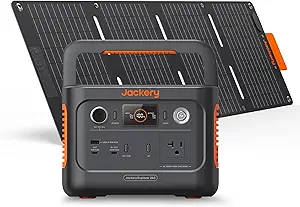
The Jackery Solar Generator 240 v2 is one of the more capable options in this compact category. Its 256Wh LiFePO4 battery and 300W continuous AC output give it considerably more flexibility than ultra-small power banks.
The Explorer 240 v2 uses a LiFePO4 battery rated for up to 4,000 cycles before retaining at least 70% of its original capacity. It also provides pure sine wave AC output, making it suitable for many common electronics.
One of its biggest improvements over the original Explorer 240 is the increase to 300W of continuous AC output, with up to 600W of instantaneous output. It also has a 100W USB-C port and supports up to 100W of solar input.
The unit weighs approximately 7.9 pounds, so it is still easy to carry for camping and emergency use, although it is heavier than some of the smallest power stations.
Technical Specs
- Battery Type: LiFePO4
- Capacity: 256Wh
- Continuous AC Output: 300W
- Peak Output: 600W
- Solar Input: Up to 100W
- USB-C: Up to 100W
- AC Output: Pure sine wave
- Weight: Approximately 7.9 lbs
- Cycle Life: Up to 4,000 cycles to 70% capacity
- Best For: Camping, laptops, phones, cameras, lights, routers, and small electronics
What Can the Jackery 240 v2 Power?
The 256Wh capacity makes the Jackery much more versatile than an ordinary power bank. It can handle devices such as laptops, phones, cameras, lights, fans, and other electronics that remain below its 300W continuous output rating.
It is still a small power station, though. A space heater, microwave, coffee maker, electric kettle, or other high-wattage appliance is outside the intended range of this class.
For solar charging, Jackery lists compatibility with SolarSaga panels, including 40W, 80W, and 100W configurations. A 100W panel provides substantially more charging potential than a 40W panel under suitable sunlight.
MARBERO Portable Power Station 88Wh: Ultra-Portable Emergency Power
Check Amazon Price Click Here!
If portability is your priority, the MARBERO 88Wh Portable Power Station takes a different approach from larger 200Wh-class stations.
Its battery provides 88.8Wh of energy, while its AC inverter is rated for 80W with a 120W peak. That makes it better suited to phones, small lights, cameras, tablets, small fans, and other low-power electronics rather than appliances with significant energy demands.
MARBERO lists eight output options, including USB, USB-C, DC, and AC connections. The station also includes an LED light with multiple brightness levels and an SOS mode, which can be useful in an emergency kit or while camping.
The current manufacturer specifications list a weight of about 3.2 pounds and dimensions of approximately 6.5 × 4.6 × 3.1 inches.
Technical Specs
- Battery Type: Lithium-ion
- Capacity: 88.8Wh
- Continuous AC Output: 80W
- Peak Output: 120W
- Solar Charging: Supported with optional solar panel
- Outputs: USB, USB-C, DC and AC
- Weight: Approximately 3.2 lbs
- Charging: AC wall outlet or compatible solar panel
- Notable Features: LED light, SOS mode, BMS protection
- Best For: Phones, lights, cameras, tablets and emergency kits
Why Choose an 88Wh Power Station?
The main advantage is size.
An 88Wh unit is easier to carry than a 250Wh or 300Wh power station, making it attractive for hiking, road trips, small emergency bags, and situations where every pound matters.
The trade-off is runtime. With less stored energy and only 80W of continuous AC output, it cannot replace a larger portable power station for sustained loads.
For example, if you need to run a laptop for several hours, power a router during an extended outage, or operate several devices simultaneously, moving up to a 200Wh-plus power station makes more sense.
Upusa LiFePO4 Mini Portable Generator: Small Backup Power for Essential Devices
Check Amazon Price Click Here!
The Upusa LiFePO4 Mini Portable Generator occupies the ultra-compact end of the portable power market.
Instead of competing directly with 200Wh and 300Wh power stations, this type of mini generator is designed primarily for low-power electronics and emergency essentials.
Its 12,500mAh LiFePO4 battery, USB and DC outputs, built-in flashlight, and compact design make it suitable for keeping phones, lights, radios, and other small devices operating when wall power is unavailable.
It is also designed around multiple charging options, including AC power, solar charging, and vehicle charging, making it useful as part of a basic emergency or camping kit.
Technical Specs
- Battery Type: LiFePO4
- Battery Capacity: 12,500mAh
- AC Outlet: No
- Outputs: USB and DC
- Solar Charging: Supported
- Solar Panel: Included with the listed configuration
- Weight: Approximately 1.6 lbs
- Built-In Light: Yes
- Best For: Phones, lights, radios, small fans and emergency kits
Who Should Consider It?
The Upusa makes more sense if you want something closer to an emergency power bank with solar capability than a traditional portable power station.
Its lack of an AC inverter limits the types of devices it can operate, but that can also make the unit simpler and lighter.
If your primary goal is keeping USB-powered devices alive during a short outage or outdoor trip, a very small station can be more convenient than carrying a larger 200Wh-plus power station.
GRECELL Portable Power Station 330W: More Output in a Compact Package
Check Amazon Price Click Here!
The GRECELL Portable Power Station 330W provides 230.88Wh of battery capacity and a 330W continuous output rating, with up to 600W of surge power.
That combination puts it toward the more capable end of this compact group.
GRECELL lists one AC outlet, a 60W USB-C PD port, three USB-A outputs, a 12V car port, two DC outputs, and wireless charging. The station can charge multiple devices at the same time.
For solar charging, GRECELL states that the unit can be recharged with a 100W solar panel, with actual charging time depending on sunlight and conditions.
Technical Specs
- Battery Capacity: 230.88Wh
- Continuous Output: 330W
- Surge Output: 600W
- Battery Type: Lithium-ion
- Solar Input: Up to 100W
- USB-C: 60W PD
- AC Output: 1 outlet
- Other Outputs: USB-A, DC and car port
- Wireless Charging: Yes
- LED Light: Yes
- Best For: Camping, laptops, cameras, lights, small fans and emergency backup
What Makes the GRECELL Different?
The key advantage is output.
A 330W inverter gives you more headroom than an 80W or 100W mini generator. That doesn’t mean the 230.88Wh battery will run high-power equipment for long, but it does allow the station to handle a broader range of electronics.
The important distinction is between watts and watt-hours.
Watts indicate how much power the inverter can provide at a given moment. Watt-hours indicate how much energy the battery stores.
A 330W power station does not contain 330Wh of energy. The GRECELL stores 230.88Wh, so a device drawing 100W would theoretically consume that stored energy in a little over two hours before accounting for inverter losses and other factors.
Apowking Solar Powered Generator 200W: Lightweight Solar Kit
Check Amazon Price Click Here!
The Apowking Solar Powered Generator is aimed at buyers who want a lightweight station and a solar panel included in the package.
The listed configuration uses a 146Wh battery, 100W of rated output, and up to 200W peak output. Apowking also specifies a 40W monocrystalline solar panel in the kit.
The package is designed for basic outdoor and emergency applications, including phones, cameras, lights, fans, small electronics, and other devices that remain within its 100W continuous output limit.
Technical Specs
- Battery Type: Lithium-ion
- Capacity: 146Wh
- Continuous Output: 100W
- Peak Output: 200W
- Solar Panel: 40W monocrystalline panel included
- AC Output: 2 × 110V outlets for devices under 100W
- USB: Yes
- USB-C: Yes
- DC Output: 12V
- Weight: Approximately 3.3 lbs
- Best For: Camping, emergency backup, cameras, lights, phones and small electronics
Why the Included Solar Panel Matters
One advantage of a solar generator kit is convenience.
A standalone power station may be solar-compatible, but you still need to purchase a compatible panel separately. The Apowking configuration listed here includes a 40W panel, so it can be used as a basic solar charging system without buying a panel as a separate component.
The limitation is charging speed. A 40W panel is appropriate for a 146Wh station, but solar charging will naturally take longer than using a larger 80W or 100W panel with a compatible power station.
Mini Solar Generator Comparison: What You Actually Get
The five models above are not interchangeable.
Their battery capacities range from less than 100Wh to more than 250Wh, while continuous AC output ranges from approximately 80W to 330W. That means the right model depends on both how much power your device requires and how long you need to operate it.
For Maximum Portability
The MARBERO 88Wh and Upusa mini generator are the easiest choices when minimizing weight and size is the priority.
They are well suited to phones, lights, cameras, radios, and other small electronics.
For More General-Purpose Use
The Jackery Explorer 240 v2 and GRECELL 330W offer considerably more flexibility.
Their roughly 230Wh-to-256Wh battery capacity gives you more stored energy, while their 300W-plus output allows them to handle a wider range of electronics.
For a Ready-to-Use Solar Kit
The Apowking configuration is convenient because it includes a 40W solar panel.
The GRECELL is also available in a configuration that includes a 40W solar panel, according to the manufacturer’s current product listing.
How Long Can a Mini Solar Generator Run?
Runtime depends on the device’s actual power consumption, battery capacity, inverter efficiency, and other factors.
A simple way to estimate runtime is:
Runtime ≈ Battery Capacity (Wh) × Efficiency ÷ Device Power (W)
For example, a 256Wh power station powering a 50W device will not necessarily provide exactly 5.1 hours because some energy is lost during conversion.
As a practical rule, allow for conversion losses rather than assuming the entire advertised battery capacity will reach an AC-powered device.
Here are examples of the types of equipment these compact stations are commonly suited for:
| Device | Typical Power Range | Suitability for Mini Power Stations |
|---|---|---|
| Smartphone charger | 5–25W | Excellent |
| LED camping light | 3–15W | Excellent |
| Camera charger | 5–30W | Excellent |
| Wi-Fi router | 10–25W | Very good |
| Laptop | 30–100W | Very good |
| Small fan | 10–50W | Very good |
| Portable monitor | 20–60W | Good |
| CPAP | Varies considerably | Depends on model and settings |
| Mini refrigerator | Highly variable | Limited runtime |
| Microwave | 800W+ commonly | Not suitable for this category |
| Space heater | 1,000W+ commonly | Not suitable |
Always check the wattage printed on your actual device rather than relying on a generic estimate.
What to Look for in a Compact Solar Generator
1. Battery Capacity
Battery capacity is measured in watt-hours (Wh).
A larger Wh rating generally means more stored energy, although usable energy will be somewhat lower than the nameplate figure because of conversion losses and operating conditions.
For basic phone charging, an 80Wh-to-100Wh station may be enough.
For laptops, routers, cameras, lights, and several devices, moving toward 200Wh or more provides substantially more flexibility.
2. Continuous AC Output
Continuous output is measured in watts.
This tells you approximately how much power the inverter can provide continuously.
For example:
- 80W is appropriate for low-power electronics.
- 100W works for many small electronics and chargers.
- 300W gives you significantly more flexibility.
- 600W or more opens the door to additional small appliances, depending on the model.
Always compare the device’s running wattage with the power station’s continuous output rating.
3. Surge Power
Some appliances draw more power when they start.
This temporary demand is known as surge power.
A power station rated at 300W continuous and 600W surge may be able to handle a brief startup demand above 300W, but this does not mean it can continuously operate a 600W appliance.
4. Battery Chemistry
LiFePO4, or lithium iron phosphate, has become increasingly common in compact power stations.
The Jackery Explorer 240 v2, for example, uses LiFePO4 cells and is rated for up to 4,000 cycles before retaining at least 70% of its original capacity.
Battery chemistry should be considered alongside cycle life, warranty, capacity, charging speed, weight, and price rather than viewed in isolation.
5. Solar Input
If you plan to recharge from the sun, check the station’s maximum solar input.
A power station accepting 100W of solar input can take advantage of a larger compatible panel than a model with a much lower solar-input limit.
Also remember that a panel’s advertised wattage is a maximum under suitable test conditions. Actual solar production varies throughout the day.
6. USB-C Power
USB-C has become especially important for modern portable power.
A higher-output USB-C port can allow you to charge compatible laptops, tablets, phones, cameras, and other devices without first converting battery power through an AC inverter.
That can make charging more efficient for compatible electronics.
7. Weight and Size
A compact power station only makes sense if you can comfortably transport it.
For backpacking and short hikes, a 3-pound unit may be preferable to a 8-pound model.
For car camping, emergency backup, or a home office, the additional weight of a 200Wh-plus power station may be worthwhile.
Solar Generators vs. Gas Generators
A compact solar generator is not a direct replacement for a conventional fuel-powered generator.
Solar generators are better suited to situations where you need quiet, portable electricity for electronics and smaller loads.
They have several practical advantages:
- No gasoline storage
- No exhaust while operating
- Very quiet operation
- Useful indoors when operated according to manufacturer instructions
- USB and DC charging options
- Solar recharge capability
- Easy transportation
Gas generators, on the other hand, can provide substantially more continuous power and can be refueled quickly.
For large appliances, central air conditioning, electric heating, or whole-home backup, a compact solar generator is generally not the appropriate category.
Are Mini Solar Generators Good for Power Outages?
Yes, but expectations matter.
A compact power station can be useful during a short outage for keeping a phone, laptop, router, lights, camera equipment, or other low-power electronics running.
A 200Wh-to-300Wh station is not designed to keep an entire home powered for days.
For longer outages, the most important question is not simply “How many watts does it have?” but rather:
How many watt-hours do I need?
If your essential devices consume 50W combined and you need them for 10 hours, you would need approximately 500Wh before accounting for conversion losses.
That is already beyond the capacity of most mini power stations in this roundup.
Are Mini Solar Generators Good for Camping?
This is one of their strongest use cases.
A compact station can keep phones, cameras, laptops, lights, fans, GPS devices, and other electronics charged without the noise and fuel requirements of a gas generator.
For weekend camping, portability can be more important than maximum battery capacity.
If you travel by car, a 200Wh-to-300Wh station can provide a useful balance between stored energy and portability.
For backpacking, however, even a 7-to-8-pound power station may be heavier than necessary. A smaller USB-focused power station or power bank can make more sense.
How to Choose the Right Compact Solar Generator
Choose the MARBERO 88Wh if your priority is a lightweight station for phones, lights, cameras, and other low-power electronics.
Choose the Upusa mini generator if you want an extremely compact emergency power source with USB/DC charging and solar capability.
Choose the Apowking 146Wh if you want a lightweight system with a 40W solar panel included.
Choose the GRECELL 330W if you want more AC output and multiple charging options in a compact power station.
Choose the Jackery 240 v2 if you want a 256Wh LiFePO4 power station with 300W continuous AC output and up to 100W solar input.
Final Thoughts on Compact Solar Generators in 2026
The best compact solar generator is not necessarily the one with the largest battery or highest wattage.
The better approach is to match the station to the equipment you actually need to power.
For small electronics and emergency kits, an ultra-portable 88Wh or similar unit can be enough. For laptops, routers, cameras, lights, and more demanding electronics, a 200Wh-plus power station provides more usable capacity.
The Jackery Solar Generator 240 v2 stands out in this group for its combination of 256Wh capacity, LiFePO4 battery chemistry, 300W AC output, and up to 100W solar input.
The GRECELL 330W offers another compact option with 230.88Wh of capacity and 330W of continuous output, while the smaller MARBERO, Upusa, and Apowking models focus more heavily on portability and lower-power applications.
Before buying, check five things: battery capacity, continuous output, surge capacity, battery chemistry, and solar input.
Those specifications will tell you far more about a compact solar generator’s real-world usefulness than marketing terms such as “mini,” “powerful,” or “eco-friendly.”
Ready for Portable Solar Power?
A compact power station can be a useful addition to a camping setup, emergency kit, road-trip vehicle, or remote-work gear.
The key is to choose enough battery capacity and output for your actual devices rather than paying for power you will never use.
Check the current specifications and Amazon listing for the model you’re considering before purchasing, since included accessories, bundles, and product configurations can change over time.