As an Amazon Associate I earn from qualifying purchases.
When you are boondocking, camping without hookups, or traveling in an RV, dependable electricity can make the difference between a comfortable trip and a frustrating one. A portable generator can keep your rooftop air conditioner, refrigerator, microwave, lights, battery charger, and other essential equipment running when shore power is unavailable.
The right generator for an RV is not necessarily the biggest one. You need enough running watts for your everyday electrical load, enough starting watts for motors and compressors, the right RV outlet, manageable weight, and a noise level that works for your camping environment.
For many RV owners, an inverter generator is especially attractive because it can provide cleaner electrical output for sensitive electronics and typically adjusts engine speed according to the load. Larger conventional generators can make sense when maximum power is more important than weight or noise.
Below are five portable generators worth considering in 2026, ranging from a compact 4,000-watt inverter to a heavy-duty dual-fuel generator with enough output for demanding RV and home-backup applications.
RV Portable Generators at a Glance
| Generator | Starting Watts | Running Watts | Fuel | RV Use |
|---|---|---|---|---|
| WEN DF680iX | 6,800W gas / 6,000W propane | 5,100W gas / 4,500W propane | Gasoline/Propane | Heavy-duty RVs and high-demand loads |
| Champion 4000W Inverter | 4,000W | 3,000W | Gasoline | 30A RVs and camping |
| Westinghouse WGen3600 | 4,650W | 3,600W | Gasoline | Basic 30A RV power |
| Westinghouse iGen4000DFc | 4,000W | 3,300W | Gasoline/Propane | Quiet RV and boondocking use |
| Westinghouse WGen9500DFc | 12,500W gas / 11,200W propane | 9,500W gas / 8,500W propane | Gasoline/Propane | Large RVs and high-demand backup |
Generator specifications can vary by model revision and fuel. Always confirm the current manufacturer’s specifications before purchasing.
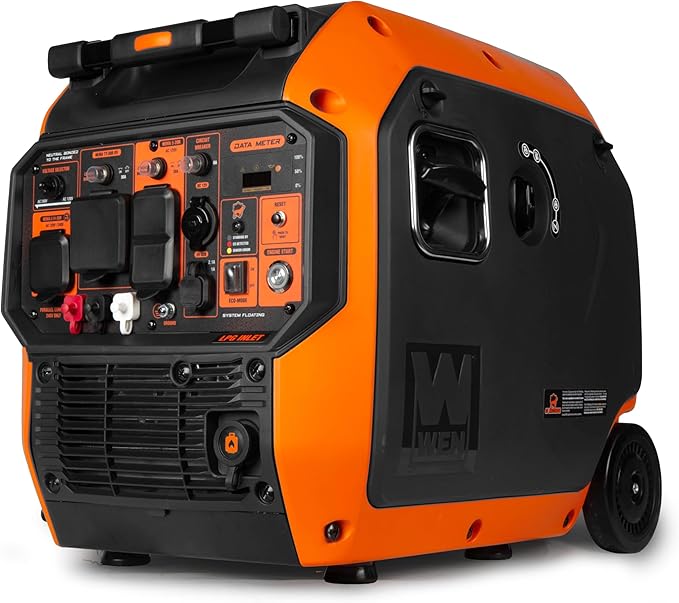
1. WEN DF680iX 6800-Watt Dual Fuel RV-Ready Inverter Generator
Check Amazon Price Click Here!
The WEN DF680iX is one of the more powerful options in this group and is designed for RV owners who need more than the typical 3,000-running-watt generator can provide.
It uses a 224cc dual-fuel engine and can operate on either gasoline or propane. On gasoline, it produces 6,800 surge watts and 5,100 rated watts. On propane, the output is 6,000 surge watts and 4,500 rated watts.
That additional capacity can be useful when an RV has a rooftop air conditioner, microwave, refrigerator, converter, battery charger, and other appliances operating at the same time.
Key Features
- Dual-fuel operation with gasoline or propane
- Up to 6,800 starting watts
- Up to 5,100 running watts on gasoline
- Up to 4,500 running watts on propane
- Electric start
- RV-ready TT-30R outlet
- 120V/240V capability
- CO Watchdog automatic shutdown
- Fuel shutoff function
- Wheels and telescoping handle
- USB charging ports
- Inverter generator design
The WEN also has a bonded-neutral configuration and includes a 120V/240V receptacle, making it more versatile than a basic RV generator.
Pros
- High output for an inverter generator
- Dual-fuel flexibility
- RV-ready 30A connection
- Electric start
- CO shutdown protection
- Useful for larger RV electrical loads
Cons
- Heavier than compact RV generators
- More generator than many small travel trailers need
- Larger physical footprint
- Higher fuel consumption when operating under heavy loads
Who Is It For?
The WEN DF680iX makes the most sense for RV owners who need substantial power and do not want to step down to a small 2,000- or 3,000-watt inverter.
It is particularly interesting for larger travel trailers, fifth wheels, and RV setups where air conditioning and other high-demand appliances may operate at the same time.
2. Champion Power Equipment 4000-Watt RV Ready Inverter Generator
Check Amazon Price Click Here!
The Champion Power Equipment 4000-Watt Inverter Generator takes a different approach. Instead of maximizing output, it focuses on keeping the generator relatively compact while providing enough capacity for many 30-amp RV applications.
Champion rates this model at 4,000 starting watts and 3,000 running watts, with up to 10 hours of runtime. Its official noise rating is 64 dBA at 23 feet, so the original article’s claim that it operates below 49 dBA was incorrect.
The generator includes a built-in 120V 25A TT-30R RV outlet, making it straightforward to connect to a compatible 30-amp RV power cord.
Key Features
- 4,000 starting watts
- 3,000 running watts
- Gasoline powered
- 64 dBA at 23 feet
- CO Shield automatic carbon monoxide shutdown
- Built-in TT-30R RV outlet
- Less than 49 pounds
- Parallel capable
- Less than 3% THD
- Up to 10 hours of runtime
The inverter system provides clean electrical power for sensitive electronics, while the TT-30R outlet avoids relying on an adapter simply to connect a typical 30-amp RV.
Pros
- Lightweight for its power class
- Built-in 30A RV outlet
- Inverter technology
- CO Shield protection
- Parallel capability
- Easy to transport
Cons
- Gasoline only
- 3,000 running watts may not be enough for multiple heavy loads
- 64 dBA is not an ultra-quiet rating
- Not designed as a 50A whole-RV solution
Who Is It For?
This Champion is a practical choice for RV owners with a 30-amp electrical system who want something easier to move than a large open-frame generator.
It is especially useful when portability matters and the RV’s electrical demands are moderate.
3. Westinghouse WGen3600 4650 Peak Watt Portable Generator
Check Amazon Price Click Here!
The Westinghouse WGen3600 is a more traditional portable generator rather than a modern enclosed inverter model.
Westinghouse documentation lists 4,650 peak watts and 3,600 running watts, with a 4-gallon fuel tank and recoil starting system.
For RV owners who prioritize straightforward operation and useful running wattage over inverter technology, this type of generator can still be practical.
Key Features
- 4,650 peak watts
- 3,600 running watts
- Gasoline powered
- 4-gallon fuel tank
- Recoil start
- 120V output
- 30A RV connection
- Traditional open-frame design
The larger fuel tank can be useful for extended operation, although actual runtime depends heavily on electrical load.
Pros
- More running watts than the Champion 4000
- Simple mechanical design
- Large fuel tank
- Suitable for basic RV power requirements
- Straightforward operation
Cons
- Heavier and less compact than suitcase-style inverter generators
- Recoil start
- No dual-fuel capability
- Not as quiet as enclosed inverter models
- Traditional generator output rather than inverter power
Who Is It For?
The WGen3600 is worth considering if your priority is simple, straightforward portable power and you do not need the additional features found on newer inverter generators.
It can be a sensible match for RVers who mainly need to power a 30A connection and do not expect to operate numerous high-demand appliances simultaneously.
4. Westinghouse iGen4000DFc 4000-Watt Dual Fuel Inverter Generator
Check Amazon Price Click Here!
For RV owners who want a combination of inverter technology and dual-fuel flexibility, the Westinghouse iGen4000DFc is a more compact alternative to the larger WEN.
This generator provides 4,000 peak watts and 3,300 running watts on gasoline, with reduced output when operating on propane. The iGen4000DFc also includes an RV-ready 30A connection, CO shutdown protection, low-oil shutdown, and an LED information display.
The enclosed design is intended to reduce operating noise, with published specifications as low as approximately 52 dBA under the manufacturer’s stated conditions.
Key Features
- Dual-fuel gasoline/propane operation
- 4,000 peak watts
- 3,300 running watts on gasoline
- RV-ready 30A outlet
- Inverter technology
- CO automatic shutdown
- Low-oil automatic shutdown
- LED data center
- Wheels and telescoping handle
- Approximately 59 pounds for the recoil-start version
- Parallel capable
There are different versions of the iGen4000DF family, so buyers should check whether the particular listing includes remote start or recoil start before ordering.
Pros
- Dual-fuel flexibility
- Inverter technology
- Compact design
- RV-ready 30A outlet
- CO protection
- Relatively quiet operation
- Easier to move than larger open-frame generators
Cons
- More expensive than basic open-frame models
- 3,300 gasoline running watts is still a mid-range output
- Propane produces less power than gasoline
- Model variations can make feature comparisons confusing
Who Is It For?
The iGen4000DFc is a strong fit for RV owners who want to carry one generator that can run on either gasoline or propane without moving up to a much larger unit.
It is particularly well suited to 30-amp RVs where portability and fuel flexibility are important.
5. Westinghouse WGen9500DFc 12500-Watt Dual Fuel Generator
Check Amazon Price Click Here!
The Westinghouse WGen9500DFc belongs in a different power class from the other generators on this list.
It produces 12,500 peak watts and 9,500 running watts on gasoline, while propane output is rated at 11,200 peak watts and 8,500 running watts. Westinghouse also lists remote and electric start, transfer-switch readiness, and up to 12 hours of runtime at 25% load.
For RV owners, one of its most useful features is the inclusion of an RV-ready 120/240V 14-50R outlet. However, that does not automatically mean every 50-amp RV can use the generator to its full potential. The RV’s electrical system, plug configuration, neutral arrangement, and generator connection should all be compatible.
Key Features
- 12,500 peak / 9,500 running watts on gasoline
- 11,200 peak / 8,500 running watts on propane
- Dual-fuel operation
- Electric start
- Remote start
- Recoil start
- 50A RV-ready 14-50R outlet
- Transfer-switch-ready L14-30R outlet
- CO protection
- Automatic low-oil shutdown
- 457cc engine
- Heavy-duty open-frame construction
Pros
- Extremely high power output
- Dual-fuel capability
- Remote and electric start
- 50A RV-ready outlet
- Useful for large RVs and fifth wheels
- Can also serve as a home-backup generator when properly connected
Cons
- Very heavy compared with RV inverter generators
- Not the right choice for small travel trailers
- Louder than enclosed inverter generators
- Takes up considerably more storage space
- Excessive capacity for many RV setups
Who Is It For?
The WGen9500DFc is primarily for RV owners with very high electrical demands, especially large fifth wheels and motorhomes.
It can also make sense for someone who wants one portable generator capable of handling both substantial RV loads and properly installed home-backup applications.
How Many Watts Does an RV Generator Need?
There is no single wattage that works for every RV.
The first step is to determine the electrical loads you expect to use at the same time.
Typical RV loads can include:
- Rooftop air conditioner
- Refrigerator
- Microwave
- Coffee maker
- Electric water heater
- Converter or battery charger
- Television
- Laptop and other electronics
- Lights
- Fans
- Induction cooktop
The important numbers are running watts and starting watts.
A refrigerator or air conditioner may require significantly more power for a short period while its compressor starts. That is why a generator with 4,000 starting watts and 3,000 running watts is not equivalent to a generator that can continuously produce 4,000 running watts.
Before buying, add the running wattage of the equipment you expect to operate simultaneously and then account for startup requirements.
30-Amp vs. 50-Amp RV Generators
Your RV’s electrical connection is one of the most important things to check.
30-Amp RVs
A typical 30-amp RV connection uses a TT-30 plug and provides a single 120V circuit.
Many mid-size inverter generators include a TT-30R outlet specifically for this application.
The Champion 4000W, WEN DF680iX, and Westinghouse iGen4000DFc are examples of generators with RV-oriented 30A connections.
50-Amp RVs
A 50-amp RV connection is different. It normally uses a 14-50 configuration with two 120V hot legs and can support substantially more electrical load.
However, simply seeing a 14-50 receptacle on a generator does not mean that the generator can deliver the same electrical capacity as campground 50A shore power.
Always verify the generator’s voltage configuration and your RV’s electrical requirements before connecting it.
Inverter Generator vs. Conventional Generator for an RV
Both designs can be useful, but they serve different purposes.
Inverter Generators
Inverter generators are generally attractive for RV use because they can provide cleaner electrical output and vary engine speed according to demand.
They are often:
- Quieter
- More fuel efficient at lighter loads
- More compact
- Better suited to sensitive electronics
- Easier to carry
The trade-off is that inverter generators can cost more and may provide less maximum power for their size.
Conventional Generators
Traditional open-frame generators can deliver substantial output for the money.
Their advantages can include:
- Higher power output
- Larger fuel tanks
- Straightforward mechanical design
- Lower cost per watt
The disadvantages are typically greater weight, more noise, and less convenient portability.
For RV camping, an inverter generator is often attractive when noise and portability matter. For high-demand applications, a larger conventional generator may be more practical.
Gasoline vs. Propane for RV Generators
A dual-fuel generator gives you the ability to use gasoline or propane.
Gasoline
Gasoline generally provides higher output and is widely available while traveling.
However, gasoline has a limited storage life and requires more attention when a generator will sit unused for long periods.
Propane
Propane is convenient for RVers who already carry propane for cooking or other appliances.
It also stores differently from gasoline, but the generator normally produces less power when operating on propane.
For example, the WEN DF680iX produces 5,100 rated watts on gasoline compared with 4,500 rated watts on propane.
If you frequently travel off-grid, dual-fuel capability can provide useful flexibility.
How Quiet Should an RV Generator Be?
Noise matters much more at a campground than it does during a home power outage.
A generator that seems acceptable in a backyard can become annoying when parked close to neighboring RVs.
When comparing noise ratings, pay attention to how and where the manufacturer measured the dBA level. Two generators should not be considered directly comparable unless the testing conditions are similar.
For example, Champion specifies 64 dBA at 23 feet for its 4000W inverter.
Westinghouse lists the iGen4000DFcv at as low as 52 dBA under its specified conditions.
That illustrates why simply looking for the lowest number in a product listing can be misleading.
RV Generator Safety: What You Need to Know
Carbon monoxide is one of the most important hazards associated with fuel-powered generators.
A CO sensor or automatic shutdown system is useful, but it does not make indoor generator operation safe.
Never operate a gasoline or propane generator inside:
- An RV
- A garage
- A tent
- A shed
- An enclosed trailer
- A partially enclosed structure
Place the generator outdoors and follow the clearance, exhaust-direction, and operating instructions specified by the manufacturer.
Keep the exhaust away from RV doors, windows, roof vents, and other openings. Your RV should also have functioning carbon monoxide alarms.
Never assume that because a generator has CO shutdown protection it can safely operate close to the RV.
What Features Matter Most for RV Use?
When comparing portable generators for an RV in 2026, pay attention to these features.
RV-Ready Outlet
A built-in TT-30R is useful for many 30A RVs because it provides a direct connection without relying on an additional adapter.
Starting Watts
Starting watts matter when compressors, pumps, and motors turn on.
Running Watts
Running watts determine how much equipment the generator can continuously power.
Inverter Technology
Inverter generators are attractive for camping because of their cleaner electrical output, variable engine speed, and typically quieter enclosed design.
Dual-Fuel Capability
Gasoline/propane operation provides flexibility during extended trips and emergencies.
Electric or Remote Start
Electric start can be convenient on larger generators. Remote start can be especially useful when the generator is stored outside the RV and you do not want to walk outside every time you need to start it.
Weight
Do not underestimate generator weight.
A 100-pound-plus generator may be easy to move with wheels on pavement but considerably harder to load into an RV storage compartment or pickup bed.
Runtime
Look at runtime at a stated load rather than assuming a published maximum-runtime figure represents normal heavy-load operation.
Which RV Generator Size Makes Sense?
A rough starting point looks like this:
| RV Setup | Generator Class to Consider |
|---|---|
| Small trailer with light electrical loads | 2,000–2,500W |
| Typical 30A RV | 3,000–4,000W running |
| 30A RV with higher AC/startup demands | 4,000–5,000W+ |
| Large fifth wheel or high-demand setup | 5,000–7,000W+ |
| Very large RV / multiple heavy loads | 8,000W+ |
These are starting points rather than universal rules. The actual requirement depends on the appliances installed in your RV and which ones you intend to operate simultaneously.
Final Thoughts on RV Portable Generators in 2026
The right RV generator is the one that matches your electrical system, power requirements, camping environment, and ability to transport it.
The WEN DF680iX stands out for RV owners who need substantial inverter-generator capacity and dual-fuel flexibility. Its 5,100 gasoline running watts give it considerably more headroom than typical 3,000-watt RV inverters.
The Champion 4000-Watt Inverter takes a more portable approach, with 3,000 running watts, a built-in TT-30R outlet, and a weight of less than 49 pounds.
The Westinghouse WGen3600 is a straightforward conventional generator for buyers who prefer a simple design and 3,600 running watts.
The Westinghouse iGen4000DFc adds dual-fuel capability and inverter technology in a more compact package, making it an interesting option for 30A RV owners who want gasoline and propane flexibility.
For very high-demand applications, the Westinghouse WGen9500DFc moves into a completely different class, offering up to 9,500 running watts on gasoline and a 50A RV-ready connection.
Before buying, don’t simply choose the generator with the highest wattage. Check your RV’s amp rating, calculate the loads you actually need to run, verify the generator’s outlet configuration, consider its weight and noise level, and follow the manufacturer’s safety requirements.
For most RV owners, matching the generator to the actual electrical demands of the rig is a better strategy than buying the largest portable generator available.