As an Amazon Associate I earn from qualifying purchases.
Whether you’re spending a weekend at a campground, traveling in an RV, working remotely from a van, or heading somewhere without reliable electricity, having the right portable camping generator can make a big difference.
The best option depends on what you actually need to power. A small portable power station can be enough for phones, lights, cameras, laptops, and other electronics. If you need to run a refrigerator, coffee maker, microwave, power tools, or an RV air conditioner, a gasoline-powered inverter generator can provide considerably more continuous power.
For 2026, the portable generator market includes everything from ultra-light battery power stations to 4,500-watt inverter generators. The five models below cover different camping situations, so the goal isn’t simply to choose the generator with the highest wattage. It’s to match the generator to your equipment, expected runtime, weight requirements, and camping style.
Portable Camping Generators at a Glance
| Model | Type | Capacity / Output | Weight | Best For |
|---|---|---|---|---|
| MARBERO 88Wh Power Station | Battery power station | 88Wh / 120W peak | 3.2 lbs | Lightweight camping |
| Bailibatt 300W Power Station | Battery power station | 257Wh / 300W | 4.6 lbs | Small electronics |
| Jackery Explorer 300 | Battery power station | 293Wh / 300W | About 7.1 lbs | General camping |
| AMERISUN 2500W Inverter | Gas inverter generator | 1,900W running / 2,500W peak | 39.7 lbs | Higher-power camping |
| ERAYAK 4500W Portable Inverter | Gas inverter generator | 3,500W running / 4,500W peak | About 55 lbs | RVs and larger loads |
The first three options are battery-powered units. They are quiet and produce no exhaust while operating, but their output is limited by battery capacity and inverter wattage.
The AMERISUN and ERAYAK are gasoline inverter generators. They are heavier and require fuel, but they can provide substantially more continuous power and can be refueled when the tank runs low.
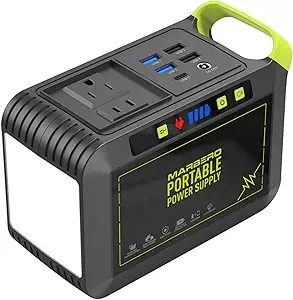
MARBERO Portable Power Station 88Wh
Check Amazon Price Click Here!
If keeping weight and bulk to a minimum is your priority, the MARBERO 88Wh portable power station is designed for a very different type of camping than a large gasoline generator.
At approximately 3.2 pounds, it is easy to carry and store in a backpack, vehicle, or camping bag. Its compact size makes it particularly useful when you mainly need electricity for smaller electronics rather than household appliances.
The built-in inverter can provide up to 120W of peak power, making this type of power station suitable for phones, tablets, lights, small fans, cameras, and similar low-power devices.
One of its biggest advantages is silent operation. Unlike a gasoline generator, there is no engine running beside your campsite and no fuel to transport.
The limitation is equally important: 88Wh is a small battery capacity. You should not expect it to run high-wattage appliances for long periods. It makes more sense as a lightweight electronics power source than as a replacement for a conventional camping generator.
Best for
- Backpacking and lightweight camping
- Phones and tablets
- Cameras and other small electronics
- LED lights
- Small fans
- Campers who want silent power
If your camping setup consists mostly of electronics and you want something that takes up very little space, the MARBERO is an easy unit to carry.
Check the MARBERO 88Wh on Amazon
Bailibatt Portable Power Station 300W
Check Amazon Price Click Here!
The Bailibatt 300W portable power station steps up the capacity considerably while remaining lightweight enough for car camping, road trips, and outdoor activities.
This model provides a 257Wh battery capacity and 300W of rated output. At about 4.6 pounds, it occupies a useful middle ground between tiny emergency power banks and larger portable power stations.
The unit uses pure sine wave AC output, which is useful when powering electronics such as laptops, cameras, tablets, and other equipment that benefits from stable electrical output.
Its battery capacity also gives it more flexibility than an 88Wh unit. However, 300W is still the maximum output range, so it isn’t designed for high-draw appliances such as full-size coffee makers, microwave ovens, heaters, or air conditioners.
One detail worth remembering with any battery power station is that watt-hours and watts are different measurements. The 257Wh figure describes how much energy the battery stores, while the 300W figure describes the maximum electrical load the inverter is designed to handle.
Best for
- Car camping
- Laptops and tablets
- Phones and cameras
- LED lighting
- Small fans
- Portable electronics
- Campers who want more battery capacity without carrying a heavy generator
The Bailibatt is a practical choice when portability matters but an ultra-small power bank doesn’t provide enough energy for your trip.
Check the Bailibatt 300W on Amazon
Jackery Explorer 300 Portable Power Station
Check Amazon Price Click Here!
The Jackery Explorer 300 remains a popular option for campers who want battery power without the noise, fumes, and maintenance associated with gasoline generators.
It has a 293Wh capacity and a 300W inverter with up to 500W of surge power. Jackery currently lists the Explorer 300 at around 7.1 pounds, with pure sine wave AC output and multiple charging options.
You can recharge the unit from an AC outlet, a vehicle, or compatible solar panels. That flexibility is particularly useful for multi-day trips where access to an electrical outlet isn’t guaranteed.
The Explorer 300 is a good fit for devices such as laptops, phones, lights, small fans, cameras, and some compact coolers. Jackery also provides estimated operating times for different loads, although actual runtime depends on the device and power consumption.
The main limitation is its 300W continuous inverter. Even though the battery stores almost 300Wh of energy, that does not mean you can connect a 1,000W appliance to it.
For example, a coffee maker, electric kettle, space heater, or larger microwave can require substantially more power than the Explorer 300 can provide.
Best for
- General car camping
- Remote work
- Phones and laptops
- Cameras and drones
- LED lights
- Small coolers and fans
- Quiet overnight power
If you want a recognizable portable power station that can handle everyday camping electronics without carrying gasoline, the Explorer 300 is a versatile option.
Check the Jackery Explorer 300 on Amazon
AMERISUN 2500-Watt Gas Inverter Generator
Check Amazon Price Click Here!
When battery power isn’t enough, a gasoline inverter generator provides a major increase in available output.
The AMERISUN 2500W inverter generator produces 1,900W of rated running power and 2,500W of starting power. It weighs approximately 39.7 pounds, which makes it considerably heavier than a battery power station but still manageable for car camping and RV trips.
The generator uses a 1.05-gallon fuel tank and is listed for up to approximately 11 hours of runtime at 25% load and 5.5 hours at 50% load. Actual runtime will vary depending on the load and operating conditions.
It also includes 120V AC outlets, a 12V DC outlet, and USB connections. A CO monitoring/safety system is another important feature for a gasoline generator.
The AMERISUN is better suited to situations where you need sustained power rather than simply charging electronics. Depending on the actual starting requirements of your equipment, it can handle appliances and equipment that are far beyond the capability of a small 300W power station.
However, 1,900W of running power still has limits. Before connecting multiple appliances, add their running watt requirements and consider the startup surge of motors and compressors.
Best for
- Car camping
- RV trips
- Outdoor events
- Refrigerators and freezers
- Small appliances
- Tools
- Emergency power for selected loads
One thing to keep in mind is noise. AMERISUN lists this model at approximately 69 dB at 23 feet, so it is not comparable to a silent battery power station.
Check the AMERISUN 2500W on Amazon
ERAYAK 4500W Portable Inverter Generator
Check Amazon Price Click Here!
For campers who need considerably more power, the ERAYAK 4500W inverter generator moves into the higher-output category.
The current ERAYAK 4500P specification lists 4,500W of peak power and 3,500W of running power, with a weight of about 55 pounds. It is designed around 120V output and includes a 30A RV-ready connection.
That additional capacity makes a difference when you’re trying to run several moderate loads or equipment with significant startup demand.
For example, ERAYAK lists applications including portable air conditioners, refrigerators, microwaves, lights, routers, televisions, and laptops. The exact combination of appliances still needs to be checked against their nameplate wattage and startup requirements.
The current 4500P is listed as a gasoline-only model, while ERAYAK also sells 4500PD dual-fuel versions using gasoline and propane. That distinction is important because specifications and starting systems vary between versions.
The gasoline 4500P is rated at approximately 60.5 dB, with a 2.25-gallon tank and up to about eight hours of runtime under specified conditions. ERAYAK also lists pure sine wave inverter output and THD below 1.2% for the 4500P.
At roughly 55 pounds, this isn’t the generator you’d normally choose for backpacking. It’s much more appropriate for an RV, vehicle-based campsite, outdoor event, or a situation where higher electrical output matters more than minimum weight.
Best for
- RV camping
- Larger campsites
- Portable air conditioners
- Refrigerators and freezers
- Outdoor events
- Multiple moderate electrical loads
- Selected emergency backup loads
If you need substantially more output than a 2,000W-class generator can provide, the ERAYAK 4500W category gives you considerably more headroom while remaining portable enough for vehicle-based camping.
Check the ERAYAK 4500W on Amazon
How to Choose the Right Camping Generator in 2026
Choosing a camping generator isn’t simply about buying the highest wattage available. Start by identifying what you actually need to run.
1. Calculate Your Running Watts
Every appliance has a power requirement, usually listed on a label or in the owner’s manual.
For example, you might have:
- Laptop: 50–100W
- LED lights: 10–50W
- Portable refrigerator: approximately 50–150W while running
- Small fan: 20–75W
- TV: approximately 50–150W
- Coffee maker: often 800–1,500W
- Microwave: often 1,000W or more
- Portable air conditioner: commonly several hundred watts to more than 1,000W
These numbers are examples rather than universal specifications. Always check the actual equipment you intend to use.
Add the running watts of the appliances you expect to operate simultaneously.
2. Don’t Forget Starting Watts
Some appliances need substantially more power for a short period when their motors or compressors start.
Refrigerators, freezers, air conditioners, pumps, and some power tools can have significant startup demands.
This is why a generator advertised at 2,500W peak and 1,900W running should not be treated as a 2,500W continuous generator.
For reliable operation, pay attention to running watts first, then make sure the generator has enough surge capacity for startup.
3. Decide Between a Power Station and Gas Generator
A portable power station makes sense when you prioritize:
- Quiet operation
- No gasoline
- No exhaust while operating
- Lightweight transportation
- Charging electronics
- Simple setup
A gasoline inverter generator makes more sense when you need:
- Higher continuous output
- Longer operation through repeated refueling
- RV air-conditioning capability
- Power for appliances and tools
- More power than a small battery can provide
There is no universal winner because the two categories solve different problems.
4. Consider Weight
Weight becomes especially important when you have to carry the generator any meaningful distance.
A 3–5 pound power station is easy to move around camp. A 40–55 pound gasoline generator is much more practical when you can transport it by car or RV.
If your campsite is a short walk from your vehicle, a larger inverter generator may be perfectly manageable. If you’re hiking several miles, the equation changes completely.
5. Think About Noise
Noise matters at a campground.
Battery power stations are effectively silent compared with gasoline generators because there is no combustion engine running.
Gas inverter generators are generally quieter than traditional open-frame generators, but they still produce engine noise.
Always check the manufacturer’s noise rating and understand how it was measured. A specification measured at a particular distance should not automatically be compared with another measurement taken under different conditions.
6. Consider Fuel and Runtime
Battery power stations need to be recharged. Depending on the model, you may use AC power, a vehicle outlet, or solar panels.
Gas generators can continue operating as long as you have fuel and can safely refuel them.
For longer trips, gasoline can be convenient because you aren’t limited by the initial battery capacity. On the other hand, transporting and storing fuel requires additional planning.
Which Type of Camping Generator Is Best for Different Situations?
Best for Lightweight Camping
A small battery power station such as the MARBERO is more practical when your main goal is keeping phones, lights, cameras, and other small devices charged.
There’s no gasoline to carry and no engine noise around the campsite.
Best for General Car Camping
A 250–300W power station provides more flexibility for laptops, phones, lights, fans, cameras, and other everyday electronics.
The Bailibatt and Jackery Explorer 300 fall into this category.
Best for Higher-Power Camping
If you need to operate larger appliances, a gasoline inverter generator is the more appropriate category.
The AMERISUN 2500W offers a significant increase in available output compared with a small battery station.
Best for RV Camping
RV owners should pay particular attention to the generator’s outlet configuration, continuous wattage, surge capability, and the specific electrical requirements of the RV.
A 4,500W-class inverter generator such as the ERAYAK can provide considerably more headroom for selected RV loads than a small portable power station.
However, never assume a generator will automatically run an RV air conditioner. Check the air conditioner’s starting and running requirements and account for other loads operating at the same time.
Using a Portable Generator Safely While Camping
Safety should be part of the buying decision, especially with gasoline-powered generators.
Never operate a gasoline generator inside a tent, RV, vehicle, garage, shed, or other enclosed or partially enclosed space.
Generators produce carbon monoxide, an odorless and potentially deadly gas. Opening a door or window does not make indoor operation safe.
Place the generator outdoors in a location where exhaust cannot enter your tent, RV, vehicle, building, or neighboring occupied area. Follow the clearance requirements in the owner’s manual and local campground rules.
You should also:
- Keep the generator dry and protected from direct rain unless the manufacturer specifically permits operation in those conditions.
- Refuel only according to the manufacturer’s instructions and with the generator in a safe condition.
- Let a hot engine cool before refueling when required by the manual.
- Avoid overloading the generator.
- Use properly rated extension cords when extension cords are necessary.
- Inspect cords for damage before use.
- Keep fuel containers away from ignition sources.
- Use the generator’s CO safety features as an additional protection, not as permission to operate it indoors.
For battery power stations, follow the manufacturer’s charging, temperature, storage, and battery-maintenance instructions.
Camping Generator vs. Solar Generator: What’s the Difference?
The term solar generator can be confusing because it doesn’t necessarily describe a traditional generator.
In most consumer products, a solar generator is actually a portable battery power station that can be recharged using solar panels.
The MARBERO, Bailibatt, and Jackery Explorer 300 fall into the battery power station category.
The advantage is simple: the battery stores electricity and can provide power without an engine running.
A gasoline inverter generator works differently. It generates electricity while the engine operates and can be refueled when necessary.
Solar charging can be extremely useful for extended trips, but it depends on sunlight, panel size, weather, and the power station’s solar input limits. It should not automatically be assumed that a small solar panel will keep a high-power campsite running indefinitely.
Camping Generator Size Guide
A simple way to think about generator size is:
Small battery power station: phones, cameras, lights, tablets and other small electronics.
300W-class power station: electronics, small fans, lights and selected low-power appliances.
Around 2,000W running power: refrigerators, selected kitchen appliances, tools and several moderate loads, provided the startup requirements are compatible.
Around 3,500W running power: larger RV and campsite loads, including selected portable air conditioners and multiple appliances when properly load-managed.
The actual requirements always depend on the equipment you own.
A larger generator isn’t automatically better. It can mean more weight, more fuel consumption, more storage space, and potentially more noise.
Final Thoughts: Choosing a Portable Camping Generator in 2026
The best portable camping generator depends on how you camp and what you need to power.
For minimalist trips where weight and silence matter most, a small battery power station can be all you need. The MARBERO 88Wh is aimed at ultra-light use, while the Bailibatt 300W and Jackery Explorer 300 provide more capacity for general electronics and car camping.
If your campsite requires considerably more power, a gasoline inverter generator is the better fit. The AMERISUN 2500W moves into the range needed for larger appliances and selected emergency loads, while the ERAYAK 4500W provides substantially more running power for RV camping and demanding outdoor setups.
Before buying, focus on four things: running watts, starting watts, runtime, and portability. Then consider noise, fuel type, outlet configuration, and the safety requirements for your camping environment.
The right generator isn’t necessarily the biggest or most expensive model. It’s the one that can safely handle the equipment you actually plan to use without forcing you to carry more weight or capacity than your trip requires.