As an Amazon Associate I earn from qualifying purchases.
When you need to weld where there is no electrical service, carrying a separate welder and generator can take up valuable space and add unnecessary equipment to your truck or trailer. The best welder generator combos solve that problem by combining welding capability and auxiliary AC power in one engine-driven machine.
These machines are useful for farm repairs, construction sites, mobile maintenance, fabrication, ranch work, equipment repair, and remote jobs. Depending on the model, you can use the welding output for stick or TIG work while also having generator power available for lights, grinders, drills, compressors, and other compatible tools.
However, not every welder generator is designed for the same type of work. A lightweight 120A machine is very different from a 225A professional engine-driven welder with nearly 10,000 watts of continuous auxiliary power.
Below, I compare five welder generator combos available through Amazon US, including compact options for occasional repairs and larger machines designed for demanding field work.
Best Welder Generator Combos Available on Amazon US in 2026
| Product | Welding Output | Generator Output | Best For |
|---|---|---|---|
| Zinnore 2000W/130A Stick Welder Generator | Up to 130A | 2,000W | DIY and light repairs |
| Tomahawk TWG210A 210A Welder Generator | Up to 210A | 2,000W | Heavy field repairs |
| Tomahawk TWG120A 120A Welder Generator | Up to 120A | 2,200W max | Compact portable work |
| Hobart Engine-Driven Welder/Generator | Up to 225A | Up to 11,000W depending on model | Professional job sites |
| ESAB Ruffian ES 150G | Up to 150A | 4,500W peak / 4,000W continuous | Remote stick welding |
Important: Product availability, specifications, included accessories, and Amazon listings can change. Always confirm the current manufacturer’s specifications and the Amazon listing before purchasing.
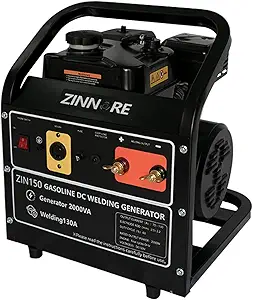
1. Zinnore 2000W/130A Stick Welder Generator
Check Amazon Price Click Here!
The Zinnore 2000W/130A Stick Welder Generator is aimed at buyers who want an engine-driven welder without moving up to the size and cost of a full professional welding generator.
With up to 130 amps of welding output and approximately 2,000 watts of generator capacity, it makes the most sense for smaller repairs, property maintenance, DIY fabrication, and situations where portability matters more than maximum welding capacity.
Key Specifications
- Welding output: Up to 130A
- Generator output: 2,000W
- Welding process: Stick
- Approximate weight: 75 lb, depending on listing/version
- Power source: Gasoline engine
Why Consider the Zinnore?
The main advantage is its compact approach. You get an engine-driven welding machine and auxiliary electrical power without having to transport a much larger professional unit.
It can be useful for repairing gates, brackets, equipment, trailers, farm implements, and other metal components where a 130A stick welder is sufficient.
The 2,000W generator output can also be useful for smaller electrical loads, but buyers should not expect it to replace a large job-site generator.
Best For
The Zinnore is best suited to DIY users, property owners, hobby welders, and light-duty field repairs.
If your work regularly involves long welding sessions, larger electrodes, or several high-draw tools at the same time, moving up to a larger engine-driven welder makes more sense.
2. Tomahawk TWG210A 210A Portable Welder Generator
Check Amazon Price Click Here!
The Tomahawk TWG210A is a much more capable option for users who need higher welding amperage while still wanting a relatively compact engine-driven machine.
It provides up to 210 amps of welding output, uses a 15 HP, 420cc gasoline engine, and provides 2,000 watts of generator power. The machine also supports stick/MMA and TIG applications and has a 60% duty cycle.
Key Specifications
- Welding output: Up to 210A
- Generator output: 2,000W
- Engine: 15 HP, 420cc
- Fuel: Gasoline
- Duty cycle: 60%
- Fuel tank: 7 gallons
- Starting system: Electric start
- Weight: Approximately 202 lb
- Welding: Stick/MMA and TIG
- Wheels: 8-inch wheels
Why Consider the TWG210A?
The biggest reason to choose the TWG210A is the combination of higher welding amperage and relatively modest generator size.
That makes it particularly interesting for farm repairs, ranch work, construction, equipment maintenance, and remote welding where the welding function is more important than running several high-powered electrical tools.
The machine also uses an inverter-based design and includes a digital meter and adjustable amperage control. The current product information lists compatibility with electrodes from 6010 through 7024.
One Important Limitation
The 2,000W generator is not comparable to the 9,000–11,000W auxiliary output available from full-size professional engine-driven welders.
In other words, the TWG210A is primarily a portable welding machine with auxiliary generator power, rather than a high-capacity job-site generator that happens to weld.
Best For
Choose the TWG210A if you need higher welding amperage in remote locations but don’t need enough generator capacity to operate multiple large tools simultaneously.
3. Tomahawk TWG120A 120A 2200W Welder Generator
Check Amazon Price Click Here!
The Tomahawk TWG120A is one of the more portable options in this group. It combines a 120A engine-driven stick welder with a generator rated at 2,000 watts and capable of up to 2,200 watts maximum output.
The current specifications list a 7 HP, 208cc gasoline engine, two 120V AC outlets, automatic idle control, and a weight of approximately 99 pounds.
Key Specifications
- Welding output: 120A
- Maximum generator output: 2,200W
- Rated generator output: 2,000W
- Engine: 7 HP, 208cc
- Fuel: Gasoline
- Welding process: Stick/MMA/Arc
- Outlets: Two 120V AC outlets
- Weight: Approximately 99 lb
- Wheels: 8-inch never-flat wheels
Why Consider the TWG120A?
Portability is the main attraction.
At around 99 pounds, it is considerably easier to move than a traditional 225A-class engine-driven welder. That can be a major advantage for property maintenance, small farms, trailer repairs, gates, brackets, and occasional welding away from an electrical outlet.
The generator can also supply power for compatible small tools and lights.
What Are the Limitations?
The 120A welding output puts this machine in a different category from professional 225A–300A engine-driven welders.
If your projects require long welding passes, larger electrodes, or heavy production work, the TWG120A may not provide enough welding capacity.
For occasional repairs and portability, however, its smaller size can be an advantage.
Best For
The TWG120A is best for light field repairs, DIY welding, property maintenance, small farms, and users who prioritize portability.
4. Hobart Engine-Driven Welder/Generator
Check Amazon Price Click Here!
For professional field work, a larger Hobart engine-driven welder/generator is in a completely different class from the compact machines above.
The Hobart Champion Elite 225, for example, is rated for 225 amps at 100% duty cycle and provides approximately 9,500 watts of continuous generator power and 10,000 watts peak power in the current specification. It uses a 23 HP gasoline engine and is designed for applications including fabrication, farm and ranch work, and auto repair.
Key Specifications
- Welding output: Up to 225A
- Rated welding duty cycle: 100% at rated output
- Generator output: Approximately 9,500W continuous / 10,000W peak on current Champion Elite 225 specifications
- Engine: 23 HP
- Fuel: Gasoline
- Current: AC/DC welding
- Fuel tank: Approximately 11 gallons
- Weight: Approximately 373 lb for the current Champion Elite 225
- Application: Professional, farm/ranch, fabrication, auto repair
Why Choose a Hobart Engine-Driven Welder?
The major advantage is auxiliary power capacity.
A machine in this class can do much more than weld. The generator output can support grinders, lights, drills, compressors, and other job-site equipment, provided the connected loads remain within the machine’s ratings.
That makes a full-size engine-driven welder particularly useful for service trucks and professional crews that need one machine to handle multiple tasks.
The Trade-Off
Weight is the obvious disadvantage.
A 300–500 lb engine-driven welder is not something most people want to carry by hand. These machines are better suited to trucks, trailers, service bodies, or permanent mobile setups.
Best For
A Hobart engine-driven welder is best suited to professional welders, contractors, farm and ranch operators, fabrication work, and mobile repair businesses.
5. ESAB Ruffian ES 150G 4.5kW Welder Generator
Check Amazon Price Click Here!
The ESAB Ruffian ES 150G sits between compact portable welders and full-size professional engine-driven machines.
It combines a 150A inverter stick welder with an engine-driven generator. ESAB specifies 150A at a 60% duty cycle, along with 4.5 kW of peak generator power and 4 kW of continuous power.
Key Specifications
- Welding output: Up to 150A
- Duty cycle: 60% at 150A
- Generator output: 4.5 kW peak / 4 kW continuous
- Engine: Kohler Command PRO CH440
- Engine power: 14 HP
- Fuel: Gasoline
- Fuel tank: Approximately 5 gallons
- Generator voltage: 120/240V
- Weight: Approximately 248 lb with wheels and handles
- Welding process: Stick/SMAW
Why Consider the Ruffian ES 150G?
The Ruffian is designed for users who want more generator capacity than a small 2,000W machine without moving all the way into a 225A-plus professional engine drive.
Its inverter welding technology is designed to provide a stable DC welding arc, and ESAB lists support for common stick electrodes including 6010, 6011, and 7018.
Another useful feature is the ability to run compatible electrical tools while welding. ESAB specifically lists grinders, circular saws, lights, air compressors, drills, and even light-duty plasma cutters among possible auxiliary loads.
Generator Output Matters
One important correction from the original article is that 4.5 kW should not be treated as the continuous generator output.
The ESAB specifications identify 4.5 kW as peak power and 4 kW as continuous power.
Best For
The Ruffian ES 150G is a strong fit for mobile maintenance, ranch work, property repairs, construction, light fabrication, and remote stick welding where additional auxiliary power is useful.
Welder Generator vs. Separate Welder and Generator
A welder generator combines two functions into one engine-driven machine.
A separate setup uses:
- A portable generator
- A conventional welding machine
Both approaches have advantages.
Welder Generator Advantages
- One engine instead of two
- Less equipment to transport
- Useful for remote welding
- No wall power required
- Can provide auxiliary AC power
- Convenient for mobile repair work
- Saves space on trucks and trailers
Separate Equipment Advantages
A separate generator and welder can offer greater flexibility.
For example, if you already own a high-quality portable generator, buying a standalone inverter welder may make more sense than purchasing another engine-driven machine.
Separate equipment can also make replacement easier if one component fails.
The best choice depends on how often you weld away from electrical power and whether you need generator power at the same time.
How to Choose the Best Welder Generator Combo
1. Look at Welding Amperage
Don’t choose a machine based solely on its advertised maximum amperage.
A 120A machine and a 225A machine are intended for different levels of work.
Higher amperage generally gives you more flexibility with thicker material and larger electrodes, but actual welding capability also depends on the electrode, material, welding process, and duty cycle.
2. Check the Duty Cycle
Duty cycle is one of the most important specifications for serious welding.
It tells you how long a machine can weld at a specified output before it needs a cooling period.
For example, the ESAB Ruffian ES 150G is rated at 150A with a 60% duty cycle, while the current Hobart Champion Elite 225 is rated at 225A with a 100% duty cycle.
If you’re doing occasional repairs, a lower duty cycle may be perfectly adequate.
For production welding or long continuous passes, pay much more attention to the rated duty cycle.
3. Don’t Confuse Peak Watts With Continuous Watts
Generator specifications often list both maximum/peak output and continuous/rated output.
These are not the same thing.
For example:
- ESAB Ruffian ES 150G: 4.5 kW peak / 4 kW continuous
- Tomahawk TWG120A: 2,200W maximum / 2,000W rated
- Hobart Champion Elite 225: approximately 10,000W peak / 9,500W continuous
The continuous rating is generally the more useful number when determining what equipment you can run for an extended period.
4. Consider the Welding Process
Many engine-driven machines focus on stick welding because it is particularly useful in outdoor and remote environments.
Some models also support TIG, while larger machines may provide additional capabilities or support wire feeders.
If you need MIG or flux-core welding, check whether the machine provides the appropriate constant-voltage (CV) output and whether a compatible wire feeder is supported.
Don’t assume that every machine advertised as a “welder generator” is a multiprocess welder.
5. Think About Weight
Portability means different things depending on the machine.
A roughly 99 lb unit such as the Tomahawk TWG120A can be moved relatively easily with its wheels. A 200 lb class machine requires substantially more effort. A 225A professional machine weighing several hundred pounds is generally better suited to a truck, trailer, or service body.
Before buying, consider how you will load, unload, transport, and secure the machine.
6. Check Fuel Capacity
Larger fuel tanks can reduce the number of refueling stops during long field jobs.
The Tomahawk TWG210A, for example, has a 7-gallon fuel tank, while the ESAB Ruffian ES 150G uses a 5-gallon tank.
Fuel capacity doesn’t automatically mean longer runtime because engine load and welding activity affect consumption.
7. Check the Electrical Outlets
If you plan to use the generator for tools, don’t just look at the total wattage.
Check:
- 120V outlets
- 240V availability
- Outlet amperage
- Circuit protection
- Number of receptacles
- Continuous generator rating
The ESAB Ruffian ES 150G, for example, provides 120V and 240V outlets, while the Tomahawk TWG120A provides two 120V outlets.
8. Think About Your Typical Job
The best welder generator is the one that matches the work you actually perform.
Occasional DIY Repairs
A 120A–150A machine can make sense if you’re repairing gates, brackets, small equipment, or other relatively light projects.
Farm and Ranch Repairs
A 150A–225A engine-driven machine gives you more flexibility for equipment repairs, trailers, implements, and structural repairs.
Professional Mobile Welding
For daily field work, a larger machine with higher duty cycle, more auxiliary power, and better service support is generally more appropriate.
Construction Jobs
Consider both welding output and generator capacity. Running grinders, drills, lights, compressors, or other equipment can quickly make a 2,000W generator feel limiting.
Welder Generator Safety Tips
Engine-driven welders combine two hazards: hot welding equipment and an internal-combustion engine.
Always follow the manufacturer’s operating instructions.
Never Run a Gas-Powered Welder Generator Indoors
Never operate a gasoline-powered engine-driven welder inside a garage, basement, enclosed trailer, workshop, or other enclosed or partially enclosed area.
Carbon monoxide can build up quickly and become life-threatening.
Operate the machine outdoors in an appropriate location away from doors, windows, vents, and occupied areas.
Protect Yourself From Welding Hazards
Use appropriate:
- Welding helmet
- Welding gloves
- Flame-resistant clothing
- Eye protection
- Hearing protection
- Proper ventilation
- Protective footwear
Keep gasoline, solvents, dry vegetation, and other combustible materials away from welding sparks and hot metal.
Don’t Overload the Generator
Check both the running wattage and startup requirements of connected equipment.
A tool with a large electric motor can require substantially more power when starting than when running.
Stay within the manufacturer’s rated generator output.
Summary Comparison: Best Welder Generator Combos
| Product | Welding Output | Generator Output | Approx. Weight | Best For |
|---|---|---|---|---|
| Zinnore 2000W/130A | 130A | 2,000W | ~75 lb | DIY and light repairs |
| Tomahawk TWG210A | 210A | 2,000W | 202 lb | Heavy field welding |
| Tomahawk TWG120A | 120A | 2,200W max / 2,000W rated | 99 lb | Portable repairs |
| Hobart Champion Elite 225 | 225A | 10,000W peak / 9,500W continuous | 373 lb | Professional work |
| ESAB Ruffian ES 150G | 150A | 4,500W peak / 4,000W continuous | 248 lb | Mobile maintenance |
Specifications can vary by exact model, production version, and package. Confirm the current manufacturer’s specifications before purchasing.
Which Welder Generator Combo Should You Buy?
The right welder generator combo depends more on your workload than on the highest number printed on the product page.
Best for Lightweight DIY Welding
The Zinnore 130A makes sense when portability and basic stick welding are the priorities.
Best for Higher-Amperage Portable Welding
The Tomahawk TWG210A provides substantially more welding capacity while retaining a relatively compact design compared with large professional engine-driven welders.
Best for Portability
The Tomahawk TWG120A is the better fit when moving the machine easily is a major consideration.
Best for Professional Job-Site Power
The Hobart Champion Elite 225 belongs in a different class, with substantially greater auxiliary generator capacity and a 225A welding output. It is better suited to professional users who need both welding and serious job-site power.
Best Middle-Ground Option
The ESAB Ruffian ES 150G offers a useful balance between portability, welding performance, and auxiliary generator power. Its 150A inverter welding system and 4 kW continuous generator capacity make it considerably more capable than the smallest machines without becoming a full-size 225A-class unit.
Final Thoughts
A good portable welding generator can be extremely useful when your work takes you away from a reliable electrical connection.
The key is to look beyond the advertised maximum amperage or peak wattage. Consider the welding process, duty cycle, continuous generator output, fuel capacity, weight, electrical outlets, and the type of work you actually perform.
For occasional repairs, a compact 120A–150A machine may provide everything you need. For demanding field welding and professional use, moving up to a 225A-class engine-driven welder can provide a much larger safety margin and substantially more auxiliary power.
Before ordering, verify the current Amazon listing, exact model number, included accessories, warranty, and manufacturer’s specifications. That final check is especially important because product configurations and availability can change over time.
Check the current options on Amazon US: