As an Amazon Associate I earn from qualifying purchases.
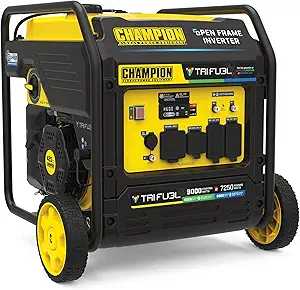
The Champion Power Equipment 201176 is a 9,000-watt tri-fuel open-frame inverter generator designed for portable home backup, RV use, job sites, and other high-power applications. Its main advantage is not simply the 9,000-watt starting output, but the combination of inverter technology and three fuel options: gasoline, propane, and natural gas.
On gasoline, the generator produces 7,250 running watts and 9,000 starting watts. The continuous output drops to 6,525 watts on propane and 5,875 watts on natural gas. That difference is important when planning which appliances and household circuits you can run at the same time.
The 201176 is also different from a conventional portable generator because it uses inverter technology, includes CO Shield, offers electric and recoil starting, and provides 120/240V power. For homeowners considering portable backup power in 2026, those features make this model worth a closer look.
Champion 201176 Key Specifications
| Specification | Details |
|---|---|
| Model Number | 201176 |
| Starting Watts | 9,000W |
| Running Watts – Gasoline | 7,250W |
| Running Watts – Propane | 6,525W |
| Running Watts – Natural Gas | 5,875W |
| Fuel Types | Gasoline, propane, natural gas |
| Engine | 420cc Champion OHV |
| Generator Type | Open-frame inverter |
| Voltage | 120/240V |
| Frequency | 60 Hz |
| Gasoline Tank Capacity | 4.32 gallons |
| Gasoline Runtime | Up to 14 hours at 25% load |
| Propane Runtime | Up to 12 hours at 25% load with a 20-lb tank |
| Starting System | Electric and recoil |
| Battery | Included |
| Noise Rating | 72 dBA |
| Weight | 165.8 lb |
| Dimensions | 26.6 × 25.5 × 25.4 in. |
| CO Protection | CO Shield automatic shutdown |
| Outlets | 120V GFCI, 120/240V 30A locking, 120/240V 50A |
| Parallel Capability | No |
| Warranty | 3-year limited warranty |
The specifications above are based on Champion’s current product information and operator documentation for model 201176.
Tri-Fuel Operation: Gasoline, Propane, or Natural Gas
One of the biggest reasons to consider the Champion 201176 is its tri-fuel capability.
You can operate the generator using:
- Gasoline for maximum rated output and portability.
- Propane when you want a fuel that can be stored for longer periods.
- Natural gas when your property has an appropriately sized utility gas connection.
The output changes depending on the fuel. Gasoline provides the highest continuous output at 7,250 watts, followed by propane at 6,525 watts and natural gas at 5,875 watts.
That distinction is important. If you plan to use natural gas during a long power outage, you should size your household load around the 5,875-watt running output, rather than the 9,000-watt starting figure.
Natural gas can also reduce the need to keep refilling a gasoline tank during an extended outage. However, connecting a portable generator to a natural gas supply is not simply a matter of attaching a hose. Champion specifies that the gas supply line must be properly sized and installed, and local codes should be followed.
How Much Power Does the Champion 201176 Produce?
The headline 9,000-watt figure refers to starting watts, not continuous output.
For normal operation, the numbers that matter most are:
- 7,250 running watts on gasoline
- 6,525 running watts on propane
- 5,875 running watts on natural gas
The 9,000 starting watts are useful when equipment with higher startup demands comes on, but the generator cannot continuously supply 9,000 watts.
Depending on your home’s electrical setup and the appliances you prioritize, the 201176 can support a substantial selection of household loads. Possible loads include refrigerators, freezers, lighting, internet equipment, sump pumps, selected HVAC equipment, and other appliances.
However, you should calculate the actual running and starting wattage of your appliances before connecting them. Large air conditioners, well pumps, electric water heaters, electric ranges, dryers, and other high-demand equipment can consume a significant portion of the generator’s available capacity.
Inverter Technology for Home Backup
The 201176 is an open-frame inverter generator, which separates it from many traditional open-frame portable generators.
Champion combines inverter technology with its Quiet Technology and Economy Mode. The company rates the generator at 72 dBA, and its design is intended to be quieter than a traditional generator in the same general power class.
That does not mean it is silent.
At 72 dBA, the 201176 is still a substantial running machine, particularly when it is under heavier loads. Buyers expecting the quiet operation of a small enclosed suitcase-style inverter should keep that distinction in mind.
The advantage is that you get considerably more power than most compact inverter generators while retaining the benefits of inverter technology.
Runtime: What to Expect During an Outage
Runtime depends heavily on the fuel and the load.
Champion rates the generator for up to 14 hours on gasoline at 25% load using its 4.32-gallon fuel tank. With a 20-pound propane tank, Champion lists up to 12 hours at 25% load.
Those figures should not be interpreted as a guarantee of 14 or 12 hours under every operating condition.
A generator operating at a higher load will consume fuel more quickly. For that reason, it is better to think of the published runtime as a reference point rather than a fixed number.
For extended outages, natural gas can be particularly convenient because an appropriately installed utility connection can provide fuel without requiring repeated gasoline refills. The trade-off is lower continuous output, with the 201176 producing 5,875 running watts on natural gas.
Electric Start and Recoil Backup
The Champion 201176 includes both electric and manual starting.
The electric start uses an included battery, which is useful when you need to start a relatively large generator without repeatedly pulling a recoil cord. Champion also includes Cold Start Technology to assist with starting in colder conditions.
The recoil start provides a manual backup if the electric-start system is unavailable.
One thing owners should not overlook is battery maintenance. Champion’s operator manual recommends fully charging the battery at least once per month.
That is especially relevant for a generator that may sit unused for weeks or months between storms.
120/240V Power and Home Connection
The 201176 provides both 120V and 240V output, including a 120/240V 50A receptacle and a 120/240V 30A locking receptacle. It also has GFCI-protected 120V household outlets.
This makes the generator suitable for more than simply plugging individual appliances into extension cords.
For home backup, the available 120/240V connections can be used with an appropriately designed transfer-switch or interlock setup.
However, the generator does not automatically make a home’s electrical panel compatible with it. A proper connection requires the correct equipment, wiring, grounding arrangement, and compliance with local electrical codes.
If you want to connect the generator to your home’s electrical system, have the installation evaluated and completed by a qualified electrician.
CO Shield: An Important Safety Feature
The Champion 201176 includes CO Shield, which is designed to automatically shut the generator down when dangerous carbon monoxide conditions are detected.
That is an important additional protection, but it should never be treated as permission to operate the generator indoors.
The generator must be operated outdoors and away from doors, windows, vents, and other openings where exhaust could enter the building. Never operate it inside a home, garage, basement, crawlspace, shed, or other enclosed area.
CO Shield is a backup safety feature. It does not replace correct generator placement or a properly installed carbon monoxide alarm in the home.
Is the Champion 201176 Easy to Move?
The 201176 weighs 165.8 pounds, so calling it lightweight would be misleading.
The included wheel kit and handle make it considerably easier to move across a driveway, garage floor, or other relatively flat surface, but moving a generator of this size still requires some planning.
Its dimensions are approximately 26.6 inches long, 25.5 inches wide, and 25.4 inches high.
This is one area where buyers should be realistic: the wheels make repositioning easier, but they do not make a 166-pound generator easy to carry up stairs or load into a truck by yourself.
What About Noise?
Champion lists the 201176 at 72 dBA. The company describes this as 50% quieter than a traditional 7,250-watt generator, thanks in part to its Quiet Technology.
Still, 72 dBA is not silent.
If the generator will be operating near a bedroom, neighboring property, or outdoor living area, placement matters. You should also follow all required clearance and exhaust-safety instructions rather than choosing a location simply because it is convenient.
For a generator in this power class, the noise level is a trade-off for having substantial portable output in an open-frame design.
Where the Champion 201176 Makes the Most Sense
The 201176 is versatile enough to serve several purposes.
Home Backup
This is one of its strongest applications. The combination of 120/240V output, tri-fuel operation, inverter technology, and 7,250 gasoline running watts gives homeowners considerable flexibility during outages.
The key is to decide in advance which circuits are essential.
Job Sites
The 9,000-watt starting capacity and 7,250-watt gasoline running output can be useful for contractors and other users who need to operate multiple tools or equipment away from utility power.
RV Use
The 120/240V capability and substantial output can make the 201176 useful for larger RV applications, although its size and weight should be considered before choosing it specifically for travel.
Rural Properties
Natural gas, propane, and gasoline flexibility can be particularly useful for rural properties where fuel availability and electrical demands vary.
Maintenance Requirements
Regular maintenance is important because a portable generator may spend long periods sitting unused.
Champion’s current operator documentation recommends the following schedule:
- Check the oil level before each use or every 8 hours of operation.
- Change the oil after the first 5 hours during break-in.
- Clean the air filter every 50 hours or annually.
- Change the oil every 100 hours or annually under normal conditions.
- Clean or adjust the spark plug every 100 hours or annually.
- Clean the spark arrestor every 100 hours or annually.
- Inspect the generator more frequently when operating under heavy loads or in hot conditions.
- Follow the specified service intervals for the fuel system, combustion chamber, and valve clearance.
The manual also recommends charging the starting battery fully at least once a month.
For a backup generator, maintenance should not begin when the power goes out. Periodic test runs and inspections are a much better approach.
Things to Consider Before Buying the Champion 201176
The 201176 has several strong features, but it is not the right generator for every buyer.
First, remember that 9,000 watts is the starting output. The continuous gasoline rating is 7,250 watts, and natural gas reduces that further to 5,875 watts.
Second, the generator weighs about 166 pounds. The wheels help, but this is still a large portable machine.
Third, it is an open-frame generator. At 72 dBA, it is quieter than many conventional generators in its class, but it is not comparable to a small, enclosed inverter generator.
Fourth, natural gas requires the correct supply setup. An undersized gas line can limit performance, so homeowners should not assume that any existing household gas connection will automatically provide what the generator needs. Champion specifically warns that improper gas-line sizing can cause hard starting or reduced output.
Finally, the 201176 does not have parallel capability, so you cannot simply connect another compatible generator to double its output.
Champion 201176: Final Verdict
The Champion Power Equipment 201176 is an interesting option for buyers who want more flexibility than a conventional single-fuel portable generator can provide.
Its combination of 9,000 starting watts, 7,250 running watts on gasoline, tri-fuel operation, inverter technology, 120/240V output, electric start, and CO Shield gives it a useful combination of features for portable backup power.
The biggest thing to understand is what the numbers actually mean. If you plan to run the generator on natural gas, you’re working with 5,875 running watts rather than 9,000. If portability is important, remember that the unit weighs 165.8 pounds. And although its 72 dBA rating is relatively restrained for its power class, this remains a large open-frame generator.
For a homeowner who wants gasoline, propane, and natural gas flexibility without moving to a permanently installed standby system, the 201176 offers a practical middle ground.
Before buying, calculate your home’s actual running and starting loads, decide which fuel you are most likely to use during an outage, and make sure your planned electrical and fuel connections comply with local requirements.