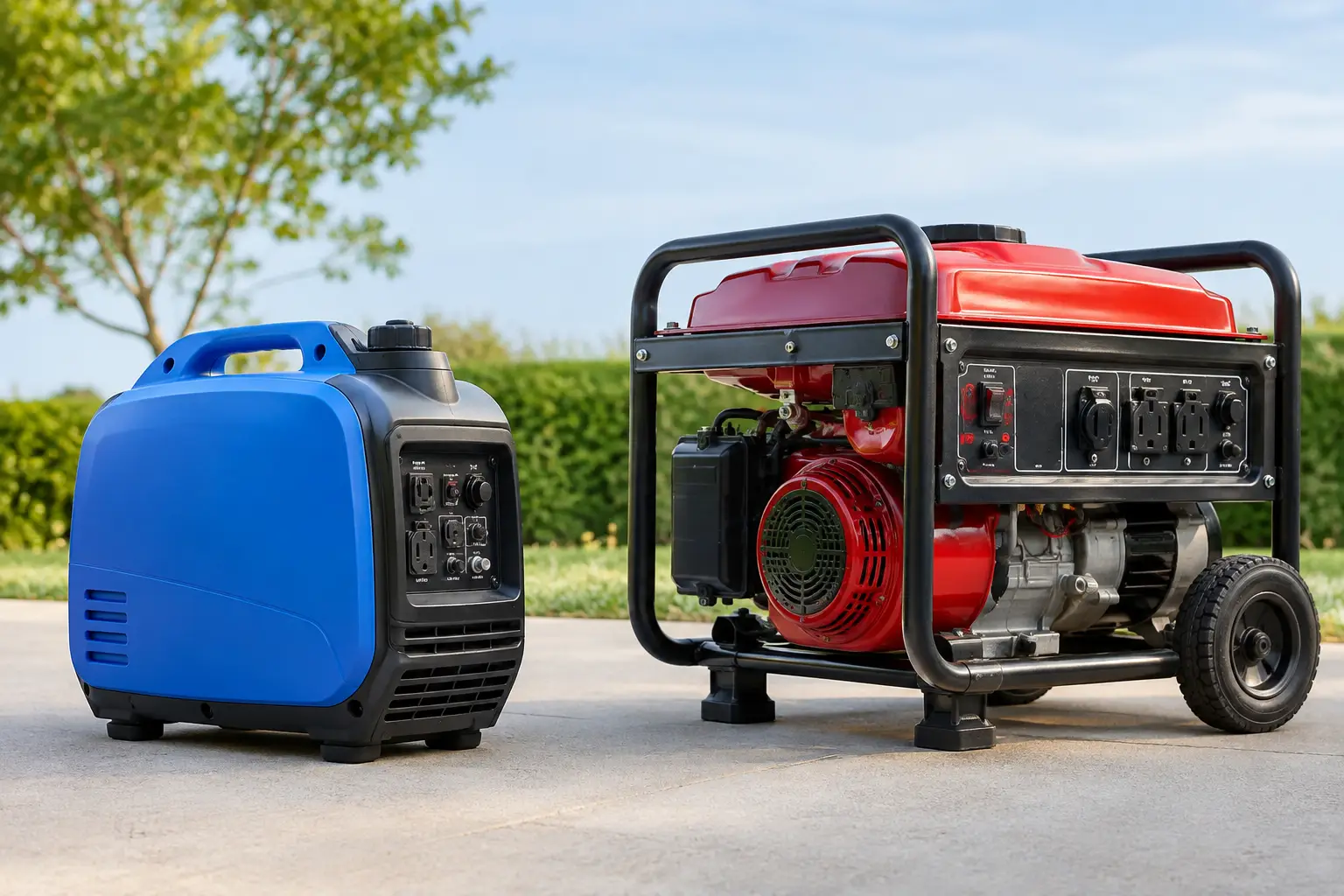
A refrigerator starts hard. A well pump starts even harder. Meanwhile, a laptop, phone charger, and RV air conditioner need power that is not only available, but clean and correctly delivered. That is why the choice between inverter versus conventional generators is more than a question of price or wattage. It affects what you can run, where you can run it, how much fuel you use, and how complicated your backup-power setup becomes.
For many buyers, an inverter generator is the better everyday tool. For others, especially homeowners covering larger essential loads or contractors powering demanding equipment, a conventional generator delivers more output per dollar. The right answer depends on the loads, the location, and the way you plan to connect power safely.
Inverter Versus Conventional Generators: The Core Difference
A conventional generator uses an engine that generally runs at a fixed high speed, typically 3,600 RPM, to produce 120/240-volt AC power at 60 Hz. It is a straightforward design: engine speed drives the alternator, and the alternator supplies power to the outlets. Larger open-frame portable generators commonly use this approach.
An inverter generator works differently. Its engine produces electricity that is converted to DC, then electronically inverted back into regulated AC power. That extra electronic step allows the generator to adjust engine speed to match the demand. When you are charging a few devices, it can slow down; when an air conditioner kicks on, it can speed up to meet the load.
Neither design is automatically better. Conventional models favor high output and value. Inverter models favor quieter operation, lower fuel use at light loads, and smoother power for sensitive electronics.
Power Output and Starting Watts Matter Most
The first buying mistake is choosing by running watts alone. Many motors need a brief surge of extra power to start. A refrigerator may run on 600 to 800 watts but need significantly more for a moment at startup. A sump pump, circular saw, window air conditioner, and well pump can create much larger starting demands.
Conventional generators are often the practical choice when those motor loads add up. A 7,500-watt running, 9,500-watt starting-watt conventional unit can support a broader set of home essentials than a compact 2,200-watt inverter generator. It may be able to feed a properly installed inlet box and transfer switch for selected circuits, such as refrigeration, lighting, a furnace blower, garage-door opener, and sump pump.
That does not mean an inverter is underpowered. Inverter generators range from small suitcase-style units to 7,000-watt-and-larger models. A compact model such as the Honda EU2200i is well suited to a campsite, tailgate, small travel trailer, or a refrigerator-and-charger emergency plan. Two compatible inverter generators can often be connected with a parallel kit when you need more capacity, though the combined cost can exceed that of one larger conventional unit.
Before choosing either type, list each load’s running watts and starting watts. If you have a 240-volt well pump, central air equipment, or shop machinery, confirm the voltage and starting requirements before buying. A generator with only 120-volt outlets cannot operate a 240-volt load, no matter how many watts its label claims.
Noise, Fuel Use, and Where You Will Operate
Noise is where inverter generators usually pull ahead. Because their engines can slow down under light demand and are often housed in insulated enclosures, many operate at a level that is far more comfortable around campsites, RV parks, and nearby homes. The difference is especially noticeable at night when the generator is supporting only a CPAP machine, battery charger, small fan, or refrigerator.
A conventional open-frame generator commonly remains louder because it operates at a more consistent engine speed. That may not matter on an active jobsite, during daytime farm work, or when it is placed well away from the house during an outage. It can matter a great deal in a neighborhood or campground where noise limits and courtesy are real considerations.
Fuel efficiency follows a similar pattern. An inverter generator is usually more efficient at partial loads because it does not need to run at full engine speed all the time. If your typical use is modest, that can mean longer run time from a small fuel tank. Conventional generators can still offer excellent run times, particularly larger models with large tanks, but they tend to burn more fuel when lightly loaded.
For extended outages, fuel planning deserves as much attention as generator selection. Gasoline ages, propane storage requires space, and dual-fuel models may produce less power on propane than on gasoline. Choose a fuel type based on what you can safely store and realistically replenish during an emergency.
Power Quality: When an Inverter Is Worth Paying For
Modern conventional generators can provide acceptable power for many household devices, but inverter generators typically produce cleaner, more stable electricity. This is often described as low total harmonic distortion, or THD. Lower THD is helpful for laptops, modem and router equipment, newer televisions, battery chargers, medical devices, and electronics with sensitive charging circuits.
Do not assume every conventional unit will harm electronics. Quality models with automatic voltage regulation can perform well, and many homeowners successfully use them for common appliances. Still, if your primary use involves RV electronics, remote work, camera batteries, or frequent charging of expensive devices, an inverter model provides more peace of mind.
There is also a practical middle ground. A conventional generator can handle heavier loads while a quality surge protector or UPS protects specific electronics. That approach can work, but it adds equipment and does not solve every power-quality concern. It is best treated as a planned system rather than an improvised extension-cord arrangement.
Home Backup Requires the Right Connection Equipment
A generator’s outlets do not create a safe home backup system by themselves. For selected-circuit backup, a licensed electrician can install a transfer switch or panel interlock, an appropriately rated inlet box, and the correct generator power cord. This setup prevents dangerous backfeeding into utility lines and gives you a controlled way to power the circuits you actually need.
Match the cord and inlet box to the generator outlet and the expected load. A common 30-amp, 120/240-volt locking outlet supports up to 7,200 watts under ideal conditions, while a 50-amp connection can support more capacity when paired with suitable equipment. The plug configuration matters just as much as amperage. A cord that physically does not match should never be forced or adapted without verifying its voltage, neutral, and grounding arrangement.
Neutral bonding can also matter with transfer switches, GFCI outlets, and certain RV or home connections. Some portable generators have a bonded neutral, while others use a floating neutral. The correct arrangement depends on the generator and the transfer equipment. A bonding plug is not a universal fix, and using one incorrectly can create nuisance tripping or a safety problem. Check both manuals or have an electrician confirm the setup.
Never run any generator in a garage, enclosed porch, basement, or near open windows. Carbon monoxide is odorless and can become deadly quickly. Place the generator outdoors, away from doors and vents, and use working carbon monoxide alarms inside the home.
Which Generator Fits Common Use Cases?
For camping, tailgating, and most RV use, an inverter generator is usually the easy recommendation. It is quieter, easier to carry, and better suited to charging electronics. Confirm that it has enough starting capacity for the RV air conditioner, or choose a soft-start device and a generator sized for that application.
For occasional home emergency power, the choice depends on your expectations. An inverter generator works well when the plan is limited to a refrigerator, lights, internet equipment, and charging. A conventional generator often makes more sense when you need several appliances, a sump pump, or a properly connected set of essential household circuits.
For a jobsite, conventional generators remain compelling. Their output, durability, and lower cost per watt suit compressors, saws, pumps, and multiple crews. If the work includes delicate testing equipment or residential settings where noise is a concern, a larger inverter generator may justify its higher price.
For well pumps, start with the pump’s voltage, horsepower, and control equipment. A 240-volt pump can rule out many small inverter models immediately. Because pumps have high startup demand, a conventional generator with strong surge capacity is frequently the safer fit, although larger 240-volt inverter models can work when correctly sized.
Buy for the Load You Need, Not the Label You Like
An inverter generator earns its premium through quiet operation, efficient low-load performance, clean power, and portability. A conventional generator earns its place with stronger value at higher wattages, broad 120/240-volt availability, and the surge capacity needed for many home and work loads.
The best purchase begins with a realistic power plan: identify the appliances you will actually run, verify their voltage and startup demands, and include the inlet box, cord, transfer equipment, and fuel storage in the budget. A generator that fits that whole plan will be far more useful than a bigger or quieter model chosen from its spec sheet alone.