As an Amazon Associate I earn from qualifying purchases.
A good portable generator does more than produce electricity. It needs to provide enough usable power for your equipment, run efficiently, remain manageable to transport, and deliver stable electricity for sensitive electronics.
That is why 2500-watt portable inverter generators remain popular for camping, tailgating, RV trips, emergency backup, and other situations where you need power away from a wall outlet.
However, there is an important detail to understand before buying one: 2,500 watts usually refers to starting or surge power, not continuous power. Many generators in this class provide around 1,800 to 1,900 running watts. That difference matters when you are powering refrigerators, microwaves, tools, air conditioners, or multiple devices at the same time.
For this 2026 guide, we look at five 2500W portable inverter generators from Champion Power Equipment, AMERISUN, PowerSmart, WEN, and Oxseryn. The goal is not simply to compare headline wattage, but to look at portability, runtime, noise, fuel options, safety features, and the types of equipment each generator makes sense for.
2500-Watt Portable Inverter Generators
| Brand | Fuel | Approx. Power Class | Key Advantage | Amazon |
|---|---|---|---|---|
| Champion Power Equipment | Gasoline / Propane | 2,500 starting watts | Dual-fuel flexibility and quiet operation | Check Amazon |
| AMERISUN | Gasoline | 2,500 starting watts | Simple gasoline-powered design | Check Amazon |
| PowerSmart | Gasoline | 2,500 starting watts | Lightweight design and parallel capability | Check Amazon |
| WEN 56250i | Gasoline | 2,500 surge watts | Lightweight and fuel shutoff | Check Amazon |
| Oxseryn | Gasoline | 2,500 peak watts | Compact design and long light-load runtime | Check Amazon |
Important: Specifications can vary by model revision and seller listing. Always verify the exact model number, running wattage, fuel capacity, and safety features before purchasing.
What Does a 2500-Watt Inverter Generator Actually Power?
Before comparing individual generators, it helps to understand what the 2,500W rating means.
A generator can have two wattage ratings:
- Starting watts: The temporary surge available when an appliance or motor starts.
- Running watts: The amount of power the generator can continuously supply.
For example, Champion’s current 2500W Dual Fuel model 201323 produces up to 2,500 starting watts but 1,850 running watts on gasoline. On propane, it produces 2,500 starting watts and 1,665 running watts.
That means you should not plan to continuously use 2,500 watts of electricity from a generator simply because the product is advertised as a “2500W generator.”
A generator in this class can be well suited to loads such as:
- Refrigerator
- Freezer
- Lights
- Wi-Fi router
- Television
- Laptop and phone chargers
- Small kitchen appliances
- Fans
- Battery chargers
- Small power tools
- Camping equipment
The actual combination depends on the running wattage of each device and, more importantly, the starting surge required by motor-driven equipment.
If you want to run a large central air conditioner, electric water heater, electric range, large well pump, or several high-demand appliances simultaneously, a 2500W-class inverter generator may not provide enough continuous power.
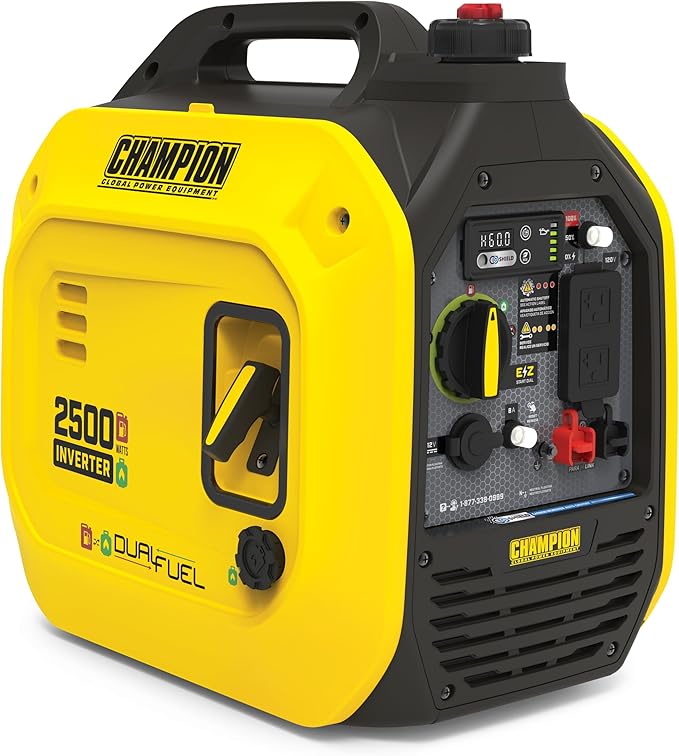
Champion Power Equipment 2500-Watt Dual Fuel Portable Inverter Generator
Check Amazon Price: Click Here
If you want the flexibility to use either gasoline or propane, the Champion 2500W Dual Fuel Inverter Generator is one of the most versatile choices in this group.
Champion’s model 201323 produces 2,500 starting watts and 1,850 running watts on gasoline, while propane provides 2,500 starting watts and 1,665 running watts. It is rated at 53 dBA from 23 feet, and Champion lists up to 11.5 hours of gasoline runtime or up to 25 hours on a 20-pound propane tank at 25% load.
That last number is important. The 25-hour propane figure is a light-load runtime rating, not an indication that the generator can run a heavy electrical load for 25 hours.
Key Features
- 2,500 starting watts
- 1,850 running watts on gasoline
- 1,665 running watts on propane
- Gasoline and propane operation
- 53 dBA noise rating from 23 feet
- Up to 11.5 hours on gasoline at 25% load
- Up to 25 hours on a 20-lb propane tank at 25% load
- CO Shield carbon monoxide shutoff system
- Less than 3% THD
- Parallel capable
- Recoil start
- 43.2-pound listed weight
- Three-year limited warranty
The inverter produces clean electricity with less than 3% THD, making it appropriate for many sensitive electronic devices when used according to the manufacturer’s instructions. Champion also includes CO Shield protection designed to automatically shut down the generator if dangerous carbon monoxide levels are detected.
Best suited for: Camping, tailgating, emergency essentials, and users who want the option of gasoline or propane.
AMERISUN 2500-Watt Gas-Powered Portable Inverter Generator
Check Amazon Price: Click Here
The AMERISUN 2500W inverter generator is aimed at buyers who want a straightforward gasoline-powered portable generator without paying for dual-fuel capability.
The original article gave this model a 69 dBA noise rating, but product specifications can vary between listings and revisions, so buyers should verify the exact Amazon listing before relying on a particular noise or runtime figure.
Its main appeal is simplicity. Gasoline is widely available throughout the United States, and there is no need to keep a separate propane cylinder available.
Key Features to Consider
- 2,500W-class inverter generator
- Gasoline powered
- Portable design
- Inverter technology
- 120V output
- Recoil starting system
- Designed for recreational and backup applications
- Suitable for electronics when the specific model’s inverter specifications support the load
One advantage of choosing a gasoline-only generator is that you can focus on a single fuel type. The trade-off is that you do not have the additional fuel option available with a dual-fuel model.
For emergency preparation, always store gasoline safely and follow local fire-safety requirements. Never refuel a hot or running generator.
Best suited for: Buyers looking for a simple gasoline-powered inverter generator for camping, outdoor work, and basic backup power.
PowerSmart 2500-Watt Portable Inverter Generator
Check Amazon Price: Click Here
PowerSmart’s 2500W inverter generator is designed around portability. Current specifications for the HB5020C list 2,500 starting watts and 1,900 running watts, with a listed weight of about 39 pounds. The manufacturer also lists up to 11 hours at 25% load and 5.5 hours at 50% load.
The model includes an ECO mode, CO protection, parallel capability, two 120V outlets, a 12V DC outlet, and USB ports.
Noise specifications should be read carefully because the manufacturer’s published figures vary with operating conditions. The current product page describes lower noise in ECO mode while also listing 69 dBA at 23 feet in its specification section.
Key Features
- 2,500 starting watts
- 1,900 running watts
- Gasoline powered
- Approximately 39 pounds
- Up to 5.5 hours at 50% load
- Up to 11 hours at 25% load
- ECO mode
- Carbon monoxide auto shutoff
- Parallel capability
- Two 120V AC outlets
- 12V DC output
- USB ports
- Under-3% THD inverter output
Its relatively low weight makes it particularly interesting for campers and users who frequently move their generator.
Best suited for: Camping, tailgating, RV-related loads, emergency essentials, and users who prioritize portability.
WEN 56250i 2500-Watt Inverter Generator
Check Amazon Price: Click Here
The WEN 56250i takes a slightly different approach by combining 2500-watt surge capability with a lightweight design.
WEN currently lists the 56250i at 2,500 surge watts and 1,900 rated watts. The generator weighs approximately 37.5 pounds, making it one of the lighter options in this category.
One feature worth paying attention to is the fuel shutoff system. Rather than simply stopping the engine with fuel remaining in the carburetor, the system is designed to use the remaining fuel before shutdown, which can help reduce stale-fuel issues during storage.
Key Features
- 2,500 surge watts
- 1,900 rated watts
- 80cc engine
- Approximately 37.5 pounds
- Clean inverter power
- Fuel shutoff
- Two 120V receptacles
- Two USB ports
- Hour meter
- Three-year warranty
The compact size and relatively low weight make the WEN particularly practical when the generator has to be loaded into an SUV, carried to a campsite, or stored between uses.
WEN also offers high-altitude kits for the 56250i, including kits covering 3,000–6,000 feet and 6,000–8,000 feet.
Best suited for: Camping, tailgating, portable backup power, electronics, and buyers who want a lightweight 2500W-class generator.
Oxseryn Portable Inverter Generator 2500W
Check Amazon Price: Click Here
The Oxseryn 2500W Portable Inverter Generator is another compact gasoline-powered option. Current product information lists 2,500 peak watts and 1,800 running watts, along with a 1.1-gallon fuel tank and up to 9.5 hours of runtime at 25% load.
That makes the load rating particularly important. At approximately 450 watts, a 9.5-hour runtime can make sense for light emergency loads, charging electronics, lighting, and similar applications. Runtime will decrease as the electrical load increases.
The model is also listed with ECO mode, parallel capability, CO protection, low-oil shutdown, and inverter output below 3% THD.
Key Features
- 2,500 peak watts
- 1,800 running watts
- 79.8cc four-stroke OHV engine
- Approximately 40 pounds
- 1.1-gallon fuel tank
- Up to 9.5 hours at 25% load
- ECO mode
- Parallel capability
- CO sensor with automatic shutdown
- Low-oil shutdown
- 120V AC outlets
- 12V DC output
- USB and USB-C connectivity
- Less than 3% THD
Best suited for: Camping, emergency preparedness, outdoor electronics, and users who want a compact gasoline inverter generator with modern connectivity.
How to Choose the Right 2500W Inverter Generator
Choosing between these generators is easier when you focus on the specifications that actually affect everyday use.
1. Check Running Watts First
This is the most important specification.
Do not build your load calculation around the advertised 2,500 peak watts. Instead, look at the generator’s running watt rating.
For example:
- Champion 201323: 1,850W running on gasoline
- PowerSmart HB5020C: 1,900W running
- WEN 56250i: 1,900W rated
- Oxseryn 2500W: 1,800W running
These numbers are much more useful when deciding what you can operate continuously.
2. Calculate Starting Watts
Motors can require significantly more power when they start.
Refrigerators, freezers, pumps, compressors, power tools, and air conditioners are common examples.
If your refrigerator requires 800W while running but briefly needs substantially more power during startup, the generator must have enough available surge capacity to handle that demand.
Never assume that two appliances can be run together simply because their running watts appear to fit within the generator’s rating.
3. Gasoline vs. Dual Fuel
A gasoline-only generator is straightforward and uses a widely available fuel.
A dual-fuel inverter generator gives you another option when gasoline is unavailable or when you prefer propane for storage.
Champion’s 201323, for example, can operate on either gasoline or propane, but its rated running wattage is lower on propane than on gasoline.
That is a good example of why fuel type should be evaluated together with output rather than separately.
4. Pay Attention to Noise Ratings
Noise is especially important for:
- Campgrounds
- National forest camping
- RV sites
- Tailgating
- Residential neighborhoods
- Overnight operation
A specification such as 53 dBA at 23 feet is more useful than simply calling a generator “quiet.” Champion, for example, specifies 53 dBA from 23 feet for its 2500W models.
Remember that engine load affects noise. A generator working harder will generally produce more noise than one operating under a light load.
5. Consider Weight
Portable generators are only truly portable if you can move them safely.
A difference of 5–10 pounds may not sound significant on paper, but it becomes noticeable when loading equipment into a truck, carrying it to a campsite, or moving it during an outage.
The WEN 56250i is listed at approximately 37.5 pounds, while PowerSmart’s current 2500W model is around 39 pounds. Champion also offers 2500W models around the 39-pound range, although model 201323 is listed at 43.2 pounds.
6. Look for Carbon Monoxide Protection
Modern portable generators increasingly include automatic CO shutdown systems.
This is a useful safety feature, but it does not make indoor generator operation safe.
A gasoline or propane generator should never be operated inside a home, garage, basement, tent, or other enclosed or partially enclosed area. Keep exhaust away from doors, windows, vents, and other openings.
CO protection should be considered an additional safety feature, not a replacement for safe generator placement and a working carbon monoxide alarm.
7. Check Parallel Capability
Parallel operation allows compatible inverter generators to work together to provide more power.
This can be useful if your needs change over time. Instead of replacing a smaller inverter generator immediately, you may be able to connect another compatible unit using the manufacturer’s approved parallel equipment.
Champion, for example, provides a parallel-kit selector for compatible inverter models.
Always verify compatibility before purchasing a parallel kit. Not every inverter generator can be connected to every other generator.
Is a 2500W Generator Enough for an RV?
It can be, but the answer depends heavily on the RV’s electrical loads.
A 2500W-class inverter generator can be useful for:
- Refrigerator operation
- Battery charging
- Interior lighting
- Electronics
- Fans
- Small appliances
- Television
- Laptop charging
The biggest question is usually the RV air conditioner.
A small RV air conditioner may have a substantial startup requirement, and the generator’s available running and surge watts must be compared with the air conditioner’s specifications.
If the air conditioner has a high starting demand, a 2500W generator may struggle even if the air conditioner’s normal running wattage appears acceptable.
For RV use, check the air conditioner’s starting watts and running watts before buying.
Is a 2500W Generator Good for Home Backup?
A 2500W inverter generator is better viewed as a small emergency power source, not a whole-house generator.
It can be very useful during a short outage for keeping selected essentials running, such as:
- Refrigerator
- Freezer
- Internet equipment
- Phones
- Laptops
- LED lighting
- Fans
- Small medical or electronic equipment when the equipment’s power requirements are compatible
It is not designed to power an entire modern house with central HVAC, electric water heating, kitchen appliances, and other large loads simultaneously.
For home backup, make a list of the appliances you actually need during an outage and calculate both their running and starting watt requirements.
Inverter Generators vs. Conventional Portable Generators
The biggest advantage of an inverter generator is not simply portability.
Inverter generators are designed to produce stable electrical output and can adjust engine speed according to electrical demand. Many models also use ECO modes to reduce fuel consumption and noise when the load is low.
This makes them particularly attractive for camping, RVs, electronics, and situations where noise matters.
Traditional open-frame generators can make more sense when you need significantly more power for construction equipment, large tools, or high-demand backup applications.
A 2500W inverter generator is therefore best thought of as a portable, efficient power source for moderate electrical loads, rather than a smaller version of a whole-house generator.
2500W Portable Inverter Generator Safety Tips
Always follow the owner’s manual for your specific model.
Important practices include:
- Operate the generator outdoors.
- Keep it well away from occupied buildings.
- Point exhaust away from people and structures.
- Never use a generator inside a garage, even with the garage door open.
- Keep gasoline and propane away from ignition sources.
- Turn the generator off and allow it to cool before refueling.
- Use properly rated extension cords when extension cords are necessary.
- Keep the generator dry and protected from rain according to the manufacturer’s instructions.
- Do not overload the generator.
- Monitor carbon monoxide alarms.
- Perform oil changes and other maintenance according to the owner’s manual.
A CO shutdown system is an important additional protection, but it should never be treated as permission to operate a portable generator indoors.
Which 2500W Inverter Generator Should You Buy?
The right choice depends on what you value most.
Champion 2500W Dual Fuel
A strong option if fuel flexibility is your priority. Its gasoline/propane capability, 53 dBA rating, CO Shield, and parallel capability make it versatile for recreational use and emergency essentials.
AMERISUN 2500W
A reasonable option for buyers who prefer a simple gasoline-powered inverter generator. Because specifications can vary by listing, verify the exact model’s runtime, noise rating, running watts, and safety features before ordering.
PowerSmart 2500W
A practical choice when portability and a 1,900W running rating are important. The current model is listed at about 39 pounds and includes CO protection and parallel capability.
WEN 56250i
Worth considering if low weight and storage convenience are priorities. At about 37.5 pounds, it is one of the lighter options in this comparison, while still offering 2,500 surge watts and 1,900 rated watts.
Oxseryn 2500W
A compact alternative for users interested in longer light-load runtime and multiple charging options. Its published 9.5-hour runtime is based on a 25% load, so actual runtime will depend on how much power you draw.
Final Thoughts on the Best 2500W Portable Inverter Generators in 2026
A 2500W portable inverter generator can be an excellent middle ground between a small personal generator and a much larger portable unit.
The key is to look beyond the 2,500W number.
If you need dual-fuel flexibility, Champion offers gasoline and propane operation. If low weight is your priority, the WEN 56250i is particularly compact. PowerSmart combines a lightweight design with 1,900 running watts and CO protection, while Oxseryn offers a compact gasoline-powered option with a 1,800W running rating.
Before purchasing, calculate your actual electrical load, including startup surges. Then compare running watts, starting watts, runtime at a stated load, noise level, weight, fuel type, CO protection, and parallel capability.
For camping and recreational use, portability and noise may matter most. For emergency backup, runtime, fuel availability, and safety features deserve more attention. For RV use, the starting requirements of your air conditioner and other motor-driven equipment should be checked before making a decision.
A 2500W inverter generator will not power everything in a house or RV at once, but when matched to the right load, it can provide a practical source of portable electricity when you are away from the grid or dealing with a short power outage.