As an Amazon Associate I earn from qualifying purchases.
A remote start generator can make a major difference when you need backup power but don’t want to walk outside every time the generator needs to be started or stopped. During a storm, winter outage, or late-night power failure, being able to start a generator with a wireless key fob is more than a convenience—it can make backup power much easier to manage.
The best remote start generators for 2026 range from compact inverter models designed for RVs and camping to larger generators capable of powering essential household circuits during an outage. Some also add dual-fuel capability, clean inverter power, CO shutdown protection, and transfer-switch compatibility.
In this guide, I’ll compare five remote-start generators and explain what to look for before buying one.
Best Remote Start Generators in 2026
| Generator | Best For | Power | Fuel | Generator Type |
|---|---|---|---|---|
| Westinghouse iGen4000DFc | RVs and portable backup | 4,000 peak / 3,300 running W | Gas/Propane | Inverter |
| Champion 4500W Wireless Start | RV and camping | 4,500 peak / 3,500 running W | Gasoline | Inverter |
| Westinghouse iGen5000 | Quiet portable backup | 5,000 peak / 3,900 running W | Gasoline | Inverter |
| Westinghouse WGen5300 | Home and RV backup | 6,600 peak / 5,300 running W | Gasoline | Conventional |
| Westinghouse WGen9500DF | Higher-output home backup | 12,500 peak / 9,500 running W | Gas/Propane | Conventional |
Important: Generator specifications, availability, and Amazon pricing can change. Check the current product listing before purchasing.
1. Westinghouse 4000W Dual Fuel Inverter Generator
Check Amazon Price Click Here!
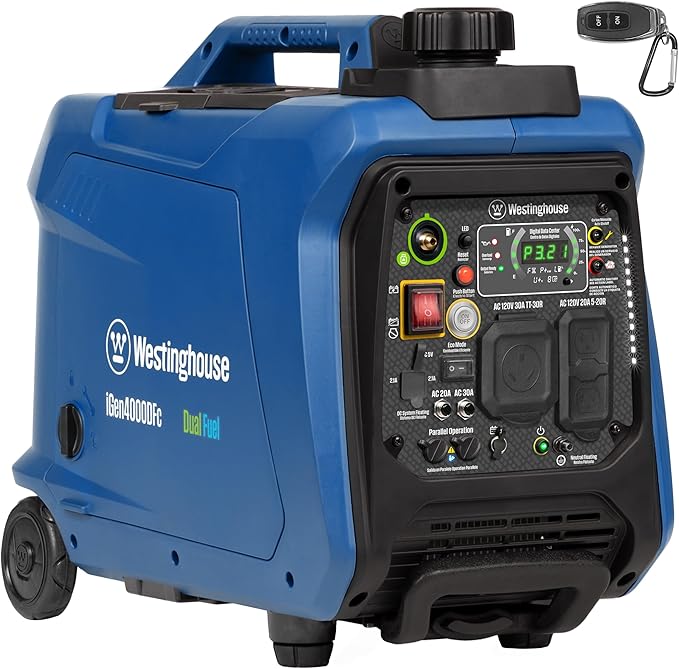
If you want a relatively compact generator with remote start, inverter power, and dual-fuel capability, the Westinghouse iGen4000DFc is a strong option.
It produces up to 4,000 peak watts and 3,300 running watts on gasoline, while its dual-fuel design lets you use either gasoline or propane. Westinghouse also lists a TT-30R RV-ready outlet, making this model particularly interesting for RV owners.
Key Specifications
- Peak Power: 4,000 watts
- Running Power: 3,300 watts
- Fuel: Gasoline or propane
- Type: Inverter generator
- Weight: About 62.8 lbs
- Starting: Wireless remote, push-button, and recoil
- RV Outlet: TT-30R
- CO Protection: Automatic CO shutdown
Why It Stands Out
The biggest advantage is the combination of portability and remote start. At roughly 63 pounds, this is considerably easier to move than many large open-frame generators.
The inverter design also makes it appropriate for sensitive electronics, while the variable-speed engine can reduce fuel consumption and noise when the electrical load is lower.
The dual-fuel capability is another practical advantage. If gasoline becomes difficult to obtain during an extended outage, propane gives you another option.
Best For
- RV owners
- Camping
- Tailgating
- Essential home backup
- Buyers who want dual-fuel flexibility
- Users who prioritize portability
Keep in Mind
A 3,300-watt running capacity is not enough for every home. Large central air-conditioning systems, electric water heaters, electric ranges, and other high-demand appliances may require considerably more capacity.
For those applications, moving up to a 5,000W or larger generator makes more sense.
2. Champion 4500W Wireless Remote Start Inverter Generator
Check Amazon Price Click Here!
The Champion 4500W Wireless Start Inverter Generator is one of the more practical choices if you want wireless remote starting without moving into the much larger 9,000W-plus generator class.
The current Champion 201324 produces 4,500 starting watts and 3,500 running watts and can be started or stopped from up to 80 feet away with its wireless key fob.
Key Specifications
- Starting Power: 4,500 watts
- Running Power: 3,500 watts
- Fuel: Gasoline
- Type: Inverter generator
- Remote Range: Up to 80 feet
- Noise: 61 dBA at 23 feet
- Runtime: Up to 14 hours at 25% load
- RV Outlet: 120V 30A TT-30R
- CO Protection: CO Shield automatic shutdown
Why It Stands Out
The 80-foot wireless remote is the feature that makes this generator particularly useful.
You can keep the generator outside in its proper operating location and start or stop it without walking directly to the control panel. That’s especially useful during bad weather.
Champion also includes Quiet Technology, Economy Mode, Cold Start Technology, and Clean Power with less than 3% THD.
The generator is also parallel capable, so a compatible second Champion inverter can be used when additional capacity is required.
Best For
- RVs
- Camping
- Tailgating
- Emergency backup for essential loads
- Buyers who want a true wireless remote
- Users who don’t need whole-home capacity
Keep in Mind
This is still a 120V portable inverter generator. It is not a substitute for a large 120/240V home-backup generator if you need to power major 240V loads.
3. Westinghouse 5000W Inverter Generator
Check Amazon Price Click Here!
The Westinghouse iGen5000 moves into a higher power class while keeping the advantages of an enclosed inverter design.
It provides 5,000 peak watts and 3,900 running watts, with wireless remote start and push-button electric start. Westinghouse also lists an RV-ready TT-30R outlet, USB ports, and up to 18 hours of runtime at 25% load.
The current iGen5000c version adds automatic carbon monoxide shutdown while retaining the 5,000/3,900-watt output and remote-start configuration.
Key Specifications
- Peak Power: 5,000 watts
- Running Power: 3,900 watts
- Fuel: Gasoline
- Type: Inverter generator
- Remote Start: Wireless key fob
- Runtime: Up to 18 hours at 25% load
- RV Outlet: TT-30R
- Noise: As low as 52 dBA
- THD: Less than 3%
Why It Stands Out
This generator sits in an interesting middle ground.
It’s more capable than a typical 3,000- to 4,000-watt portable inverter but is still considerably more compact than a large open-frame home-backup generator.
The variable-speed engine adjusts output according to electrical demand, helping reduce fuel consumption and noise when the generator isn’t operating under a heavy load. Westinghouse also lists a telescoping handle and wheels for easier transportation.
Best For
- Home emergency backup
- RVs
- Camping
- Refrigerators and freezers
- Internet equipment
- Lights and smaller appliances
- Sensitive electronics
Keep in Mind
The gasoline-only configuration may be less attractive if you want the flexibility of propane during a prolonged outage.
Westinghouse also sells an iGen5000DFc dual-fuel version, which adds gasoline/propane operation while retaining remote start and inverter technology.
4. Westinghouse 6600W Home Backup Generator
Check Amazon Price Click Here!
The generator originally described simply as the “Westinghouse 6600W Home Backup Generator” is the Westinghouse WGen5300.
It produces 6,600 peak watts and 5,300 running watts and includes both push-button electric start and a remote-start key fob. Westinghouse also lists 120/240V capability and a 120V TT-30R RV outlet.
Key Specifications
- Peak Power: 6,600 watts
- Running Power: 5,300 watts
- Fuel: Gasoline
- Type: Conventional portable generator
- Engine: 274cc 4-stroke OHV
- Runtime: Up to 14.5 hours at 25% load
- Starting: Electric and wireless remote
- Voltage: 120/240V
- RV Ready: Yes
Why It Stands Out
This is where the article’s original selection becomes much more useful for homeowners.
The WGen5300 has considerably more capacity than the smaller inverter models and adds 120/240V output, making it better suited to home backup applications involving larger loads.
It is also rated to run for up to 14.5 hours at 25% load on its 4.7-gallon gasoline tank.
A dual-fuel version, the WGen5300DFc, is also available with gasoline/propane operation and remote start.
Best For
- Home backup
- RVs
- Sump pumps
- Well pumps
- Refrigerators and freezers
- Larger essential loads
- Users who need 120/240V output
Keep in Mind
This is not an enclosed inverter generator like the iGen models above. It is larger, heavier, and generally better suited to home backup than quiet campground use.
5. Westinghouse 12500W Dual Fuel Generator
Check Amazon Price Click Here!
If you need substantially more power, the Westinghouse WGen9500DF moves into the high-output portable generator category.
It produces up to 12,500 peak watts and 9,500 running watts on gasoline, with propane output rated at 11,200 peak and 8,500 running watts. The generator supports both remote and electric start and is designed for home backup applications.
Key Specifications
- Gasoline Peak Power: 12,500 watts
- Gasoline Running Power: 9,500 watts
- Propane Peak Power: 11,200 watts
- Propane Running Power: 8,500 watts
- Fuel: Gasoline or propane
- Engine: 457cc 4-stroke OHV
- Tank: 6.6 gallons
- Runtime: Up to 12 hours at 25% load
- Starting: Remote and electric
- Voltage: 120/240V
Why It Stands Out
This is the option for buyers who have substantially greater power requirements than a typical RV or camping generator can handle.
The combination of 120/240V output, dual-fuel operation, remote start, and transfer-switch compatibility makes it much more appropriate for serious home backup applications.
For even more capacity, Westinghouse’s current lineup also includes larger models such as the WGen10500DFc, which is rated at up to 13,500 peak and 10,500 running watts on gasoline.
Best For
- Larger homes
- Extended outages
- High-demand essential loads
- Home backup systems
- Users who want propane as a backup fuel
- 120/240V applications
Keep in Mind
A generator this large is heavy and is not intended to be carried around like a small inverter generator.
You also need to plan carefully for how it will connect to your home’s electrical system. A properly sized transfer switch or other approved connection method is essential for a safe installation.
What Is a Remote Start Generator?
A remote start generator uses a wireless key fob or another remote-control system to start and stop the engine without requiring you to stand next to the generator.
That is different from electric start.
With electric start, you press a button on the generator itself. With wireless remote start, you can operate the starter from a distance.
For example, the Champion 4500W model provides wireless starting and stopping from up to 80 feet away.
This distinction matters because some product listings use phrases such as “electric start” prominently even when the generator does not include a true wireless remote.
If remote operation is the reason you’re buying the generator, verify that the product specifically includes a wireless remote key fob.
Why Remote Start Is Useful
1. You Don’t Have to Go Outside During Bad Weather
The biggest advantage is simple.
If the generator is correctly positioned outside and a storm is passing through, you can start it without walking through rain or snow to reach the control panel.
2. It Is Convenient During Long Outages
If you are using the generator for several days, remote start makes routine operation easier.
You may need to stop the generator before refueling and restart it afterward. A remote makes the process more convenient.
3. It Works Well for RVs
For RV owners, a remote-start inverter can be especially convenient when the generator is positioned outside the RV.
The Champion 4500W and Westinghouse iGen models, for example, combine remote starting with RV-friendly outlets.
4. You Can Keep the Generator Outside
Remote starting should never be interpreted as permission to operate a generator indoors.
Portable generators must be operated outdoors in a safe location because of carbon monoxide and exhaust hazards. CO shutdown technology is an additional safety feature, not a replacement for proper placement and ventilation.
Remote Start vs. Electric Start: What’s the Difference?
| Feature | Electric Start | Wireless Remote Start |
|---|---|---|
| Start from generator | Yes | Yes |
| Start from a distance | No | Yes |
| Requires starter battery | Usually | Yes |
| Useful during bad weather | Somewhat | Excellent |
| Wireless key fob | No | Yes |
| Best for | Easy local starting | Convenient remote operation |
Remote start is essentially an additional layer of convenience on top of electric starting.
It does not automatically mean the generator will detect a utility outage and start by itself.
How to Choose the Best Remote Start Generator
1. Calculate Your Required Running Watts
Don’t choose a generator based only on its peak-wattage number.
First determine the appliances you actually want to run simultaneously.
For example, you might need power for:
- Refrigerator
- Freezer
- Internet modem and router
- Lights
- Television
- Security system
- Sump pump
- Furnace blower
- Window air conditioner
Starting watts can be substantially higher than running watts because motors often require additional power when they start.
The generator should have enough running capacity for your normal load and enough starting capacity for appliances with high startup demand.
2. Decide Whether You Need an Inverter Generator
Inverter generators are generally attractive for RVs, camping, electronics, and situations where lower noise is important.
The Westinghouse iGen5000, for example, uses inverter technology and produces less than 3% THD, making it suitable for sensitive electronics.
Larger conventional generators can provide more power for the money, but they are usually larger and less focused on quiet operation.
3. Consider Dual-Fuel Operation
A dual-fuel generator can operate on gasoline or propane.
That flexibility can be valuable during extended outages because you don’t have to rely exclusively on gasoline.
The Westinghouse iGen4000DFc, WGen5300DFc, and WGen9500DF are examples of remote-start generators that offer gasoline/propane flexibility.
4. Check the Remote Range
Don’t assume every wireless remote has the same range.
Some manufacturers publish a specific distance. Champion, for example, rates the 4500W model and the 11,000W 201407 model at up to 80 feet.
Walls, doors, other structures, and interference can affect practical range.
5. Don’t Ignore the Starting Battery
Remote start depends on the generator’s electric-start system.
If the starting battery is discharged after sitting unused for months, the wireless remote may not be able to start the generator.
This is one of the most overlooked issues with remote-start generators. Current buying guides specifically point out that maintaining the starter battery is important for reliable remote operation.
For emergency preparedness, periodically test the generator and follow the manufacturer’s battery-maintenance recommendations.
6. Look for CO Protection
Carbon monoxide is one of the most important safety concerns with portable generators.
Modern generators may use automatic CO shutdown systems such as Champion’s CO Shield. Westinghouse also offers models with automatic CO shutdown.
However, CO protection does not make indoor operation safe.
Always follow the manufacturer’s placement requirements and keep exhaust away from doors, windows, vents, and occupied areas. Consumer Reports recommends looking for recognized safety certifications such as ANSI/UL 2201 or ANSI/PGMA G300.
Do You Need a Transfer Switch?
If you only want to run individual appliances, you can often use properly rated extension cords connected directly to the generator.
If you want to power circuits through your home’s electrical panel, you need an appropriate connection method such as a transfer switch or approved interlock system.
A transfer switch prevents the generator and utility power from being connected to the home’s wiring at the same time. This is a critical safety issue because improper backfeeding can endanger utility workers and damage electrical equipment.
A portable generator with remote start is not automatically a whole-house automatic standby system.
If you want the generator to detect an outage, start automatically, and transfer your home’s electrical load without someone operating it, you are looking at a different type of backup-power system.
For a panel connection, have the system evaluated and installed by a qualified electrician.
Remote Start Generator Safety Tips
Remote start makes operation easier, but it doesn’t eliminate the basic safety requirements.
Always operate the generator outdoors
Never operate a gasoline or propane portable generator inside a house, garage, basement, shed, or other enclosed space.
Keep exhaust away from openings
Position the generator so exhaust cannot enter through doors, windows, vents, or other openings.
Check the oil regularly
Low oil can damage the engine, and many generators include an automatic low-oil shutdown.
Maintain the starter battery
A remote start system is only useful if the battery has enough charge to operate the starter.
Keep fuel stored safely
Follow local requirements and the manufacturer’s instructions for gasoline and propane storage.
Test the generator before an emergency
Don’t wait for a major storm to discover that the battery is dead, the fuel is stale, or the remote isn’t working.
Maintenance Tips for Remote Start Generators
A remote-start generator still requires the same basic maintenance as other portable generators.
Check the battery
Because the starter battery is directly connected to the remote-start function, battery maintenance deserves special attention.
Change the oil
Follow the manufacturer’s recommended oil-change intervals rather than relying on a generic schedule.
Inspect the air filter
A dirty air filter can reduce engine performance and increase fuel consumption.
Check the spark plug
Inspect and replace the spark plug according to the manufacturer’s maintenance schedule.
Manage stored gasoline
If gasoline will remain in the tank for an extended period, follow the manufacturer’s recommendations for fuel stabilization and storage.
Run the generator periodically
A generator that sits unused for an entire year is not something you want to test for the first time during a blackout.
Best Remote Start Generator for Different Uses
| Generator | Best Use | Main Advantage |
|---|---|---|
| Westinghouse iGen4000DFc | RV and camping | Compact dual-fuel inverter |
| Champion 4500W | RV and essential backup | 80-ft wireless remote |
| Westinghouse iGen5000 | Quiet backup | 3,900 running watts and inverter technology |
| Westinghouse WGen5300 | Home/RV backup | 5,300 running watts and 120/240V |
| Westinghouse WGen9500DF | High-output home backup | 9,500 running watts and dual fuel |
Which Remote Start Generator Should You Buy?
The right generator depends on how you plan to use it rather than simply choosing the model with the highest wattage.
For RVs and camping
The Westinghouse iGen4000DFc is attractive if portability, inverter power, remote start, and dual-fuel capability are priorities.
For a smaller wireless remote-start generator
The Champion 4500W Wireless Start Inverter is a practical choice. Its 80-foot remote range, RV-ready outlet, inverter technology, and 3,500 running watts make it useful for recreational and essential backup applications.
For quieter 5,000-watt-class backup
The Westinghouse iGen5000 provides more running capacity while retaining the compact inverter format and remote-start convenience.
For larger home backup requirements
The Westinghouse WGen5300 offers 5,300 running watts and 120/240V capability, making it much better suited to larger household loads than the smaller inverter models.
For high-output backup power
The Westinghouse WGen9500DF is the choice among these five if you need significantly more capacity and want the flexibility of gasoline or propane.
Final Thoughts
The best remote start generators in 2026 are not necessarily the generators with the highest wattage. The better choice depends on your power requirements, fuel preferences, noise tolerance, portability needs, and how you plan to connect the generator to your home or RV.
For camping and RV use, a compact inverter generator can provide a useful combination of clean power, lower noise, and wireless starting.
For home backup, a larger 120/240V generator may be a better fit, especially if you need to run pumps, appliances, or other higher-demand equipment.
The most important thing is to look beyond the words “remote start.” Check the actual running wattage, starting wattage, fuel type, remote range, battery system, CO protection, outlets, and transfer-switch compatibility before buying.
A remote-start generator can make an outage much easier to manage—but only when the generator is properly sized, maintained, and operated safely.