As an Amazon Associate I earn from qualifying purchases.
Choosing the right generator for your RV comes down to more than the number printed on the box. A generator that powers your lights and charges your batteries may still struggle to start a rooftop air conditioner. Buy too much capacity, and you could end up carrying extra weight, burning more fuel than necessary, and spending money on power you rarely use.
The right approach to RV generator sizing is to calculate the appliances you plan to run at the same time, account for the highest starting surge, and leave enough reserve capacity for changing conditions.
As a general starting point, a small camper without air conditioning may work well with a 2,000-watt-class generator. Many RVs with one rooftop air conditioner need approximately 3,000 to 4,500 running watts, while larger motorhomes with two air conditioners may require 6,000 to 8,000 watts or more. These are planning ranges, not guarantees; your appliances and generator specifications determine the actual requirement.
This guide explains how to calculate your RV’s power needs, choose between generator sizes, understand 30-amp and 50-amp connections, and avoid common sizing mistakes before you buy.
RV Generator Sizing Starts With Running and Starting Watts
Every electrical item has a running watt requirement, which is the power it uses after it is operating. Motor-driven appliances also have a higher starting-watt requirement. Air conditioners, refrigerators, microwaves, water pumps, and power tools can briefly draw much more power when they first cycle on.
A generator must handle both figures. If its continuous output is below your normal combined load, it will overload. If its surge rating cannot cover a motor starting, it may trip its breaker or shut down even though the appliance’s listed running wattage looks acceptable.
Use the appliance label, owner manual, or a plug-in watt meter to build a realistic load estimate. When only amps are listed, use this calculation:
Watts = volts x amps
Most RV appliances use 120 volts. A device rated at 5 amps uses roughly 600 watts. This is useful for estimating small loads, although appliance labels and measured wattage are more reliable than assumptions.
Do not total every appliance in the RV. Add the loads that will realistically operate together. Your air conditioner and microwave may overlap at lunch. The hair dryer, toaster, and electric space heater could also overlap, but running all three on generator power is usually a choice to avoid, not a requirement to size around.
Estimate Your Real RV Power Demand
A typical travel trailer or motorhome can have loads like these:
- A 13,500 BTU air conditioner may use about 1,300 to 1,800 running watts and 2,500 to more than 3,500 starting watts.
- A 15,000 BTU air conditioner often needs about 1,500 to 2,000 running watts, with a potentially larger startup surge.
- A microwave commonly draws 1,000 to 1,500 input watts, even when its cooking output is listed lower.
- A coffee maker, hair dryer, toaster, or electric skillet can each consume roughly 800 to 1,800 watts.
- A converter or battery charger may draw 300 to 1,000 watts, depending on battery state and charger size.
- RV lighting, fans, a water pump, televisions, and device chargers typically add modest loads, but they still count.
Here is a practical one-air-conditioner example. Assume your AC runs at 1,500 watts, the converter draws 500 watts, a refrigerator is on electric at 300 watts, and small electronics and lights use 200 watts. Your normal load is about 2,500 watts. Add a microwave at 1,200 watts and you are at 3,700 watts. The generator also needs enough surge capacity to start the AC compressor.
That points many owners toward a generator rated around 4,000 running watts, or a paired inverter setup with similar continuous output. A 2,200-watt inverter generator can be excellent for quiet battery charging and low-demand camping, but it generally is not the right standalone choice for a conventional rooftop AC.
Match Generator Capacity to Your RV Setup
There is no single generator size for every RV. The number of air conditioners, the size of the electrical service, and how you camp matter more than RV length alone.
Small campers and low-demand travel
Pop-up campers, teardrops, and small trailers without air conditioning often do well with 1,800 to 2,500 running watts. A compact inverter model such as the Honda EU2200i class is easy to move, fuel-efficient at lighter loads, and suitable for charging batteries, running a small microwave, or powering basic campsite equipment. Confirm that the RV’s converter and any high-draw appliances fit within its limits.
One-air-conditioner RVs
For a single 13,500 or 15,000 BTU air conditioner, 3,000 to 4,500 running watts is the practical range for many owners. A quiet 4,500-watt dual-fuel inverter generator, such as models offered in the Champion class, can provide useful headroom for the AC plus everyday loads. Actual results depend on the AC unit, altitude, heat, and whether a soft starter is installed.
Large fifth wheels and two-AC motorhomes
Two rooftop air conditioners often call for 5,500 to 7,500 or more running watts, especially if you expect to use kitchen appliances and charge a substantial battery bank. A built-in RV generator may be the cleanest solution for frequent travel, while two parallel-capable inverter generators can work for owners who want portability and quieter operation. Parallel operation requires compatible units and the correct manufacturer-approved parallel kit.
→ Compare RV-Ready Generators by Wattage
Choose a generator that matches your RV’s running load, startup surge, and preferred fuel before making a purchase.
A Soft Starter Can Change the Math
An air-conditioner soft starter reduces the compressor’s startup demand. It does not make the AC dramatically cheaper to run, but it can lower the brief surge that causes smaller generators to stumble.
For some RVs, this means a quality 2,200- to 3,000-watt inverter generator can start an AC that previously required a larger machine. That can be valuable for boondockers who prioritize low noise and easy lifting. Still, verify the generator’s continuous rating against the AC running load and other appliances. A soft starter is not permission to overload a generator for long periods.
Leave Headroom Instead of Running at the Limit
A generator performs best when it is not constantly pinned at maximum output. As a rule, plan to keep expected continuous loads at roughly 70 to 80 percent of the generator’s rated running watts. This reserve helps with refrigerator and water-pump cycling, hot-weather air-conditioner demand, and the gradual power loss that occurs at higher elevations.
Avoid choosing based on peak watts alone. A generator advertised as “4,500 watts” may have a lower continuous rating, such as 3,500 watts. The continuous figure is the one that determines what it can sustain through a long afternoon of cooling.
Altitude and temperature deserve attention. Gasoline engines produce less power as elevation rises, and extreme heat can add stress to both the generator and air conditioner. If you routinely camp in the mountains or desert heat, more capacity is a sensible margin rather than an unnecessary upgrade.
Check the RV Connection Before You Buy
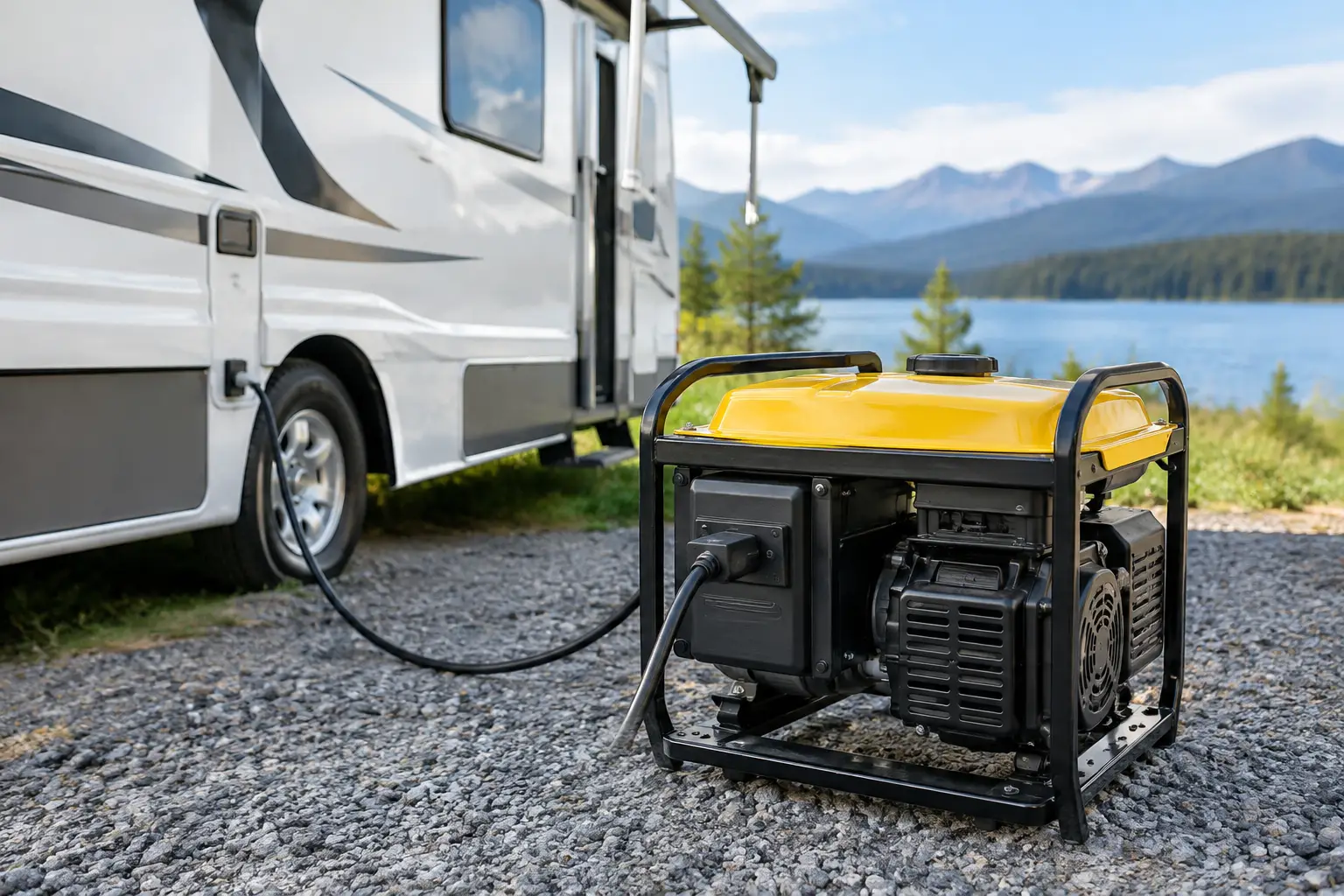
Generator output is only part of the system. Your RV may have a 30-amp TT-30 inlet or a 50-amp 14-50 connection. A 30-amp RV service supplies up to 3,600 watts at 120 volts. A 50-amp RV service has two 120-volt legs and can support far more power, but that does not mean every portable generator can supply its full capability.
Use an RV-rated adapter when needed, not a random household extension cord and plug combination. A 30-amp RV cord, a compatible dogbone adapter, and the generator’s correctly rated outlet should match the generator’s output. For longer runs, use a properly sized cord to limit voltage drop. Undersized cords can heat up, reduce appliance performance, and create a fire risk.
If you are connecting a generator to a home-style inlet box or transfer equipment for another use, confirm neutral bonding requirements with the equipment manuals and a qualified electrician. RVs, portable generators, transfer switches, and bonding plugs are not interchangeable by guesswork.
Fuel, Noise, and Portability Are Part of the Decision
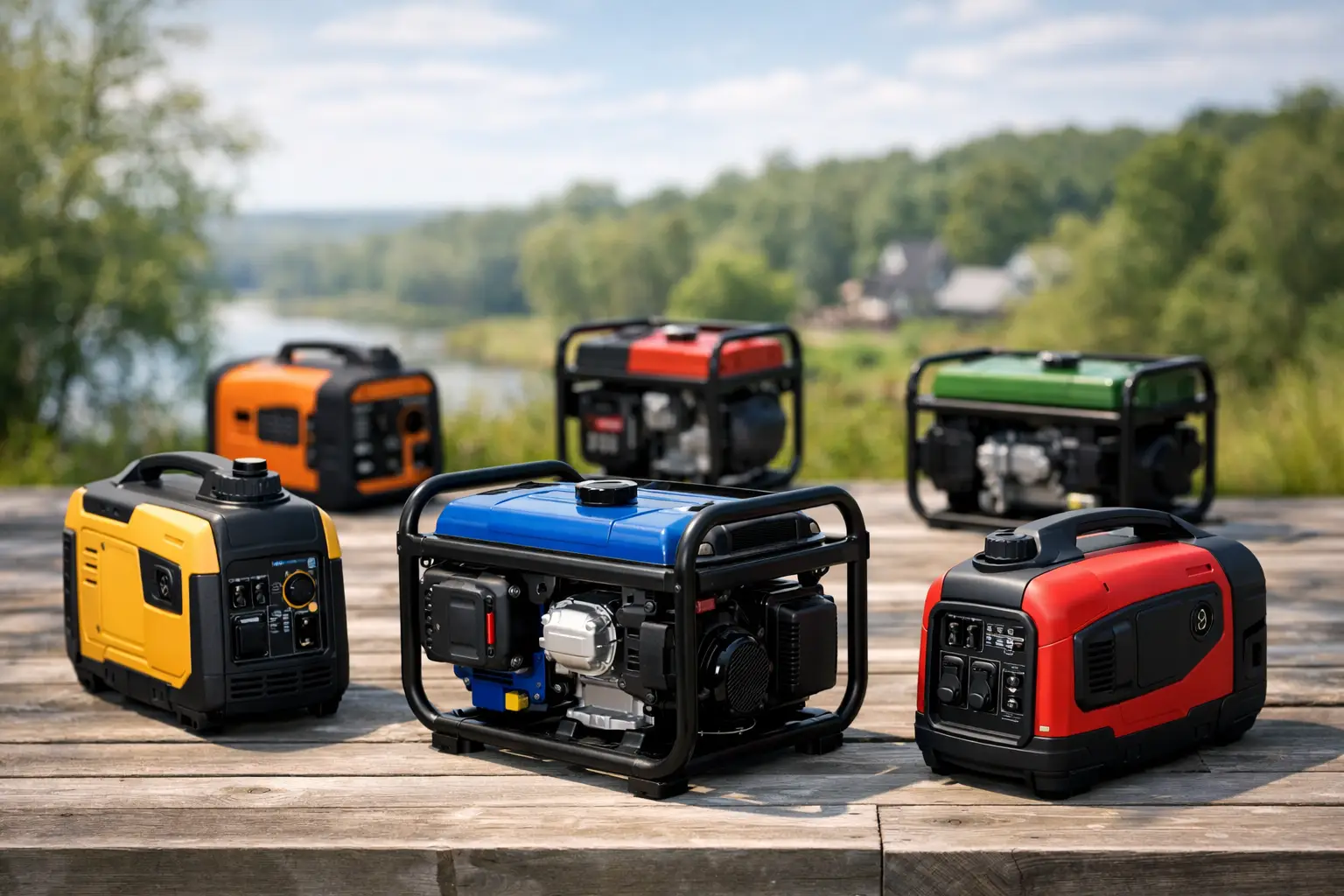
Two generators with similar wattage can suit very different owners. Inverter generators are generally quieter, more fuel-efficient at partial load, and safer for sensitive electronics. They are usually the better fit for campgrounds and dispersed sites where noise matters.
Conventional open-frame generators often provide more watts per dollar and can make sense for occasional high-demand use. Their trade-off is higher noise, heavier fuel consumption, and less neighbor-friendly operation. Never operate any generator inside an RV, garage, enclosed storage bay, or near open windows. Place it outdoors on stable ground, follow campground spacing rules, and use a functioning carbon monoxide detector inside the RV.
Dual-fuel capability can add flexibility. Propane stores well and is convenient when your RV already carries cylinders, while gasoline usually offers higher available output and broader refueling access. Check the running-watt rating on propane specifically, because many generators produce less power on propane than on gasoline.
→ Check Prices on Quiet Dual-Fuel Inverter Generators
Compare noise ratings, gasoline and propane output, portability, and RV-compatible outlets to find a model that fits your camping setup.
Make the Final Choice From Your Highest Likely Load
Before purchasing, write down your largest realistic combination of appliances. Include the air conditioner, converter, refrigerator setting, microwave, and any appliances your family uses routinely. Compare that number to the generator’s running watts, then confirm that its surge rating can start the largest motor load.
The right RV generator is not the biggest unit on the shelf. It is the one that starts your essential equipment reliably, works with your cords and adapters, and leaves enough margin that a normal camping morning does not turn into a breaker-reset routine.
Frequently Asked Questions About RV Generator Sizing
What size generator do I need to run an RV air conditioner?
Many RVs with one rooftop air conditioner use a generator in the 3,000–4,500 running-watt range. The correct size depends on the AC’s running demand, startup surge, other appliances, and generator ratings. A compatible soft starter may allow a smaller generator to start some air conditioners, but you must verify the actual specifications.
Will a 2,000-watt generator run my RV?
A 2,000-watt-class generator can be suitable for lights, electronics, battery charging, and other modest loads. Running a rooftop air conditioner is more complicated because the compressor may need more startup power than the generator can provide. A soft starter may help in certain setups, but compatibility and the total running load must be checked first.
Is a 3,500-watt generator enough for a 30-amp RV?
It may be enough for a 30-amp RV with one compatible air conditioner and carefully managed appliance use. However, the generator’s running-watt rating, startup capacity, and the AC’s requirements determine whether it will work reliably. A 30-amp RV service has a theoretical maximum capacity of 3,600 watts at 120 volts.
Can a 50-amp RV run on a 30-amp generator?
Yes, some 50-amp RVs can operate from a suitable 30-amp generator using a correctly rated adapter. However, the available power is limited by the generator and connection, and the RV’s two electrical legs may not receive power in the same way as they would from a full 50-amp source. Verify compatibility before connecting the equipment.
Does a soft starter reduce the generator size I need?
A soft starter can reduce an air conditioner’s startup surge, potentially allowing a smaller generator to start the compressor. It does not eliminate the AC’s normal running demand or increase the generator’s continuous output. You still need sufficient capacity for the air conditioner and every other appliance operating at the same time.
Is an inverter generator better for RV camping?
An inverter generator is often a good choice when quiet operation, portability, and fuel efficiency at lighter loads are priorities. A conventional generator may offer more power for the price. The better option depends on your required wattage, noise restrictions, weight limits, fuel preferences, and budget.
The Bottom Line on RV Generator Sizing
The best RV generator is not necessarily the biggest or the most expensive. It is the model that can handle your realistic continuous load, start your largest motor-driven appliance, and work safely with your RV’s electrical connection.
Start with the air conditioner if you have one, add the appliances you expect to use simultaneously, and verify both running and starting watts. Leave a sensible reserve, account for altitude and temperature, and check the output available on your preferred fuel.
With those numbers in hand, you can compare generators based on actual requirements instead of guessing from the wattage printed on the box. That makes it easier to choose a generator that fits your RV, your camping style, and your budget without paying for unnecessary capacity.
Compare RV-Ready Generators by Wattage
Choose a generator that matches your RV’s running load, startup surge, and preferred fuel before making a purchase.
→ Check PriceCheck Prices on Quiet Dual-Fuel Inverter Generators
Compare noise ratings, gasoline and propane output, portability, and RV-compatible outlets to find a model that fits your camping setup.
→ Check Price