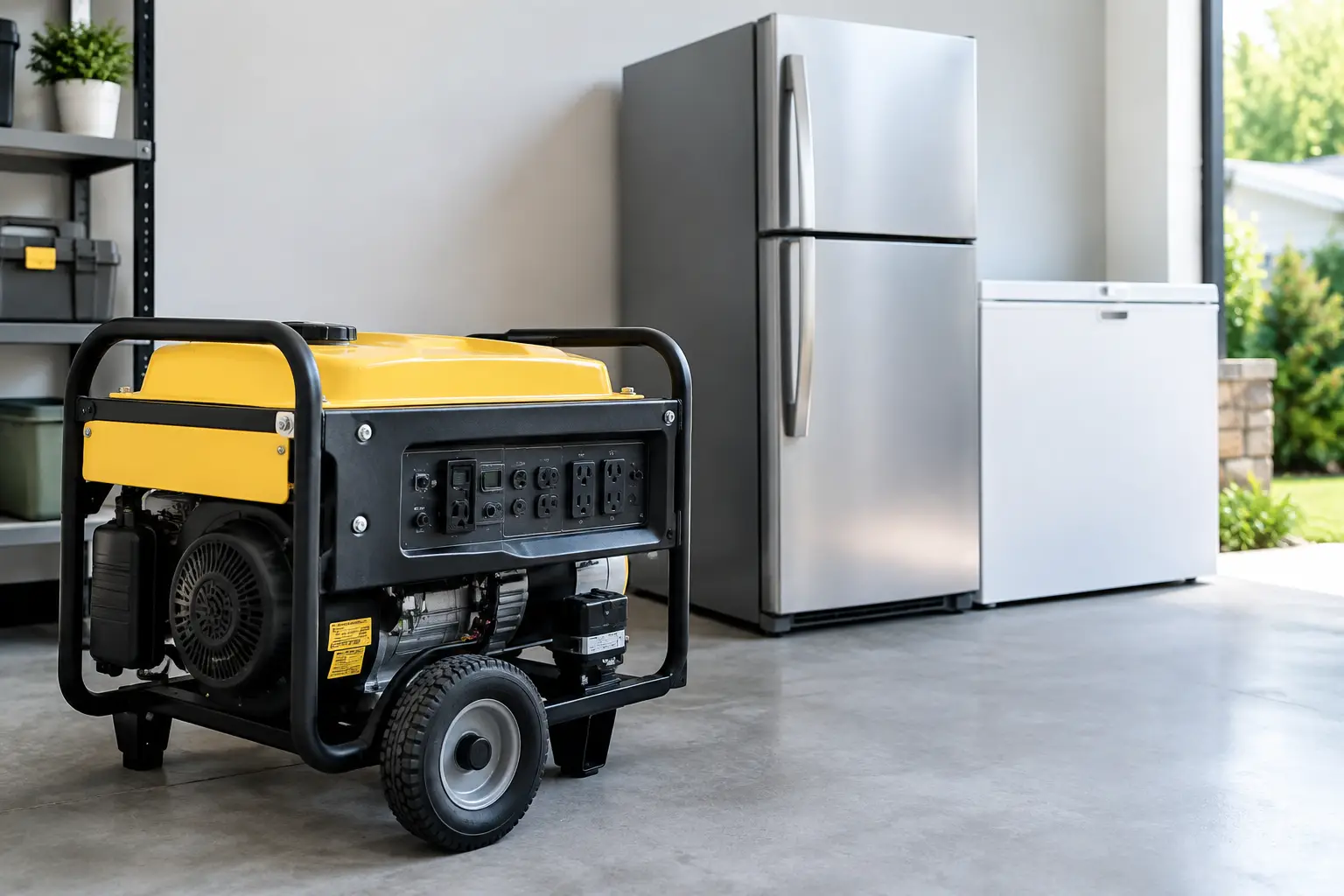
When the power goes out, a refrigerator is one of the first appliances most homeowners want to keep running. A freezer is just as important if you have hundreds of dollars of food stored inside. The challenge is choosing a generator that can handle the compressor’s startup demand without buying far more capacity, fuel, noise, and equipment than you actually need.
The best generators for refrigerators and freezers are not necessarily the largest models. For a single refrigerator, a compact inverter generator in the 2,000- to 2,500-watt class can be a practical starting point. If you want to run a refrigerator and freezer at the same time, or add lights, a furnace blower, a sump pump, or other essentials, stepping up to a 2,500- to 4,500-watt generator may make more sense.
→ Compare portable generators by starting watts, running watts, fuel type, and noise level to find a model that fits your refrigerator and freezer backup needs.
The important thing is to look at both running watts and starting watts. Refrigerator and freezer compressors can require a temporary surge when they start, and that startup demand is what can overload an undersized generator.
How Much Generator Power Does a Refrigerator Need?
Most modern refrigerators use roughly 100 to 800 running watts, depending on size, age, compressor type, ice maker use, and defrost cycle. The brief surge when the compressor starts can be two to three times the running demand. A refrigerator that normally uses 600 watts may need 1,200 watts or more for a moment at startup.
For a refrigerator by itself, look for a generator with at least 2,000 starting watts and about 1,600 to 1,800 running watts. That gives useful room for startup variation and avoids operating the generator constantly at its limit. A compact 1,000-watt unit may run some smaller refrigerators, but it leaves little margin and can trip its overload protection when the compressor cycles.
The appliance label, owner’s manual, or a plug-in watt meter gives you a better answer than estimates. Measure running watts, then account for the highest startup demand. If you are powering more than one appliance, add their running watts and make sure their combined startup demands will not exceed the generator’s surge rating.
6 Best Generators for Refrigerators and Freezers
These models cover the most common refrigerator backup situations, from a single fridge in an apartment or RV to a portable generator supporting several home essentials. Specifications and included outlets can change by model year, so verify the current manual before buying.
| Generator | Best fit | Main trade-off |
|---|---|---|
| Honda EU2200i | Premium single-fridge backup | Higher purchase price |
| Champion 2500-Watt Dual Fuel Inverter | Fuel flexibility for fridge or RV | Less capacity for major household loads |
| WEN 56235i | Budget-friendly refrigerator backup | Fewer premium refinements |
| Westinghouse iGen4500DF | Fridge plus freezer and small essentials | Larger and heavier than compact units |
| Generac GP6500 COsense | Several home circuits or larger loads | Louder conventional-generator operation |
| DuroMax XP13000HX | Transfer-switch backup with major loads | Far more capacity than one refrigerator needs |
Honda EU2200i for quiet, long-term ownership
The Honda EU2200i is a strong choice when your priority is dependable, quiet power for one refrigerator, a freezer, and modest electronics. Its inverter design produces stable power, and its 2,200-watt peak output gives most household refrigerators a comfortable startup cushion.
It is especially appealing for homeowners who expect occasional outages but also want one generator for camping or travel. The drawback is cost. You are paying for a well-established reputation, compact design, and refined operation rather than the lowest dollars per watt.
Champion 2500-Watt Dual Fuel Inverter for propane readiness
Champion’s 2500-watt dual-fuel inverter generator is a sensible middle ground for people who want to store propane for emergencies. Propane does not degrade in the same way gasoline can, which makes it useful for a generator that may sit unused for months.
Its output is suitable for a refrigerator and several light-duty loads, but do not treat it as a whole-house solution. Propane operation usually delivers slightly less power than gasoline, so preserve extra capacity if your refrigerator has a high startup draw or if you will add a chest freezer.
WEN 56235i for lower-cost fridge protection
The WEN 56235i offers a practical route to inverter power without the premium price of some competing portable models. With 2,350 surge watts and 1,900 rated watts, it has enough headroom for many refrigerators and a few essentials such as LED lights, a phone charger, or an internet modem.
This is a good example of buying to the load. For a refrigerator-only plan, spending thousands on a high-output open-frame generator usually does not improve your outcome. A smaller inverter unit is easier to move, uses less fuel at light loads, and is more pleasant to live with outside a bedroom window.
→ Compare compact inverter generators for a quieter refrigerator backup setup, especially if you only need to power a fridge, a few lights, and small electronics.
Westinghouse iGen4500DF for multiple cold-storage loads
The Westinghouse iGen4500DF is worth considering when the refrigerator is only the first priority. Its higher inverter-generator output can support a refrigerator, freezer, lights, a modem, and selected kitchen loads while retaining useful startup margin.
Dual-fuel capability adds flexibility, and the larger fuel capacity can reduce refueling interruptions during a multi-day outage. It is still portable, but it is no longer a lightweight carry-and-go unit. Plan for storage space, safe lifting, and an appropriate outdoor operating location.
Generac GP6500 COsense for essential home circuits
A Generac GP6500 COsense makes more sense for a home that needs to keep a refrigerator running alongside a sump pump, furnace blower, or other heavier essentials. Its conventional open-frame design provides substantially more output than a compact inverter generator and can be paired with properly installed home power equipment.
The trade-off is noise, size, and fuel use. It is not the ideal generator for quietly running one refrigerator overnight, but it can be a practical value when several loads must run at the same time. If you use a transfer switch or panel interlock, have the connection method designed and installed correctly.
DuroMax XP13000HX for larger backup plans
The DuroMax XP13000HX belongs in a different category. It is for households building a broader portable-generator backup plan that may include refrigeration, a well pump, select kitchen circuits, and HVAC-related loads. For refrigerator duty alone, it is excessive.
That does not make it a poor choice. It can be the right choice for rural homes or properties with a 240-volt well pump, provided you calculate motor starting loads carefully. Its size also means more fuel, more storage needs, and more attention to safe connection equipment such as an inlet box and generator cord.
→ Compare higher-output portable generators if your backup plan includes a refrigerator, a freezer, a well pump, or other essential household loads that need additional starting-watt capacity.
Choose the Generator Around Your Actual Backup Plan
Start by deciding what must stay powered for the first 24 hours. A refrigerator-only plan is simple. A refrigerator, freezer, modem, lights, CPAP machine, and sump pump plan needs a worksheet and more reserve capacity. Well pumps and furnace blowers deserve special attention because motors can create high startup loads.
Inverter generators are usually the better fit for a refrigerator-focused setup. They automatically reduce engine speed at lighter loads, tend to be quieter, and generally produce cleaner power for electronics. A conventional generator can offer more watts per dollar, which is valuable when the backup plan includes several large loads.
Fuel choice matters as much as wattage. Gasoline offers full output and is widely available, but it requires rotation and proper storage. Propane is easier to store for long periods and works well for emergency preparedness, though it can reduce available output. Dual-fuel models give you options, not unlimited capacity.
Use the Right Cord and Connection Method
A generator can be correctly sized and still fail to protect your food if the cord or connection setup is wrong. For direct refrigerator use, choose a heavy-duty outdoor-rated extension cord with three conductors and a grounding plug. A 12/3 cord is a dependable all-purpose choice for a typical refrigerator circuit, particularly when the cord run is longer. Keep it as short as practical and inspect it for heat damage, cuts, or loose connections.
Never run a generator indoors, in a garage, under a carport, or near open doors and windows. Operate it outdoors well away from the home, with exhaust directed away from occupied areas. Carbon monoxide shutoff is useful protection, but it is not permission to place a running generator too close to the house.
For powering household circuits, do not use a dryer outlet, improvised adapter, or any backfeeding method. Use a listed transfer switch or a panel interlock installed for your electrical system, plus a properly rated inlet box and generator cord. Neutral bonding and ground-fault protection can affect compatibility, so follow the generator and transfer-equipment instructions instead of removing a bonding connection based on internet advice.
A refrigerator generator is most valuable when it starts easily after months of waiting. Test it under load several times a year, rotate fuel, change oil on schedule, and keep a compatible cord and fuel supply stored with it. When the power fails, that preparation is what keeps a simple appliance from becoming an expensive loss.
Final Verdict: What Is the Best Generator for a Refrigerator?
For a single refrigerator, the Honda EU2200i is an excellent premium choice, while the Champion 2500 Dual Fuel and WEN 56235i offer useful alternatives.
For a refrigerator and freezer, the Westinghouse iGen2800 offers a particularly useful combination of 2,200 running watts, 2,800 peak watts, compact size, and inverter technology.
If your refrigerator and freezer are only part of a larger emergency-power plan, the Westinghouse iGen4500DF or Generac GP6500 makes more sense.
The most important lesson is simple: do not size a generator based only on the refrigerator’s running watts. Check the appliance’s starting demand, add the loads you actually plan to operate at the same time, and leave reasonable capacity for startup.
That approach gives you a generator that can keep your food cold without paying for far more power than you need.