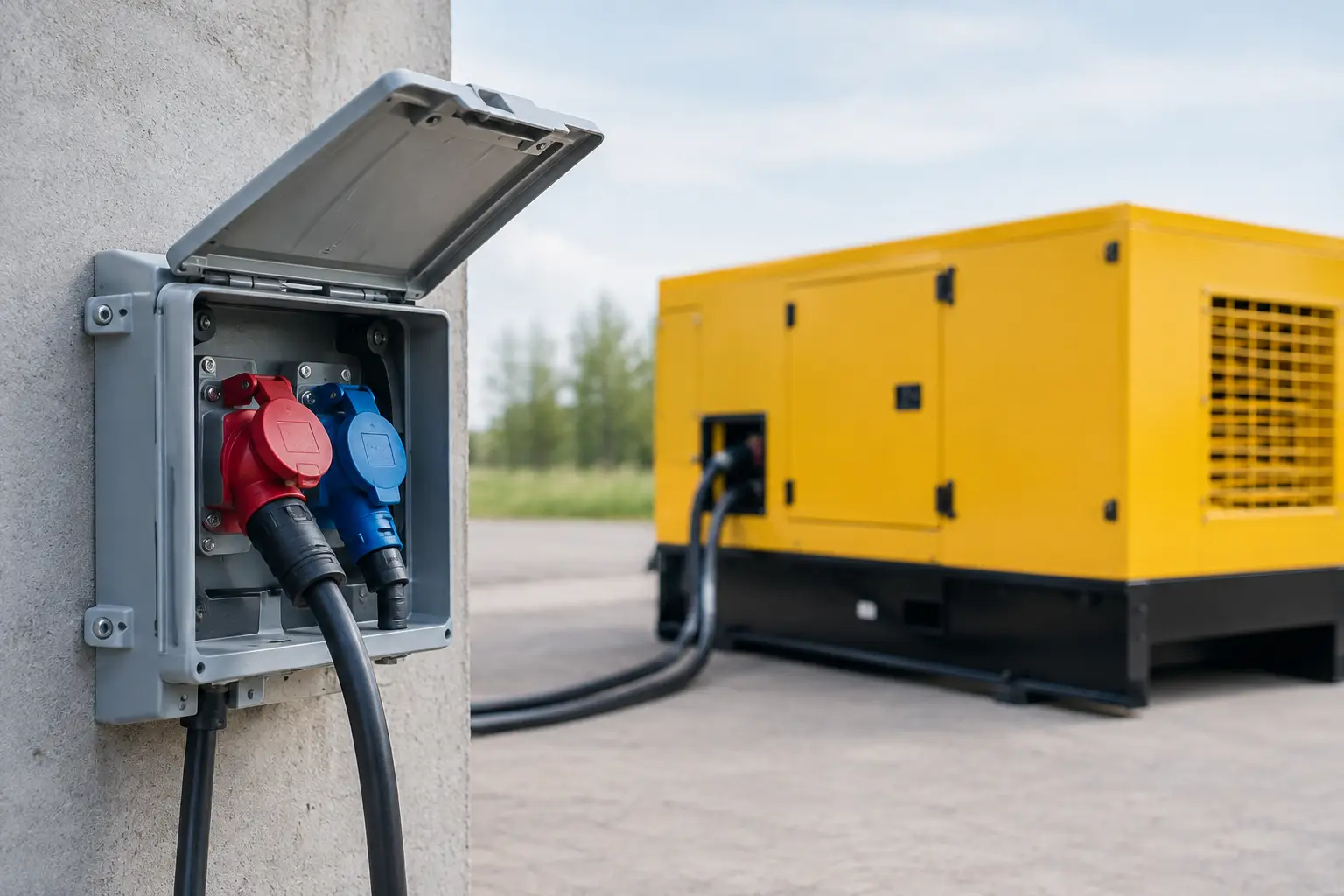
A generator inlet box gives a portable generator a dedicated connection point outside your home. Instead of running a generator cord through a window or door, the cord plugs into the exterior inlet box, which is wired to a manual transfer switch, generator-ready panel, or compatible panel interlock.
The important part is that the inlet box is only one piece of the system. The generator outlet, generator cord, inlet box, wiring, transfer equipment, and planned electrical loads all need to match.
Choose the wrong amperage or connector configuration and you can end up with an inlet that does not match your generator or cannot support the way you intend to use backup power.
This guide explains what to look for when choosing a generator inlet box, including 30-amp and 50-amp options, NEMA configurations, weather protection, cord compatibility, and installation considerations.
What an Inlet Box Does – and Does Not Do
An inlet box is a weather-resistant power entry point. It has recessed male prongs on the exterior of the house, garage, shed, or RV pedestal. A generator cord with female ends connects the generator’s outlet to those prongs. From there, properly sized building wire carries power to a manual transfer switch, generator-ready load center, or listed panel interlock arrangement.
That recessed design matters. The generator energizes the cord only after it is connected to the generator, while the inlet’s prongs are protected inside the enclosure. A standard receptacle is designed to provide power outward. An inlet is designed to receive power safely.
An inlet box does not switch your home between utility and generator power. It does not increase generator output, manage loads, or make an unsafe connection safe by itself. The transfer equipment is what isolates utility power from generator power. Without that isolation, generator electricity can travel onto utility lines and endanger line workers, damage equipment, and create a fire risk.
Match the Inlet Box to Your Generator
The best inlet is determined by the generator output, the transfer equipment, and the cord as one system. Start with the generator’s owner manual and inspect its generator-ready outlet. Do not choose by appearance alone. Several locking plugs look similar but use different blade configurations.
30-amp 120/240-volt connections
For many homeowners with a portable generator in the 5,000- to 8,000-watt range, a 30-amp, 120/240-volt locking connection is the practical choice. The common configuration is NEMA L14-30. At its rated maximum, a 30-amp 120/240-volt connection can carry up to 7,200 watts, although your generator’s rated running watts may be lower.
A product such as the Reliance Controls PB30 is built around this familiar 30-amp locking format. It can make sense for a small transfer switch serving essential circuits such as a refrigerator, furnace blower, well pump if starting load allows, lighting, and a few outlets. The final load plan still matters more than the inlet label.
50-amp 120/240-volt connections
A 50-amp inlet is often used with larger portable generators and generator-ready panels. It is commonly paired with a NEMA 14-50 connection, though you should verify both sides of the cord and inlet before ordering. A 50-amp, 120/240-volt circuit has a theoretical capacity of 12,000 watts, but it does not mean every generator connected to it can deliver that much power.
The larger connection offers more room for a house with heavier planned loads, multiple branch circuits, or a larger well pump and HVAC strategy. It also requires appropriately sized wiring, a compatible transfer switch or interlock, and a generator with a suitable outlet. Using a 50-amp inlet with a 30-amp generator does not create extra capacity. The generator remains the limiting factor.
120-volt generator considerations
Many inverter generators used for camping, tailgating, and light RV duty provide 120 volts only. They are excellent for quiet operation, electronics, and modest appliance loads, but they cannot supply 240-volt equipment such as most deep-well pumps, central air conditioners, or electric ranges.
A 120-volt inlet setup can still be useful for a small shed, workshop, travel trailer, or selected 120-volt household circuits. The transfer equipment must be designed for that application. Never assume a 120-volt generator can run a standard 120/240-volt home transfer setup as intended.
Look Beyond Amperage When Comparing Inlet Boxes
Amperage and plug type narrow the field, but several construction details affect whether an inlet holds up during an outage.
A weatherproof, corrosion-resistant enclosure is worth prioritizing, especially where rain, snow, coastal air, or high humidity are normal. Look for a spring-loaded cover that closes securely around the connected cord, and check the enclosure’s listed weather rating. Metal boxes are common and durable, while quality nonmetallic options can resist corrosion. Either can work when properly listed and installed.
Placement also affects real-world usability. A box mounted near the generator’s planned location reduces the need for an excessively long, expensive cord. At the same time, the generator must remain outdoors, away from doors, windows, vents, and attached garages to reduce carbon monoxide risk. Do not place the inlet where connecting the cord requires standing in pooled water, crossing a walkway, or stretching the cord across a driveway.
A power inlet should be listed by a recognized testing laboratory and rated for the voltage and amperage of the installation. Be cautious with vague marketplace listings that do not clearly identify their NEMA configuration, enclosure rating, wiring terminals, or listing information. A lower upfront price is not a good trade for a component that becomes part of your home’s emergency power path.
The Cord, Transfer Switch, and Inlet Must Agree
Generator accessories are often sold separately, which is where compatibility mistakes happen. The generator outlet, generator cord, inlet box, transfer switch, and branch-circuit plan should all be checked together.
For example, an L14-30 generator outlet needs an L14-30 generator cord and an L14-30 inlet, not a 50-amp twist-lock product that merely looks close. The cord must also be rated for outdoor use and for the circuit amperage. A light-duty household extension cord is not a substitute for a generator inlet cord.
Transfer switches offer an organized way to choose specific circuits, while panel interlocks can offer more flexibility when installed on a compatible panel. Neither approach is automatically better. A transfer switch is straightforward for homeowners who only want to run a fixed list of essentials. An interlock can be useful where a qualified electrician confirms panel compatibility and the owner understands how to manage loads during an outage.
If a well pump is part of the plan, check more than its running wattage. Motors can require a substantial surge at startup. The generator must handle that surge while other loads are running, and the transfer equipment must support the pump’s voltage and circuit requirements. The same caution applies to sump pumps, air compressors, refrigerators, and some RV air conditioners.
Installation Is a Safety Job, Not a Shortcut
Installing an inlet box typically involves exterior mounting, conduit or cable routing, grounding and bonding considerations, breaker sizing, and connection to transfer equipment. Local electrical rules apply, and permits may be required. For most homeowners, this is work for a licensed electrician rather than a weekend experiment.
Before the electrician arrives, decide what you want to power and where the generator will run. Share the generator model, outlet type, running and starting wattage, and any large loads such as a well pump or furnace. This helps prevent a costly mismatch between the installed inlet and the generator you actually own.
Ask how neutral handling and generator bonding will be addressed for your specific equipment. Portable generators vary: some have a bonded neutral and others a floating neutral. The correct arrangement depends on the transfer equipment and installation method. Do not add a bonding plug or alter generator wiring based on a generic online tip.
After installation, practice the procedure before an emergency. With utility power available, review how to shut off utility power through the transfer equipment, start the generator outdoors, connect the cord, energize selected circuits, and manage loads. Then practice the shutdown sequence. A calm test run makes a storm outage far less confusing.
When a Different Setup Makes More Sense
An inlet box is ideal when you want to power selected home circuits from a portable generator. It may be unnecessary for a camping setup where appliances plug directly into the generator, or for an RV that already has an appropriate shore-power connection. For a jobsite, heavy-duty extension cords and temporary power distribution may be the more practical approach.
For households that need automatic operation, longer runtime, and whole-home coverage, a permanently installed standby generator with an automatic transfer switch is a different category of solution. It costs more and requires professional installation, but it avoids the manual fueling and connection steps of a portable generator setup.
The right inlet box is the one that fits your generator, cord, load plan, and transfer equipment without compromises or improvised adapters. Treat it as part of a complete backup-power system, and it will give you a clean, repeatable way to use portable power when you need it most.
Frequently Asked Questions Do I need a generator inlet box for a portable generator?
You need an appropriate inlet when you want to connect a portable generator to a home’s electrical system through an exterior connection. The inlet works with the generator cord and transfer equipment. It is not required when appliances are being connected directly to the generator.
What size generator inlet box do I need?
The inlet should match the generator outlet, cord, voltage, amperage and transfer equipment. Common residential configurations include 30-amp L14-30 connections and several 50-amp configurations. Check the generator’s exact receptacle before buying.
Can I use a 50-amp inlet with a 30-amp generator?
A 50-amp inlet does not increase the generator’s output. Compatibility depends on the generator outlet, cord, transfer equipment and wiring. If the generator only provides a 30-amp output, the system remains limited by that source.
What is an L14-30 inlet?
An L14-30 is a four-wire locking configuration commonly used for 30-amp, 120/240-volt generator connections. It is designed to mate with a compatible generator cord and inlet. Always verify the exact receptacle on the generator.
Does a generator inlet box prevent backfeeding?
No. The inlet provides the connection point, but source isolation comes from properly installed transfer equipment, such as a compatible transfer switch or listed panel interlock.
Can I install a generator inlet box myself?
Installation involves electrical wiring, protection, grounding, bonding and transfer equipment. For that reason, installation is generally best handled by a qualified electrician in accordance with applicable electrical codes and the manufacturer’s instructions.
How far should a portable generator be from the house?
Follow current safety guidance and the generator manufacturer’s instructions for placement. Portable generators should be operated outdoors and well away from doors, windows and vents to reduce carbon monoxide exposure.
Final Takeaway
The best generator inlet box is not necessarily the one with the highest amperage or the lowest price.
It is the one that matches your generator outlet, generator cord, voltage, transfer equipment and electrical load plan.
For many mid-size portable generators, a 30-amp L14-30 system is a practical solution. Larger generators may use 50-amp connections, but the exact connector configuration needs to be verified rather than assumed.
Before buying, check the generator receptacle, choose a compatible outdoor-rated inlet and cord, and make sure the transfer equipment provides proper isolation from utility power.
When those pieces are designed as one system, a generator inlet box provides a much cleaner and more dependable way to connect portable backup power when the grid goes down.