As an Amazon Associate I earn from qualifying purchases.
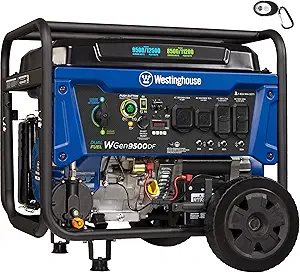
A 10,000-watt generator can be a practical middle ground between a small portable generator and a permanently installed whole-house standby system. With enough capacity for major appliances, power tools, RV equipment, and many home essentials, generators in the 10,000-watt class are popular with homeowners who want substantial backup power without committing to a permanent installation.
There is one important detail to understand before comparing models: 10,000 watts does not always mean 10,000 running watts.
Many generators marketed as 10,000-, 11,000-, 12,000-, or 13,000-watt models advertise their higher starting or peak wattage, while their continuous rated output is considerably lower. For example, the Westinghouse ecoGen10000 produces 10,000 peak watts but 7,600 rated watts.
That difference matters when you’re trying to determine whether a generator can actually run your air conditioner, refrigerator, sump pump, well pump, furnace, or other high-demand appliances at the same time.
For this 2026 guide, I’m comparing several generators around the 10,000-watt class, including larger portable models that make sense for homeowners who need additional starting capacity.
Quick Comparison: 10000-Watt Generators
| Model | Fuel | Running Watts | Peak Watts | Starting System | Best Use |
|---|---|---|---|---|---|
| Westinghouse 12500 Watt Dual Fuel | Gas/Propane | 9,500 gas | 12,500 gas | Remote/Electric | Home backup |
| WEN DF1100T | Gas/Propane | 8,300 gas | 11,000 gas | Electric | Home backup and job sites |
| Westinghouse ecoGen10000 | Gasoline | 7,600 | 10,000 | Electric/Remote | Cleaner inverter power |
| DuroMax XP13000EH | Gas/Propane | 10,500 gas | 13,000 gas | Electric | High-demand home backup |
| Generac Guardian 10kW | Natural Gas/LP | 10,000 | — | Automatic | Automatic standby backup |
The first four are portable generators, while the Generac Guardian is a permanently installed standby system. That distinction is important because a standby generator is designed to work with an automatic transfer switch and can start automatically when utility power fails.
Westinghouse 12500 Watt Dual Fuel Portable Generator
Check Amazon Price Click Here!
The Westinghouse 12500 Watt Dual Fuel Generator is designed for homeowners who want substantial portable backup power without moving to a permanently installed standby generator.
Although it is commonly grouped with 10,000-watt generators, its gasoline output is actually higher than 10,000 watts at startup. The important numbers are 9,500 running watts and 12,500 peak watts on gasoline, while propane output is lower.
That makes this type of generator particularly useful when several household appliances need to operate at the same time and some of them have significant startup demands.
The dual-fuel design is another practical advantage. Gasoline provides higher output, while propane gives you another fuel option that can be useful for emergency preparedness and longer-term storage.
Westinghouse’s current portable generator lineup also includes newer models such as the WGen10500DFc, which produces 10,500 rated watts and up to 13,500 peak watts on gasoline.
Key Specs
- Fuel: Gasoline and propane
- Gasoline output: 9,500 running / 12,500 peak watts
- Propane output: 8,500 running / 11,200 peak watts
- Voltage: 120/240V
- Starting: Electric and remote start
- Transfer switch ready: Yes
- Fuel tank: 6.6 gallons
- Engine: 457cc 4-stroke OHV
What I Like About It
The biggest advantage is the combination of high output and dual-fuel flexibility. It is powerful enough for serious home backup but remains portable compared with a permanently installed standby generator.
The remote start is also useful during bad weather because you don’t necessarily have to stand next to the generator to start it.
What to Consider
This is still a large portable generator. At this power level, portability means wheels and handles rather than something you casually move around by yourself.
It also requires proper outdoor placement and a safe connection method if you want to supply circuits in your home.
WEN DF1100T 11,000-Watt Dual Fuel Portable Generator
Check Amazon Price Click Here!
The WEN DF1100T is one of the more straightforward options in this category. It produces 11,000 surge watts and 8,300 running watts on gasoline, while propane output is rated at 9,500 surge watts and 7,500 running watts.
That makes it a good example of why shoppers should look at the running-watt rating instead of judging a generator only by the large number in its product name.
The DF1100T uses a 457cc four-stroke OHV engine and includes electric start. Its 6.6-gallon tank provides up to 8.5 hours of runtime at half load according to WEN.
The generator also provides 120V/240V operation and includes a 50A NEMA 14-50R outlet, making it suitable for certain home backup configurations when connected through an appropriately installed transfer switch or other code-compliant equipment.
Key Specs
- Fuel: Gasoline and propane
- Gasoline output: 8,300 running / 11,000 peak watts
- Propane output: 7,500 running / 9,500 peak watts
- Engine: 457cc 4-stroke OHV
- Starting: Electric
- Voltage: 120/240V
- Fuel tank: 6.6 gallons
- Runtime: Up to 8.5 hours at 50% load
- 50A outlet: Yes
- Warranty: 2 years
What I Like About It
The DF1100T is easy to understand. You get dual-fuel capability, electric start, 120/240V output, a large fuel tank, and a wheel-and-handle kit without moving into the more complicated territory of a permanently installed generator.
It’s also useful for more than emergency backup. The same basic power capacity can be useful on a job site or for larger outdoor projects.
What to Consider
Its 8,300 running watts on gasoline is significantly different from its advertised 11,000 peak watts. If you are planning to power several large appliances simultaneously, calculate your actual continuous load before buying.
WEN also offers a high-altitude kit for the DF1100T for operation from 2,000 to 7,000 feet, which can be relevant for users living at higher elevations.
Westinghouse ecoGen10000 Inverter Generator
Check Amazon Price Click Here!
The Westinghouse ecoGen10000 is the most interesting option in this group for shoppers who specifically want inverter technology rather than a traditional open-frame generator.
It produces 10,000 peak watts and 7,600 running watts, with total harmonic distortion below 3%. Westinghouse also lists a CO sensor with automatic shutdown, remote key-fob starting, electric start, and transfer-switch readiness.
The inverter design is useful when you want cleaner electrical output for electronics while still having enough capacity for substantial household loads.
The generator has a 5.28-gallon gasoline tank and is rated for up to 12 hours of runtime at 25% load. Westinghouse lists its operating volume as low as 79 dBA, depending on operating conditions.
Key Specs
- Fuel: Gasoline
- Running watts: 7,600
- Peak watts: 10,000
- Engine: 420cc 4-stroke OHV
- Technology: Inverter
- THD: Less than 3%
- Starting: Electric and remote key fob
- Fuel tank: 5.28 gallons
- Runtime: Up to 12 hours at 25% load
- CO sensor: Yes
- Voltage: 120/240V
- Transfer switch ready: Yes
- Weight: Approximately 148 lbs
Why Choose an Inverter Generator?
An inverter generator can be attractive when you’re concerned about the quality of the electrical output and want a generator that can handle sensitive electronics.
The ecoGen10000 also has a more manageable weight than many of the larger traditional generators in this comparison.
The tradeoff is output. At 7,600 running watts, it provides less continuous power than some of the larger 12,000- and 13,000-watt-class portable generators.
For that reason, I would not choose it simply because the name says “10,000 watts.” The 7,600-watt running rating is the number you should use when calculating your continuous electrical load.
DuroMax XP13000EH 13,000-Watt Dual Fuel Generator
Check Amazon Price Click Here!
The DuroMax XP13000EH moves beyond the traditional 10,000-watt class, but it makes sense in this comparison because many shoppers searching for a 10,000-watt generator are actually looking for enough capacity to handle large household loads.
Its 13,000-watt peak capacity gives it additional headroom for appliances and equipment with demanding startup requirements.
The closely related DuroStar DS13000E is rated at 13,000 peak watts and 10,500 running watts, with a 500cc engine, 120/240V output, a 50A outlet, and an 8.3-gallon fuel tank. DuroMax currently lists the XP13000EH as its dual-fuel version.
Key Specs
- Fuel: Gasoline and propane
- Gasoline output: Up to 10,500 running / 13,000 peak watts
- Voltage: 120/240V
- Starting: Electric start
- Transfer switch compatible: Yes
- Engine: 500cc class
- Construction: Heavy-duty metal frame
- Fuel tank: Large-capacity tank
- Use: Home backup, job sites and outdoor power
Why Consider the XP13000EH?
The main reason is simple: more continuous power and more starting capacity.
If your home has a large central air conditioner, well pump, sump pump, refrigerator, freezer, electric appliances, or other equipment with significant startup requirements, having additional generator capacity can make load management easier.
However, more power also means more fuel consumption, more weight, and more space required for storage.
This is not the type of generator you buy because you want something small and easy to carry. It is better suited to users who prioritize power capacity.
Generac Guardian 10kW Home Standby Generator
Check Amazon Price Click Here!
The Generac Guardian 10kW is fundamentally different from the portable generators above.
Instead of being stored in a garage and rolled outside when the power fails, the Guardian is a permanently installed standby generator designed to remain outside your home and automatically provide backup power when utility electricity is interrupted.
Generac’s current 10kW Guardian model with a 16-circuit transfer switch is designed to provide essential-circuit protection and includes Wi-Fi-enabled Mobile Link monitoring. Generac also lists a five-year limited warranty and True Power technology with less than 5% total harmonic distortion.
Key Specs
- Generator type: Automatic standby
- Rated output: 10kW
- Fuel: Natural gas or LP
- Starting: Automatic
- Transfer switch: Included with the referenced configuration
- Remote monitoring: Mobile Link
- Power quality: Less than 5% THD
- Warranty: 5-year limited warranty
- Installation: Professional installation required
Portable vs. Standby: What’s the Difference?
This is one of the most important decisions you’ll make.
A portable generator requires you to take it out of storage, position it outdoors, connect the appropriate equipment, and start it.
A standby generator is installed ahead of time. When utility power fails, the transfer equipment can automatically move the selected circuits to generator power.
That convenience comes at a much higher initial installation cost.
The Generac 10kW is therefore not necessarily a direct alternative to the portable generators in this article. It is an option for homeowners who want an automatic backup system rather than manually operated emergency power.
How Much Can a 10000-Watt Generator Run?
This is a better question than simply asking how many watts a generator has.
A generator’s ability to run your appliances depends on their running wattage and starting wattage.
For example, a refrigerator may consume relatively modest power while running but briefly require significantly more power when its compressor starts.
The same principle applies to:
- Central air conditioners
- Window air conditioners
- Well pumps
- Sump pumps
- Refrigerators
- Freezers
- Furnaces
- Power tools
- Compressors
- Electric water pumps
A generator rated at 10,000 peak watts and 7,600 running watts should generally be sized according to the 7,600-watt continuous rating, not the 10,000-watt peak figure.
Before purchasing, make a list of the appliances you actually need during an outage and add their running wattage. Then account for the startup requirements of equipment with motors or compressors.
Are 10000-Watt Generators Good for Whole-House Backup?
They can be, but the answer depends heavily on the house.
A 10,000-watt-class portable generator can handle many essential household circuits, but that does not automatically mean it can run every electrical appliance in a modern home simultaneously.
A home with gas appliances and moderate electrical demand may have very different requirements from a home with an electric furnace, electric water heater, large central air conditioner, well pump, electric range, and other high-load equipment.
That’s why the generator’s running wattage and your home’s actual electrical load are more important than the product’s headline wattage.
For larger electrical loads, a 12,000- or 13,000-watt-class portable generator can provide additional capacity.
For automatic whole-home or essential-circuit backup, a permanently installed standby generator may make more sense.
Dual Fuel vs. Gasoline Generators
Dual-fuel generators give you the ability to operate using gasoline or propane.
That flexibility can be useful during extended outages because you are not dependent on a single fuel source.
Gasoline generally provides higher output on many dual-fuel generators, while propane can be convenient for storage and emergency preparedness.
The important thing is to compare the output ratings for each fuel separately.
For example, the WEN DF1100T produces 8,300 running watts on gasoline but 7,500 running watts on propane.
Do not assume that a generator’s gasoline rating automatically applies when operating on propane.
What About Generator Safety?
A high-output generator can be extremely useful during a blackout, but it must be operated correctly.
Never operate a gasoline or propane portable generator inside a house, garage, basement, shed, or other enclosed or partially enclosed area.
Portable generators produce carbon monoxide, an odorless and potentially deadly gas.
Place the generator outdoors in a location that provides plenty of ventilation and keeps exhaust away from doors, windows, vents, and other openings.
You should also follow the manufacturer’s minimum clearance requirements.
For home connection, use equipment designed for generator power. Never backfeed a home through a standard wall outlet.
If you want to connect a portable generator to your electrical panel, have the appropriate transfer switch, interlock, inlet, and wiring installed according to applicable electrical requirements.
CO sensors and automatic shutdown systems add another layer of protection, but they should never be treated as a substitute for proper generator placement.
Portable Generator vs. Standby Generator
| Feature | Portable Generator | Standby Generator |
|---|---|---|
| Installation | Minimal compared with standby | Professional installation |
| Startup | Manual or remote | Automatic |
| Fuel | Gasoline/propane depending on model | Natural gas/LP depending on model |
| Mobility | Yes | No |
| Cost | Usually lower | Usually higher |
| Automatic outage response | No | Yes |
| Home connection | Transfer equipment required | Permanent transfer equipment |
| Best for | Flexible backup power | Automatic residential backup |
Portable generators make sense when flexibility and lower upfront cost are important.
Standby generators make more sense when you want the system to remain installed and automatically respond to an outage.
Which 10000-Watt Generator Size Is Right for You?
Instead of choosing based solely on the number printed in the product name, look at the following specifications:
Running Watts
This is the continuous output the generator can provide. It is one of the most important numbers when sizing your generator.
Peak Watts
This is the additional short-term capacity available for starting certain appliances and equipment.
Fuel Type
Gasoline is common for portable generators. Dual-fuel models provide gasoline and propane flexibility, while standby systems commonly use natural gas or LP.
120/240V Output
If you plan to supply larger household loads through an appropriate connection, 120/240V capability can be important.
50A Outlet
A 50A outlet can be useful for certain higher-capacity home backup setups, but having the outlet does not by itself make a generator suitable for every home.
CO Protection
Look for a generator with a carbon monoxide sensor and automatic shutdown, but continue to follow safe outdoor operating practices.
Runtime
Runtime figures are normally measured at a particular load. A generator running at 25% load will generally run longer than the same generator operating at 50% or higher load.
For that reason, don’t compare runtime numbers without checking the load percentage used by the manufacturer.
Final Thoughts
The best 10,000-watt generator for your home depends less on the headline wattage and more on how much electricity you actually need.
The Westinghouse 12500 Watt Dual Fuel provides a strong combination of high output, remote starting, and fuel flexibility.
The WEN DF1100T offers a straightforward dual-fuel design with 8,300 running watts on gasoline and 7,500 running watts on propane.
The Westinghouse ecoGen10000 is worth considering if you specifically want inverter technology, cleaner power, remote starting, and a 10,000-watt peak rating in a relatively lighter package.
The DuroMax XP13000EH steps into the 13,000-watt class for homeowners who need additional power capacity and dual-fuel flexibility.
And the Generac Guardian 10kW belongs in a different category altogether: it is designed for homeowners who want permanently installed, automatic backup power rather than a portable generator that has to be deployed manually.
Before buying, focus on running watts, startup demand, fuel type, voltage, transfer-switch compatibility, runtime, noise, safety features, and installation requirements.
Most importantly, don’t assume that a generator advertised as “10,000 watts” can continuously deliver 10,000 watts. In many cases, that number refers to peak output. The continuous running-watt rating is the figure you should use when determining whether the generator can handle your home’s actual electrical load.