As an Amazon Associate I earn from qualifying purchases.
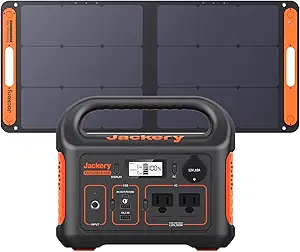
A reliable portable power station can make a big difference during a power outage, camping trip, RV adventure, or unexpected emergency. In 2026, solar backup power stations are more capable than ever, with faster charging, lithium iron phosphate (LiFePO4) batteries, higher solar input, and expandable storage available across a wide range of sizes.
Despite the common term solar generator, these devices do not actually generate electricity. They store energy in a battery and use an inverter to provide AC power to your devices. When paired with compatible solar panels, they can be recharged using sunlight, making them useful when the electrical grid is unavailable.
The right model depends heavily on what you need to power. A compact 88Wh or 293Wh unit can be useful for phones, laptops, lights, cameras, and other small electronics, while a 1,000Wh-plus power station is much more practical for refrigerators, CPAP machines, longer camping trips, and emergency backup. Larger systems can provide several kilowatt-hours of storage and are designed for more demanding home backup applications.
Best Solar Backup Power Stations of 2026
| Power Station | Best For | Battery Capacity | AC Output |
|---|---|---|---|
| Jackery Solar Generator 300 | Camping and small electronics | 293Wh | 300W |
| MARBERO Portable Power Station 88Wh | Emergency charging and travel | 88Wh | Compact backup |
| GRECELL 300W Portable Power Station | Budget camping and small backup loads | 230.88Wh | 330W |
| EF ECOFLOW DELTA 2 Max | Extended emergency backup | 2,048Wh | 2,400W |
| Anker SOLIX C1000 | Portable home and outdoor backup | 1,056Wh | 1,800W |
The five models above cover very different use cases, so the most useful way to compare them is by capacity, output, portability, and the type of equipment you expect to run.
Jackery Solar Generator 300 – Compact Power for Camping and Travel
Check Amazon Price Click Here!
The Jackery Solar Generator 300 remains a compact option for users who mainly need portable electricity for electronics rather than large appliances. With a 293Wh battery and a 300W inverter, it is better suited to camping, road trips, remote work, emergency charging, and smaller devices than to extended home backup.
Its relatively low weight is one of its biggest advantages. At around 7.1 pounds, it is easy to move between a car, campsite, RV, or home emergency kit.
The Explorer 300 can be charged from AC power, a vehicle, or compatible Jackery solar panels. Jackery currently lists a 60W USB-C PD port, two AC outlets, USB-A charging, and a 12V car port among its available outputs.
Key Features
- Battery capacity: 293Wh
- AC output: 300W
- Peak output: Up to 500W
- Weight: Approximately 7.1 pounds
- USB-C: 60W PD
- AC outlets: 2
- Solar charging: Compatible with Jackery SolarSaga panels
- Best for: Camping, phones, laptops, lights, cameras, and small electronics
What Can the Jackery 300 Power?
This is where the original article needed more clarification.
A 293Wh battery should not be viewed as a replacement for a home backup battery. Instead, it is a convenient source of portable electricity for smaller loads.
For example, Jackery estimates that the unit can provide several hours of operation for a 50W device, although actual runtime varies according to inverter losses, battery condition, temperature, and the device being powered.
If your main goal is keeping phones, laptops, lights, cameras, or other low-power equipment running during an outage, its small size can be an advantage.
MARBERO Portable Power Station 88Wh – Lightweight Emergency Charging
Check Amazon Price Click Here!
The MARBERO 88Wh Portable Power Station belongs to a different category from the larger power stations in this guide. Its primary advantage is portability.
With an 88Wh battery, it makes more sense as an emergency charging device than as a general-purpose home backup system. It can be useful for keeping small electronics charged when you’re traveling, camping, working away from an outlet, or dealing with a short power interruption.
The compact design also makes it easier to keep in an emergency kit, vehicle, or backpack than a 1,000Wh-class power station.
Key Features
- Battery capacity: 88Wh
- Design: Compact and lightweight
- Outputs: USB, DC, and AC options depending on configuration
- Solar charging: Compatible with supported solar charging equipment
- Best for: Phones, small electronics, lights, travel, and emergency charging
- Ideal user: Anyone who values minimum size and weight over long runtime
Who Should Consider an 88Wh Power Station?
An 88Wh unit is appropriate when your priority is portable emergency electricity, not running household appliances for hours.
For example, it can make sense for charging phones and other small electronics during a short outage. However, users who want to run a refrigerator, CPAP machine, coffee maker, microwave, heater, or other high-draw appliance should move into a much larger capacity class.
This distinction is important because battery capacity and inverter output determine what a power station can realistically do.
GRECELL 300W Portable Power Station – Affordable Portable Backup
Check Amazon Price Click Here!
The GRECELL 300W Portable Power Station is another compact option for camping, travel, and basic emergency backup.
One important 2026 update is that GRECELL’s product lineup has changed. The company says the older T300 model was discontinued and replaced by the T300S configuration. The current T300S uses a 230.88Wh battery and provides 330W of rated output with up to 600W peak power.
That makes it a useful middle ground between a small emergency battery pack and a larger 1,000Wh-class power station.
Key Features
- Battery capacity: 230.88Wh
- Rated output: 330W
- Peak output: 600W
- USB-C: Up to 60W
- Solar input: Up to 45W on the current T300S configuration
- AC output: 110V/60Hz
- Battery chemistry: NCM lithium-ion
- Best for: Camping, travel, electronics, lights, and smaller emergency loads
GRECELL states that the current T300S can power equipment rated below 330W and that actual runtime depends on the load and conversion efficiency.
What Makes the GRECELL Different?
The GRECELL makes sense for shoppers who want more capacity than a basic power bank without moving into the size and cost of a 1,000Wh power station.
It can handle devices such as laptops, phones, cameras, lights, and other smaller electronics. However, its 330W continuous output means it is not designed for high-demand household appliances.
For camping and occasional emergency use, that limitation may not be a problem.
EF ECOFLOW DELTA 2 Max – High-Capacity Emergency Backup
Check Amazon Price Click Here!
The EF ECOFLOW DELTA 2 Max moves into a completely different class of portable power station.
With 2,048Wh of battery capacity and 2,400W of AC output, it is designed for users who need considerably more energy storage than compact camping power stations can provide.
The DELTA 2 Max uses a LiFePO4 battery and can accept up to 1,000W of solar input when using the appropriate configuration. EcoFlow also supports additional batteries for significantly more stored energy.
Key Features
- Battery capacity: 2,048Wh
- AC output: 2,400W
- Peak output: Up to 4,800W
- Battery chemistry: LiFePO4
- Solar input: Up to 1,000W
- AC charging: Up to 1,800W
- Expansion: Compatible with additional batteries
- Connectivity: Wi-Fi and Bluetooth
- Weight: Approximately 50 pounds
- Best for: Home emergency backup, RV use, extended camping, refrigerators, and larger loads
Is the DELTA 2 Max Good for Home Backup?
It can be useful for essential-load backup, but it is important not to confuse a portable 2kWh power station with a whole-home battery system.
A DELTA 2 Max can provide significantly more energy than the smaller stations in this article, making it much more practical for an outage. Depending on the power draw, it can run selected appliances and electronics for substantially longer.
For example, a refrigerator, router, lights, laptops, and other essential devices can potentially be supported during an outage. Actual runtime will depend on the refrigerator’s duty cycle and the combined wattage of everything connected.
The unit can also be expanded, which makes it more suitable for users who want additional stored energy without immediately moving to a permanently installed home battery.
Outdoor Life’s current solar-generator coverage also continues to identify the DELTA 2 Max as a large-capacity option, listing its 2,048Wh capacity, 2,400W maximum output, and LiFePO4 battery.
Anker SOLIX C1000 – Powerful Portable Backup in a Smaller Package
Check Amazon Price Click Here!
The Anker SOLIX C1000 is one of the more capable options in the 1,000Wh class.
It stores 1,056Wh, provides 1,800W of continuous AC output, and can handle up to 2,400W through its SurgePad feature. It also supports up to 600W of solar input and uses a LiFePO4 battery rated for 3,000 cycles to 80% capacity.
At approximately 28.4 pounds, it is substantially easier to move than a 2,000Wh-class station such as the DELTA 2 Max.
Key Features
- Battery capacity: 1,056Wh
- Continuous AC output: 1,800W
- SurgePad: Up to 2,400W
- Battery chemistry: LiFePO4
- Solar input: Up to 600W
- AC outlets: 6
- USB-C: Up to 100W on one port
- UPS transfer time: Less than 20ms
- Cycle life: 3,000 cycles to 80% capacity
- Weight: Approximately 28.4 pounds
- Warranty: 5 years
- Best for: Home essentials, camping, RVs, remote work, and emergency backup
The C1000 can also be expanded to 2,112Wh with an additional battery, giving users a path to more storage without replacing the original power station.
Why Consider a 1,000Wh-Class Power Station?
A 1,000Wh power station is often a practical middle ground.
It is much more capable than a small 200–300Wh unit, while remaining portable enough for camping, RV trips, outdoor events, and emergency use.
For example, if you need to keep a refrigerator, Wi-Fi router, laptops, lights, phones, and other essential electronics operating during an outage, a 1,000Wh-class station is considerably more appropriate than an 88Wh or 293Wh unit.
How to Choose the Right Solar Backup Power Station in 2026
The biggest mistake shoppers make is choosing a power station based only on the advertised wattage.
There are two numbers you need to understand:
Watt-Hours (Wh)
Watt-hours measure battery capacity.
A 1,000Wh battery stores substantially more energy than a 200Wh battery.
In simple terms, a theoretical 1,000Wh battery could supply 100W for about 10 hours before accounting for conversion losses and other variables.
Real-world runtime will be lower because power stations are not 100% efficient.
Watts (W)
Watts measure how much power the inverter can deliver at one time.
A device requiring 1,500W cannot normally be operated from a power station with a 300W inverter, regardless of how large the battery is.
That’s why both numbers matter.
Which Size Solar Generator Do You Need?
Under 300Wh
Choose this range for:
- Smartphones
- Cameras
- Tablets
- Small lights
- Small fans
- Laptops
- Short camping trips
- Emergency charging
The Jackery 300 and similar products fit this category.
Around 500Wh to 1,000Wh
This range is more appropriate for:
- Longer camping trips
- Remote work
- CPAP equipment
- TVs
- Routers
- Small refrigerators
- Multiple electronic devices
- Short emergency outages
The Anker SOLIX C1000 is an example of a power station in this class.
Around 2,000Wh or More
This category makes more sense when you need:
- Longer outage coverage
- Refrigerators
- Multiple household essentials
- RV appliances
- Larger electronics
- Extended off-grid use
- Expandable energy storage
The EcoFlow DELTA 2 Max is an example of this larger class.
For even larger home backup requirements, 4,000Wh-plus systems and expandable 120V/240V solutions are increasingly common in the 2026 market. Current competitors are highlighting products such as the EcoFlow DELTA Pro 3 and Anker SOLIX F3800 for these more demanding applications.
Solar Charging vs. Wall Charging
A solar power station does not automatically mean fast solar charging.
The charging speed depends on the maximum solar input, the solar panel configuration, sunlight intensity, panel orientation, temperature, and other environmental conditions.
For example, the Anker SOLIX C1000 supports up to 600W of solar input, while the DELTA 2 Max can accept up to 1,000W under the appropriate setup.
This is one reason the larger systems are more attractive for multi-day outages or off-grid use.
If you only need enough energy to recharge phones and laptops, a small solar panel may be sufficient. If you want to replenish several kilowatt-hours of battery storage, you need a much larger solar array and favorable sunlight.
Are Solar Generators Safe During a Power Outage?
Portable battery power stations have an important advantage over conventional gasoline generators: they do not produce exhaust while operating.
However, they still need to be used according to the manufacturer’s instructions.
Keep these points in mind:
- Do not exceed the rated continuous output.
- Pay attention to the surge requirements of appliances.
- Keep ventilation openings clear.
- Protect the power station from water unless it is specifically rated for wet conditions.
- Use compatible solar panels and cables.
- Follow the manufacturer’s charging-temperature limits.
- Keep batteries away from extreme heat.
- Never assume a portable power station can safely connect directly to household wiring.
- For permanent home integration, use equipment and installation methods approved for that purpose.
A portable power station is not automatically a substitute for a professionally installed home battery or transfer-switch system.
Solar Generator vs. Gas Generator
Solar power stations and gasoline generators solve similar problems in very different ways.
A gasoline generator can provide high continuous output for as long as fuel is available. However, it produces exhaust, creates noise, requires fuel storage, and must be operated outdoors in accordance with safety requirements.
A battery power station operates quietly and produces no exhaust while delivering power. It can also be recharged from solar panels, making it useful for extended off-grid situations.
The tradeoff is energy storage.
A portable power station has a finite battery capacity. Once that stored energy is depleted, you need solar, AC power, vehicle charging, or another source to recharge it.
That makes solar power stations particularly useful for electronics, essential appliances, camping, RVs, remote work, and moderate emergency loads.
Which Solar Backup Power Station Is Right for You?
The answer depends on the job rather than simply choosing the biggest battery.
For lightweight camping and electronics: the Jackery Solar Generator 300 is easier to carry and transport.
For an emergency charging kit: the MARBERO 88Wh is designed around portability rather than long runtime.
For budget camping and small electronics: the GRECELL 300W class provides more capacity than a basic power bank while remaining relatively compact.
For longer outages and higher-demand equipment: the EcoFlow DELTA 2 Max provides substantially more stored energy and output.
For a balance between portability and emergency backup: the Anker SOLIX C1000 provides 1,056Wh, 1,800W of continuous AC output, LiFePO4 chemistry, and up to 600W of solar input.
Final Thoughts: Choosing Solar Backup Power in 2026
Solar backup power stations have become considerably more capable, but there is still no single model that fits every situation.
Small units such as the MARBERO 88Wh, Jackery Solar Generator 300, and GRECELL 300W are primarily portable power solutions for electronics, camping, travel, and short emergency situations.
The Anker SOLIX C1000 moves into the 1,000Wh class and provides considerably more flexibility for emergency backup, camping, RV use, and essential household equipment.
For longer outages and higher energy requirements, the EF ECOFLOW DELTA 2 Max provides 2,048Wh of storage, 2,400W of AC output, LiFePO4 battery chemistry, and up to 1,000W of solar input.
The most important thing is to match the power station to your actual load. Look at both watt-hours for runtime and watts for the appliances you need to operate. Once you know those two numbers, choosing the right solar backup power station becomes much easier.
For a short camping trip, portability may matter most. For an emergency kit, compact size can be more useful. For a multi-day outage, battery capacity and solar input become much more important.
In 2026, the best solar backup setup is not necessarily the biggest one. It is the one that gives you enough usable energy, enough output for your equipment, and a practical way to recharge when the power is unavailable.