Choosing the right well pump is not simply a matter of picking the highest horsepower model you can afford. The pump has to match your well’s water level, sustainable yield, household demand, piping, pressure requirements, and electrical system.
For most homeowners, two numbers are especially important: required flow in gallons per minute (GPM) and total dynamic head (TDH). These tell you what the pump actually needs to deliver. Well depth alone is not enough to choose a pump.
A properly sized system can provide reliable water pressure without unnecessarily stressing the pump, pressure tank, or electrical system. An oversized pump can create its own problems, while an undersized pump may struggle to keep up with demand.
If you are replacing an existing pump or planning for generator backup, you should also know the pump’s voltage, running amperage, starting requirements, and whether it uses a 2-wire or 3-wire motor.
How Well Pumps Move Water to Your House
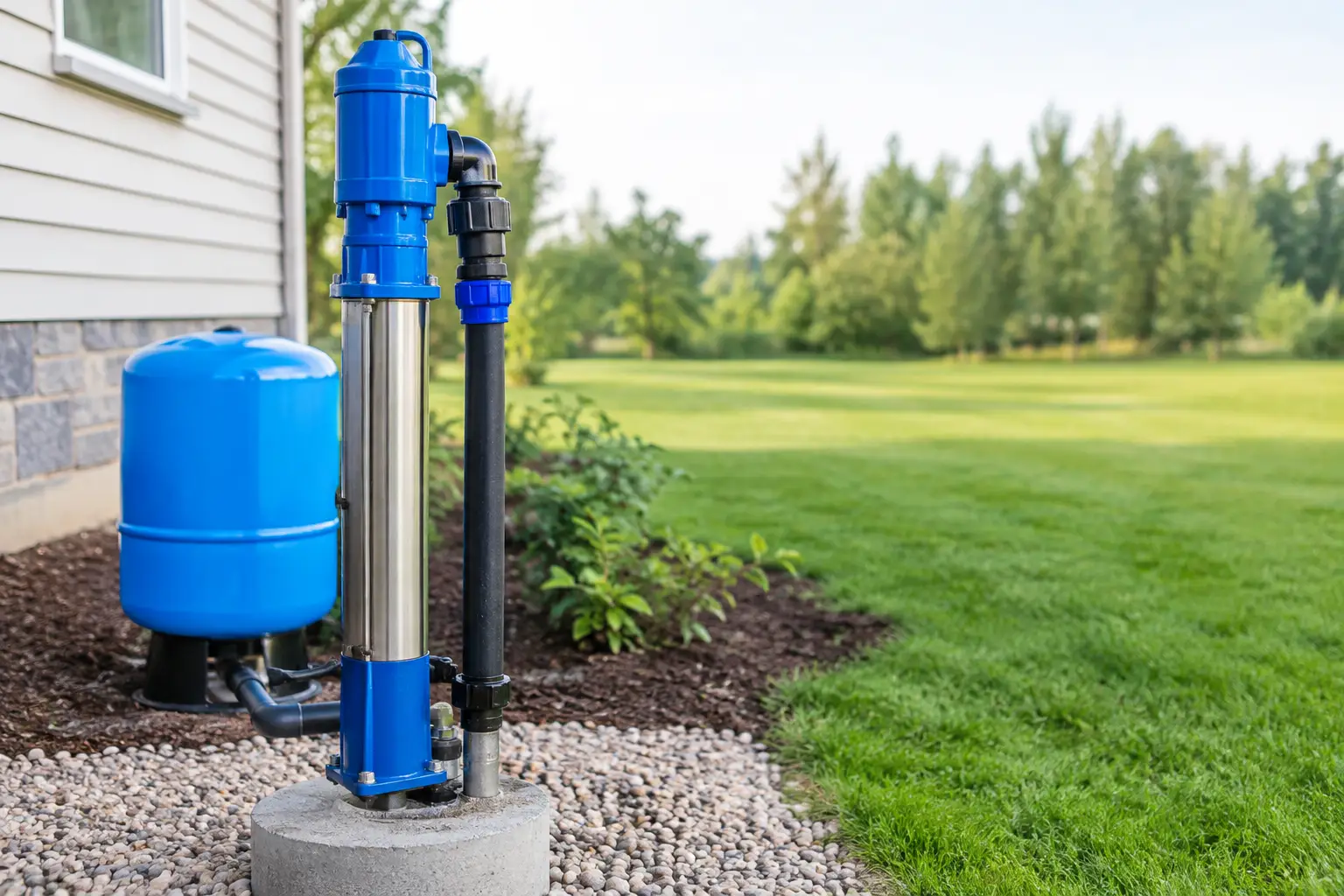
Most residential well systems have more than a pump. They include a pressure tank, pressure switch, piping, electrical controls, and often a check valve or pump control box. The pump moves water into the pressure tank. Once the tank reaches its set pressure, usually around 40 to 60 psi, the pressure switch shuts the pump off. When someone opens a faucet and pressure drops, the pump starts again.
That cycling matters. A properly sized pressure tank reduces how often the motor starts, which helps limit wear. A pump that is oversized or paired with an undersized tank can short-cycle, meaning it turns on and off too frequently. That can shorten the life of the motor, pressure switch, and control components.
The pump also has to overcome more than vertical depth. It must push water through pipe, fittings, filters, water heaters, and the elevation changes inside the home. This total resistance is commonly called total dynamic head, and it is one reason two wells of the same depth may need different equipment.
The Main Types of Well Pumps
The well construction and water level usually determine which pump style makes sense. There are exceptions, particularly on older systems, but these are the common choices for residential properties.
Submersible pumps for deeper wells
A submersible pump sits below the water line inside the well casing and pushes water upward. It is the standard choice for most drilled wells and is especially effective for deep applications. Because the motor is submerged and cooled by moving water, submersible pumps tend to be quiet and efficient.
The trade-off is service access. Pulling a failed submersible pump can require removing hundreds of feet of pipe and wiring. It is usually a job for a licensed well professional, not a casual DIY repair.
Jet pumps for shallow and intermediate wells
Jet pumps are installed above ground, typically in a basement, utility room, or well house. A shallow-well jet pump generally serves water levels up to about 25 feet below the pump. Deep-well jet systems can work at greater depths using a two-pipe arrangement and an ejector installed in the well.
Jet pumps are easier to access for maintenance, but they are generally less efficient than submersible designs. They can also be noisier, and they need protection from freezing temperatures. They remain a practical option where existing plumbing already supports a jet system or where the well is shallow.
Constant-pressure systems
Traditional systems allow pressure to rise and fall within a range, such as 40 to 60 psi. A constant-pressure system uses a variable-speed drive or controller to adjust pump output as demand changes. The result can feel more like municipal water service, with steadier pressure while showers, appliances, and outdoor fixtures run at the same time.
These systems can improve comfort and may reduce cycling, but the electronics add cost and complexity. Before buying one, confirm that the pump, motor, controller, and generator backup plan are compatible. Variable-speed controls can have different power-quality requirements than a basic pump motor.
How to Size Well Pumps Correctly
Horsepower gets the most attention, but it is only one part of pump sizing. A 1-horsepower pump is not automatically better than a 1/2-horsepower pump. If it produces more water than the well can safely yield, it can draw down the water level, pull sediment, or cycle excessively.
Start with the well record if it is available. It may show the well depth, static water level, recovery rate, casing size, and previous pump information. Static water level is where water rests when the pump is off. Pumping water level is where it drops while the pump runs. The distance from that pumping level to the discharge point is far more useful than total well depth alone.
Next, estimate household demand. Many typical homes are adequately served by a pump capable of roughly 8 to 15 gallons per minute, but large households, irrigation systems, livestock use, or multiple bathrooms may need more. The well itself must be able to sustain that flow. A high-flow pump cannot create water that is not available underground.
A professional pump curve is the best final sizing tool. It compares the pump’s gallons-per-minute output against total dynamic head. Choose a pump whose efficient operating range matches your actual conditions rather than selecting the highest horsepower on the shelf.
Match the Electrical Requirements Before You Buy
Most modern submersible well pumps use 240-volt power. Smaller systems may use 120 volts, while larger residential pumps are commonly 240-volt and may draw significant starting current. The nameplate on the pump, control box, or breaker panel provides the information needed for an accurate replacement or backup-power plan.
Do not rely only on
running watts when selecting a generator. Motor-driven equipment can require considerably more power for a few seconds at startup. A generator may run a 240-volt pump once it is operating yet still stall or trip its breaker when the pump starts.
For outage planning, identify the pump voltage, running amps, starting requirement, and whether it uses a control box or electronic drive. A generator with 120/240-volt output, adequate surge capacity, and a properly sized
4-prong generator cord is often needed for a standard deep-well pump. An inlet box paired with a transfer switch or listed panel interlock provides a controlled way to supply selected home circuits.
Never feed generator power into a home receptacle or connect a generator directly to the service panel without approved transfer equipment. Backfeeding can injure utility workers, damage equipment, and create a fire risk. A qualified electrician should evaluate the connection, grounding and neutral setup, breaker sizing, and local code requirements.
Backup Power Changes the Buying Decision
A well pump is one of the most useful loads to support during an outage, but it should not always be the first appliance started. Let the generator stabilize, then energize the pump circuit with large optional loads switched off. Electric water heaters, clothes dryers, central air conditioners, and electric ranges can consume capacity that the pump needs at startup.
A pressure tank provides a valuable buffer. If the tank is full when an outage begins, the home may have enough water for handwashing, toilet flushing, and limited cooking before the pump must run again. Conserving water also reduces generator fuel use and noise.
If frequent outages are common, prioritize a
dependable generator installation over buying an oversized pump. A correctly sized pump, healthy pressure tank, transfer equipment, and generator that can handle motor starting demand make a more reliable system than horsepower alone.
Maintenance That Protects Your Water Supply
Well pumps often last many years, but their lifespan depends on water quality, cycling frequency, electrical health, and proper installation. Warning signs include sputtering faucets, rapidly changing pressure, repeated breaker trips, cloudy water after normal use, or a pump that runs continuously.
Homeowners can check the pressure gauge, inspect exposed wiring and pipe connections for obvious damage, and listen for unusual cycling. Keep the well cap secure and the area around the casing clear of chemicals, fuel, and standing water. For a private well, periodic water testing is also wise, especially after flooding, plumbing work, or a noticeable change in taste, odor, or color.
Do not keep resetting a tripped breaker or force a failing pump to run. The underlying issue could be a damaged wire, failing capacitor, seized motor, dry well condition, or pressure-switch problem. Prompt diagnosis is usually less expensive than waiting for a complete failure.
A reliable water system is built around the right match, not the biggest specification. Confirm the well data, size the pump to real demand, and plan the electrical side before an emergency puts those decisions to the test.
What to Check Before Buying a Well Pump
Use this checklist before ordering a replacement pump:
What to Check Why It Matters Well depth Helps establish the overall well configuration Static water level Shows where water sits when the well is not pumping Pumping water level Helps determine actual lift under operating conditions Well yield Prevents selecting a pump that exceeds sustainable supply Required GPM Determines how much water the home needs Total dynamic head Determines how much resistance the pump must overcome Pump curve Confirms the pump can deliver the required GPM at the required head Horsepower Must match the actual hydraulic requirement Voltage Must match the electrical supply 2-wire or 3-wire Determines motor/control compatibility Pressure switch Affects system operating pressure Pressure tank Helps control cycling and provides drawdown Pipe size Affects friction loss Generator compatibility Important if backup power is required Frequently Asked Questions About Well Pumps What size well pump do I need for a house?
The correct pump size depends on required GPM, total dynamic head, well yield, pressure requirements, and the pump’s performance curve. Horsepower alone is not enough to determine the correct size.
Is a 1 HP well pump enough for a house?
It can be, but horsepower by itself does not answer the question. A 1 HP pump may be appropriate for one system and poorly matched to another. Check the required GPM and TDH against the manufacturer’s pump curve.
How deep can a well pump work?
The answer depends on the type of pump and its specific performance. Shallow-well jet pumps are generally used for water levels around 25 feet or less, while submersible pumps are commonly used in much deeper wells. Convertible and deep-well jet systems can operate at greater depths depending on their configuration.
Are submersible well pumps better than jet pumps?
They serve different applications. Submersible pumps are commonly used for deeper wells, while jet pumps are often used for shallow wells and some convertible deep-well installations. The appropriate choice depends on water level, well construction, performance requirements, and the existing system.
What is total dynamic head on a well pump?
Total dynamic head is the total resistance the pump must overcome. It includes vertical lift, required pressure, and friction losses through piping and system components. It is one of the most important numbers used to select a pump.
Can a generator run a well pump?
Yes, provided the generator is correctly matched to the pump’s voltage, running load, starting demand, and other electrical requirements. Many deep-well pumps require 240-volt power, so generator configuration matters.
How long do well pumps usually last?
There is no guaranteed lifespan. Pump life depends on water quality, cycling frequency, installation quality, electrical conditions, pump construction, operating conditions, and maintenance. A well pump that is correctly sized and installed can provide many years of service, but individual systems vary.
Why does my well pump keep turning on and off?
Rapid cycling can be caused by pressure-tank problems, incorrect pressure-switch settings, water leaks, an improperly sized pump, or other system issues. Repeated short cycling should be investigated because it can place additional stress on the pump and controls.
Final Thoughts
Choosing the right well pump starts with the well itself, not the horsepower number on a product listing.
First determine your required GPM and the well’s sustainable yield. Then determine the pumping water level and total dynamic head. Once those numbers are known, use the manufacturer’s performance curve to find a pump that can deliver the required flow at the required head.
From there, verify the electrical requirements, pressure-tank setup, pressure-switch settings, wiring configuration, and any generator plans.
The best well pump for a home is not necessarily the biggest or most expensive model. It is the pump that is correctly matched to the water source, household demand, plumbing system, pressure requirements, and electrical supply.
That approach can help you avoid an expensive mismatch and build a well system that delivers dependable water when your household needs it most.