As an Amazon Associate I earn from qualifying purchases.
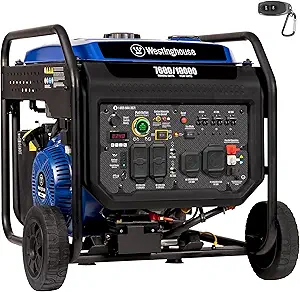
If you need more power than a typical 2,000- or 3,000-watt portable generator can provide, a high-capacity inverter generator can be a practical middle ground between a small portable unit and a permanently installed standby generator.
The best 10,000-watt inverter generators and larger models can provide enough power for demanding backup applications while offering cleaner electrical output, 120/240V capability, electric start, and useful safety features. Depending on the model, you can also get dual-fuel operation, remote start, CO shutdown protection, and transfer-switch-ready connections.
One important distinction matters before you buy: not every 10,000- to 12,500-watt portable generator is an inverter generator. Some high-output models use conventional generator technology. They can still be excellent choices for home backup, but they should not be compared directly with inverter models when clean power and lower electrical distortion are priorities.
High-Capacity Generator Options for 2026
| Model | Generator Type | Fuel | Peak Watts | Running Watts | Amazon |
|---|---|---|---|---|---|
| Westinghouse 10,000W Open Frame | Inverter | Gasoline | 10,000W | 7,600W | Amazon Link |
| DuroMax XP11000iH | Inverter | Gasoline/Propane | 11,000W | 9,000W | Amazon Link |
| WEN DF1100T | Conventional | Gasoline/Propane | 11,000W | 8,300W | Amazon Link |
| Champion 12,500W Tri-Fuel | Conventional | Gas/Propane/Natural Gas | 12,500W | 10,000W | Amazon Link |
| Westinghouse 12,500W Dual Fuel | Conventional | Gasoline/Propane | 12,500W | 9,500W | Amazon Link |
Wattage can vary by fuel type and operating conditions. Always check the current manufacturer specifications before purchase.
Why Choose a High-Capacity Inverter Generator?
A high-capacity inverter generator is designed for situations where you need substantially more power than a compact portable inverter can provide.
The biggest advantage is the combination of high output and inverter technology. An inverter generator produces electricity through an electronic conversion process that helps provide a stable output with low total harmonic distortion (THD). That can be useful when powering modern electronics, appliances, battery chargers, televisions, computers, and other sensitive equipment.
High-capacity inverter generators can also offer:
- 120/240V output for larger electrical loads
- Electric and remote starting
- Dual-fuel operation on selected models
- CO detection and automatic shutdown
- GFCI-protected receptacles
- Transfer-switch-ready connections
- Wheels and handles for portability
- Lower electrical distortion than many conventional generators
However, high-capacity does not mean lightweight. These machines can weigh well over 150 pounds, so portability usually means moving the generator on wheels rather than carrying it.
Best High-Capacity Inverter Generator Options
Westinghouse 10,000-Watt Open Frame Inverter Generator
Check Amazon Price Click Here!
The Westinghouse 10,000-watt open-frame inverter is one of the more direct matches for shoppers searching specifically for a 10,000-watt inverter generator.
It produces 10,000 peak watts and 7,600 running watts on gasoline. The unit uses a 420cc four-stroke OHV engine and provides less than 3% THD. It also includes remote electric start, push-button start, and recoil starting.
The 5.28-gallon fuel tank can provide up to 12 hours of runtime under the manufacturer’s stated test conditions. The control panel includes 120V GFCI outlets along with 30A and 50A connections suitable for certain transfer-switch or home-backup applications.
Why consider it?
The biggest advantage is that it combines substantial output with inverter technology without moving into the much larger class of 12,000- to 15,000-watt conventional generators.
It is particularly interesting for homeowners who want cleaner inverter power but do not need the additional output of a 13,000- or 15,000-watt generator.
Best for: Home backup, sensitive electronics, larger RVs, and users specifically looking for a 10,000-watt inverter.
DuroMax XP11000iH 11,000-Watt Dual-Fuel Inverter Generator
Check Amazon Price Click Here!
The DuroMax XP11000iH is one of the most capable options in this group for buyers who want both high output and inverter technology.
On gasoline, it produces 11,000 peak watts and 9,000 running watts. Propane output is rated at 10,450 peak watts and 8,550 running watts.
The 459cc engine supports electric start, recoil start, and remote start. DuroMax rates the generator at less than 3% THD and includes both 120V and 240V capability.
The generator also has a 7.1-gallon gasoline tank, GFCI outlets, a 30A L14-30R connection, and a 50A NEMA 14-50R connection. DuroMax lists it as home-backup and RV ready.
Noise is rated at approximately 61 dB at 25% load, although actual sound levels will vary with load and operating conditions.
Why consider it?
The XP11000iH makes sense when you want a high-output inverter but also need the flexibility of gasoline and propane.
Its 9,000 running watts on gasoline gives it more continuous capacity than a typical 7,000- or 8,000-watt portable generator.
Best for: High-demand home backup, RV use, job sites, and users who want dual-fuel flexibility.
High-Capacity Alternatives That Are Not Inverter Generators
This distinction is important because several popular generators in this wattage range use conventional generator technology.
They can still be useful for backup power, but they should not be advertised as inverter generators.
WEN DF1100T 11,000-Watt Dual-Fuel Generator
Check Amazon Price Click Here!
The WEN DF1100T is a high-output dual-fuel portable generator, but it is not an inverter generator.
It produces up to 11,000 surge watts and 8,300 running watts on gasoline. On propane, the ratings drop to 9,500 surge watts and 7,500 running watts.
The 457cc four-stroke OHV engine has electric start, and the generator provides 120/240V output. Its 6.6-gallon fuel tank can provide up to 8.5 hours of runtime at half load on gasoline according to WEN’s specifications.
This model can make sense if your priority is affordable high-output backup power rather than inverter technology.
Best for: Home backup, tools, appliances, and buyers who want dual-fuel capability at a potentially lower cost.
Champion 12,500-Watt Tri-Fuel Generator
Check Amazon Price Click Here!
The Champion 12,500-watt tri-fuel generator is another example of why wattage alone should not determine whether a generator belongs in an inverter comparison.
This model is a conventional open-frame generator, not an inverter generator.
Its major advantage is fuel flexibility. Tri-fuel operation allows the generator to use gasoline, propane, or natural gas, which can be useful during extended outages when one fuel source may not be readily available.
The 12,500-watt peak output and 10,000-watt running capacity make it a serious option for demanding home backup applications.
The trade-off is that you do not get the same inverter-based electrical architecture as the dedicated inverter models discussed above.
Best for: Whole-home backup applications where high continuous output and three fuel options are more important than inverter technology.
Westinghouse 12,500-Watt Dual-Fuel Portable Generator
Check Amazon Price Click Here!
The Westinghouse 12,500-watt dual-fuel model is another high-capacity conventional generator.
It produces up to 12,500 peak watts and 9,500 running watts on gasoline, with lower output when operating on propane.
The major advantage is straightforward: it provides more continuous power than the Westinghouse 10,000 peak-watt inverter while retaining gasoline and propane flexibility.
However, it should not be confused with Westinghouse’s inverter products.
If your priority is powering demanding household circuits, large appliances, pumps, or other high-load equipment, the additional running wattage can be useful.
Best for: High-demand home backup where maximum output is more important than inverter technology.
Inverter vs. Conventional Generator: Which Should You Choose?
This is one of the most important decisions when shopping for a generator in the 10,000-watt class.
Inverter generators
An inverter generator is generally the better fit when you care about:
- Cleaner electrical output
- Sensitive electronics
- Lower THD
- More efficient operation at lighter loads
- Variable engine speed on many models
- Quieter operation compared with similarly sized conventional units
The Westinghouse 10,000W and DuroMax XP11000iH are examples of high-capacity inverter generators.
Conventional generators
A conventional generator can make more sense when your priority is:
- Maximum wattage for the money
- Large motors and heavy loads
- Long-duration backup
- Tri-fuel flexibility
- Straightforward home backup applications
The WEN, Champion 12,500W, and Westinghouse 12,500W models listed above fall into this category.
Neither design is automatically better for every application. The right choice depends on what you intend to power.
How Many Watts Do You Really Need?
Do not choose a generator based only on its peak wattage.
Running watts are the amount of power the generator can continuously provide. Starting watts or peak watts represent the temporary extra power available for starting motors and other loads.
For example, a refrigerator, sump pump, well pump, air conditioner, or power tool can require substantially more power during startup than during normal operation.
Before buying a generator, make a list of the equipment you actually need during an outage.
Typical priorities may include:
- Refrigerator and freezer
- Furnace blower
- Sump pump
- Well pump
- Lights
- Internet equipment
- Television
- Microwave
- Garage door opener
- Window or portable air conditioner
- Central air conditioning
- Selected kitchen appliances
Do not simply add every appliance in your home. Determine which devices need to operate simultaneously and account for motor-starting requirements.
For larger homes, an electrician can help determine the appropriate generator size and which circuits should be backed up.
Why 120/240V Matters for Home Backup
For high-capacity generators, 120/240V output is an important specification.
Many larger household loads use 240V, including certain central air-conditioning systems, well pumps, electric water heaters, and other large appliances.
A generator capable of supplying 120/240V gives you more flexibility than a generator limited to 120V.
However, having a 240V receptacle does not mean the generator can automatically power every 240V appliance in your house. The generator still needs sufficient running and starting capacity, and the home’s electrical system must be connected correctly.
Fuel Choice: Gasoline, Propane, or Natural Gas?
Gasoline
Gasoline generally provides the highest output on many dual-fuel portable generators.
The downside is storage. Gasoline deteriorates over time, so long-term storage requires proper fuel management and stabilizer practices.
Propane
Propane can be easier to store for emergency use because properly stored propane does not degrade in the same way gasoline does.
The trade-off is that many generators produce fewer watts on propane.
For example, the DuroMax XP11000iH is rated at 9,000 running watts on gasoline but 8,550 running watts on propane.
Natural Gas
Natural gas can be attractive for home backup because it does not require storing gasoline or propane on-site.
However, natural-gas operation requires an appropriate fuel supply, and the generator’s output is typically lower than its gasoline rating. Gas-line sizing and installation should be handled according to local requirements.
Noise: Don’t Assume a 10,000-Watt Generator Will Be Quiet
A high-output generator has to move a significant amount of air and produce substantial mechanical power.
Even inverter technology does not make a large generator silent.
The DuroMax XP11000iH, for example, is rated at 61 dB at 25% load, while larger conventional open-frame generators can be considerably louder.
Noise also increases as the generator load rises.
If you live in a neighborhood with strict noise rules, check the manufacturer’s published sound rating and your local regulations before purchasing.
Transfer Switch vs. Extension Cords
A large generator is often purchased for home backup, but plugging a generator directly into household wall outlets is not a safe way to energize a house.
For a permanent connection to selected household circuits, a properly installed transfer switch or other approved interconnection method is normally required.
Some high-capacity generators include 30A or 50A connections specifically intended for home-backup applications.
Installation should follow the generator manufacturer’s instructions, local electrical codes, and utility requirements. When connecting a generator to a home’s electrical panel, use a qualified electrician when required.
Never attempt to backfeed a house through a standard wall outlet.
Carbon Monoxide Safety Is Non-Negotiable
A portable generator must be operated outdoors, away from doors, windows, and ventilation openings.
Never operate a gasoline or propane generator inside a house, garage, basement, shed, or other enclosed or partially enclosed area.
A CO sensor or automatic CO shutdown system is an additional safety feature. It is not permission to operate a generator indoors and is not a replacement for properly installed carbon monoxide alarms in the home.
Manufacturer manuals for these generators specifically warn that exhaust contains carbon monoxide and that the machines must be operated outdoors.
Always follow the clearance distances and operating instructions in the owner’s manual for your specific generator.
Consider Altitude and Temperature
Generator output is not necessarily the same everywhere.
Higher elevation can reduce engine performance because the engine receives less oxygen. Extremely hot weather can also reduce available power.
Westinghouse notes that maximum wattage can decrease with increasing altitude and temperature.
If you live at a significant elevation or regularly experience very hot temperatures, check the manufacturer’s altitude recommendations before deciding how much generator capacity you need.
What to Look for in a High-Capacity Inverter Generator
Before purchasing, compare these specifications instead of looking only at the number printed in the product title.
Running watts
This is one of the most important numbers because it determines the continuous electrical load the generator can support.
Peak watts
Peak watts help with short startup demands from motors and compressors.
Fuel type
Decide whether gasoline, propane, dual fuel, or tri-fuel operation fits your emergency-preparedness plan.
THD
If you plan to power sensitive electronics, look for an inverter generator with a low published THD rating.
The DuroMax XP11000iH and Westinghouse iGen11000DFc, for example, are listed at less than or equal to 3% THD.
120/240V capability
For home backup, this can be an important requirement.
CO protection
Look for a properly implemented CO detection and automatic shutdown system, but never treat it as a substitute for outdoor operation.
Runtime
Compare runtime at the same load percentage. A claimed runtime at 25% load is not directly comparable with another model’s runtime at 50% load.
Weight and mobility
High-capacity generators are heavy. Wheels and handles become much more important as generator size increases.
Warranty and support
A longer warranty can be useful, particularly if the generator will be used for emergency preparedness or frequent job-site work.
High-Capacity Inverter Generator Alternatives for 2026
The market is changing, and buyers searching specifically for inverter technology now have additional options beyond the original models in this article.
One example is the Westinghouse iGen11000DFc, a dual-fuel inverter generator rated at 11,000 peak and 9,000 running watts on gasoline, with 10,000 peak and 8,100 running watts on propane. It also offers 120/240V output, remote start, CO sensing, and ≤3% THD.
Another newer option is the Champion 10,000W electric-start open-frame inverter, which is rated at 10,000 starting watts and 7,500 running watts.
These newer models illustrate why it is important to verify the exact model number before buying. A generator advertised as “10,000 watts” is not necessarily an inverter generator.
Final Thoughts: Which High-Capacity Generator Makes Sense?
If your priority is specifically inverter technology, the Westinghouse 10,000W open-frame inverter and DuroMax XP11000iH are the most relevant choices among the products originally included in this article.
The Westinghouse 10,000W inverter is a straightforward option for someone who wants 10,000 peak watts, 7,600 running watts, low THD, and gasoline operation.
The DuroMax XP11000iH offers more continuous output and dual-fuel flexibility, making it particularly interesting for demanding backup applications.
If maximum output and fuel flexibility are more important than inverter technology, the WEN, Champion 12,500W, and Westinghouse 12,500W generators remain worth considering. They simply belong in a different category.
For home emergency power, the most important step is not choosing the generator with the biggest number on the box. Determine your actual running loads, account for startup requirements, decide which fuel strategy makes sense for you, and make sure the generator can be safely connected and operated according to the manufacturer’s instructions and local requirements.
For 2026, the best high-capacity generator is ultimately the one that provides enough continuous wattage, has the fuel flexibility you need, fits your noise and portability requirements, and matches the electrical connection required by your home or equipment.