As an Amazon Associate I earn from qualifying purchases.
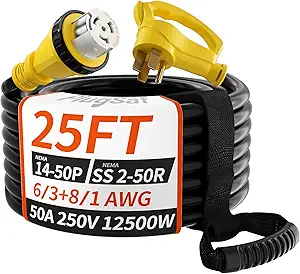
When you have a 50-amp RV, choosing the right generator cord is about more than finding a cable with a large plug. The connector configuration, wire gauge, cord length, generator output, and safety listing all matter.
For many RV and backup-power setups, a 50-amp generator cord uses a NEMA 14-50P male plug on the generator side and an SS2-50R twist-lock female connector on the RV or power-inlet side. This configuration is commonly used to connect a compatible 50-amp generator outlet to an RV inlet or a properly installed generator inlet box. Current 2026 products in this category continue to use the 14-50P-to-SS2-50R configuration with heavy-duty 6/3 + 8/1 conductors.
However, not every 50-amp RV cord has the same connectors. Some products are 14-50P to 14-50R extension cords, which serve a different purpose. That distinction is important before ordering.
Below are five Amazon-available options from the original article, updated for 2026 and evaluated according to connector type, construction, length, and intended use.
Quick Comparison: 50-Amp RV Generator Cords for 2026
| Product | Length | Connector Configuration | Wire | Best For |
|---|---|---|---|---|
| PlugSaf 50 Amp Generator Cord | 25 ft | NEMA 14-50P to SS2-50R | 6/3 + 8/1 STW | General RV and backup use |
| CircleCord UL Listed 50 Amp Cord | 50 ft | NEMA 14-50P to SS2-50R | 6/3 + 8/1 STW | Long-distance connections |
| YOMILINK 50 Amp RV/Generator Cord | 50 ft | NEMA 14-50P to SS2-50R | 6/3 + 8/1 | Long RV or generator runs |
| dé 50 Amp Generator Cord | 10 ft | NEMA 14-50P to SS2-50R | 6/3 + 8/1 | Short installations |
| POWGRN 50 Amp RV Extension Cord | 25 ft | NEMA 14-50P to 14-50R | Heavy-duty STW | Extending an existing 14-50 connection |
Important: The POWGRN model listed here is an extension cord with 14-50P and 14-50R ends. It should not automatically be substituted for a 14-50P-to-SS2-50R generator cord.
Amazon-Available 50-Amp RV Generator Cords
| Model | Amazon |
|---|---|
| PlugSaf 50 Amp 25 FT Generator Cord | Amazon Link |
| CircleCord UL Listed 50 Amp 50 FT Cord | Amazon Link |
| YOMILINK 50 FT 50 Amp RV/Generator Cord | Amazon Link |
| dé 10 FT 50 Amp Generator Cord | Amazon Link |
| POWGRN 25 FT 50 Amp RV/EV Extension Cord | Amazon Link |
Amazon availability, pricing, product configurations, and certification information can change, so always verify the current listing before purchasing.
What Is a 50-Amp Generator Cord for an RV?
A 50-amp RV generator cord is a heavy-duty power cable designed for compatible 50-amp electrical connections.
A common configuration is:
Generator NEMA 14-50R → NEMA 14-50P cord → SS2-50R RV/inlet connection
The NEMA 14-50P is the male plug. The SS2-50R is the locking female connector.
This configuration is different from a standard 50-amp extension cord that uses:
NEMA 14-50P → NEMA 14-50R
The second type is useful when you need to extend an existing 14-50 connection, but it does not replace a cord that specifically needs an SS2-50R twist-lock connector.
That is one of the easiest mistakes to make when shopping for a 50-amp RV cord.
How Much Power Can a 50-Amp RV Cord Handle?
A 50-amp, 125/250V connection has a theoretical maximum of:
50 amps × 250 volts = 12,500 watts
At 125 volts, the calculation is:
50 amps × 125 volts = 6,250 watts
But these numbers describe the electrical rating of the connection. They do not mean your generator will automatically produce 12,500 watts.
For example, a 5,000-watt generator connected through a 50-amp cord is still a 5,000-watt power source.
You should always check your generator’s actual receptacle, voltage configuration, maximum output, and owner’s manual before connecting an RV.
Some portable generators have a 14-50 receptacle but do not provide the same usable 120/240V configuration as a typical 50-amp RV electrical service. Never assume the voltage simply from the shape of the plug.
Detailed Reviews
PlugSaf 25 FT 50 Amp Generator Cord
Check Amazon Price: Click Here
The PlugSaf 25-foot 50-amp generator cord is a practical length for many RV and backup-power installations. It uses the familiar NEMA 14-50P-to-SS2-50R configuration and heavy-duty 6/3 + 8/1 STW construction.
Published product information identifies the cord as a 50-amp cable with a NEMA 14-50P male plug and SS2-50R twist-lock female connector.
Key Features
- Length: 25 ft
- Configuration: NEMA 14-50P to SS2-50R
- Wire: 6/3 + 8/1 AWG STW
- Rating: 50 amp
- Construction: Heavy-duty outdoor cable
- Connection: Twist-lock female end
- Certification: ETL listed according to the product information
The 25-foot length is useful when you need some separation between the generator and RV or inlet without dealing with the extra weight and storage bulk of a 50- or 75-foot cable.
Best For
RV owners and backup-power users who need a practical 25-foot generator-to-inlet cable.
One advantage of this length is that it provides useful routing flexibility without becoming unnecessarily difficult to handle.
CircleCord UL Listed 50 FT 50 Amp Generator Cord
Check Amazon Price: Click Here
The CircleCord 50-foot 50-amp RV/generator cord is designed for situations where 25 feet is not enough.
CircleCord’s current product information identifies this cord as a 14-50P male to SS2-50R twist-locking female cable using heavy-duty 6/3 + 8/1 STW wire. The company also offers several length options, including 10, 15, 25, 50, 75, and 100 feet.
Key Features
- Length: 50 ft
- Configuration: NEMA 14-50P to SS2-50R
- Wire: 6/3 + 8/1 AWG STW
- Certification: UL listed according to the product listing
- Connector: Twist-lock SS2-50R
- Use: RV, generator, and compatible inlet applications
- Construction: Heavy-duty outdoor cable
The biggest reason to choose this cord is reach.
A 50-foot cable can be useful when the generator must be positioned farther from an RV or inlet. This can be especially convenient for backup-power setups where generator placement is dictated by safety, noise, airflow, or available space.
However, remember that a 50-foot 50-amp cord is substantially heavier and harder to coil than a shorter cable.
Best For
RV owners and backup-power users who genuinely need 50 feet of reach.
Do not buy a 50-foot cable simply because it sounds better. If 25 feet gives you enough reach, the shorter cable is usually easier to transport and store.
YOMILINK 50 FT 50 Amp RV/Generator Cord
Check Amazon Price: Click Here
The YOMILINK 50-foot 50-amp RV/generator cord is another long-reach option using the 14-50P-to-SS2-50R configuration.
YOMILINK currently lists a 50-foot 50-amp RV/generator cord with NEMA 14-50P to SS2-50R twist-lock connectors.
Key Features
- Length: 50 ft
- Configuration: NEMA 14-50P to SS2-50R
- Wire: 6/3 + 8/1 heavy-duty construction
- Connection: Twist-lock SS2-50R
- Application: RV and generator connections
- Design: Heavy-duty outdoor power cable
The 50-foot length makes this model particularly useful when the generator and RV or inlet cannot be positioned close together.
The downside is the same one you’ll find with virtually every long 50-amp cable: weight.
A large 50-amp cord is not something most RV owners want to carry farther than necessary. Before choosing this length, measure the actual distance between the generator and the RV inlet.
Best For
Long-distance RV and generator connections where 25 feet is not sufficient.
dé 10 FT 50 Amp Generator Cord
Check Amazon Price: Click Here
The dé 10-foot 50-amp generator cord takes the opposite approach.
Instead of maximum reach, it focuses on a compact connection for installations where the generator and inlet are relatively close together.
Product information for the dé cable identifies a NEMA 14-50P/SS2-50R configuration, 6/3 + 8/1 AWG wire, and ETL listing. Some versions are also sold as kits that include an inlet box and interlock components, so check the exact Amazon package before ordering.
Key Features
- Length: 10 ft
- Configuration: NEMA 14-50P to SS2-50R
- Wire: 6/3 + 8/1 AWG
- Certification: ETL listed according to product information
- Application: Generator-to-inlet connections
- Storage: Easier to coil than longer 50A cords
A 10-foot cord can be a good choice when you have already planned your generator location and know that you do not need additional reach.
The shorter length also means less cable to store and less weight to handle.
Best For
Compact generator installations where 10 feet provides sufficient reach.
POWGRN 25 FT 50 Amp RV/EV Extension Cord
Check Amazon Price: Click Here
The POWGRN 25-foot 50-amp cord needs a different explanation because it is not the same connector configuration as the first four products.
The model associated with this product is a NEMA 14-50P to NEMA 14-50R extension cord. Product information lists it as a 50A, 125/250V cable with a heavy-duty STW construction and ETL listing.
Key Features
- Length: 25 ft
- Configuration: NEMA 14-50P to NEMA 14-50R
- Rating: 50 amp
- Voltage: 125/250V
- Construction: Heavy-duty STW
- Application: RV and EV extension applications
- Certification: ETL listed according to product information
This is useful when you need to extend an existing 14-50 connection.
It is not automatically the correct choice for a generator with a 14-50 outlet feeding an SS2-50R RV inlet.
That connector difference is more important than the brand name or cord length.
Best For
RV owners who specifically need a 14-50-to-14-50 extension cord.
14-50P vs SS2-50R vs 14-50R: Which One Do You Need?
Before buying any 50-amp cord, look at both ends of the connection.
NEMA 14-50P
This is the four-prong male plug commonly found on the generator side of many 50-amp generator cords.
NEMA 14-50R
This is the matching female receptacle used by a standard 14-50 connection.
A 14-50P to 14-50R cable is an extension cord.
SS2-50R
This is a locking female connector used on many 50-amp RV inlet and generator connection applications.
A 14-50P to SS2-50R cable is commonly used when connecting a generator’s 14-50 receptacle to a compatible RV or inlet-box connection.
Always compare the actual connectors on your generator and RV before ordering.
A 50-amp rating alone does not guarantee that two connectors will physically mate.
How to Choose the Right 50-Amp Generator Cord
1. Match the Connectors First
This should be your first check.
If your setup requires:
14-50P → SS2-50R
do not buy a:
14-50P → 14-50R
just because both products say “50 amp.”
The connector configuration determines whether the cable will work with your equipment.
2. Choose the Shortest Practical Length
For many RV setups, 25 feet is a useful middle ground.
Choose:
- 10 ft for very close installations
- 25 ft for general-purpose setups
- 50 ft when additional distance is genuinely necessary
Longer cables provide more flexibility, but they also add weight, storage requirements, and cost.
3. Look for Heavy-Duty Conductors
Many 50-amp RV generator cords use 6/3 + 8/1 AWG construction.
That designation generally means three 6-gauge conductors plus an 8-gauge grounding conductor.
Heavy-gauge copper construction is important because a 50-amp circuit can carry substantial current.
Do not select a cord based only on the phrase “heavy duty.” Check the actual conductor specification.
4. Consider UL or ETL Listing
A recognized safety certification can provide an additional layer of confidence when selecting an electrical product.
But check the certification for the specific cord model, not simply other products sold by the same brand.
The original article’s claim that other POWGRN products were certified was not enough to establish the certification of the particular cable being recommended.
5. Think About Generator Placement
Cord length should be considered together with generator safety.
A longer cord can allow you to position a portable generator farther from the RV or building, but the generator itself must still be operated according to current safety guidance.
The U.S. Consumer Product Safety Commission recommends operating portable generators outdoors and at least 20 feet from homes, with exhaust directed away from windows, doors, and vents.
Never operate a portable generator inside a garage, RV, basement, shed, or other enclosed space.
50-Amp Generator Cord Safety Tips
A high-quality cable cannot compensate for an incorrect electrical installation.
Inspect the cord before use
Look for:
- Cuts or cracks in the jacket
- Exposed conductors
- Damaged plugs
- Bent or missing pins
- Burn marks
- Melted insulation
- Loose connectors
- Evidence of overheating
OSHA recommends visually inspecting flexible cords for damage and removing damaged equipment from service.
Fully seat the connections
Turn the generator off before making or changing electrical connections unless the manufacturer’s instructions specifically require another procedure.
Make sure the connectors are completely inserted and, where applicable, the locking mechanism is properly engaged.
Do not overload the generator
A 50-amp cord does not mean that you can draw 50 amps simply because the cable is rated for it.
Your generator determines how much power is actually available.
If the generator is rated at 7,500 watts, the cord does not increase that capacity to 12,500 watts.
Keep the cord away from damage
Do not route a heavy cable where vehicles, doors, sharp edges, or other equipment can crush or cut the jacket.
Do not use damaged cords or attempt makeshift repairs.
Keep connections protected from excessive moisture
Outdoor-rated does not mean that an electrical connection should be placed underwater or in standing water.
Follow the cord and generator manufacturer’s instructions for wet-weather operation.
Never backfeed a house
If you’re using a portable generator for home backup, do not connect it directly to a household receptacle or electrical panel without a properly installed transfer switch or approved interlock system.
OSHA specifically warns that connecting a generator directly to a building electrical system without a properly installed transfer switch can energize electrical lines and create a serious electrocution hazard.
For permanent installations, have the electrical equipment installed and inspected according to applicable local requirements.
What Length Is Best for a 50-Amp RV Generator Cord?
For most buyers, the answer comes down to the actual distance between the generator and the RV inlet.
10-foot cord
A good choice for a compact setup where the generator and inlet are close together.
Main advantage: easy storage.
25-foot cord
Often the most practical compromise.
Main advantage: useful reach without the bulk of a very long cable.
50-foot cord
Useful when generator placement requires more distance.
Main advantage: maximum flexibility among the products in this comparison.
Trade-off: significantly more weight and storage bulk.
Don’t buy a longer cord simply because it has a larger number on the package. Measure first.
Can You Use a 50-Amp Generator Cord With a 30-Amp RV?
Not directly.
A 50-amp RV electrical system and a 30-amp RV electrical system use different connectors and electrical configurations.
You should never assume that an adapter automatically makes two electrical systems equivalent.
If your RV has a 30-amp inlet, use equipment specifically designed and rated for that configuration and follow the generator manufacturer’s instructions.
Can a 50-Amp Cord Be Used With a Smaller Generator?
Yes, provided the generator has a compatible receptacle and the connection is appropriate for the generator’s electrical output.
The cord’s 50-amp rating is its capacity; it does not force the generator to supply 50 amps.
For example, a generator capable of supplying less than 50 amps can use a properly matched 50-amp cord when its receptacle and electrical configuration are compatible.
The important point is that the cord rating does not increase generator capacity.
Which 50-Amp Generator Cord Should You Buy?
The right choice depends primarily on the connector configuration and required length.
PlugSaf 25 ft
A practical choice when you want a 25-foot 14-50P-to-SS2-50R generator cord without the bulk of a 50-foot cable.
CircleCord 50 ft
A better fit when you specifically need a longer 14-50P-to-SS2-50R cable and want a UL-listed option according to the product listing.
YOMILINK 50 ft
Another long-distance 14-50P-to-SS2-50R option for RV and generator applications.
dé 10 ft
A compact choice when your installation does not require a long cable.
POWGRN 25 ft
The option to consider when what you actually need is a 14-50P-to-14-50R extension cord, rather than a 14-50P-to-SS2-50R generator cord.
Final Thoughts
The best 50-amp generator cord for an RV isn’t necessarily the longest or most expensive cable. The most important step is matching the cord to your actual electrical setup.
For a typical generator-to-RV or generator-to-inlet connection, pay particular attention to the NEMA 14-50P to SS2-50R configuration, conductor size, certification, cord length, and the generator’s actual output.
A 25-foot cable is often easier to manage, while a 50-foot model makes sense when you genuinely need additional distance. A 10-foot cable can be ideal for a compact installation, and a 14-50P-to-14-50R cable such as the POWGRN is better suited to extension applications where both ends use the 14-50 configuration.
Most importantly, don’t confuse the cable’s 50-amp rating with your generator’s available power. The generator, receptacle, RV inlet, and electrical installation all have to be compatible.
For portable generator use, keep safety at the center of the setup: operate the generator outdoors, keep it at least 20 feet from the home as recommended by CPSC, direct exhaust away from openings, inspect the cord before use, and never backfeed a building without a properly installed transfer switch or approved interlock.
If you match the connector type first and then choose the shortest practical length, you’ll have a much better chance of getting a 50-amp RV generator cord that actually fits your setup and is easy to live with.
2026 Amazon Links
- PlugSaf 25 FT 50 Amp Generator Cord: Check Amazon
- CircleCord 50 FT 50 Amp RV/Generator Cord: Check Amazon
- YOMILINK 50 FT 50 Amp RV/Generator Cord: Check Amazon
- dé 10 FT 50 Amp Generator Cord: Check Amazon
- POWGRN 25 FT 50 Amp RV/EV Extension Cord: Check Amazon