As an Amazon Associate I earn from qualifying purchases.
If you enjoy camping, you already know that a loud generator can quickly take the peace out of an otherwise great trip. The goal is not to find a generator that makes absolutely no sound—gas-powered generators cannot do that—but to find a quiet camping generator that provides the power you need without creating an unnecessary disturbance.
The best quiet inverter generators for camping combine efficient engine operation, enclosed designs, stable electrical output, and practical portability. Depending on your setup, you may need a compact 2,000-watt-class generator for lights, phones, a refrigerator, or a CPAP machine, or a larger model capable of supporting an RV and higher-demand appliances.
For 2026, it is also important to look beyond a single decibel number. Noise ratings can vary depending on the testing distance and electrical load, so a generator rated at 52 dBA under a light load should not automatically be considered quieter than another model tested under a heavier load.
Below, we compare five portable generators and explain which type of camping setup each one makes the most sense for.
Best Quiet Camping Generators for 2026
| Generator | Peak Watts | Running Watts | Noise | Fuel | Best For |
|---|---|---|---|---|---|
| Westinghouse iGen5000 | 5,000W | 3,900W | As low as 52 dBA | Gasoline | RV camping and higher power needs |
| Champion 4000-Watt Inverter | 4,000W | 3,000W | 64 dBA @ 23 ft | Gasoline | RVs and general camping |
| ERAYAK 2400W Portable Inverter | 2,400W | 1,800W | About 52.5 dB @ 25% load | Gasoline | Tent and car camping |
| WEN DF680iX 6800W Dual Fuel | 6,800W | 5,100W | 64 dBA @ 25% load | Gasoline/Propane | High-power RV camping |
| AMERISUN 2500W Inverter | 2,500W | 1,900W | 69 dBA @ 23 ft | Gasoline | Budget portable power |
What Makes a Generator Quiet Enough for Camping?
A quiet generator for camping is generally an enclosed inverter generator designed to reduce engine speed when electrical demand is low.
Unlike many traditional open-frame generators, inverter models can adjust engine RPM according to the load. That means the engine does not necessarily have to run at maximum speed when you are only charging phones, running LED lights, or powering a small refrigerator.
The result is usually lower fuel consumption and less noise.
However, don’t compare decibel ratings without checking the conditions behind them. A noise rating may be measured at 23 feet, 7 meters, quarter load, rated load, or another test condition. Those differences matter.
For example, Honda currently lists the EU2200i at 48 dBA at quarter load and 57 dBA at rated load, illustrating how much the load can affect the published noise level.
For camping, I would look for:
- An enclosed inverter generator
- A published noise rating around 60 dBA or lower when possible
- ECO or Economy mode
- Enough running watts for your actual appliances
- CO shutoff protection where available
- Low total harmonic distortion for sensitive electronics
- A manageable weight for your type of camping
- The correct RV outlet if you plan to connect directly to an RV
1. Westinghouse iGen5000 Inverter Generator
Check Amazon Price Click Here!
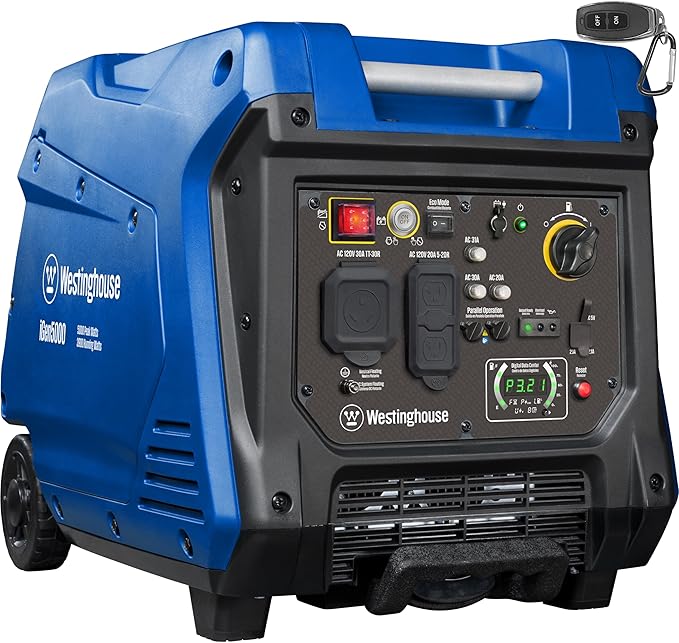
The Westinghouse iGen5000 is the largest generator in this group and is aimed at campers who need considerably more power than a compact 2,000-watt inverter can provide.
It produces 5,000 peak watts and 3,900 running watts, making it much more suitable for RV camping, multiple appliances, and larger electrical loads.
Westinghouse rates the iGen5000 at as low as 52 dBA and lists a runtime of up to 18 hours at 25% load from its 3.4-gallon gasoline tank. It also has a TT-30R RV outlet, two 120V household outlets, USB ports, electric start, remote start, and an LED data center.
Key Specifications
- Peak output: 5,000 watts
- Running output: 3,900 watts
- Noise: 52 dBA
- Fuel: Gasoline
- Tank: 3.4 gallons
- Runtime: Up to 18 hours at 25% load
- Weight: About 104.7 lb
- RV outlet: TT-30R
- THD: ≤3%
- Starting: Recoil, electric, and remote
- Parallel capable: Yes
One important detail is easy to miss: the standard iGen5000 specification does not list a CO sensor. Westinghouse sells the iGen5000c separately with a CO sensor and automatic CO shutdown. Therefore, you should verify which model you are purchasing rather than assuming every iGen5000 includes CO protection.
Best For
The Westinghouse makes the most sense for RV campers and outdoor users who need substantial 120V power without moving up to a much louder open-frame generator.
Its main disadvantage is weight. At more than 100 pounds, this is not a generator you want to carry deep into a campsite.
2. Champion 4000-Watt Inverter Generator
Check Amazon Price Click Here!
The Champion 4000-Watt Inverter Generator occupies a useful middle ground. It provides significantly more power than a compact 2,000-watt-class generator while remaining much easier to transport than many larger portable generators.
Champion lists 4,000 starting watts and 3,000 running watts, with a noise rating of 64 dBA at 23 feet. The company also specifies a weight of less than 49 pounds, making this one of the more portable options in its output class.
Key Specifications
- Peak output: 4,000 watts
- Running output: 3,000 watts
- Noise: 64 dBA at 23 feet
- Fuel: Gasoline
- Runtime: Up to 10 hours at 25% load
- Weight: Less than 49 lb
- RV outlet: TT-30R
- THD: Less than 3%
- Starting: Recoil
- Parallel capable: Yes
Champion also includes CO Shield, which automatically shuts down the generator when dangerous carbon monoxide levels are detected. Economy Mode can reduce engine speed when the electrical load is lower.
Best For
This model is a practical choice for RV camping, tailgating, and car camping when you need more power than a compact 2,000-watt generator can provide.
The trade-off is noise. At 64 dBA, it is not in the same low-noise class as the quietest 2,000-watt inverter generators.
3. ERAYAK 2400W Portable Inverter Generator
Check Amazon Price Click Here!
If your camping setup is mostly about keeping essential electronics running, the ERAYAK 2400W Portable Inverter Generator is much closer to the sweet spot.
It provides 1,800 running watts and 2,400 peak watts and weighs approximately 42 pounds. The published specification lists about 52.5 dB at 7 meters and 25% load, while the manufacturer’s current product information also describes it as a compact generator for camping and small essential loads.
Key Specifications
- Peak output: 2,400 watts
- Running output: 1,800 watts
- Noise: About 52.5 dB at 25% load
- Fuel: Gasoline
- Tank: 0.95 gallon
- Weight: About 42 lb
- Engine: 79.7cc
- ECO mode: Yes
- Inverter technology: Yes
- THD: Under 3% according to current product information
The compact size makes it easier to transport than the Westinghouse or WEN models. It is a better match for campers who mainly need power for lights, electronics, chargers, a small refrigerator, or other moderate loads.
Despite its relatively low weight, remember that 42 pounds is still substantial for backpacking. This is better suited to car camping, tent camping, van camping, and tailgating than carrying long distances on foot.
Best For
Choose the ERAYAK if low noise and portability are more important than maximum wattage.
It is also a good example of why you should not automatically buy the biggest generator available. If your actual electrical demand is modest, a smaller inverter can be easier to transport and less intrusive at the campsite.
4. WEN DF680iX 6800-Watt Dual Fuel Inverter Generator
Check Amazon Price Click Here!
The WEN DF680iX is designed for campers who need substantially more power and want the flexibility of using either gasoline or propane.
On gasoline, WEN lists 6,800 surge watts and 5,100 rated watts. With propane, the output is 6,000 surge watts and 4,500 rated watts. WEN rates the generator at 64 decibels at quarter load.
Key Specifications
- Gasoline peak: 6,800 watts
- Gasoline running: 5,100 watts
- Propane peak: 6,000 watts
- Propane running: 4,500 watts
- Noise: 64 dBA at quarter load
- Fuel: Gasoline or propane
- Starting: Electric and recoil
- RV outlet: TT-30R
- 120/240V outlet: L14-30R
- CO protection: WEN Watchdog
- Fuel shutoff: Yes
- Parallel capable: Yes
The dual-fuel design is particularly useful for RVers who already carry propane for other camping equipment.
The built-in fuel shutoff is another useful feature. It allows the generator to use the remaining fuel in the carburetor before shutting down, which can help reduce fuel-related maintenance problems during storage.
Best For
The WEN is best for large RVs, extended camping trips, and campers who need high output.
It is not the generator I would choose if absolute quiet is your priority. At 64 dBA at quarter load, smaller inverter generators can be noticeably quieter.
5. AMERISUN 2500W Inverter Generator
Check Amazon Price Click Here!
The AMERISUN 2500W Inverter Generator is compact and relatively light, but there is an important reason it should not be described as one of the quietest generators in this roundup.
The AM5020C produces 2,500 starting watts and 1,900 running watts and weighs about 39.7 pounds. However, the current AMERISUN product information lists its noise rating at 69 dB at 23 feet.
Key Specifications
- Peak output: 2,500 watts
- Running output: 1,900 watts
- Noise: 69 dBA at 23 feet
- Fuel: Gasoline
- Tank: About 1.06 gallons
- Weight: About 39.7 lb
- CO protection: CO Alert
- ECO mode: Yes
- Runtime: About 5.5 hours at 50% load
- THD: Less than 3%
Its biggest advantages are portability, compact dimensions, and a relatively low price compared with larger generators.
However, if your primary search intent is quiet camping generator, the 69 dBA specification makes the AMERISUN a weaker fit than the ERAYAK.
Best For
Consider the AMERISUN if weight, price, and compact size are more important to you than having the lowest possible noise level.
For a campground with strict generator noise rules, always check the campground’s current requirements before relying on this model.
How to Choose a Quiet Generator for Camping
Choosing the right generator is easier when you start with the appliances you actually plan to use.
1. Calculate Your Running Wattage
Running watts are the amount of electricity an appliance normally consumes while operating.
For example, a camping setup might include:
- LED lights
- Phone chargers
- Laptop
- Small fan
- Refrigerator
- Coffee maker
- Microwave
- CPAP machine
- Television
Add the running wattage of the devices you expect to operate simultaneously.
Then consider starting watts.
Refrigerators, compressors, pumps, and some air conditioners can require substantially more power for a few seconds when their motors start.
That is why a generator rated at 1,800 running watts and 2,400 peak watts can handle loads that would overload a generator with only 1,800 watts of surge capacity.
2. Think About Your Camping Style
Your camping style should influence the generator you buy.
Tent Camping
For basic tent camping, a 1,800–2,400 running/peak-watt-class inverter generator can be sufficient for charging electronics, lights, fans, and other small loads.
The ERAYAK is much easier to handle than a 100-pound generator.
Car Camping
Car camping gives you more flexibility because you do not have to carry the generator long distances.
A 2,000- to 4,000-watt inverter can make sense if you want to operate more appliances.
RV Camping
RV campers should pay close attention to the outlet configuration.
A generator with a TT-30R RV outlet can be much more convenient than using adapters.
If you want to run an RV air conditioner, check both the generator’s running output and its starting/surge capability.
Large RVs and High-Demand Loads
If you need several high-demand appliances at once, moving into the 5,000-watt-plus category may make sense.
This is where generators such as the Westinghouse and WEN become more relevant.
How Quiet Is Quiet Enough for Camping?
There is no single decibel number that makes a generator universally acceptable at every campground.
Noise ratings depend on:
- Measurement distance
- Electrical load
- Engine speed
- Test conditions
- Surrounding environment
For example, Honda lists the EU2200i at 48 dBA at quarter load and 57 dBA at rated load.
That illustrates why simply comparing “52 dB” against “64 dB” without understanding the testing conditions can be misleading.
As a practical rule, look for an enclosed inverter generator with a published rating around 60 dBA or lower, then check the campground’s specific noise rules.
Also remember that some campgrounds restrict generator operation entirely during certain hours.
Inverter Generators vs. Conventional Generators for Camping
For most camping applications, an inverter generator is preferable to an open-frame conventional generator.
Inverter Generator Advantages
- Generally quieter
- Better fuel efficiency at lighter loads
- Variable engine speed
- Cleaner electrical output
- More compact designs
- Better suited to campgrounds
Conventional Generator Disadvantages
- Usually louder
- Often larger and heavier
- Engine may operate at a constant speed
- Less pleasant around tents and neighboring campsites
If your main objective is quiet camping power, an enclosed inverter generator is usually the better starting point.
Gasoline vs. Dual Fuel for Camping
Gasoline remains convenient because it is widely available and many compact generators are designed around it.
Dual-fuel generators add propane as another option.
Gasoline
Advantages:
- Easy to find
- High energy density
- Good choice for portable camping
Disadvantages:
- Requires proper fuel storage
- Gasoline can deteriorate during long-term storage
- Spills and odors can be inconvenient
Propane
Advantages:
- Long shelf life
- Convenient for campers already carrying propane
- Useful as an alternative fuel during extended trips
Disadvantages:
- Can produce less power than gasoline on some generators
- Requires propane cylinders
- Adds another fuel container to your camping setup
The WEN DF680iX is an example of a generator designed specifically around this flexibility.
Generator Safety for Camping
Quiet operation does not make a gasoline generator safe to use inside a tent, RV, vehicle, cabin, garage, or other enclosed space.
Carbon monoxide is colorless and odorless and can become dangerous quickly.
The U.S. Consumer Product Safety Commission recommends operating portable generators outside and at least 20 feet away from homes, with the exhaust directed away from buildings and openings.
For camping, apply the same principle to your sleeping and living areas.
Follow These Rules
- Keep the generator outside.
- Keep it at least 20 feet away from tents, RV openings, cabins, and other occupied structures where practical.
- Point the exhaust away from people and openings.
- Never operate it inside a tent or enclosed shelter.
- Never operate it inside an RV.
- Never operate it inside a vehicle.
- Never operate it inside a garage or shed.
- Keep the generator dry and protected from direct rain according to the manufacturer’s instructions.
- Allow the engine to cool before refueling.
- Keep fuel away from flames and ignition sources.
- Follow the generator’s owner manual.
- Check campground-specific generator rules before your trip.
A built-in CO shutoff is an important safety feature, but it is not permission to operate a generator indoors. CPSC specifically recommends looking for generators with automatic CO shutoff protection while still following outdoor-use requirements.
Tips for Making a Camping Generator Quieter
You cannot make a gasoline generator silent, but you can reduce unnecessary noise.
Use ECO Mode
When your electrical load is light, ECO or Economy mode can reduce engine speed, which may lower noise and fuel consumption.
Avoid Oversizing the Generator
A generator that is much larger than necessary may be heavier, more expensive, and less convenient.
Choose enough capacity for your real load rather than automatically buying the biggest model.
Place It Correctly
Keep the generator on a stable surface and away from your tent or RV.
Do not place it closer simply because it sounds quiet.
Safety distance is more important than noise reduction.
Maintain the Generator
A poorly maintained engine can run rougher and louder.
Keep up with:
- Oil changes
- Air-filter maintenance
- Spark-plug inspection
- Fuel-system maintenance
- Manufacturer-recommended service
Respect Quiet Hours
Even a relatively quiet generator can annoy nearby campers at night.
Follow the campground’s posted generator hours rather than assuming that a low dBA rating means you can operate it whenever you want.
Quiet Camping Generator FAQs
What is the quietest type of generator for camping?
An enclosed inverter generator is generally the best type for quiet camping because its engine speed can vary with the electrical load. Smaller inverter generators in the roughly 2,000-watt class can be particularly quiet when operating at light loads. Battery power stations are quieter still because they have no gasoline engine, although they provide a different type of power solution.
Is 60 dB quiet enough for camping?
A generator rated around 60 dBA can be reasonably quiet compared with many conventional generators, but the number alone does not determine whether it is allowed at a campground. Check the measurement distance, load condition, and campground rules before buying or operating a generator.
Can I run a generator next to my tent?
No. A gasoline generator should not be operated next to a tent. Portable generators produce carbon monoxide, and CPSC recommends operating them outdoors at least 20 feet from homes, with exhaust directed away from buildings and openings. Apply the same safety principle when positioning a generator around a campsite.
What size generator do I need for camping?
For basic charging, lights, small electronics, and similar loads, a generator in the 1,800- to 2,400-watt range may be sufficient. RVs and larger appliances can require 3,000 watts or more. Always calculate your expected running and starting wattage before choosing a generator.
Are inverter generators better for camping?
For most camping situations, yes. Inverter generators are generally quieter, more fuel-efficient at partial loads, and designed to provide stable electrical output for electronics. Their enclosed designs also make them more appropriate for campsites than many loud open-frame generators.
Can a quiet generator run a CPAP machine?
Many inverter generators can power CPAP machines, but you should verify the CPAP manufacturer’s power requirements and the generator’s electrical specifications. A generator with stable inverter output and adequate wattage can be appropriate, but a CO-safe outdoor setup is still essential.
Are silent gasoline generators actually silent?
No. “Silent generator” is primarily a marketing or search term. Gasoline generators have combustion engines and therefore produce noise. The more accurate terms are quiet generator, low-noise generator, or quiet inverter generator.
Which Quiet Camping Generator Should You Choose?
There is no single generator that makes sense for every camper.
Choose the ERAYAK 2400W if you want a compact generator for tent camping, car camping, charging electronics, and other relatively small loads.
Choose the Champion 4000-Watt Inverter if you want a balance between portability and higher electrical output, particularly for RV camping and tailgating.
Choose the Westinghouse iGen5000 if you need significantly more 120V power and want features such as remote start and an RV-ready TT-30R outlet.
Choose the WEN DF680iX if high output and dual-fuel capability are priorities. Its gasoline and propane capability makes it particularly interesting for extended RV trips.
Consider the AMERISUN 2500W if compact size and low weight are more important than having the lowest possible noise level. Its current manufacturer-listed 69 dBA rating means it should not be confused with the quietest generators in this category.
Final Recommendation
For 2026, the best quiet camping generator is not necessarily the generator with the highest wattage.
Start by determining what you actually need to power. If your camping setup consists mostly of phones, laptops, lights, a small refrigerator, fans, or other modest loads, a compact inverter generator can save you from carrying a much larger machine.
For RV camping, pay more attention to running watts, starting watts, TT-30R compatibility, noise, weight, and fuel options.
Most importantly, never sacrifice safety for quiet operation. A generator should remain outside and safely away from tents, RV openings, buildings, and other occupied spaces. CPSC recommends at least 20 feet from homes and directing exhaust away from openings.
The right generator should give you useful power without becoming the loudest thing at the campsite. In 2026, an efficient enclosed inverter generator remains one of the most practical ways to bring portable electricity outdoors while keeping noise under control.