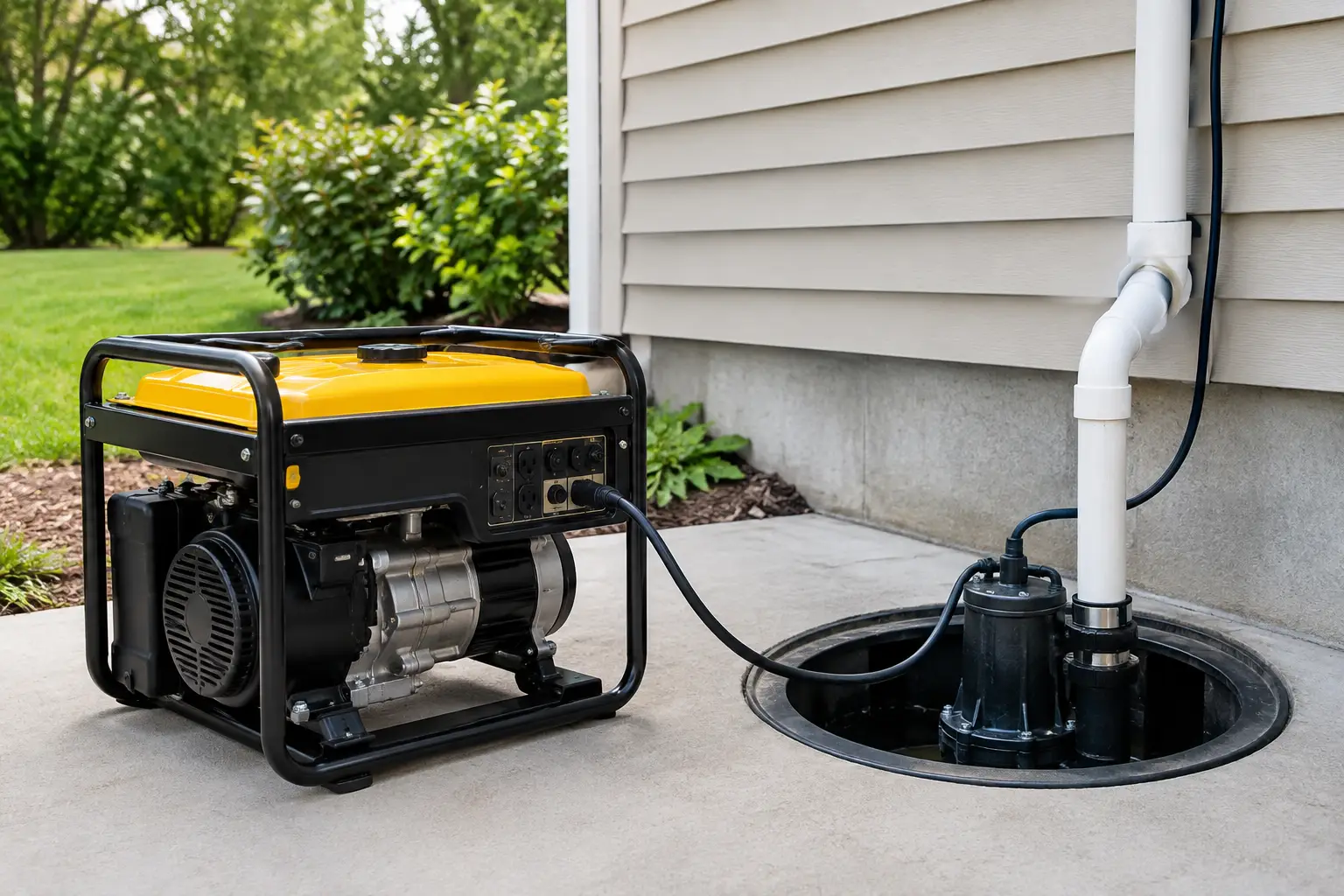
A power outage during heavy rain can become a serious problem when a basement relies on a sump pump. Without electricity, the pump cannot remove incoming water, and the risk of flooding increases as the outage continues. So, can a generator power a sump pump? In most cases, yes. The generator needs enough continuous power to run the motor and enough starting capacity to handle the pump’s initial surge. Just as important, it must be connected and operated in a way that avoids electrical shock, fire, and backfeeding hazards.
The main mistake is sizing the generator only by its running-watt rating. A sump pump motor can draw considerably more power when it starts, so a generator that looks large enough on paper may still struggle to start the pump.
Can a Generator Power a Sump Pump During an Outage?
A portable generator can power a residential sump pump when the generator’s output matches the pump’s electrical requirements. Many household sump pumps operate on 120-volt power, but the exact amperage, horsepower, and starting demand vary by model. Check the pump’s nameplate or owner’s manual before choosing a generator.
As a rough planning example, a 1/3-horsepower sump pump may run in the neighborhood of 800 to 1,000 watts and require substantially more power when the motor starts. A 1/2-horsepower pump can also have a significantly higher starting demand than its running load suggests. These figures are only examples, not universal specifications. The pump’s nameplate, owner’s manual, or manufacturer documentation should take priority.
That startup demand matters because generators are rated in two different ways. Running watts describe what the generator can supply continuously. Starting watts, also called surge capacity by some manufacturers, describe the extra short-term capacity available to start motors. A generator that produces 1,800 running watts but only 2,200 starting watts may be marginal for a pump that needs a 2,400-watt startup surge.
For a sump pump by itself, the required generator size depends on the pump’s running and starting requirements. A generator in the 2,000- to 3,000-watt range may be sufficient for some installations, but the pump’s actual electrical specifications should determine the minimum capacity. If you also want to keep a refrigerator, freezer, lights, modem, furnace blower, or well pump operating, calculate the combined load rather than guessing.
Size the Generator for the Pump You Actually Have
Start with the pump’s nameplate or owner’s manual. Look for watts, amps, volts, and horsepower. If the label lists volts and amps but does not provide watts, multiplying volts by amps gives you an approximate electrical load in volt-amperes. For motor loads, however, that number should not be treated as an exact running-watt figure. Use the manufacturer’s specifications whenever they are available.
Motor startup is less exact. Many motors can draw substantially more power for a short period when they start, and the actual surge depends on the motor and pump design. When documentation does not list starting watts, giving the generator a healthy margin is smarter than buying at the edge of the estimate.
A practical planning example: a 1/2-horsepower sump pump uses 1,200 running watts and 3,000 starting watts. Add a refrigerator at 700 running watts with a 2,100-watt startup need. The combined operating load would be about 1,900 watts once both appliances are running. In this example, the generator also needs enough surge capacity to start the motors without triggering an overload. The exact generator size should be selected from the actual starting specifications of both appliances.
Do not overlook other loads that may cycle on unexpectedly. A dehumidifier, freezer, gas furnace blower, or powered septic system can consume the capacity you intended to reserve for the sump pump. During a storm, the pump is the priority. Turn off nonessential loads before starting it.
Inverter or Conventional Generator?
An inverter generator is often a practical choice when the pump is one of the main emergency loads. Inverter generators are often quieter and can use less fuel at lighter loads because their engines can adjust output to demand. They can also provide clean power for sensitive electronics, depending on the model’s specifications. A 3,000- to 4,500-watt inverter generator may serve many homeowners well if its surge rating matches the pump’s requirements.
A conventional open-frame generator may provide more watts per dollar and can make sense for a larger pump, several appliances, or a home that also needs to run a well pump. The trade-off is usually more noise, more weight, and less convenient storage. Either type can work for a sump pump when its electrical output, starting capacity, and operating requirements match the load.
The Safest Ways to Connect a Generator to a Sump Pump
The simplest temporary method is to plug the sump pump directly into the generator with one outdoor-rated extension cord. Use a heavy-duty cord sized for the distance and the amperage of the pump. For a 15-amp load, a properly rated 12-gauge outdoor extension cord is often a practical choice, particularly over longer distances. The cord’s amp rating, length, and the pump’s actual load should all be considered.
Keep the cord as short as practical, inspect it for damage, and keep every connection dry and off the floor. The generator must remain outdoors, well away from doors, windows, vents, and attached garages. Carbon monoxide can enter a house quickly, even when the generator is positioned outside.
For a more permanent backup plan, a qualified electrician can install a manual transfer switch or generator interlock with a properly sized inlet box. This lets you power the sump pump’s dedicated circuit through the home’s electrical panel without running a cord through a window or basement door. It is especially useful when the pump is hardwired, located far from an exterior wall, or paired with other essential circuits.
Never plug a generator into a wall outlet or attempt to energize the house through a dryer receptacle. This practice, called backfeeding, can send dangerous electricity onto utility lines and can damage equipment when utility power returns. A transfer switch or listed interlock is the correct way to connect a portable generator to household circuits.
Check Neutral and Grounding Requirements
Generator grounding and neutral bonding can become complicated when a generator is connected through a transfer switch. Some portable generators have a bonded neutral, while others use a floating neutral. The transfer equipment and local electrical requirements determine which arrangement is appropriate.
This is not something to solve with an improvised bonding plug or adapter. Follow the generator manual and the transfer switch instructions, and ask a qualified electrician to verify compatibility before an emergency. A direct extension-cord connection to the pump is generally less complicated, but the generator still needs to be used according to its manual.
Test the Setup Before Storm Season
A backup generator is only useful if it starts, carries the load, and has fuel when the rain begins. Test the complete setup periodically and before the seasons when heavy rain or storms are most likely in your area. Run the generator outdoors, connect the pump using the exact cord or transfer equipment you plan to use, and let the pump complete several normal cycles.
Watch for overload lights, tripped breakers, dimming lights, unusual pump noise, or a generator engine that bogs down when the float activates. These signs can point to an undersized generator, an undersized extension cord, a worn pump motor, or a partially blocked discharge line.
Also test the sump pump itself by slowly adding water to the pit until the float engages. Confirm that water moves freely through the discharge pipe and that the check valve prevents water from draining back into the basin. Generator capacity cannot compensate for a failed float switch, a jammed impeller, or a frozen discharge line.
Keep fresh fuel on hand in an approved container and follow the generator manufacturer’s storage recommendations. If gasoline will be stored for an extended period, use fuel stabilizer according to the product and generator instructions. Follow the storage and fuel-maintenance guidance in the generator’s owner’s manual rather than relying on a one-size-fits-all schedule.
Propane can simplify some fuel-storage concerns associated with gasoline, although propane tanks still need to be stored and handled according to applicable safety guidance. The generator’s expected fuel consumption and the size of the available propane supply should also be considered during a prolonged outage.
When a Generator Is Not the Whole Answer
A battery backup sump pump adds another layer of protection. It can keep a secondary pump running during a short outage, cover the period while you set up the generator, or help when you are away from home. It is not necessarily a replacement for a generator during a long storm because battery runtime is limited, but the two systems can work well together.
Homes with frequent flooding, deep basements, or a single critical pump may also benefit from a secondary sump pump and a high-water alarm. If the primary pump fails mechanically, even the best generator will not move water. For a flood-prone basement, having a second layer of protection can address risks that a larger generator alone cannot solve.
Common Questions About Generators and Sump Pumps
What size generator do I need for a sump pump?
The correct generator size depends on the sump pump’s running and starting requirements. Check the pump’s nameplate or owner’s manual first. The generator must have enough continuous output to run the pump and enough starting capacity to handle the motor’s startup demand. If other appliances will run at the same time, include their loads in the calculation.
Can I plug my sump pump directly into a generator?
Yes, a portable sump pump can often be connected directly to a generator with a properly rated outdoor extension cord. Keep the generator outdoors and away from doors, windows, vents, and attached garages. Never connect a generator to a household wall outlet. For hardwired pumps, a transfer switch or listed interlock installed by a qualified electrician is the appropriate approach.
Can a 2,000-watt generator run a sump pump?
It may, depending on the pump’s running and starting requirements. A 2,000-watt generator can be enough for some smaller sump pumps, but the starting surge can exceed the generator’s available capacity. Check both the generator’s continuous and surge ratings and compare them with the pump’s actual specifications before relying on the setup during an outage.
Before the next major storm, identify your pump’s electrical requirements, test the generator under load, and decide how you will connect it safely. A little preparation can make it much easier to keep the sump pump operating when utility power fails.