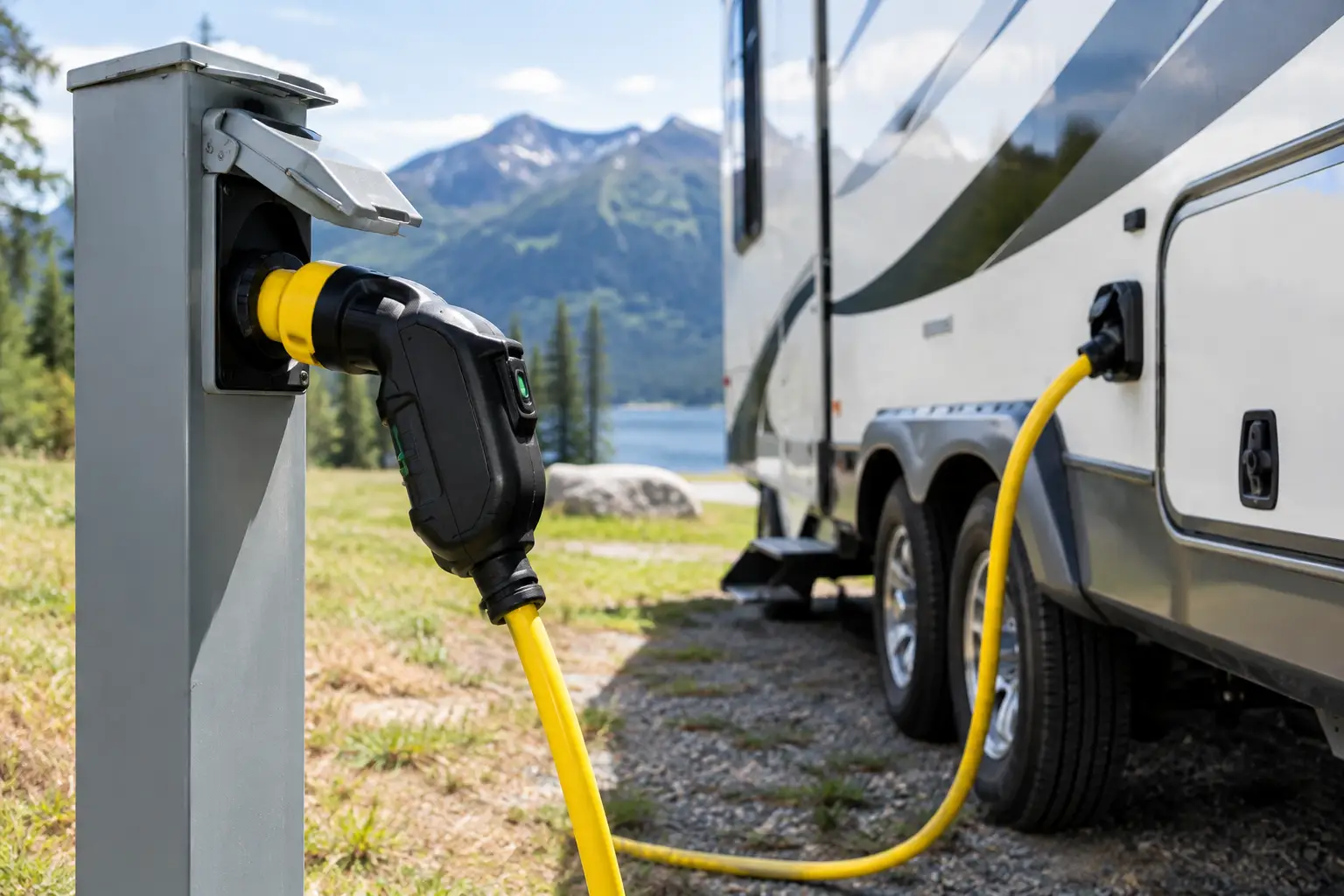
A campground pedestal can look perfectly normal and still have low voltage, high voltage, reversed polarity, an open neutral, or other wiring problems that can damage sensitive RV equipment. That is why many RV owners choose more than basic surge suppression. An electrical management system (EMS) can test the pedestal before your RV is connected, monitor incoming power while you camp, and shut off electricity when conditions become unsafe.
For most RV owners, electrical protection is easier to justify before something goes wrong than after an expensive repair. The right unit depends mainly on whether your RV uses 30-amp or 50-amp shore power, whether you want a portable or hardwired system, and whether you want basic surge protection or full EMS monitoring.
What the Best RV Surge Protectors Actually Do
The term “surge protector” covers several different types of RV electrical protection. A basic surge protector is designed primarily to handle voltage spikes, but it may not shut down the RV when the pedestal has low voltage, high voltage, an open neutral, reverse polarity, or other wiring problems.
An electrical management system, commonly called an EMS, provides a much broader layer of protection. It checks the pedestal before allowing power to reach the RV and continues monitoring the electrical supply while you are connected. If voltage becomes too low or too high, or the system detects a wiring fault, an EMS can disconnect power and restore it only after conditions return to an acceptable range.
That delay matters because RV air conditioners use compressors that should not restart immediately after power is interrupted. A properly designed EMS uses a restart delay before restoring power, helping reduce unnecessary stress on the compressor.
No plug-in device can fix a defective campground electrical system. What it can do is detect certain unsafe conditions and disconnect your RV before those conditions reach its electrical system. That distinction is important when comparing a basic surge protector with a full EMS.
Our Top Picks by RV Setup
| Model | Best For | RV Service | Protection Type | | ————————————– | ————————— | ———- | ————————– | | Progressive Industries EMS-PT30 family | 30-amp RVs | 30A | Portable EMS | | Progressive Industries EMS-PT50 family | 50-amp RVs | 50A | Portable EMS | | Hughes Power Watchdog Gen II | App-based monitoring | 30A / 50A | Portable EMS/EPO options | | Southwire Surge Guard | Different protection levels | 30A / 50A | Portable and other options |
Best for 30-Amp RVs: Progressive Industries EMS-PT30
The Progressive Industries EMS-PT30 family is a strong choice for owners of 30-amp RVs who want broader electrical protection than a basic surge protector provides. It is particularly suited to campers who regularly use campground hookups and want a portable unit that can check incoming power before allowing it into the RV.
Progressive Industries documentation for its 30-amp EMS protection includes monitoring for low and high voltage, wiring problems, frequency, and surge protection, along with a compressor restart delay. The exact specifications can vary by model revision, so check the current documentation before purchasing.
Best for 50-Amp RVs: Progressive Industries EMS-PT50
For a fifth wheel or larger motorhome with 50-amp service, the Progressive Industries EMS-PT50 family is a corresponding portable EMS option. It is best suited to RV owners who want automatic monitoring and shutdown protection for the two hot legs used by a typical 50-amp RV connection.
Progressive Industries documentation for its 50-amp EMS products includes separate voltage monitoring and protection against miswired power and accidental 240-volt conditions. Check the exact model documentation for the specific fault codes and protection thresholds before buying.
Best for App-Based Monitoring: Hughes Power Watchdog Gen II
Hughes Power Watchdog Gen II is worth considering if you want to monitor RV electrical information from a mobile device. The lineup includes 30-amp and 50-amp models, with standard and EPO versions available. Depending on the specific model, features can include Wi-Fi, Bluetooth, mobile energy monitoring, fault alerts, remote power control, and a replaceable surge module.
The important distinction is between standard Power Watchdog models and EPO models. Hughes states that its EPO models can automatically shut off power when certain unsafe conditions are detected, while non-EPO models do not provide the same automatic high- and low-voltage shutdown function. Always check the exact model number rather than assuming every Gen II unit has the same features.
Best Established Alternative: Southwire Surge Guard
Southwire’s Surge Guard lineup gives RV owners another established option, with 30-amp and 50-amp products ranging from basic surge protection to models with more extensive electrical monitoring. Depending on the model, features can include pedestal wiring analysis, automatic shutdown, overheating protection, surge protection, and wireless or app-based monitoring.
When comparing Surge Guard products, check the exact model rather than assuming every unit has the same features. Southwire’s recreational power lineup includes different levels of protection, so the cheapest Surge Guard model may not provide the same monitoring or shutdown features as a more advanced unit.
How We Compare RV Surge Protectors
The most useful way to compare RV surge protectors is to look beyond the advertised surge rating. We compare these systems based on the RV’s electrical service, the type of protection provided, voltage monitoring, wiring-fault detection, automatic shutdown, restart delay, portability, weather exposure, display information, warranty, and whether the surge-protection components can be replaced.
We also consider how practical each system is for different types of RV owners. A portable EMS can make more sense for someone who moves between campgrounds or changes RVs, while a hardwired system may be more attractive to an owner who wants permanent protection inside the coach.
The goal is not to choose the unit with the biggest number on the package. It is to find the level of protection that matches the RV, the type of hookups you use, and the electrical problems you want the system to detect.
30-Amp vs. 50-Amp: Buy for Your RV, Not the Pedestal
Match the EMS or surge protector to your RV’s shore-power service. A typical 30-amp RV uses a three-prong TT-30 connection, while a 50-amp RV uses the four-prong NEMA 14-50-style RV connection. A pedestal may offer both receptacles, but that does not change the electrical service your RV is designed to use.
A 50-amp RV has two 120-volt hot legs and can provide far more available power than a 30-amp RV. The two services are not interchangeable simply because an adapter fits. An adapter can change the physical connection, but it does not upgrade a 30-amp RV, its wiring, or its cord to a 50-amp electrical system. A 50-amp RV connected to a 30-amp pedestal through an appropriate adapter remains limited by the pedestal’s 30-amp supply.
If you use a dogbone adapter, follow the hookup order specified by the surge protector manufacturer. The goal is to have the EMS or surge protector evaluate the incoming power before it reaches the RV. Avoid unnecessary combinations of adapters,
extension cords, and splitters. Each additional connection creates another place for a loose fit, corrosion, overheating, or an incorrect connection to develop.
Portable or Hardwired RV Protection?
Portable units are the straightforward choice for many owners. They require no installation, can move to a new RV, and let you see the status display at the pedestal. They are also easier to replace if damaged. The main drawback is exposure to weather, theft, and physical damage. Units designed for outdoor use should still be positioned according to the manufacturer’s instructions and protected from unnecessary exposure to standing water.
A suitable locking cable can reduce the risk of theft, but it should not put pressure on the plug, cord, or protector housing. Keep the connection clear of standing water and avoid putting unnecessary strain on the pedestal connection.
Hardwired EMS units are installed inside the RV, typically as part of the shore-power circuit before electricity reaches the main distribution system. They stay protected from weather and theft, and many installations use a remote display so you can check electrical information from inside the coach. That makes hardwired protection particularly attractive to full-time RVers or owners who prefer a permanent installation.
The trade-off is installation complexity. A hardwired EMS requires working with the RV’s electrical system, correct conductor sizing, secure connections, and appropriate placement. If you are not qualified to work on RV electrical wiring, have the unit installed by a qualified RV technician or electrician. The EMS is only one part of the electrical system, and a poor connection can still create heat or damage.
For a simple comparison, portable protection is generally better for flexibility and easy replacement, while hardwired protection is better for a permanent installation that stays inside the RV. Neither format is automatically safer simply because of how it is installed; the quality of the installation and the features of the specific EMS still matter.
Features Worth Paying For
Do not choose an RV surge protector based on joule rating alone. A higher joule rating generally indicates greater surge-energy absorption capacity, but it does not tell you whether the unit detects low voltage, high voltage, reverse polarity, an open neutral, or other pedestal problems. For RV use, those monitoring and shutdown features can be just as important as surge protection.
Look for protection against high and low voltage, open ground, open neutral, reverse polarity, and accidental 240-volt conditions when those features are supported by the model. Also look for a clear fault display and a restart delay for air-conditioning equipment. Finally, check the warranty and find out whether the surge module can be replaced or whether the entire unit must be replaced after a major surge.
App-based monitoring can be useful if you want to check voltage, current, faults, or power status from inside the RV. Some current models use Bluetooth, while other systems add Wi-Fi and mobile monitoring on selected models. A physical display is still valuable during setup because it lets you diagnose the pedestal without depending on a phone connection.
Weather resistance, a secure grip, and a well-supported connection are easy features to overlook. RV power cords are heavy, especially 50-amp cords, so the protector should be designed to handle the physical load without placing excessive stress on the pedestal connection.
Do You Need an EMS or Just a Surge Protector?
If you only want protection against electrical surges, a basic RV surge protector may be enough. But if you want protection from low voltage, high voltage, reverse polarity, open ground, open neutral, or other pedestal problems, an EMS is the more comprehensive choice.
This distinction matters because a surge protector and an EMS do different jobs. Surge suppression helps reduce the effect of voltage spikes, while an EMS can continuously evaluate incoming power and disconnect the RV when it detects conditions outside its programmed limits.
For most RV owners who regularly use campground hookups, a full EMS is worth considering because it provides broader protection. It is especially useful for RVs with expensive air conditioners, refrigerators, converters, residential appliances, or other electronics that could be affected by poor shore power.
A basic surge protector can still make sense for owners who want a simpler and less expensive layer of protection. Just make sure you understand exactly what the model does before assuming it provides automatic shutdown for low or high voltage.
Using an RV EMS With Generators and Inverters
RV EMS units are primarily designed around shore-power connections, but some can also be used with generators or inverter generators when the electrical configuration is compatible. The generator’s neutral-ground arrangement matters because some RV EMS units may report an open-ground or related fault when connected to a generator with a floating neutral. Always check the generator and EMS manuals before assuming the two systems are compatible.
A properly sized generator outlet is also important when powering an RV.
Do not use a bonding plug simply to make an EMS error disappear. Whether a neutral-ground bond is appropriate depends on the generator, transfer equipment, RV electrical system, and applicable instructions. Follow the generator and EMS manufacturer’s guidance rather than treating a bonding plug as a universal solution.
Also match the
generator outlet, adapter, and RV cord to the generator’s rated output and the RV’s electrical service. A 30-amp generator setup should use appropriately rated connections and protection. A 50-amp RV can sometimes be powered by a smaller generator when loads are carefully managed, but an EMS cannot increase the generator’s available output.
A Quick Check Before Every Hookup
Before plugging in, inspect the pedestal outlet for discoloration, cracked plastic, loose contacts, or signs of overheating. Check your RV cord and adapters for worn blades, melted areas, and loose grips. Then connect the EMS or surge protector to the pedestal first and let it complete its startup test before connecting the RV.
If the device reports a wiring fault, do not bypass the warning simply to restore power. Check the displayed error against the manufacturer’s instructions and notify campground staff if the pedestal appears to be the problem. If another approved pedestal is available, staff may be able to move you to a different connection. Do not connect the RV to power you know is unsafe.
A quality RV EMS does not make campground power perfect, but it can identify many electrical problems before they reach your RV and disconnect power when conditions become unsafe. For most RV owners who regularly use campground hookups, a full EMS is worth considering over a basic surge protector because it provides broader protection and useful diagnostics.
For a 30-amp RV, look for a 30-amp EMS that matches your electrical service. For a 50-amp fifth wheel or motorhome, choose a 50-amp model designed to monitor both hot legs. Portable units are convenient for travelers who want a plug-in solution, while hardwired systems make more sense for owners who want permanent protection.
The important thing is not simply buying the device with the biggest joule number. Choose a system that matches your RV, provides the electrical protections you actually need, and gives you a clear indication when campground power is not safe.
RV Surge Protector FAQs
What is the best RV surge protector for a 30-amp RV?
For a 30-amp RV, the Progressive Industries EMS-PT30 family is a strong choice if you want full EMS-style protection rather than basic surge suppression. Hughes Power Watchdog also offers 30-amp models, including EPO versions with additional monitoring and automatic shutdown features. Compare the exact model features before choosing.
What is the best RV surge protector for a 50-amp RV?
For a 50-amp RV, the Progressive Industries EMS-PT50 family is a strong option for portable EMS protection. Hughes Power Watchdog also offers 50-amp models with different feature levels, including EPO versions. Southwire’s Surge Guard lineup provides additional 50-amp alternatives, so compare the exact protection features rather than choosing by brand alone.
Do I really need a surge protector for my RV?
A surge protector or EMS is a worthwhile layer of protection when you regularly connect your RV to campground power. A full EMS can provide more than surge suppression by detecting conditions such as low voltage, high voltage, reverse polarity, or wiring faults and disconnecting the RV when necessary.
Is an EMS better than an RV surge protector?
An EMS generally provides broader protection. A basic surge protector is mainly designed to handle electrical surges, while an EMS can also monitor incoming voltage and detect certain wiring problems. For frequent campground use, an EMS is usually the more comprehensive choice.
Should I use a 30-amp or 50-amp surge protector?
Match the protector to your RV’s electrical service. A 30-amp RV should use a 30-amp device, while a 50-amp RV should use a 50-amp device designed for that service. An adapter can change the connection but does not upgrade the RV’s electrical capacity.
Can an RV surge protector be used with a generator?
Some can, but compatibility depends on the generator and the EMS. Neutral-ground configuration is particularly important because a floating-neutral generator may cause certain EMS units to report an electrical fault. Check both manufacturers’ instructions before using an EMS with a generator.
How long do RV surge protectors last?
There is no universal replacement interval. A surge protector may continue working for years if it has not experienced a damaging event, while a major surge can use up its protection components. Models with replaceable surge modules can be serviced without replacing the entire device.