As an Amazon Associate I earn from qualifying purchases.
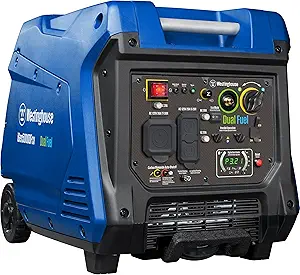
Finding the right RV inverter generator is not simply a matter of buying the model with the highest wattage. For a travel trailer, the generator needs to provide enough running power for your everyday appliances, enough starting power for demanding loads such as a rooftop air conditioner, and an RV-friendly outlet that works with your trailer’s electrical system.
In 2026, several portable inverter generators stand out for travel trailers because they combine relatively quiet operation, clean power, fuel efficiency, and practical RV features. Dual-fuel models are especially useful for campers who want the option of running on either gasoline or propane.
The five models below cover different needs, from lightweight camping power to higher-output generators capable of handling a larger appliance load.
Quick Comparison: Best RV Inverter Generators for Travel Trailers
| Generator | Peak Watts | Running Watts | Fuel | RV Outlet | Noise | Best For |
|---|---|---|---|---|---|---|
| Westinghouse iGen5000DFc | 5,000 W gas / 4,500 W propane | 3,900 W gas / 3,500 W propane | Dual fuel | TT-30R | 52 dBA | Larger 30A travel trailers |
| WEN DF680iX | 6,800 W gas / 6,000 W propane | 5,100 W gas / 4,500 W propane | Dual fuel | TT-30R | Varies by load | High-power RV use |
| MaXpeedingrods 3500W | 3,500 W | 3,000 W | Gasoline | 30A RV outlet | 58 dBA | Lightweight RV use |
| Champion 4500W Inverter | 4,500 W | 3,500 W | Gasoline | TT-30R | 61 dBA | Balanced RV performance |
| Westinghouse iGen2550DFc | 2,550 W gas / 2,300 W propane | 1,900 W gas / 1,700 W propane | Dual fuel | TT-30R | 52 dBA | Lightweight trailers and basic loads |
Important: Peak or starting watts are not the same as continuous running watts. When sizing a generator for your travel trailer, running watts are usually the more important number after the generator has started your appliances.
1. Westinghouse iGen5000DFc Dual Fuel Inverter Generator
Check Amazon Price Click Here!
The Westinghouse iGen5000DFc is a strong choice for travel trailer owners who want more power without moving to a conventional open-frame generator.
It produces up to 5,000 peak watts and 3,900 running watts on gasoline. When operating on propane, output is rated at 4,500 peak watts and 3,500 running watts.
That gives a 30-amp travel trailer considerably more usable capacity than a small 2,000-watt-class inverter generator.
Key specifications
- Gasoline output: 5,000 peak / 3,900 running watts
- Propane output: 4,500 peak / 3,500 running watts
- Noise rating: as low as 52 dBA
- Fuel: gasoline or propane
- RV outlet: 120V TT-30R
- Gasoline tank: 3.4 gallons
- Gasoline runtime: up to 18 hours at 25% load
- Propane runtime: up to 22 hours at 25% load
- Starting: electric, remote, and recoil
- THD: ≤3%
- Weight: approximately 106 lb.
- Parallel capable: yes
The generator also includes a digital data center, economy mode, automatic low-oil shutdown, and a carbon monoxide sensor.
Why it works well for a travel trailer
The biggest advantage is the combination of 3,900 running watts, dual-fuel operation, and a TT-30R outlet. That makes it much better suited to an RV lifestyle than a basic portable generator designed primarily for household outlets.
It also has enough capacity for many common travel-trailer setups where you need to run an air conditioner while still using smaller appliances.
The tradeoff is weight. At more than 100 pounds, this is not a generator you want to lift repeatedly by yourself.
Best for: RV owners who want a higher-output, relatively quiet dual-fuel generator for a 30-amp travel trailer.
2. WEN DF680iX 6800-Watt Dual Fuel Inverter Generator
Check Amazon Price Click Here!
If your travel trailer needs more electrical capacity, the WEN DF680iX moves into a higher power class.
This dual-fuel inverter generator produces 6,800 surge watts and 5,100 rated watts on gasoline. On propane, it provides 6,000 surge watts and 4,500 rated watts.
That extra running capacity can be useful when you need to operate multiple larger appliances rather than just an air conditioner and a few small electronics.
Key specifications
- Gasoline output: 6,800 surge / 5,100 rated watts
- Propane output: 6,000 surge / 4,500 rated watts
- Fuel: gasoline or propane
- RV outlet: TT-30R
- Engine: 224cc
- Starting: electric start
- CO protection: WEN Watchdog automatic shutdown
- Fuel shutoff: yes
- Wheels: yes
- Telescoping handle: yes
- Warranty: 3 years
The DF680iX also includes a 120V/240V L14-30R receptacle, standard 120V outlets, a TT-30R RV receptacle, USB ports, and a propane quick connector.
Why choose a 6,800-watt generator for an RV?
More power does not automatically mean a better RV generator.
If your travel trailer has a single rooftop air conditioner and you mainly use lights, a refrigerator, a television, chargers, and occasional small appliances, you may not need this much capacity.
However, additional headroom becomes useful when several high-demand appliances are operating close together.
The main disadvantage is size and weight. This is better suited to RV owners who prioritize electrical capacity over maximum portability.
Best for: larger trailers, heavier electrical loads, and campers who want substantial power headroom.
3. MaXpeedingrods 3500W Inverter Generator
Check Amazon Price Click Here!
The MaXpeedingrods 3500W inverter generator takes a different approach. Instead of maximizing output, it focuses on providing a useful amount of RV power while keeping the generator considerably lighter than the larger models.
It is rated for 3,500 starting watts and 3,000 running watts.
Key specifications
- Peak output: 3,500 watts
- Running output: 3,000 watts
- Fuel: gasoline
- Noise: approximately 58 dBA
- Weight: about 47 lb.
- Fuel tank: 4 liters
- Runtime: up to about 8.3 hours at 25% load
- Starting: recoil
- RV outlet: 30A
- Parallel capable: yes
- Eco mode: yes
- CO protection: yes
- THD: ≤3%
The manufacturer’s current specifications also list two 120V 20A outlets, a 120V 30A outlet, USB outlets, and parallel capability.
Why portability matters
A generator can be excellent on paper and still be frustrating for RV use if it is too heavy to move.
At roughly 47 pounds, this model is much easier to load into a truck, move around a campsite, or store when you’re not using it.
The compromise is its lower continuous output compared with the 5,000W and 6,800W models.
Before choosing it for your trailer, check the starting requirements of your rooftop air conditioner. A 3,000-watt running capacity may be adequate for many setups, but actual startup demand varies by air-conditioner model and other loads running at the same time.
Best for: campers who value portability and have moderate electrical demands.
4. Champion 4500-Watt Inverter Generator
Check Amazon Price Click Here!
The Champion 4500W inverter generator is a practical middle-ground option for RV owners who want more capacity than a compact inverter generator without stepping up to a 5,000W-plus machine.
It produces 4,500 starting watts and 3,500 running watts and includes a 120V 30A RV outlet.
Key specifications
- Starting watts: 4,500
- Running watts: 3,500
- Fuel: gasoline
- Noise: 61 dBA at 23 feet
- Runtime: up to 14 hours at 25% load
- RV outlet: 120V 30A
- THD: less than 3%
- CO protection: CO Shield
- Parallel capable: yes
- Weight: approximately 92 lb.
- Engine: 212cc
- Start: recoil
Champion specifically lists the 4500W model as suitable for RVs and camping. Its 120V 29.2A RV outlet is designed for a 30-amp RV connection, and the inverter produces less than 3% THD.
What makes it attractive for RV use?
The 3,500 running watts give you a useful amount of operating capacity for a typical 30-amp travel trailer.
It also includes Economy Mode, which allows the engine speed to vary according to the electrical demand. That can reduce fuel consumption and noise when the generator isn’t heavily loaded.
One important distinction is that the specific Champion model represented by the specifications above is gasoline-only. Champion also sells a separate 4500W dual-fuel inverter model, so shoppers should verify the exact model number before ordering.
Best for: RV owners looking for a well-equipped 4,500-watt gasoline inverter generator with a dedicated RV outlet.
5. Westinghouse iGen2550DFc Dual Fuel Inverter Generator
Check Amazon Price Click Here!
The Westinghouse iGen2550DFc is the lightweight option in this group.
It produces 2,550 peak watts and 1,900 running watts on gasoline, while propane output is rated at 2,300 peak and 1,700 running watts.
Key specifications
- Gasoline: 2,550 peak / 1,900 running watts
- Propane: 2,300 peak / 1,700 running watts
- Noise: as low as 52 dBA
- Fuel: gasoline or propane
- Weight: approximately 43 lb.
- Gasoline tank: 1.1 gallons
- Gasoline runtime: up to 11 hours at 25% load
- Propane runtime: up to 25 hours at 25% load
- RV outlet: TT-30R
- THD: ≤3%
- Starting: recoil
- CO sensor: yes
- Parallel capable: yes
The current Westinghouse specifications confirm its TT-30R RV outlet, 52 dBA rating, dual-fuel operation, and 43.2-pound dry weight.
Who should buy it?
This generator makes sense when portability is a higher priority than maximum output.
It can be useful for smaller travel trailers and campers who primarily need electricity for a refrigerator, lights, chargers, television, and other moderate loads.
However, its 1,900 running watts on gasoline means you should be careful about assuming it will start and continuously operate a large rooftop air conditioner.
For a trailer where air conditioning is essential, a larger generator may be the safer choice.
Best for: lightweight camping setups and smaller travel trailers with modest electrical requirements.
How Many Watts Does a Travel Trailer Generator Need?
This is one of the most important questions to answer before buying.
A generator’s advertised peak wattage can be misleading if you don’t also look at its continuous or running wattage.
For example, a generator advertised as 4,500 watts may provide only 3,500 watts continuously.
That distinction matters because your refrigerator, microwave, air conditioner, television, battery charger, and other appliances all consume power while running.
A typical 30-amp travel trailer
Many 30-amp travel trailers use a 120V electrical system with a maximum theoretical capacity of approximately 3,600 watts.
In practical use, you don’t want to select a generator based solely on that mathematical maximum.
Instead, consider your actual appliances.
A rough example could look like this:
| Appliance | Approximate Running Load |
|---|---|
| RV rooftop air conditioner | 1,200–1,800+ W |
| Refrigerator | 100–400 W |
| Microwave | 900–1,500 W |
| Television | 50–150 W |
| LED lighting | 20–100 W |
| Laptop/chargers | 50–200 W |
These numbers vary substantially between appliances.
The air conditioner’s startup demand can also be significantly higher than its running consumption.
That’s why a 3,500W to 4,500W inverter generator is often a more comfortable range for a 30-amp travel trailer when air conditioning is important.
What About a 50-Amp Travel Trailer or Fifth Wheel?
A 50-amp RV electrical system is a different situation.
Large fifth wheels and motorhomes may have substantially greater electrical demands, particularly when they have multiple air conditioners.
One portable generator may not be enough to operate every appliance simultaneously.
In those cases, you may need a higher-output generator, a suitable generator configuration, or two compatible inverter generators connected through a manufacturer-approved parallel system.
Don’t assume that simply plugging a generator into an adapter will provide the same capability as a properly sized 50-amp system.
Gasoline vs. Propane for RV Generators
Gasoline
Gasoline generally provides strong output and is widely available.
The disadvantage is that gasoline can be inconvenient to store for long periods, and stale fuel can create maintenance problems.
Propane
Propane is convenient for many RV owners because it can be stored for longer periods when handled correctly and is often already carried for an RV’s appliances.
The tradeoff is that generator output may be lower when running on propane.
For example, the Westinghouse iGen5000DFc is rated at 3,900 running watts on gasoline but 3,500 running watts on propane.
Dual fuel
For many RVers, dual fuel provides the best flexibility.
You can use gasoline when maximum output is important and propane when storage convenience or fuel availability makes it preferable.
How Quiet Should an RV Generator Be?
Noise matters more at a campground than it does in your driveway.
A generator rated at 52–61 dBA can be considerably more pleasant than a loud conventional open-frame generator, but don’t treat the published number as an absolute comparison.
Manufacturers may measure noise under different loads and conditions.
The Westinghouse iGen5000DFc, for example, is listed at as low as 52 dBA, while the Champion 4500W is listed at 61 dBA from 23 feet.
The actual sound you hear at your campsite will depend on load, distance, surrounding terrain, and the generator’s operating mode.
Always follow the campground’s generator hours and noise rules.
What Does Clean Power Mean?
Inverter generators are popular for RV use partly because they produce a stable electrical output suitable for sensitive electronics.
Many manufacturers advertise total harmonic distortion of 3% or less.
That can be useful for electronics such as:
- Laptops
- Televisions
- Phone chargers
- Battery chargers
- Modern appliances
- Other sensitive electronic equipment
However, don’t assume every generator is an inverter simply because it is advertised as “quiet.”
Check the specifications and confirm that it is actually an inverter generator.
RV Generator Safety: What You Need to Know
A portable generator produces carbon monoxide, which is a colorless and odorless poisonous gas.
Never operate a portable gasoline or propane generator inside your travel trailer, inside a storage compartment, under the trailer, inside a garage, or in another enclosed or partially enclosed area.
Keep the generator outside and position it according to the generator manufacturer’s safety instructions and applicable RV/campground requirements.
A carbon monoxide sensor or automatic CO shutdown is an important safety feature, but it does not make indoor operation safe.
Also remember to:
- Let the generator cool before refueling.
- Keep gasoline away from ignition sources.
- Use the correct oil specified by the manufacturer.
- Inspect cables and plugs before use.
- Never overload the generator.
- Follow the owner’s manual for grounding and connection procedures.
- Keep the generator protected from rain and standing water according to the manufacturer’s instructions.
- Observe campground quiet hours.
What Features Matter Most in an RV Inverter Generator?
When comparing models, focus on these features rather than simply choosing the largest number on the box.
1. Running watts
This is one of the most important specifications for determining whether the generator can handle your continuous electrical load.
2. Starting watts
Starting watts help handle the temporary surge required by motors and compressors.
This is particularly important for rooftop air conditioners.
3. TT-30R RV outlet
A dedicated 120V TT-30R outlet makes a generator much more convenient for a typical 30-amp travel trailer.
4. Dual-fuel capability
Gasoline and propane flexibility can be extremely useful when boondocking or traveling.
5. Noise level
Look for an enclosed inverter design and a realistic published noise specification.
6. CO protection
A carbon monoxide sensor with automatic shutdown provides an additional safety layer.
7. Portability
A 5,000-watt generator may provide excellent electrical capacity, but if it weighs more than 100 pounds, moving it can become a serious consideration.
8. Parallel capability
Some inverter generators can be connected to a second compatible unit using an approved parallel kit.
This can provide additional capacity without buying a single much larger generator.
Which RV Inverter Generator Is Right for You?
There isn’t one perfect generator for every travel trailer.
If you want high output and dual-fuel flexibility, the Westinghouse iGen5000DFc offers a useful combination of 3,900 running watts on gasoline, 3,500 on propane, a TT-30R outlet, remote starting, and a relatively low published noise rating.
If your priority is maximum power capacity, the WEN DF680iX moves into the 5,100-watt gasoline running range.
If low weight matters most, the MaXpeedingrods 3500W is much easier to transport at roughly 47 pounds.
If you want a balanced 4,500-watt gasoline inverter, the Champion 4500W provides 3,500 running watts and a dedicated 30A RV outlet.
And if you have a small travel trailer with modest electrical demands, the Westinghouse iGen2550DFc offers a much lighter dual-fuel package.
The key is to size the generator around your actual trailer rather than buying strictly by advertised peak wattage. Pay particular attention to your air conditioner’s startup requirements, your trailer’s electrical service, and the appliances you expect to run at the same time.
For many 30-amp travel trailers, a quiet 3,500W to 5,000W inverter generator provides a practical balance between air-conditioning capability, portability, fuel consumption, and campground-friendly operation.