As an Amazon Associate I earn from qualifying purchases.
If you spend weekends in an RV, travel in a van, camp away from electrical hookups, or simply want a quiet backup power source, a portable solar power station can make off-grid life much easier.
Unlike conventional gas generators, portable power stations produce no exhaust fumes while operating, require no gasoline, and can be recharged from AC power, a vehicle, or compatible solar panels. The challenge is choosing the right size. A compact 300Wh unit may be perfect for phones, lights, cameras, and a laptop, while an RV setup with a refrigerator, CPAP machine, Starlink, or cooking appliances may need 1,000Wh or more.
For 2026, battery chemistry, inverter output, solar input, weight, charging speed, and expandable capacity are just as important as the headline watt-hour number.
Below are five portable solar power stations worth considering, ranging from compact options for basic electronics to high-capacity models for demanding RV and off-grid use.
Solar Power Stations for RVs and Off-Grid Use
| Product | Battery Capacity | AC Output | Best For | Amazon |
|---|---|---|---|---|
| ZeroKor 300W Portable Solar Generator | 280Wh | 300W | Basic electronics and short trips | Amazon Link |
| Jackery Solar Generator 300 | 293Wh | 300W | Lightweight camping and electronics | Amazon Link |
| Jackery Explorer 500 | 518Wh | 500W | Weekend RV trips and small appliances | Amazon Link |
| Jackery Explorer 1000 v2 | 1,070Wh | 1,500W | RV appliances and longer off-grid trips | Amazon Link |
| EF ECOFLOW DELTA 2 Max | 2,048Wh | 2,400W | Extended RV and high-demand off-grid use | Amazon Link |
Important: Solar panels are not necessarily included with every configuration. Check the Amazon listing attached to each product before ordering, especially when a product is offered in multiple bundles.
1. ZeroKor 300W Portable Solar Generator – Compact and Budget-Friendly
Check Amazon Price Click Here!
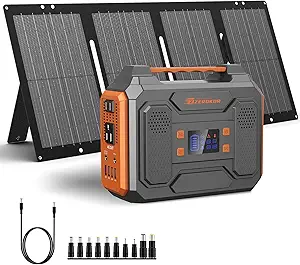
The ZeroKor 300W Portable Solar Generator is aimed at people who want a small power station without carrying a large battery around. Its 280Wh capacity and 300W inverter put it firmly in the lightweight, basic-power category.
This type of power station makes the most sense when your primary loads are phones, tablets, cameras, LED lights, small fans, and other low-wattage electronics.
It can also be useful for short RV trips where you are not trying to operate large heating or cooking appliances from the battery.
Key Features
- Battery capacity: 280Wh
- AC output: 300W
- Battery type: Check the current Amazon listing for the exact configuration
- Solar panel: 60W foldable panel in the referenced configuration
- Ports: AC, USB-A, USB-C and DC outputs
- Charging options: AC, vehicle and solar charging
Why Consider It?
The main advantage is portability. A 300W-class power station is much easier to move between a vehicle, campsite, tent, or small RV setup than a 2,000Wh model.
It is also better suited to users who do not need to run high-wattage appliances.
Best For
The ZeroKor 300W makes the most sense for:
- Weekend camping
- Phone and tablet charging
- Cameras and drones
- LED lighting
- Small fans
- Basic emergency power
- Light-duty RV use
What It Is Not Designed For
A 300W power station should not be treated as a replacement for a large RV battery bank. Appliances such as microwaves, electric heaters, coffee makers, and air conditioners can quickly exceed the inverter’s output limit.
2. Jackery Solar Generator 300 – Lightweight Power for Camping and Electronics
Check Amazon Price Click Here!
The Jackery Solar Generator 300 is a compact solution for campers, travelers, and RV owners who mainly need electricity for personal electronics.
The referenced model provides 293Wh of capacity and 300W of continuous AC output, putting it in the same general class as other small portable power stations.
Its biggest advantage is portability rather than raw capacity.
For a weekend trip, that can be exactly what you want. There is little benefit in carrying a 50-pound power station if your actual electrical needs are a phone, laptop, camera batteries, lights, and a small fan.
Key Features
- Battery capacity: 293Wh
- AC output: 300W
- Solar charging: Compatible with Jackery SolarSaga panels
- Ports: AC, USB and 12V vehicle-style output
- Use case: Portable electronics and small loads
- Solar panel: Verify the included panel with the specific Amazon bundle
Why Consider It?
The Jackery 300 is easier to transport than larger RV power stations and provides enough stored energy for many common camping electronics.
For example, a laptop, several phones, camera batteries, LED lights, and other small devices can generally be handled much more easily than with a tiny emergency battery pack.
Best For
- Weekend camping
- RV electronics
- Remote work
- Cameras and drones
- Smartphones and tablets
- Small fans
- Emergency device charging
Keep Expectations Realistic
A 300Wh power station is a compact electronics solution, not a whole-RV power system.
If you want to operate a refrigerator for extended periods, run cooking appliances, or power an air conditioner, move up to a larger battery capacity and inverter.
3. Jackery Explorer 500 – A Useful Middle Ground for RV Trips
Check Amazon Price Click Here!
The Jackery Explorer 500 sits between the small 300Wh-class stations and the larger 1,000Wh models.
With approximately 518Wh of battery capacity and a 500W AC inverter, it provides more energy storage without becoming as heavy and bulky as a 1,000Wh-plus power station.
That makes it an interesting size for RV owners who want additional portable power but do not need to operate high-draw appliances.
Key Features
- Battery capacity: 518Wh
- AC output: 500W
- Surge rating: Up to 1,000W depending on the configuration
- Ports: AC, USB and vehicle/DC outputs
- Solar charging: Compatible with Jackery solar panels
- Panel bundle: Verify the exact Amazon configuration before purchasing
Why It Works for RV Use
The extra battery capacity compared with a 300Wh unit gives you more flexibility for a full day of electronics.
It can be useful for:
- Laptops
- LED lights
- TVs
- Small fans
- Camera equipment
- Routers
- Portable refrigerators with compatible power requirements
The key is to look at both watts and watt-hours.
The 500W inverter determines how much power a device can draw at one time. The 518Wh battery determines how long the battery can supply that energy.
Best For
The Explorer 500 is a practical fit for:
- Weekend RV trips
- Campgrounds without electrical hookups
- Remote work
- Small electronic appliances
- Emergency charging
- Users who want more capacity without moving to a 1,000Wh-class station
A Note About Larger Appliances
A 500W inverter does not mean that every appliance under 500W will run for a long time.
For example, a 400W appliance could theoretically consume roughly 400Wh in one hour before accounting for conversion losses. In actual use, available runtime will be lower than the simple battery-capacity calculation suggests.
4. Jackery Explorer 1000 v2 – 1,070Wh of Portable RV Power
Check Amazon Price Click Here!
The Jackery Explorer 1000 v2 is a major step up from the smaller 300Wh and 500Wh stations.
The current model has a 1,070Wh LiFePO4 battery, 1,500W continuous AC output, and up to 3,000W of surge power. It also supports up to 400W of solar input, making it considerably more capable for extended off-grid use.
At around 23.8 pounds, it remains portable enough for RV and van travel without reaching the weight of larger 2,000Wh-class stations.
Key Features
- Battery capacity: 1,070Wh
- Battery chemistry: LiFePO4
- Continuous AC output: 1,500W
- Surge output: 3,000W
- Maximum solar input: 400W
- Weight: Approximately 23.8 lb
- AC outlets: 3
- USB-C: Up to 100W on the high-output USB-C port
- USB-A: Up to 18W
- Vehicle output: 12V/10A
- Solar charging: Compatible with Jackery SolarSaga panels
Jackery lists a 4,000-cycle battery life to at least 70% capacity for the current Explorer 1000 v2.
Why It Is Better Suited to RV Life
The 1,070Wh battery gives you substantially more energy to work with than the smaller Jackery models.
Depending on actual consumption, it can support combinations of:
- Portable refrigerators
- Laptops
- CPAP machines
- TVs
- Fans
- Lighting
- Internet equipment
- Starlink equipment
- Small cooking appliances
However, runtime always depends on the actual wattage of the equipment.
A 1,070Wh battery should not be interpreted as “1,070Wh available at the AC outlet.” The inverter and electronics consume some energy during conversion.
Solar Charging
The Explorer 1000 v2 supports up to 400W of solar input. Jackery’s current specifications show configurations using multiple SolarSaga panels to reach that input level.
This is important for RVers because a larger solar array can replace more of the energy used during the day.
Actual charging time will depend on sunlight, panel orientation, temperature, shading, wiring, and the power station’s charging conditions.
Best For
The Explorer 1000 v2 is a strong fit for:
- RV boondocking
- Van life
- CPAP users
- Remote work
- Portable refrigerators
- Longer camping trips
- Emergency backup
- Users who need more inverter capacity without carrying a 2,000Wh station
What About an RV Air Conditioner?
An important distinction: being able to start or operate an air conditioner does not mean a 1,070Wh station can run it all day.
An RV air conditioner can consume a substantial amount of energy, especially when the compressor starts. Even if the inverter can handle the load, the battery may be depleted relatively quickly.
For extended air-conditioning use, a larger battery system and a substantial solar array are generally more appropriate.
5. EF ECOFLOW DELTA 2 Max – 2,048Wh for High-Demand Off-Grid Use
Check Amazon Price Click Here!
The EF ECOFLOW DELTA 2 Max moves into a completely different class of portable power.
It has a 2,048Wh LiFePO4 battery and 2,400W of continuous AC output, while EcoFlow’s X-Boost feature can support certain devices requiring up to 3,400W.
More importantly for solar-focused RV users, the DELTA 2 Max can accept up to 1,000W of solar input with the appropriate configuration.
Key Features
- Battery capacity: 2,048Wh
- Battery chemistry: LiFePO4
- Continuous AC output: 2,400W
- X-Boost: Up to 3,400W for compatible loads
- Maximum solar input: Up to 1,000W
- Expandable capacity: Up to approximately 6kWh
- AC outlets: 6
- App connectivity: Wi-Fi and Bluetooth
- Weight: Approximately 50 lb
- Solar charging: Supports high-input solar configurations
EcoFlow lists a 10-year LFP battery design and up to 3,000 cycles to 80% capacity for the DELTA 2 Max.
Why Choose a 2,000Wh-Class Station?
The biggest advantage is not simply the higher wattage.
It is the combination of battery capacity and inverter output.
A 2,048Wh battery gives you substantially more stored energy than a 300Wh, 500Wh, or 1,000Wh unit. The 2,400W inverter also gives you much more flexibility with demanding appliances.
That can be useful for:
- RV refrigerators
- Microwaves
- Coffee makers
- Cooking appliances
- Power tools
- Multiple electronic devices
- Workstations
- Extended off-grid camping
- Emergency backup
Solar Charging Advantage
The DELTA 2 Max’s maximum solar input is one of its most important features for serious off-grid users.
EcoFlow specifies up to 1,000W of solar input, although reaching that level requires an appropriate solar configuration and favorable conditions.
More solar input means you can potentially replace a larger amount of energy during daylight hours instead of depending on AC charging.
The Trade-Off: Size and Weight
At roughly 50 pounds, this is not a casual grab-and-go power station.
For a large RV, van build, cabin, or stationary campsite, that may not matter.
For backpacking or frequent carrying, it is a completely different story.
Best For
- Full-time RV life
- Extended boondocking
- Off-grid cabins
- High-demand appliances
- Emergency backup
- Larger solar arrays
- Users who need expandable battery capacity
How to Choose the Right Portable Solar Power Station for RV Life
Buying based only on the biggest watt number can lead to the wrong power station.
Instead, look at six specifications.
1. Battery Capacity: Watt-Hours (Wh)
Watt-hours tell you how much energy the battery stores.
For example, a 300Wh station stores much less energy than a 2,000Wh station.
As a general starting point:
- 200–400Wh: phones, lights, cameras, laptops and small electronics
- 400–800Wh: weekend camping and moderate electronics
- 800–1,200Wh: RV appliances, CPAP machines, refrigerators and longer trips
- 2,000Wh+: demanding appliances and extended off-grid use
These are planning categories rather than guarantees. Your actual runtime depends on the power consumption of your equipment.
2. Continuous AC Output: Watts (W)
Watts determine how much electrical power the inverter can deliver at one time.
A 1,000Wh battery with a 300W inverter is very different from a 1,000Wh battery with a 1,500W inverter.
If you plan to use appliances such as a microwave, coffee maker, blender, or power tool, check both the appliance’s running wattage and its startup requirements.
Never assume that a power station’s surge rating means it can continuously operate a device at that level.
3. Battery Chemistry
For modern RV and off-grid applications, LiFePO4 batteries are particularly useful because they are designed for long cycle life and are widely used in newer portable power stations.
The Jackery Explorer 1000 v2 and EcoFlow DELTA 2 Max, for example, use LiFePO4 chemistry.
If you plan to cycle your power station frequently, battery chemistry and rated cycle life deserve as much attention as capacity.
4. Solar Input
Do not confuse the wattage of your solar panels with the amount of solar power the power station can actually accept.
For example, a station may support 400W of solar input while your particular panel configuration only provides 200W.
Likewise, installing more panel capacity than the station can accept does not necessarily mean the station will charge faster beyond its input limit.
Always check:
- Maximum solar watts
- Voltage range
- Maximum current
- Number of solar inputs
- Panel compatibility
- Whether adapters are required
5. Weight and Physical Size
Weight becomes especially important in RVs and vans because every piece of equipment competes for limited storage space.
A 300Wh power station can be easy to move around.
A 1,000Wh station is heavier but considerably more capable.
A 2,000Wh-class unit such as the DELTA 2 Max can provide much more energy, but at around 50 pounds, it is better treated as a semi-permanent part of an RV or off-grid setup.
6. Ports and Charging Options
Before buying, make a list of everything you intend to power.
Look for the right combination of:
- AC outlets
- USB-A
- USB-C
- 12V DC
- Vehicle charging
- Solar input
- AC charging
- Battery expansion
A power station with fewer watts can still be more convenient if it has the ports you actually use.
How Long Will a Solar Power Station Run an Appliance?
A simple way to estimate runtime is:
Runtime ≈ Battery Capacity (Wh) × Efficiency ÷ Appliance Power (W)
For example, a 1,000Wh battery powering a 100W device does not necessarily provide exactly 10 hours.
After inverter and system losses, usable AC energy will be lower.
For planning purposes, applying an efficiency factor gives you a more realistic estimate:
1,000Wh × 0.85 ÷ 100W ≈ 8.5 hours
Actual performance varies by power station, load, temperature, battery condition, and operating mode.
This calculation is much more useful than assuming the printed battery capacity equals usable AC energy.
Can a Portable Solar Power Station Run an RV Air Conditioner?
Sometimes, but the answer depends on the specific air conditioner and power station.
There are three numbers you need to consider:
- Running wattage
- Compressor startup demand
- Battery capacity
A power station may have enough inverter capacity to start an air conditioner but still have insufficient battery capacity to run it for several hours.
The Jackery Explorer 1000 v2, for example, has a 1,500W continuous inverter, while the DELTA 2 Max has a 2,400W continuous AC output.
That does not mean either station will provide unlimited air-conditioning runtime.
For serious RV air-conditioning use, calculate the actual daily energy requirement and compare it with the usable battery capacity and available solar production.
How Long Does Solar Recharging Take?
Solar charging time is highly dependent on conditions.
A panel labeled “200W” will not necessarily produce 200W continuously throughout the day.
Clouds, shade, heat, panel angle, season, latitude, wiring, and the station’s solar input limits all affect charging.
For example, the current Explorer 1000 v2 supports up to 400W of solar input, while the DELTA 2 Max supports up to 1,000W in the appropriate configuration.
This is why a larger solar array can be particularly valuable for full-time RVers: you are not only carrying more battery capacity, but also have more opportunity to replenish that energy during daylight hours.
Can You Use a Solar Power Station Inside an RV?
Portable battery power stations do not produce the combustion exhaust associated with gasoline or propane generators, which makes them useful for RV environments.
However, “no exhaust” does not mean “ignore safety.”
Always:
- Follow the manufacturer’s operating instructions
- Keep ventilation openings unobstructed
- Keep the unit away from water
- Avoid excessive heat
- Use the correct charging cables and adapters
- Do not exceed the rated output
- Follow the manufacturer’s storage and charging temperature requirements
Never use a conventional fuel-burning generator inside an RV, tent, garage, or other enclosed space because of carbon monoxide risk.
Do You Need Solar Panels?
Not necessarily.
A portable power station can usually be charged from an AC outlet, and many models can also be charged from a vehicle.
Solar panels become particularly valuable when you plan to spend several days away from shore power.
For a one-night camping trip, AC charging before departure may be enough.
For extended boondocking, solar panels allow you to replenish energy during the day without returning to a campground electrical hookup.
The ideal setup depends on your daily energy consumption and how much sunlight your campsite receives.
Which Size Solar Power Station Is Best for RV Life?
There is no single capacity that works for every RVer.
For occasional weekend camping
A 300Wh-class power station can be enough for phones, lights, cameras, tablets and other electronics.
For moderate RV use
A 500Wh-class station provides more flexibility for longer trips and larger electronic loads.
For serious boondocking
A 1,000Wh-class station is a much more practical starting point when you need to support refrigerators, CPAP machines, laptops, communication equipment and multiple devices.
For full-time RV and high-demand use
A 2,000Wh-class power station provides considerably more stored energy and inverter capacity, particularly when paired with an appropriately sized solar array.
Final Thoughts: Choosing a Solar Power Station for 2026
The best compact solar power station for RV life depends less on the biggest number on the box and more on how you actually use electricity.
The ZeroKor 300W and Jackery Solar Generator 300 make sense for lightweight electronics and short trips. The Jackery Explorer 500 adds more battery capacity without moving into the size of a 1,000Wh station.
For a more capable RV setup, the Jackery Explorer 1000 v2 brings 1,070Wh of LiFePO4 storage, a 1,500W inverter and up to 400W of solar input in a relatively portable package.
At the other end, the EF ECOFLOW DELTA 2 Max provides 2,048Wh of LiFePO4 capacity, 2,400W of continuous AC output, expansion capability and up to 1,000W of solar input.
Before buying, calculate your daily watt-hour consumption, identify the appliances with the highest startup demands, check the station’s solar input limits, and consider how much weight and storage space you have available.
That approach will help you choose a power station that fits your actual RV lifestyle rather than simply buying the largest model you can afford.
If your goal is quiet, portable electricity for camping, RV travel, emergency backup, or longer off-grid adventures, a properly sized solar power station can give you considerably more flexibility without the fuel, fumes, and maintenance associated with conventional generators.