As an Amazon Associate I earn from qualifying purchases.
Finding the right 30 amp RV generator is not simply a matter of buying the generator with the highest wattage rating. Your RV’s 30-amp electrical service is limited to 120 volts and 30 amps, which equals a theoretical maximum of 3,600 watts. The generator also needs enough starting power to handle loads such as an RV air conditioner, refrigerator, microwave, and converter without constantly tripping its breaker.
For 2026, there are plenty of portable inverter and conventional generators that can power a 30-amp travel trailer or motorhome. The challenge is matching the generator’s running watts, starting watts, outlet configuration, fuel type, noise level, and portability to the way you actually camp.
A smaller generator may be perfect for lights, electronics, and charging batteries, while a 3,500- to 4,500-watt class generator gives you more practical headroom when running one RV air conditioner and other appliances.
Below are several generator and adapter options worth considering, followed by a detailed guide to choosing the right setup.
30 Amp RV Generator and Adapter Options
| Product | Main Use | Affiliate Link |
|---|---|---|
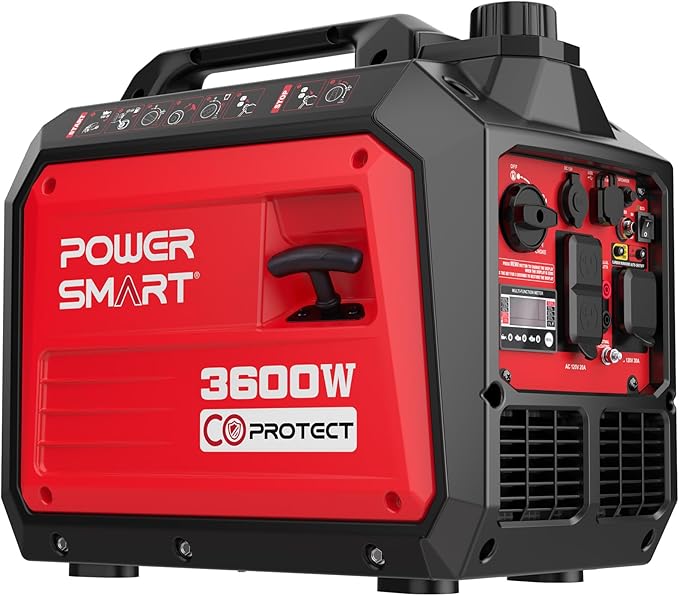
| PowerSmart 3600-Watt Portable Inverter Generator | Compact RV and camping power | Amazon Link |
| Westinghouse 5000 Peak Watt Dual Fuel Inverter Generator | Higher-output RV and backup power | Amazon Link |
| Westinghouse 4650 Peak Watt Portable Generator | Higher-output conventional generator | Amazon Link |
| Westinghouse 2550 Peak Watt Lightweight Inverter Generator | Lightweight camping and light RV loads | Amazon Link |
| WEN GNA030 30 Amp RV Adapter | L5-30P to TT-30R connection | Amazon Link |
PowerSmart 3600-Watt Portable Inverter Generator
Check Amazon Price Click Here!
The PowerSmart 3600-watt inverter generator is aimed at RV owners who want a relatively compact power source without moving up to a large open-frame generator.
It produces 3,600 starting watts and 3,200 running watts, giving it enough output for many basic RV loads. It also provides an RV-friendly 30-amp receptacle and inverter-generated power with less than 3% THD.
Key features
- 3,600 peak watts / 3,200 running watts
- Gasoline powered
- Inverter technology
- Less than 3% THD
- 120V 30-amp RV outlet
- CO protection
- Eco mode
- Built-in carry handle
- Approximately 50 pounds
- Parallel ports for compatible generators
The important limitation is its 3,200 running-watt rating. Although that is close to the maximum practical demand of a 30-amp RV, you still need to manage your loads. Running an air conditioner while starting a microwave, coffee maker, or other high-demand appliance can push the generator toward its limit.
For a camper that mainly needs one major appliance at a time, this size can make sense.
Westinghouse 5000 Peak Watt Dual Fuel Inverter Generator
Check Amazon Price Click Here!
The Westinghouse 5000-watt dual-fuel inverter generator gives RV owners more headroom than a 3,000- to 3,600-watt unit.
It produces 5,000 peak watts and 3,900 running watts on gasoline and can operate on either gasoline or propane. It also includes an RV-ready 30-amp connection, making it particularly interesting for RV owners who want additional capacity without moving to a large 50-amp generator setup.
Key features
- 5,000 peak watts / 3,900 running watts
- Gasoline and propane operation
- Inverter technology
- Approximately 52 dBA under the manufacturer’s stated test conditions
- Remote, electric, and recoil starting
- Digital data display
- Parallel capable
- RV-ready 30-amp outlet
- USB ports
- CO safety system
One important point is often overlooked: a 5,000-watt generator does not turn a 30-amp RV into a 5,000-watt electrical system.
If you connect a 30-amp RV through its standard TT-30 connection, the RV service remains limited to approximately 3,600 watts at 120 volts. The generator’s extra capacity provides useful headroom for starting loads and helps prevent the generator from operating at its limit, but the RV connection itself still has its 30-amp limitation.
That makes this type of generator useful for RV owners who want additional generator capacity without necessarily moving to a 50-amp RV.
Westinghouse 4650 Peak Watt Portable Generator
Check Amazon Price Click Here!
The Westinghouse 4650-watt portable generator is another option for RV owners who prioritize output over the compact size of a small inverter generator.
This type of conventional portable generator can provide substantial power for an RV, job site, or emergency backup application. The gasoline-powered model produces up to 4,650 peak watts and 3,600 running watts.
Key features
- 4,650 peak watts / 3,600 running watts
- Gasoline powered
- 212cc engine
- RV-ready 30-amp connection
- CO safety monitoring
- Recoil starting
- Multiple AC outlets
- Large fuel tank
- Designed for extended outdoor operation
Its 3,600-running-watt rating lines up with the theoretical maximum wattage of a 30-amp, 120V RV connection.
The trade-off is portability. A conventional generator in this output class can be substantially larger and louder than a compact inverter generator, so check campground noise requirements and available storage space before choosing one.
Westinghouse 2550 Peak Watt Lightweight Inverter Generator
Check Amazon Price Click Here!
The Westinghouse iGen2550 series takes a different approach. Instead of maximizing output, it emphasizes portability, low noise, fuel efficiency, and inverter power.
The dual-fuel version produces 2,550 peak watts and 1,900 running watts on gasoline, with propane output somewhat lower. It weighs roughly 42 pounds and can operate at approximately 52 dBA under the manufacturer’s stated conditions.
Key features
- 2,550 peak watts / 1,900 running watts on gasoline
- Gasoline and propane capability on the dual-fuel version
- Inverter technology
- Less than 3% THD
- RV-ready TT-30R outlet on the dual-fuel version
- Approximately 52 dBA
- Parallel capable
- Compact design
- Built-in carrying handle
- CO safety protection
This generator is not the obvious choice if you expect to run a large RV air conditioner together with several other high-wattage appliances.
Instead, it makes more sense for campers who prioritize low weight and quiet operation and can manage their electrical loads.
For example, it can be useful for charging electronics, running lights, fans, small appliances, and other modest loads when air conditioning is not required.
WEN GNA030 30 Amp RV Adapter
Check Amazon Price Click Here!
The generator itself is only half of the connection. If your generator has a NEMA L5-30P twist-lock connection and your RV requires a standard TT-30 connection, you need the correct adapter.
The WEN GNA030 converts a 30-amp NEMA L5-30P twist-lock connection to a TT-30R RV-ready receptacle.
Key features
- NEMA L5-30P twist-lock input
- TT-30R RV-ready output
- 120 volts
- Rated for up to 30 amps
- Rated for up to 3,600 watts
- ETL-certified design
- Compact construction
- Easy to store in an RV compartment or tool kit
This is an important distinction because L5-30 and TT-30 are not interchangeable connectors even though both are commonly associated with 30-amp, 120-volt applications.
The WEN GNA030 is designed specifically to bridge that connection when the generator and RV require those two different connector types.
What Size Generator Do You Need for a 30 Amp RV?
This is one of the most important questions to answer before buying.
A standard 30-amp RV connection operates at approximately 120 volts:
120V × 30A = 3,600 watts
That 3,600-watt figure represents the theoretical maximum of the RV’s 30-amp service. It does not mean that every RV needs a 3,600-watt generator.
Your actual generator size depends on what you plan to operate at the same time.
| RV Usage | Approximate Generator Class | What to Consider |
|---|---|---|
| Small trailer, no AC | 2,000–2,500W | Lights, electronics, charging |
| Small RV with modest loads | 2,500–3,500W | Load management is important |
| One RV AC + basic appliances | 3,500–4,500W | Starting surge matters |
| Heavy 30A RV loads | 4,000W+ | Better generator headroom |
| Large 50A RV | 7,000W+ may be required | Different electrical configuration |
These are planning ranges rather than guarantees. Check the actual wattage requirements of your appliances and the specifications of your RV before choosing a generator.
Can a 3,000-Watt Generator Run a 30 Amp RV?
Sometimes, but there are limitations.
A 3,000-watt generator can supply a substantial amount of power, but a 30-amp RV can theoretically accept up to 3,600 watts. More importantly, the generator needs enough starting watts for appliances with motors and compressors.
An RV air conditioner is the biggest concern for many campers.
If the air conditioner starts while the refrigerator, converter, microwave, or another high-demand appliance is operating, the generator may overload even though the normal running load appears manageable.
A soft-start system installed on an RV air conditioner can reduce startup demand on compatible systems, but it does not eliminate the need to size the generator correctly.
For RV owners who regularly use air conditioning, moving into the 3,500- to 4,500-watt class can provide more practical operating headroom.
Running Watts vs. Starting Watts
Generator specifications often show two wattage numbers.
Running watts
Running watts are the amount of power the generator can continuously produce under its rated operating conditions.
This is the number you should pay close attention to when calculating the total load you expect to run simultaneously.
Starting watts
Starting watts, sometimes called surge watts, represent the additional power available for a short period to start equipment with motors or compressors.
Air conditioners, refrigerators, pumps, and some power tools can require substantially more power during startup than during normal operation.
For an RV, both figures matter.
A generator with plenty of peak watts but insufficient running watts may still struggle during normal operation. Conversely, a generator with adequate running watts may trip when a large compressor starts if it lacks enough surge capacity.
What Can a 30 Amp RV Generator Run?
The exact answer depends on your appliances, but a typical RV electrical load can include:
- RV air conditioner
- Refrigerator
- Microwave
- Converter/charger
- LED lights
- Television
- Laptop computers
- Phone chargers
- Coffee maker
- Fans
- Small kitchen appliances
The key is not to assume that all of these can run simultaneously.
For example, if your generator is already running the air conditioner, switching on a microwave or coffee maker can create a substantial additional load.
A simple load-management strategy can make a smaller generator much more useful.
TT-30R vs. L5-30R: What’s the Difference?
This is one of the most important details when shopping for a 30-amp RV generator.
A standard 30-amp RV connection is commonly based on the TT-30 configuration. It is designed specifically for recreational vehicles and is a 120/125-volt connection.
An L5-30 is a locking connector. Although it is also associated with 30-amp, 120/125-volt service, its physical configuration is different.
Therefore:
TT-30R ≠ L5-30R
If your RV has a TT-30 plug and your generator provides an L5-30 receptacle, you need a properly rated adapter such as the WEN GNA030.
Never assume that two connectors are interchangeable simply because they both say “30 amp.”
Do You Need a 30 Amp Adapter for Your RV Generator?
Not always.
If your generator already has a TT-30R RV-ready outlet, you can generally connect the RV’s 30-amp cord directly, assuming the generator’s electrical specifications and your RV’s requirements are compatible.
You need an adapter when the generator has a different outlet configuration.
For example, an L5-30 outlet requires the appropriate L5-30-to-TT-30 adapter to connect to a standard 30-amp RV cord.
The adapter does not increase the amount of electricity available. It only changes the physical connection between compatible electrical systems.
Why Inverter Generators Are Popular for RVs
Inverter generators have become particularly popular among RV owners because they can combine relatively compact designs with quieter operation and electronically regulated output.
Many inverter models also offer an economy mode that allows the engine to slow down when electrical demand is low.
That can reduce fuel consumption and operating noise compared with running an engine continuously at a fixed speed.
For campers staying in areas with noise restrictions, this can be a major consideration.
However, always check the generator’s stated noise level and the campground’s current rules rather than assuming that every “quiet” generator is acceptable.
How Much Generator Noise Is Acceptable at a Campground?
Noise requirements vary between campgrounds, RV parks, public lands, and private properties.
An inverter generator rated around the low-to-mid 50 dBA range under light-load conditions can be substantially easier to live with than a louder conventional generator.
But published dBA numbers need context.
A generator’s noise can change depending on:
- Load
- Distance from the measurement point
- Eco mode
- Engine speed
- Surrounding terrain
- Generator enclosure
- Weather and campsite layout
The Westinghouse iGen2550, for example, is advertised at approximately 52 dBA under specified conditions, while the larger Westinghouse 5000-watt inverter is also marketed around the low-50-dBA range.
Always check the manufacturer’s current specifications and campground rules before relying on a published noise number.
Gasoline vs. Dual Fuel for RV Camping
Gasoline remains convenient because it is widely available, but dual-fuel generators give RV owners another option.
A dual-fuel generator can operate on:
- Gasoline
- Propane
Propane can be convenient for campers who already carry propane cylinders for their RV appliances.
It can also provide another fuel option during extended trips.
The trade-off is that generator output can be lower when operating on propane, so check both gasoline and propane wattage ratings rather than looking only at the headline peak wattage.
For example, the Westinghouse WGen3600DFc specifications show lower rated and peak output on LPG than gasoline.
What to Check Before Buying a 30 Amp RV Generator
Before ordering a generator, check these specifications.
1. Running watts
Calculate the total wattage of the appliances you expect to operate simultaneously.
2. Starting watts
Identify appliances with motors and compressors, particularly your RV air conditioner.
3. RV outlet
Look for a dedicated TT-30R if you want the simplest connection.
4. Generator outlet type
If the generator uses an L5-30 outlet instead, make sure you have the correct adapter.
5. Noise
Compare the generator’s stated dBA rating with the campground’s requirements.
6. Fuel type
Decide whether gasoline, propane, or dual-fuel operation fits your travel habits.
7. Weight
A generator that is powerful enough but too heavy to move safely may not be practical for frequent RV trips.
8. Runtime
Consider fuel tank size and advertised runtime at a specified load. Runtime at 25%, 50%, or full load can be very different.
9. Power quality
For inverter generators, check the manufacturer’s stated THD and ensure the output is appropriate for the electronics you plan to operate.
10. Safety features
CO detection/shutdown, overload protection, low-oil shutdown, and properly covered outlets can all be useful features.
How to Safely Use a Portable Generator With an RV
Portable fuel-burning generators must be operated outdoors in accordance with the manufacturer’s instructions.
Never operate a gasoline or propane generator inside an RV, inside a garage, inside a storage compartment, or in another enclosed or poorly ventilated area.
Carbon monoxide is colorless and odorless, and generator exhaust can become dangerous quickly.
Before connecting your RV:
- Position the generator in the manufacturer’s recommended outdoor location.
- Keep exhaust away from the RV, doors, windows, vents, and other openings.
- Turn off or reduce major RV loads before making the connection.
- Use the correct RV-rated cord or adapter.
- Confirm that plugs and receptacles are fully seated.
- Start the generator according to its manual.
- Add electrical loads gradually.
- Monitor the generator for overloads or shutdowns.
- Never bypass a breaker, CO shutdown, GFCI, or other safety device.
If a generator repeatedly overloads, the correct response is to reduce the electrical load and investigate the cause rather than bypassing the protection.
30 Amp RV Generator: Which Type Makes Sense for You?
The right generator depends more on how you camp than on the size of the RV alone.
For lightweight camping
A 2,000- to 2,500-watt inverter generator can make sense when your priorities are portability, quiet operation, charging, lights, and smaller loads.
For an RV with one air conditioner
A generator in roughly the 3,500- to 4,500-watt class can provide more practical headroom, especially when starting the AC while other appliances are operating.
For dual-fuel flexibility
A dual-fuel inverter generator gives you the ability to switch between gasoline and propane and can be useful for extended RV trips or emergency preparedness.
For maximum output within a 30-amp setup
A generator producing around 3,600 or more running watts gives you enough generator capacity to make better use of a 30-amp RV connection, although the RV’s 30-amp service remains limited to approximately 3,600 watts at 120V.
Frequently Asked Questions
How many watts does a 30 amp RV need?
A 30-amp RV service at 120 volts has a theoretical maximum of 3,600 watts. However, the generator you need depends on the actual appliances you intend to operate and their starting requirements. For RVs using one air conditioner, a generator in the 3,500- to 4,500-watt class can provide useful operating headroom.
Is 3,600 watts enough for a 30 amp RV?
It can be, because 30 amps at 120 volts equals 3,600 watts. However, you still need to account for starting surges and simultaneous loads. An RV air conditioner, microwave, refrigerator, and converter can collectively push a generator toward its limits.
Can a 2,000-watt generator run a 30 amp RV?
It can provide limited power through the appropriate connection, but it will not supply the full 30-amp capacity of the RV. A 2,000-watt generator is better suited to lighter loads and careful load management than running a large RV air conditioner and multiple appliances simultaneously.
Do I need a TT-30 outlet on my generator?
No, but having a TT-30R outlet makes connecting a standard 30-amp RV cord much simpler. If your generator uses another connector, such as an L5-30R, you can use a properly rated adapter designed for that connection.
Is TT-30 the same as L5-30?
No. TT-30 is an RV-specific connector configuration, while L5-30 is a locking connector configuration. They may both be rated for 30 amps and 120/125 volts, but they are physically different and require the appropriate adapter when connecting them.
Is an inverter generator better for an RV?
An inverter generator can be particularly useful for RV camping because many models offer lower noise, variable engine speed, and low-THD electrical output. Whether it is the right choice depends on your required wattage, budget, weight limitations, and campground rules.
Can a 5,000-watt generator power a 30 amp RV?
Yes, a 5,000-watt generator can provide sufficient generator capacity for many 30-amp RV applications. However, connecting it through a standard 30-amp RV service does not increase the RV’s maximum electrical service beyond approximately 3,600 watts at 120 volts.
Is a 30 amp RV connection 120V or 240V?
A standard TT-30 RV connection is a 120/125-volt configuration, not a 240-volt connection. Do not assume that another 30-amp receptacle is interchangeable with a TT-30 simply because the amperage rating is the same.
Final Thoughts on 30 Amp RV Generators in 2026
Choosing a 30 amp RV generator in 2026 starts with understanding your actual electrical load rather than simply buying the highest-wattage model available.
For lightweight camping and basic electrical needs, a compact inverter generator can be easier to carry and quieter around campgrounds. For an RV with one air conditioner and several appliances, moving into the 3,500- to 4,500-watt range can provide more useful headroom.
The PowerSmart 3600W is a compact option with 3,200 running watts, while the Westinghouse 5000W dual-fuel inverter generator provides 3,900 running watts and the flexibility of gasoline or propane. The Westinghouse 4650-watt generator reaches 3,600 running watts, while the lightweight Westinghouse 2550 focuses more heavily on portability and quiet operation.
And if your generator has an L5-30 connection instead of a TT-30 RV outlet, the WEN GNA030 can provide the appropriate L5-30P-to-TT-30R connection.
Most importantly, match the generator to the loads you actually use, understand the difference between starting and running watts, and verify the connector type before plugging your RV into a generator. A properly sized generator and correctly rated connection will make off-grid RV power considerably more practical and predictable in 2026.