As an Amazon Associate I earn from qualifying purchases.
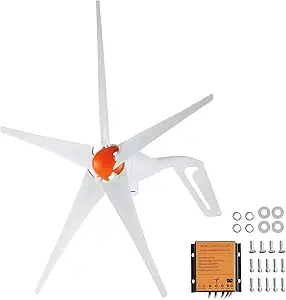
A small wind turbine can be a useful source of battery-charging power for a sailboat, remote cabin, RV, or off-grid home, especially when strong winds are available at times when solar panels are not producing much energy.
But choosing a wind turbine is not as simple as picking the model with the highest wattage on the box. Actual energy production depends on wind speed, turbine design, installation height, battery voltage, controller compatibility, and how exposed the turbine is to the wind.
That is why the best wind power generator for a boat or off-grid home depends on your particular application. A compact 500W turbine may make sense for maintaining a small battery bank, while a larger 2,000W or higher-rated turbine may be better suited to a properly designed off-grid power system.
Below, we compare five wind turbine generators available through Amazon and explain what to look for before adding one to a marine, RV, cabin, or residential renewable-energy system.
Wind Power Generators Comparison
| Wind Turbine | Rated Power | System Voltage | Turbine Type | Best Suited For |
|---|---|---|---|---|
| VEVOR 500W Wind Turbine | 500W | 12V | Horizontal axis | Boats, RVs, cabins, small battery systems |
| CNCEST 600W Vertical Wind Turbine | 600W | 12V | Vertical axis | Compact installations and variable wind |
| FLTXNY POWER 2000W Wind Generator | 2000W | Verify kit configuration | Horizontal axis | Larger off-grid and hybrid systems |
| HinLIaDa 600W Wind Turbine Kit | 600W | 12V | Vertical axis | Boats, cabins, hybrid wind-solar systems |
| Mcamgiczin 12000W Wind Generator Kit | Up to 12000W rated capacity | 12V/24V | Horizontal axis | Larger off-grid installations |
Important: Rated wattage is not the same as continuous real-world output. Wind turbines only reach their rated power under particular wind conditions, and annual energy production depends heavily on the site and installation.
1. VEVOR 500W Wind Turbine Generator – A Practical Choice for Boats and Small Off-Grid Systems
Check Amazon Price Click Here!
The VEVOR 500W Wind Turbine Generator is one of the more practical options in this group for smaller battery-based systems. The current VEVOR listing identifies a 12V configuration with a three-blade rotor, MPPT controller, adjustable windward direction, and a stated startup wind speed of 2.5 m/s. VEVOR also notes that the tower pole is not included.
For boat owners, the appeal is straightforward: a relatively compact turbine can help replenish a 12V battery bank when the boat is exposed to useful wind. It can also complement solar panels during cloudy or windy periods.
Key Specifications
- Rated power: 500W
- System voltage: 12V
- Blade configuration: 3-blade version
- Controller: MPPT
- Stated startup wind speed: 2.5 m/s
- Tower: Not included
Pros
- Compact size for smaller renewable-energy systems
- MPPT controller included with the listed configuration
- Suitable for 12V battery-based applications
- Can complement solar power
- Designed for applications including boats and RVs
Cons
- A tower or suitable mounting structure is required
- 500W is a rated maximum, not guaranteed continuous output
- Proper wind exposure is essential for useful energy production
Best For
Small sailboats, RVs, cabins, backup battery charging, and compact wind-solar systems.
If you want a relatively simple starting point for a small 12V renewable-energy setup, the VEVOR 500W is worth considering. Just remember that the quality of the installation and the available wind resource can matter as much as the turbine itself.
2. CNCEST 600W Vertical Wind Turbine – Compact Design for Space-Constrained Installations
Check Amazon Price Click Here!
The CNCEST 600W Vertical Wind Turbine takes a different approach from conventional horizontal-axis turbines. Its vertical-axis design can be attractive when installation space, appearance, or changing wind direction is a concern.
Vertical turbines are often discussed for locations where wind direction is less predictable or where a conventional yawing turbine would be inconvenient. However, a vertical design should not automatically be assumed to produce more energy. Site conditions and the specific turbine’s power curve remain critical.
This type of turbine can make sense for smaller renewable-energy projects where a compact footprint is more important than maximizing output from every available square foot.
Key Specifications
- Rated power: 600W
- System voltage: 12V
- Design: Vertical axis
- Construction: Aluminum-alloy components
- Application: Small renewable-energy and battery systems
Pros
- Vertical configuration can simplify some installations
- Compact footprint
- Suitable for locations with changing wind direction
- Can be integrated into a hybrid renewable-energy setup
Cons
- Rated power does not represent constant output
- Installation still needs appropriate structural support
- Vertical turbines are not automatically more productive than horizontal models
Best For
Compact off-grid installations, boats, cabins, and locations where a conventional horizontal turbine is difficult to position.
Before choosing this model, pay particular attention to where the turbine will be mounted. Buildings, trees, roof edges, and other obstacles can create turbulence that reduces useful energy production.
3. FLTXNY POWER 2000W Wind Generator – Higher-Capacity Option for Off-Grid Systems
Check Amazon Price Click Here!
If your renewable-energy system requires more capacity than a small 500W turbine can provide, the FLTXNY POWER 2000W Wind Turbine moves into a different class.
Current FLTXNY documentation identifies its 2000W horizontal-axis systems in 24V and 48V configurations, with three precision-molded nylon blades and options for tube or flange mounting.
That makes voltage verification particularly important. A wind turbine should be matched to the correct charge controller, battery bank, wiring, and inverter. Do not assume that every version of a 2000W FLTXNY kit uses the same voltage.
Key Specifications
- Rated power: 2000W
- Configuration: Horizontal axis
- Available system configurations: 24V and 48V versions are documented
- Blade count: 3
- Blade material: Nylon
- Mounting: Tube or flange connection options
Pros
- Higher rated capacity than compact 400W–600W turbines
- Suitable for larger battery systems
- Can be used as part of a wind-solar hybrid installation
- Aerodynamically designed blades
- Horizontal-axis design is familiar for conventional wind systems
Cons
- Requires more careful installation
- Voltage configuration must match the rest of the electrical system
- Needs a strong and appropriately designed mounting structure
- Higher rated power does not guarantee 2,000W in ordinary wind conditions
Best For
Remote cabins, larger sailboats, farms, workshops, and off-grid battery systems with adequate wind exposure.
This is the type of turbine where system design becomes particularly important. A 2,000W turbine can produce useful energy, but only when the wind resource, tower or mounting location, controller, batteries, and wiring are properly matched.
4. HinLIaDa 600W Wind Turbine Kit – Compact Vertical Turbine for Marine and Hybrid Systems
Check Amazon Price Click Here!
The HinLIaDa 600W Wind Turbine Kit is another vertical-axis option aimed at smaller renewable-energy applications.
Current product information identifies this type of HinLIaDa kit as a 12V, 600W vertical-axis turbine with five blades, a permanent-magnet generator, and a waterproof controller. Some current listings specify a 2 m/s startup wind speed and an IP67-rated controller.
That makes it particularly interesting for applications where compact size and integration with other renewable-energy equipment are priorities.
Key Specifications
- Rated power: 600W
- Voltage: 12V
- Design: Vertical axis
- Blade count: 5
- Generator: Permanent-magnet generator
- Controller: Weather-resistant/waterproof design on the documented configuration
Pros
- Compact vertical-axis configuration
- 12V compatibility for smaller battery systems
- Five-blade design
- Permanent-magnet generator
- Suitable for marine, camping, home, and hybrid wind-solar applications
Cons
- Requires secure mounting
- 600W is a rated capacity rather than guaranteed production
- Output depends strongly on actual wind conditions
- Product configurations can vary, so verify the specifications of the exact Amazon listing
Best For
Small boats, cabins, camping systems, remote monitoring equipment, and wind-solar battery systems.
One of the most useful ways to deploy a small turbine like this is alongside solar panels. Solar can provide strong daytime production, while wind can continue producing energy during windy periods after sunset or during cloudy weather.
5. Mcamgiczin 12000W Wind Generator Kit – High-Capacity Option for Larger Off-Grid Systems
Check Amazon Price Click Here!
The Mcamgiczin 12000W Wind Generator Kit is dramatically larger on paper than the other turbines in this comparison. Current product listings describe it as a 12,000W wind generator kit compatible with 12V/24V systems.
However, this is where shoppers need to be particularly careful with wind-turbine specifications.
A 12,000W rating should not be interpreted as 12kW of continuous household electricity. Wind turbine output varies with wind speed, and the actual annual energy yield depends on the turbine’s power curve and the characteristics of the installation site.
Key Specifications
- Rated capacity: Up to 12,000W
- System voltage: 12V/24V configuration
- Design: Horizontal axis
- Blade material: Nylon-fiber construction is listed for this product
- Application: Larger off-grid and renewable-energy systems
Pros
- Much higher rated capacity than small marine turbines
- Designed for larger battery-based systems
- Suitable for larger off-grid applications when properly engineered
- Can form part of a hybrid wind-solar system
Cons
- Requires substantially more planning and structural support
- Electrical components must be correctly sized
- The advertised maximum output should not be treated as continuous production
- Not a simple plug-and-play replacement for a conventional home generator
Best For
Large off-grid properties, farms, workshops, remote power systems, and properly engineered renewable-energy installations.
For a residential application, I would not select a turbine of this size based solely on the wattage printed in the product name. First evaluate the site’s wind resource, tower requirements, battery capacity, electrical infrastructure, and expected annual energy production.
What to Look for in a Wind Generator for a Boat or Off-Grid Home
Choosing a wind turbine starts with the location rather than the product name.
The U.S. Department of Energy explains that expected annual energy production depends on the turbine’s power curve, average annual wind speed, tower height, and local site characteristics. Wind maps are useful for preliminary evaluation, but local terrain, vegetation, buildings, and other obstacles can significantly affect the wind available at the turbine.
Here are the most important factors to evaluate.
1. Average Wind Speed Matters More Than Startup Wind Speed
One of the most common mistakes when shopping for a small wind turbine is focusing only on the startup wind speed.
A turbine may begin spinning at a relatively low wind speed without producing meaningful electrical power. Startup simply means that the rotor begins turning or the generator begins producing some output.
For a useful renewable-energy system, you need to consider how much wind the site receives throughout the year and how much electricity the turbine produces at those speeds.
This is why a turbine advertised with a very low startup speed is not necessarily the best choice for a low-wind property.
2. Consider the Installation Height
Wind becomes more useful when the turbine has cleaner exposure to the moving air.
Trees, houses, buildings, hills, and other structures can create turbulence. A turbine mounted in turbulent air may spin without producing the amount of energy expected from a more exposed installation.
The Department of Energy notes that wind speed generally increases with height, which is one reason tower height and siting are important parts of a small-wind project.
For boats, the situation is different because the vessel’s mast or other mounting structure determines the turbine’s exposure, while movement and vibration introduce additional considerations.
3. Match the Turbine to Your Battery Voltage
Do not buy a turbine simply because the wattage looks attractive.
The turbine, wind charge controller, battery bank, inverter, wiring, and protective equipment need to work together.
Common small-system voltages include:
- 12V
- 24V
- 48V
A 12V turbine should not simply be connected to a 24V or 48V battery bank without the appropriate equipment and configuration.
The same applies to larger turbines. Always verify the exact voltage and controller specifications of the version you are purchasing.
4. Check the Charge Controller
The controller is a critical part of a battery-based wind system.
It regulates the electricity produced by the turbine and manages battery charging. Some systems use MPPT controllers, while other turbines use different control arrangements.
The controller must be compatible with the turbine’s electrical characteristics and the battery bank. It also needs appropriate protection for the intended installation.
Do not assume that an MPPT label by itself guarantees that a complete wind system will produce a particular amount of electricity.
5. Horizontal vs. Vertical Wind Turbines
Horizontal-axis turbines are the conventional design most people picture when they think about wind power. They can be very effective when installed in an area with good wind exposure.
Vertical-axis turbines have a different geometry and can be attractive when wind direction changes frequently or when a compact configuration is desirable.
The important point is that neither design should automatically be considered better for every location.
Choose based on the actual wind conditions, mounting requirements, available space, noise considerations, maintenance requirements, and expected energy production.
Wind Turbine vs. Solar Panels for Off-Grid Homes
For many off-grid homeowners, the more useful question is not whether wind is better than solar.
It is whether wind and solar can work together.
Solar panels generally produce the most energy during daylight hours, while wind turbines can generate electricity whenever adequate wind is available. Depending on the location, this can make a hybrid system more consistent than relying on one renewable source alone.
A typical off-grid setup might include:
Solar panels + wind turbine + charge controllers + battery bank + inverter
This arrangement can be especially useful in locations where windy weather frequently occurs when solar production is reduced.
However, a hybrid system only makes sense if the location has a worthwhile wind resource. Adding a turbine to a sheltered property with weak or turbulent winds may add cost without producing much useful energy.
Are Small Wind Turbines Good for Boats?
They can be, particularly for sailboats and other vessels that spend significant time away from shore power.
A marine wind turbine can help maintain batteries for equipment such as:
- Navigation electronics
- LED lighting
- Refrigeration
- Communication equipment
- Battery-powered instruments
- Monitoring systems
- Small DC loads
One advantage of wind power on a boat is that the turbine can continue producing energy while the vessel is at anchor, assuming there is sufficient wind.
But marine installation also creates additional challenges.
Saltwater exposure can accelerate corrosion, and the mounting system needs to tolerate vibration and wind loading. The turbine should also be installed where it will not create an unsafe hazard for people moving around the vessel.
Before installing any turbine on a boat, check the manufacturer’s installation requirements and the vessel’s structural limitations.
Are Wind Turbines Good for Off-Grid Homes?
A wind turbine can be useful for an off-grid home when the property has a consistent and suitable wind resource.
The biggest mistake is buying a high-wattage turbine before determining whether the site actually has enough usable wind.
For an off-grid home, think in terms of annual energy production, not just maximum wattage.
A 500W turbine can be useful for a small battery system, communications equipment, lighting, or supplemental charging. A larger 2,000W or higher-rated turbine can be considered for more demanding systems, but it also requires more careful electrical and structural planning.
For larger homes, wind is often more practical as one part of a renewable-energy system rather than the only source of electricity.
How Much Power Does a Wind Turbine Actually Produce?
This is one of the most important questions to answer before buying.
A turbine rated at 500W does not continuously produce 500W.
Likewise, a turbine marketed as 2,000W does not automatically provide 2,000W to your battery bank every hour.
Wind speed changes constantly, and turbine output changes with it.
The manufacturer’s power curve is therefore more useful than the headline wattage alone. You want to know how much power the turbine produces at different wind speeds and then compare that information with the wind conditions at your property or sailing location.
For a serious off-grid installation, annual energy production in kWh is a much more meaningful figure than maximum rated watts. The Department of Energy specifically recommends using expected annual energy output when evaluating whether a turbine and tower can meet your electricity needs.
Wind Turbine Installation and Maintenance
A small wind turbine still has moving parts, so installation and maintenance should not be overlooked.
Before installation, consider:
- Tower or mounting structure
- Structural loading
- Cable size and distance
- Charge-controller compatibility
- Battery-bank voltage
- Inverter requirements
- Overcurrent protection
- Grounding
- Braking or shutdown procedures
- Access for maintenance
- Local building and electrical requirements
For marine installations, also consider corrosion protection, vibration, cable routing, and clearance from people and rigging.
Routine maintenance can include inspecting blades, mounting hardware, electrical connections, bearings, cables, and other exposed components according to the manufacturer’s instructions.
Which Wind Generator Should You Choose?
The right choice depends on what you are trying to power.
For a small boat or RV
A 500W-class 12V turbine can be a reasonable starting point when you have adequate wind and a compatible battery system.
For a compact off-grid setup
A 600W vertical turbine may be attractive when installation space or changing wind direction is a major consideration.
For a larger battery bank
A 2,000W-class horizontal turbine makes more sense when the property or vessel has a good wind resource and the electrical system is designed for the turbine’s voltage and output.
For a large off-grid installation
A high-capacity turbine such as the Mcamgiczin 12000W requires considerably more planning. The advertised capacity should be evaluated alongside the actual wind resource, power curve, battery storage, controller, tower, and electrical infrastructure.
Final Thoughts on Wind Power Generators for Boats and Off-Grid Homes in 2026
A small wind turbine can be a useful addition to a renewable-energy system, but the highest wattage is not automatically the right choice.
For boats and small battery systems, compact 500W and 600W turbines can provide supplemental charging when wind conditions are favorable. Larger 2,000W-class turbines are better suited to properly designed off-grid systems with greater storage capacity. High-capacity models require even more attention to siting, structure, electrical compatibility, and expected annual production.
The most important step before buying is to evaluate the wind resource at your actual installation site. Startup wind speed can tell you when a turbine begins turning, but it does not tell you how much electricity the system will generate over an entire year.
If you are building an off-grid system, also consider combining wind with solar panels and battery storage. A properly designed hybrid system can take advantage of different weather and production patterns instead of relying on a single renewable-energy source.
For 2026, the five models above cover a broad range of applications, from compact 12V marine and RV systems to larger off-grid installations. Compare the exact turbine configuration, voltage, controller, mounting requirements, and expected wind conditions before purchasing rather than choosing solely by the wattage printed in the product title.