As an Amazon Associate I earn from qualifying purchases.

If you are looking for a portable generator that gives you more fuel options than a standard gasoline model, the Generac GP9500E TF deserves a close look. This tri-fuel generator can run on gasoline, liquid propane, or natural gas, giving homeowners and contractors more flexibility when fuel availability changes during an extended power outage.
The generator is rated for up to 9,500 running watts and 12,500 starting watts on gasoline. Output is lower when using propane or natural gas, so those numbers are important to understand before deciding whether this model can handle your specific loads.
Generac has also equipped the GP9500E TF with electric start, recoil backup, COsense carbon monoxide protection, a 500cc OHV engine, covered outlets, and a wheel-and-handle kit. The current 50-state version is designed for users who want substantial portable backup power without moving all the way to a permanently installed standby generator.
If you are considering this generator for home backup, a jobsite, or emergency preparedness in 2026, here is what you should know before buying.
Generac GP9500E TF at a Glance
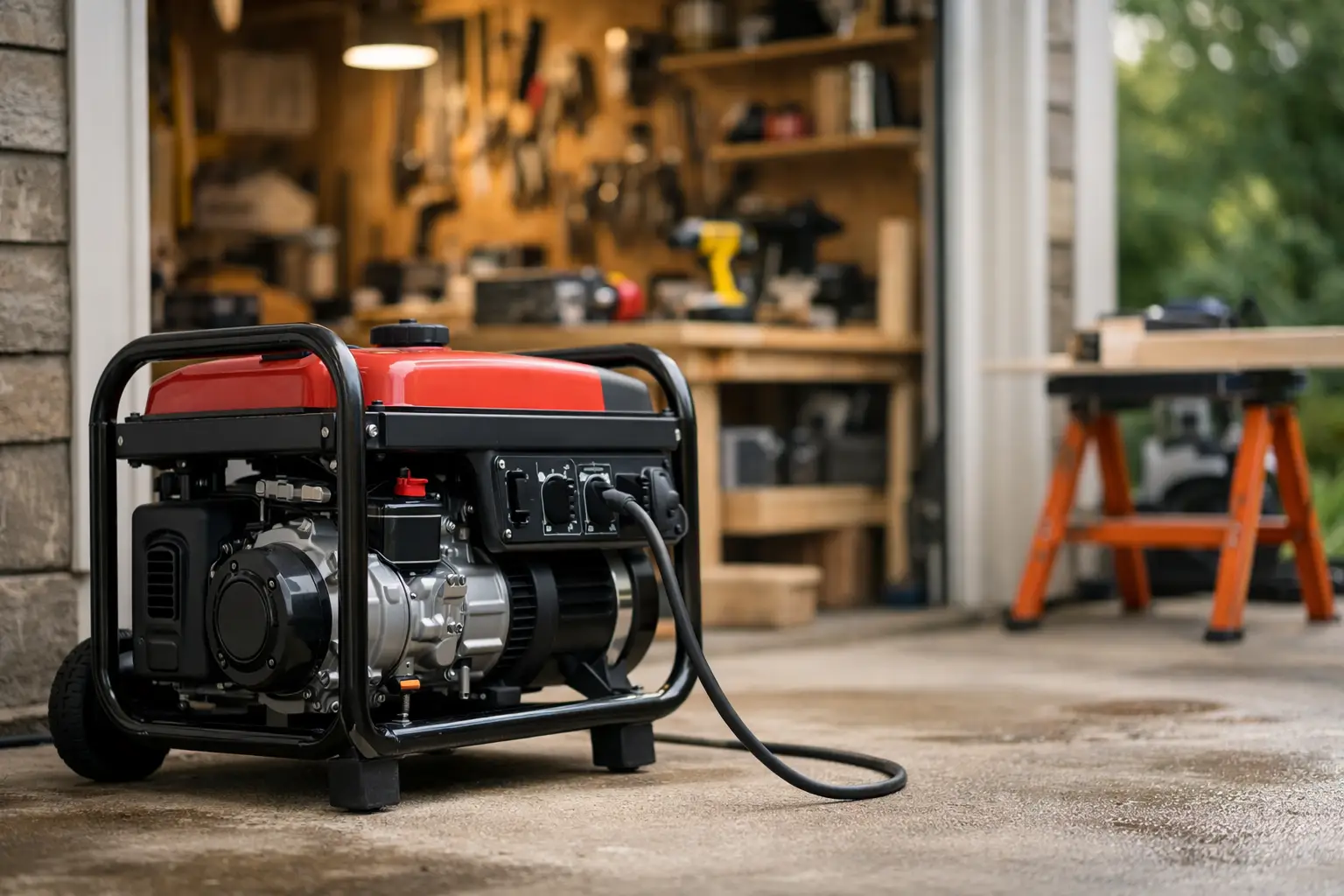
The GP9500E TF is a large open-frame portable generator built around fuel flexibility rather than quiet operation or compact size.
Its biggest advantage is straightforward: you are not limited to gasoline. If you have propane available, you can use it. If your home has a suitable natural gas connection, that gives you another option for extended operation.
The exact specifications can vary by model number and configuration, so buyers should check the model listed on the product page before ordering. Generac’s current 50-state GP9500E Tri-Fuel is model 8061, while earlier documentation also exists for the 49-state GP9500E TF model 8063-0.
For the current 50-state version, Generac lists 9,500 running watts and 12,500 starting watts on gasoline, with a 7.5-gallon fuel tank and up to 10.5 hours of runtime at 50% load.
Generac GP9500E TF Specifications
| Feature | Specification |
|---|---|
| Generator Type | Portable tri-fuel generator |
| Gasoline Running Watts | 9,500 watts |
| Gasoline Starting Watts | 12,500 watts |
| Propane Running Watts | 8,550 watts |
| Propane Starting Watts | 11,250 watts |
| Natural Gas Running Watts | 7,000 watts |
| Natural Gas Starting Watts | 9,000 watts |
| Fuel Types | Gasoline, propane, natural gas |
| Engine | 500cc OHV |
| Starting System | Electric start and recoil |
| Fuel Tank | 7.5 gallons |
| Gasoline Runtime at 50% Load | Up to 10.5 hours on current 50-state version |
| Voltage | 120/240V |
| Frequency | 60 Hz |
| Battery | 12V, 9Ah lead-acid |
| Wheels | 9.5-inch never-flat wheels |
| Weight | About 227 pounds |
| Low-Oil Shutdown | Yes |
| CO Protection | COsense |
| Automatic Voltage Regulation | Yes |
| Configuration | 50-state version available |
| Residential Warranty | 3-year limited warranty |
Specifications can change between model variants, so verify the model number and current listing before purchasing. Generac’s published documentation confirms the major differences between its 49-state and 50-state configurations.
How Much Power Does the Generac GP9500E TF Produce?
The GP9500E TF is a substantial generator, but its advertised maximum output needs some explanation.
On gasoline, Generac rates it at:
- 9,500 running watts
- 12,500 starting watts
When operating on propane, the output drops to:
- 8,550 running watts
- 11,250 starting watts
On natural gas, the published output is lower again:
- 7,000 running watts
- 9,000 starting watts
That difference matters if you are planning to use the generator for home backup.
A generator rated at 9,500 running watts on gasoline does not provide 9,500 watts regardless of fuel. Natural gas users, in particular, should plan around the lower output rather than the gasoline specification.
The extra starting wattage is useful for appliances and equipment with electric motors, since devices such as refrigerators, freezers, pumps, compressors, and air conditioners can briefly require more power when their motors start.
At the same time, the total electrical demand of your home still needs to be calculated. A 9,500-watt portable generator is not automatically capable of powering every appliance in a house simultaneously.
Tri-Fuel Operation: Gasoline, Propane, or Natural Gas
The main reason to consider the GP9500E TF over a conventional gasoline-only generator is its tri-fuel capability.
You can use:
Gasoline
Gasoline provides the generator’s highest rated output. It is useful when maximum wattage is the priority and you already have an appropriate supply available.
The downside is storage. Gasoline can degrade over time, so long-term emergency storage requires proper fuel management.
Propane
Propane gives you another option when gasoline is unavailable or you prefer to store fuel in portable cylinders.
The GP9500E produces less power on propane than gasoline, and runtime depends heavily on the size of the propane cylinder and the electrical load.
Generac lists up to about 5 hours at 50% load on a 20-pound propane tank for the current 50-state version.
Natural Gas
Natural gas is particularly interesting for home backup because it can eliminate the need to repeatedly refill a portable fuel tank.
However, natural gas does not provide the same output as gasoline. Generac’s published specifications for the GP9500E TF list 7,000 running watts and 9,000 starting watts on natural gas for the documented configuration.
A natural gas installation also requires an appropriate connection and adequate gas pressure. This is not something to improvise. If you plan to connect the generator to a home’s natural gas supply, the installation should comply with applicable local requirements and manufacturer instructions.
Runtime: How Long Will It Run?
Runtime is one of the specifications that needs the most context.
The current 50-state GP9500E is listed with a 7.5-gallon gasoline tank and up to 10.5 hours at 50% load. At a lower load, runtime can be considerably longer. Generac’s documentation lists approximately 13 hours at 25% load for gasoline.
Actual runtime will depend on:
- Total electrical load
- Fuel type
- Outdoor temperature
- Equipment connected to the generator
- Starting loads from motors and compressors
- Fuel quality and operating conditions
In other words, you should not assume that a full tank will always provide exactly 10.5 hours.
If your electrical demand is relatively light, you may run considerably longer than the 50% load figure. If you are operating several high-demand appliances simultaneously, runtime will be shorter.
Electric Start With Recoil Backup
Starting a 500cc portable generator is much easier with electric start than relying exclusively on a pull cord.
The GP9500E TF includes a battery-powered electric starting system, allowing you to start the engine from the control panel.
It also includes a recoil starting system, which is useful as a backup if the battery is discharged or the electric start cannot be used.
That combination is particularly practical for emergency preparedness. A generator that sits unused for months should still be inspected and maintained before an outage rather than assuming the electric starter will work indefinitely.
COsense Carbon Monoxide Protection
Carbon monoxide is one of the most important safety considerations with any portable generator.
The GP9500E includes COsense technology, which is designed to monitor carbon monoxide and provide protection by alerting users and shutting the generator down when dangerous conditions are detected.
However, CO protection does not make indoor operation safe.
Never operate this generator inside a home, garage, basement, enclosed porch, shed, or other enclosed or partially enclosed area.
The generator should be operated outdoors and positioned according to the owner’s manual and applicable safety requirements, with exhaust directed away from buildings and occupied spaces.
CO detectors and the generator’s built-in safety system should be considered additional layers of protection, not permission to operate the machine indoors.
Outlets and Home Backup Capability
The GP9500E TF is designed to provide both 120V and 240V power for larger electrical loads.
Its control panel includes connections intended for household, RV, and jobsite applications, depending on the exact configuration.
One detail that deserves attention is the generator’s high-amperage outlet.
Generac explains that the GP9500TF’s 50-amp receptacle is protected by a 40-amp circuit breaker. The plug configuration accepts a compatible 50-amp connection, but the actual continuous output is limited by the generator’s rated capacity and breaker.
This is important if you are purchasing the generator specifically to connect it to a home’s electrical panel.
A portable generator should never be connected to household wiring through an improvised backfeed connection. A properly installed transfer switch or other approved connection method should be used according to local electrical requirements.
Can the GP9500E TF Power a Whole House?
It can provide enough power for many essential household circuits, but “whole-house generator” can be misleading when talking about a portable generator.
The generator may be capable of running several important loads at the same time, but the exact combination depends on the home’s electrical demand.
For example, depending on their running and starting requirements, a properly configured setup may support combinations of:
- Refrigerator
- Freezer
- Sump pump
- Well pump
- Furnace blower
- Lighting
- Internet equipment
- Television
- Microwave
- Selected kitchen appliances
- Some air-conditioning equipment
Large central air-conditioning systems, electric water heaters, electric ranges, dryers, welders, and other high-demand equipment can quickly consume a large portion of the available capacity.
Before buying a generator for whole-home backup, calculate the running and starting wattage of the circuits you actually want to operate.
Portability: Powerful but Heavy
Calling the GP9500E TF “portable” does not mean it is lightweight.
The current model weighs approximately 227 pounds.
The included never-flat wheels and folding handle make it considerably easier to roll across a driveway, garage floor, or other suitable surface, but moving the generator over stairs, gravel, mud, or uneven terrain can still be difficult.
This is one area where the generator’s size becomes a trade-off.
You get substantially more power than a small inverter generator, but you also have to dedicate considerably more storage space and deal with a much heavier machine.
Noise Level
The GP9500E TF is an open-frame generator rather than a compact enclosed inverter generator.
That means buyers should not expect quiet operation.
Independent reviews of this model and generators in this power class commonly point to noticeable operating noise as one of the trade-offs for the available power. Bob Vila’s testing, for example, found the generator audible during operation and noted that an inverter generator may be preferable if low noise is a major priority.
If your main goal is maximum power for emergency backup, the noise may be an acceptable compromise.
If you need something for quiet camping, nighttime operation close to neighbors, or noise-sensitive environments, a smaller inverter generator may be a better fit.
Engine and Voltage Regulation
The GP9500E TF uses a 500cc OHV engine.
The published specifications also include automatic voltage regulation (AVR), which helps maintain the generator’s output voltage under changing loads.
The current 50-state version uses Generac’s EFI-equipped configuration, while older GP9500E TF documentation describes a 500cc OHV engine without the same EFI specification. This is another reason to check the exact model number before relying on older reviews or product descriptions.
What I Like About the Generac GP9500E TF
The strongest feature of the GP9500E TF is the combination of high output and three fuel choices.
Other advantages include:
- 9,500 running watts on gasoline
- 12,500 starting watts on gasoline
- Propane and natural gas capability
- Electric start
- Recoil backup
- COsense carbon monoxide protection
- 7.5-gallon gasoline tank
- 120/240V capability
- Never-flat wheels
- Covered outlets
- Low-oil shutdown
- Automatic voltage regulation
- Home backup capability with appropriate equipment
For someone preparing for long power outages, having three fuel options can be more useful than having a generator that simply produces a slightly higher peak wattage.
What to Consider Before Buying
The GP9500E TF is not perfect for every situation.
It Is Heavy
At roughly 227 pounds, this is not a generator you want to carry around casually.
The wheels help, but you still need a practical way to get it where you need it.
It Is Not a Quiet Generator
The open-frame design prioritizes power and accessibility over low noise.
If quiet operation is one of your top requirements, look at inverter-generator alternatives.
Power Drops With Propane and Natural Gas
The 9,500-watt gasoline rating should not be used when calculating capacity on every fuel.
Natural gas provides substantially less output than gasoline, so calculate your loads using the rating for the fuel you actually intend to use.
Home Connection Requires Planning
The generator can be used for home backup, but connecting it to a home’s electrical system should be done using an appropriate transfer switch or other code-compliant method.
Generac specifically describes compatibility with HomeLink manual transfer switches for home backup applications.
It Does Not Have Every Modern Convenience Feature
This is a fairly straightforward portable generator.
It is not designed around smartphone controls, remote start, or a sophisticated app-based monitoring system. That simplicity can be an advantage for some buyers, but it is worth knowing before purchasing.
Who Should Consider the Generac GP9500E TF?
The GP9500E TF makes the most sense for people who need substantial portable power and want multiple fuel options.
It can be a practical choice for:
Homeowners preparing for extended outages: The combination of gasoline, propane, and natural gas provides more flexibility when one fuel source becomes inconvenient or unavailable.
Contractors and jobsite users: The high output and 240V capability make it suitable for demanding tools and equipment when the required electrical loads are within its limits.
Rural homeowners: Natural gas availability or propane storage can make the tri-fuel design particularly useful.
Emergency preparedness: Multiple fuel choices can reduce dependence on a single stored fuel source during a prolonged outage.
Users who already have Generac equipment: Existing familiarity with the brand and access to appropriate service resources may be useful when maintaining a large portable generator.
Who May Want Something Else?
The GP9500E TF may not be the right match if you prioritize:
- Very quiet operation
- Lightweight portability
- Backpack or vehicle-friendly transportation
- Smartphone monitoring
- Remote start
- Minimal fuel consumption
- Small-space storage
A smaller inverter generator may be more appropriate for camping and light recreational use.
Likewise, homeowners who want automatic power restoration without manually starting and connecting a portable generator may prefer a permanently installed standby generator.
Maintenance Tips
A generator this large should not simply be stored in the garage and forgotten until the next outage.
Before an emergency, check the owner’s manual and follow the recommended maintenance schedule.
Important maintenance tasks include:
- Checking the engine oil
- Changing oil at the recommended intervals
- Inspecting the air filter
- Inspecting the spark plug
- Checking the battery
- Inspecting fuel lines and connections
- Checking the wheels and handle
- Running the generator periodically
- Inspecting electrical connections
- Keeping the generator clean and dry
- Storing gasoline appropriately when applicable
If you depend on the generator for emergency power, perform a test run before storm season rather than waiting for an actual outage to discover a battery, fuel, or starting problem.
Generac GP9500E TF vs. the Competition
The current generator market has plenty of large dual-fuel and tri-fuel models from brands such as DuroMax, Champion, Westinghouse, and others.
The GP9500E TF’s main selling point is not simply its wattage. It is the combination of 9,500 gasoline running watts, tri-fuel operation, COsense protection, electric start, and Generac’s established generator lineup.
Independent reviews have also highlighted the model’s tri-fuel capability and substantial power output while pointing out its weight and noise as trade-offs.
When comparing it with another generator, don’t look only at peak watts. Compare:
- Running watts on your preferred fuel
- Starting watts
- Fuel type
- Runtime
- Weight
- Outlet configuration
- CO protection
- Warranty
- Transfer-switch compatibility
- Noise
- Availability of service and replacement parts
That comparison will tell you much more than the headline wattage alone.
Generac GP9500E TF: Final Thoughts for 2026
The Generac GP9500E TF is built for buyers who need serious portable power without being locked into gasoline.
Its ability to operate on gasoline, propane, or natural gas is the biggest reason to consider it. On gasoline, the current version delivers up to 9,500 running watts and 12,500 starting watts, while propane and natural gas provide lower output but add useful fuel flexibility.
The electric start, recoil backup, COsense protection, 7.5-gallon tank, 120/240V output, and wheel kit make it well suited to emergency backup and demanding work applications.
The compromises are equally clear: it is heavy, it is not a quiet inverter generator, and its available power changes depending on the fuel being used.
For a homeowner considering this model in 2026, the most important step is to calculate the actual electrical loads you need to run and then verify the exact GP9500E variant you are buying. That is especially important because Generac has published different specifications for its 49-state and newer 50-state configurations.
If you need a high-output portable generator with three fuel choices and you understand those limitations, the GP9500E TF offers a flexible approach to backup power.
Frequently Asked Questions
How many watts does the Generac GP9500E TF produce?
The gasoline rating is up to 9,500 running watts and 12,500 starting watts. The published ratings are lower on propane and natural gas: 8,550/11,250 watts on propane and 7,000/9,000 watts on natural gas for the documented GP9500E TF configuration.
Can the Generac GP9500E TF run on natural gas?
Yes. The GP9500E TF is designed for gasoline, liquid propane, and natural gas. Natural gas produces less power than gasoline, so loads should be calculated using the natural-gas output rating.
How long does the GP9500E TF run on gasoline?
The current 50-state version has a 7.5-gallon fuel tank and is rated for up to 10.5 hours at 50% load. Runtime varies according to the electrical load and operating conditions.
Is the Generac GP9500E TF 50-state compliant?
The current model 8061 version is listed as 50-state compliant, while the older 8063-0 documentation identifies a 49-state configuration. Always verify the model number before buying, particularly if the generator will be used in California.
Does the Generac GP9500E TF have electric start?
Yes. The generator includes an electric starting system with a battery and also has recoil starting as a backup.
Can it power a house during an outage?
It can power selected household circuits when properly connected and when the electrical demand stays within the generator’s capacity. It should not be connected to household wiring through an improvised backfeed connection. A properly installed transfer switch or approved connection system should be used.
Is the Generac GP9500E TF quiet?
No. It is a large open-frame portable generator, so noticeable engine noise is part of the trade-off for its high output. If quiet operation is a priority, an inverter generator may be a better fit.
How heavy is the Generac GP9500E TF?
The current 50-state version weighs approximately 227 pounds. Its wheel and handle kit makes it easier to roll, but this is still a large and heavy portable generator.