As an Amazon Associate I earn from qualifying purchases.
A quiet portable generator can make a big difference when you need backup power without the constant roar of a traditional open-frame generator. That matters during a power outage, at an RV campground, while camping, or anywhere nearby noise is a concern.
The good news is that modern inverter generators can deliver useful amounts of power while keeping engine noise much lower than many conventional portable generators. But “quiet” does not mean the same thing for every model. Noise ratings can vary by load, measurement distance, and operating mode, so it is important to look at the full picture rather than choosing a generator based on a single decibel number.
For this 2026 guide, I’m focusing on portable inverter generators that balance low operating noise with useful power, portability, fuel efficiency, clean electricity, and safety features. I’ll also point out where a model makes more sense for camping or RV use than for emergency home backup.
Best Quiet Portable Generators for 2026
| Generator | Power Output | Noise Rating | Fuel | Best For |
|---|---|---|---|---|
| Westinghouse iGen5000 | 5,000 peak / 3,900 running watts | As low as 52 dBA | Gasoline | Higher-output quiet power |
| Champion 4000W Inverter | 4,000 starting / 3,000 running watts | 64 dBA | Gasoline | RVs, camping and basic backup |
| Honda EU2200i | 2,200 max / 1,800 rated watts | 48 dBA at ¼ load; 57 dBA rated load | Gasoline | Camping and quiet everyday use |
| WEN DF451i | 4,500 surge / 3,500 rated watts on gasoline | 58 dBA at ¼ load | Gasoline/Propane | RVs and dual-fuel flexibility |
| AMERISUN 2500W | Verify current specifications before purchase | Verify current rating | Gasoline | Budget portable power |
Detailed Reviews of the Best Quiet Portable Generators for 2026
1. Westinghouse iGen5000 5000-Watt Inverter Generator
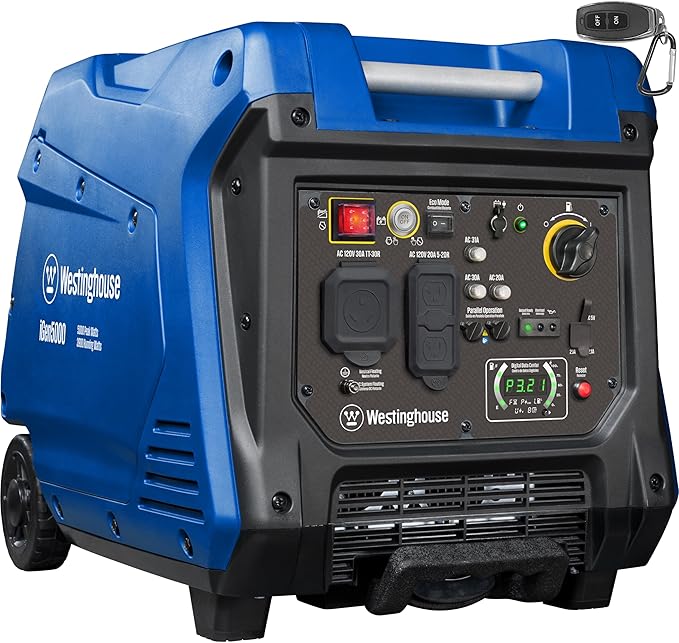
If you need more power than a small camping generator can provide but still want relatively quiet operation, the Westinghouse iGen5000 is one of the more interesting options in this group. It produces 5,000 peak watts and 3,900 running watts from gasoline, giving it enough capacity for several household essentials or larger RV loads.
Westinghouse rates the iGen5000 at as low as 52 dBA, depending on operating conditions. It also uses an enclosed inverter design, Economy Mode and a low-tone muffler system to reduce operating noise.
The generator produces less than 3% THD, making it suitable for many sensitive electronic devices.
The 3.4-gallon fuel tank can provide up to 18 hours of runtime at 25% load. It also includes electric start, remote start, a fuel gauge, an LED data center, wheels and a telescoping handle.
One thing to keep in mind is its size. At 104.7 pounds dry, this is portable in the sense that it has wheels and a handle, but it is not a generator most people will want to lift frequently.
Advantages:
- 5,000 peak and 3,900 running watts
- Noise rating as low as 52 dBA
- Up to 18 hours of runtime at 25% load
- Electric and remote starting
- RV-ready TT-30R outlet
- Less than 3% THD
- Wheels and telescoping handle
Keep in mind:
- About 105 pounds dry
- Gasoline only for this version
- The standard iGen5000 page does not list a CO sensor, so check the exact model and safety equipment before purchase
2. Champion 4000-Watt RV-Ready Portable Inverter Generator
The Champion 4000-Watt Inverter Generator is aimed at users who want a relatively high power output without moving up to one of the much heavier portable generators. It produces 4,000 starting watts and 3,000 running watts from gasoline and is rated at 64 dBA from 23 feet.
One of its biggest advantages is portability. Champion lists the generator at less than 49 pounds, which is considerably lighter than many 4,000- to 5,000-watt portable models.
The unit includes a 120V 25A TT-30R RV-ready outlet, a household 120V duplex outlet and parallel capability. Champion also specifies clean power with less than 3% THD and includes its CO Shield carbon-monoxide shutdown system.
Runtime is rated at up to 10 hours at 25% load from the 1.54-gallon gasoline tank. Economy Mode can reduce engine speed when the electrical load is lower, which can also help reduce fuel consumption and noise.
This model makes more sense for camping, RV use, tailgating and powering a few essential loads than as a substitute for a professionally installed whole-home backup system. Champion specifically states that this model is not recommended for emergency home backup.
Advantages:
- 4,000 starting and 3,000 running watts
- 64 dBA at 23 feet
- Less than 49 pounds
- RV-ready TT-30R outlet
- CO Shield automatic shutdown
- Less than 3% THD
- Up to 10 hours of runtime at 25% load
- Parallel capability
Keep in mind:
- Gasoline only
- Recoil start
- Not intended as a whole-home emergency backup solution
3. Honda EU2200i 2200-Watt Portable Inverter Generator
The Honda EU2200i remains a strong option when low operating noise and portability matter more than maximum wattage. It produces 2,200 watts of maximum output and 1,800 watts of rated output, making it better suited to smaller loads than the larger 4,000- and 5,000-watt generators in this guide.
Honda lists the EU2200i at 48 dBA at 25% load and 57 dBA at rated load. That distinction matters because a generator’s noise level changes as the engine works harder.
The generator weighs 47.4 pounds and has a 0.95-gallon fuel tank. Honda rates runtime at up to 8.1 hours at ¼ load. It also uses inverter technology to provide stable power for common electronics and appliances.
The EU2200i uses a recoil starter and can be paired with another compatible Honda unit for additional output.
Advantages:
- 2,200 watts maximum output
- 1,800 watts rated output
- 48 dBA at ¼ load
- 57 dBA at rated load
- 47.4-pound dry weight
- Up to 8.1 hours at ¼ load
- Inverter technology
- Parallel capability with compatible equipment
Keep in mind:
- Lower output than the larger generators in this guide
- Recoil start
- Gasoline only
- Buyers in California should check availability and the exact model
4. WEN DF451i 4500-Watt Dual-Fuel Inverter Generator
The WEN DF451i is a useful choice if you want more output than a 2,000-watt-class inverter generator and prefer having both gasoline and propane available.
On gasoline, it produces 4,500 surge watts and 3,500 rated watts. On propane, the output is rated at 4,500 surge watts and 3,150 running watts.
WEN rates the DF451i at 58 dBA at quarter load from 22 feet, which is more useful than simply calling it “super quiet.” Actual noise will vary with the electrical load and operating conditions.
Another useful feature is WEN’s Auto Fuel Selection Technology, which can automatically switch from propane to gasoline for longer operation. The generator also has electric start with a recoil backup, an RV-ready TT-30R outlet, wheels and a carrying handle.
For electronics, WEN states that the inverter produces clean power designed to protect sensitive devices such as laptops, tablets and smartphones.
The DF451i makes the most sense for RV owners, campers and people who want flexible fuel options during an outage. It should not be treated as a replacement for a permanently installed home standby generator.
Advantages:
- 4,500 surge watts on gasoline
- 3,500 rated watts on gasoline
- 3,150 running watts on propane
- Dual-fuel operation
- 58 dBA at quarter load
- Auto Fuel Selection Technology
- Electric and recoil starting
- RV-ready TT-30R outlet
- Inverter power for sensitive electronics
Keep in mind:
- Noise rating is measured at quarter load
- Propane output is lower than gasoline running output
- Larger and heavier than small camping generators
5. AMERISUN 2500-Watt Portable Generator
The AMERISUN 2500-Watt generator can be considered by shoppers looking for a compact and lower-cost portable option, but current specifications should be checked carefully before purchasing.
The original specifications associated with this listing stated 2,500 peak watts, 1,900 running watts, 69 dBA and a weight of 39.7 pounds. Because those figures should be verified against the current product listing before publication, they should not be presented as guaranteed current specifications.
If low noise is the main reason you are shopping for a generator, compare the current AMERISUN specifications with established inverter models before making a decision.
Before buying, check:
- Current running and starting wattage
- Current noise rating and measurement distance
- Actual product weight
- Runtime
- Outlet configuration
- CO safety features
- Warranty and service availability
Why Generator Noise Matters in 2026
Generator noise is not just a comfort issue. A loud portable generator can become a problem when you are camping near other people, staying at an RV park, using backup power in a residential neighborhood, or trying to sleep during an extended outage.
A lower noise rating can make the generator easier to live with, but it is important to compare ratings carefully. Manufacturers may measure sound at different distances and loads, so a 52 dBA rating from one manufacturer is not necessarily a direct apples-to-apples comparison with another rating taken under different conditions.
A quiet generator can offer several practical advantages:
- Less disturbance: Lower operating noise is easier on you, your family and nearby neighbors.
- Better camping experience: A quieter inverter generator is less intrusive around a campsite.
- More comfortable RV use: Lower noise makes it easier to relax outside the RV.
- Easier conversation: You are less likely to compete with the engine when talking nearby.
- Better nighttime comfort: A quieter unit is less disruptive when backup power is needed overnight.
The goal is not to find a generator that is literally silent. Gasoline-powered generators still use an internal-combustion engine. Instead, look for a model with a low published dBA rating under conditions that are relevant to how you expect to use it.
What to Look for in a Quiet Portable Generator
Choosing a quiet generator is about more than finding the lowest number on a specification sheet. Before buying, compare these factors:
1. Determine Your Actual Wattage Needs
Add up the running watts of the appliances you expect to use and account for startup surges from equipment such as refrigerators, freezers, pumps and air conditioners.
Do not assume that a generator’s peak wattage is the amount of power it can continuously provide. Running or rated watts are the more important number for sustained loads.
2. Compare Noise Ratings Carefully
Look at the manufacturer’s stated dBA rating and check the measurement distance and load.
A generator rated at 52 dBA at a light load should not automatically be described as quieter than another generator rated at 55 dBA under a different test condition.
3. Choose the Right Fuel Type
Gasoline is common for portable generators, while dual-fuel models can also use propane. Propane can be useful for longer-term fuel storage, but output and runtime can differ between gasoline and propane.
4. Consider Weight and Portability
A generator may technically be portable but still be difficult to move alone. Small inverter generators can weigh less than 50 pounds, while higher-output models may exceed 100 pounds.
5. Check Runtime at a Realistic Load
Runtime figures are often advertised at 25% load. Your actual runtime will usually be shorter if you operate the generator at a higher load.
6. Look for Inverter Technology
Inverter generators generally provide stable electricity suitable for many sensitive electronic devices. They can also vary engine speed according to electrical demand, which can help reduce fuel consumption and operating noise.
7. Pay Attention to CO Safety
Carbon monoxide is a serious hazard with fuel-burning generators. Look for appropriate CO detection and automatic shutdown features where available, and always follow the manufacturer’s safety instructions.
8. Check Outlets and RV Compatibility
If you plan to use the generator with an RV, verify that it has the correct RV-ready outlet and enough capacity for your air conditioner and other appliances.
9. Think About Maintenance
Oil changes, air-filter service, spark-plug maintenance and proper fuel storage all affect long-term reliability. A generator that is easy to maintain can be more practical over several years of use.
10. Know the Limits of Portable Backup Power
A portable generator is not automatically a whole-home backup system. If you want to connect a generator to household wiring, use equipment and installation methods approved for that purpose and follow applicable electrical requirements.
Never connect a portable generator directly to a household wall outlet.
Which Quiet Generator Is Right for Your Needs?
For Camping
A smaller inverter generator such as the Honda EU2200i makes sense when portability and low noise are more important than high output.
For RV Use
Look for an RV-ready outlet and enough running watts to handle your expected loads. The Champion 4000W and WEN DF451i both offer RV-ready connections, but their output, fuel options and noise ratings differ.
For Higher-Power Portable Backup
The Westinghouse iGen5000 provides 3,900 running watts and a 5,000-watt peak output, giving it considerably more capacity than the Honda EU2200i.
For Dual-Fuel Flexibility
The WEN DF451i is the natural fit among these models if gasoline-and-propane flexibility is a priority.
For Occasional Tailgating or Outdoor Use
A lightweight 2,000- to 2,500-watt inverter generator may be easier to transport than a larger 4,000- or 5,000-watt model. For these uses, paying for extra wattage that you rarely need may not be worthwhile.
How Quiet Is a Portable Generator?
Generator noise is measured in decibels, usually written as dBA. The lower the number, the quieter the sound level under the stated testing conditions.
However, don’t compare two generators based only on the number.
A manufacturer may publish a noise rating at 25% load, while another may publish a rating at a different load. The measurement distance can also vary.
For example, WEN lists the DF451i at 58 dBA at quarter load and 22 feet, while Champion lists its 4000W inverter at 64 dBA from 23 feet. Honda provides two EU2200i figures: 48 dBA at quarter load and 57 dBA at rated load.
That is why a useful comparison should always show:
- The stated dBA level
- Measurement distance
- Load condition
- Generator output
- Whether the generator uses an enclosed inverter design
- Whether Economy Mode is available
This gives you a much better idea of how the generator may behave in real use.
Frequently Asked Questions About Quiet Portable Generators
What is considered a quiet portable generator?
There is no single universal number that makes a generator “quiet.” Many enclosed inverter generators operate in the roughly 50-65 dBA range under lighter loads, but manufacturers measure noise differently. Always compare the stated load and measurement distance along with the dBA figure.
Is 50 dB quiet for a generator?
A rating around 50 dBA is relatively low for a gasoline-powered portable generator, particularly when measured under a light load. However, the generator can become louder as the electrical load increases, so check the manufacturer’s rating at different operating conditions when available.
Which portable generator is the quietest?
The answer depends on the generator’s output, load and testing conditions. For example, Honda lists the EU2200i at 48 dBA at 25% load, while Westinghouse lists the iGen5000 as low as 52 dBA. These ratings are not necessarily directly comparable because the generators have different power capacities and test conditions.
Are inverter generators quieter than conventional generators?
Inverter generators are often quieter because their engines can operate at variable speeds based on electrical demand and the units commonly use enclosed designs. This can also improve fuel efficiency at lighter loads.
Can I use a quiet portable generator indoors?
No. A gasoline or propane portable generator should never be operated inside a house, garage, basement, crawlspace or other enclosed or partially enclosed area. Carbon monoxide can build up quickly and become deadly. Follow the manufacturer’s placement and ventilation instructions every time you operate the generator.
Conclusion
The best quiet portable generator is not necessarily the one with the lowest advertised decibel number. The better choice depends on how much power you need, how often you expect to move the generator, which fuel you prefer, how long you need it to run and where you plan to use it.
For smaller loads and camping, the Honda EU2200i offers a compact design with a published rating of 48 dBA at 25% load. For higher portable power, the Westinghouse iGen5000 provides up to 5,000 peak watts and a noise rating as low as 52 dBA. The WEN DF451i adds dual-fuel flexibility, while the Champion 4000W inverter keeps the weight relatively low for its output class.
Before buying, compare running watts, startup capacity, noise ratings, runtime, fuel type, outlets, weight and CO safety features. Most importantly, make sure the generator is appropriate for the loads you actually need to power.
A quiet generator should make backup power less disruptive—not encourage you to compromise on electrical capacity or safety.