As an Amazon Associate I earn from qualifying purchases.
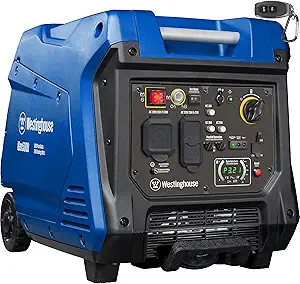
A 5000 watt inverter generator can be a useful middle ground when a 2,000- or 3,000-watt portable generator is no longer enough, but you still want the cleaner power, fuel efficiency, and lower operating noise associated with inverter technology.
The important thing is to look beyond the number in the product name. A generator advertised as having 5,000 watts may produce considerably less power continuously. For example, the Westinghouse iGen5000 is rated for 5,000 peak watts and 3,900 rated watts, while the Champion 6250-watt open-frame inverter generator produces 6,250 starting watts and 5,000 running watts.
That difference can determine whether a generator can handle your refrigerator, sump pump, microwave, RV air conditioner, power tools, or several smaller loads at the same time.
For this 2026 guide, the focus is on the specifications that actually matter: running watts, starting watts, fuel type, RV compatibility, noise, portability, safety features, outlets, and the type of backup power each generator is designed to provide.
Top 5000 Watt Inverter Generators for 2026
| Generator | Starting Watts | Running Watts | Fuel | RV Ready | Best For |
|---|---|---|---|---|---|
| Westinghouse iGen5000 | 5,000 | 3,900 | Gasoline | Yes | General home backup and RV use |
| Westinghouse iGen5000DF / DFc | 5,000 gas / 4,500 propane | 3,900 gas / 3,500 propane | Gas/Propane | Yes | Fuel flexibility |
| Pulsar GD500N | 5,000 | 4,000 | Gasoline | Yes | Portable power and RV use |
| Champion 6250-Watt Portable Inverter | 6,250 | 5,000 | Gasoline | Yes | Higher continuous output |
| Westinghouse iGen5000c / iGen5000cv | 5,000 | 3,900 | Gasoline | Yes | Buyers wanting CO protection |
Specifications can vary by exact model suffix and production version. Always verify the model number and current manufacturer’s specifications before ordering. Westinghouse currently lists multiple iGen5000 variants, including gasoline, CO-equipped, dual-fuel, and EFI versions.
What Can a 5000 Watt Inverter Generator Actually Run?
The answer depends much more on the generator’s running-watt rating and your appliances’ starting requirements than on the headline peak-watt number.
A generator in this class may be capable of running a combination of:
- Refrigerator or freezer
- Sump pump
- Microwave
- Television
- Internet router
- LED lights
- Fans
- Battery chargers
- Power tools
- Small window air conditioners
- Selected RV appliances
- Some RV air conditioners
The key is to avoid assuming that every appliance can be turned on simultaneously.
Motors and compressors can require a temporary surge of electricity when they start. A refrigerator, sump pump, well pump, air conditioner, or compressor may therefore require substantially more power for a few seconds than it uses once it is operating.
For example, a generator with 3,900 running watts should be sized around that continuous output rather than its 5,000-watt starting figure.
Before buying, check the appliance label or owner’s manual for both running and starting requirements. When several motor-driven appliances are involved, leave some capacity available for startup surges instead of operating the generator continuously at its maximum rating.
5000 Peak Watts vs. 5000 Running Watts: Why It Matters
This is one of the most important differences to understand before buying a generator.
Starting watts, also called peak or surge watts, are the additional power available for a short period when an appliance or motor starts.
Running watts, also called rated or continuous watts, are the amount of power the generator is designed to supply continuously.
Consider these two examples:
- A Westinghouse iGen5000 provides 5,000 peak watts and 3,900 rated watts.
- The Champion 6250-watt inverter generator provides 6,250 starting watts and 5,000 running watts.
Both products are often discussed in the 5,000-watt generator category, but they are not equivalent in continuous output.
If you need to operate several appliances for hours during a power outage, running watts should be one of the first specifications you compare.
Why Choose a 5000 Watt Inverter Generator?
A 5,000-watt-class inverter generator can offer several advantages over a traditional portable generator.
Cleaner Power for Electronics
Inverter generators are designed to produce a more controlled electrical output than many conventional portable generators.
This can make them a useful option for electronics such as laptops, televisions, phones, tablets, networking equipment, and other modern devices.
However, not every inverter generator has identical electrical characteristics. When sensitive electronics are important, check the manufacturer’s stated THD specification rather than relying solely on the word “inverter.”
For example, Westinghouse states that the iGen5000 produces less than 3% THD.
Lower Noise at Partial Loads
Many inverter generators can automatically adjust engine speed according to electrical demand.
When the load is relatively light, the engine may operate at a lower speed. This can reduce noise and fuel consumption compared with a conventional generator running at a fixed engine speed.
The actual noise level still depends on the generator, load, and measurement conditions.
Westinghouse, for example, lists the iGen5000 and iGen5000DFc at as low as 52 dBA under its specified conditions.
Better Fuel Efficiency at Lower Loads
Variable engine speed can also reduce fuel consumption when the generator is not operating near its maximum output.
That does not mean every inverter generator will automatically use less fuel in every situation. Runtime depends on the engine, tank size, load, fuel type, and operating mode.
Useful Portability
A 5,000-watt generator is still a substantial piece of equipment.
Enclosed inverter models often include wheels and handles, but weight varies considerably. The Westinghouse iGen5000DFc, for example, is listed at 105.8 pounds, while smaller designs such as the Pulsar DHD5000BiSRCO are around 60 pounds.
That difference can matter if you frequently load the generator into a truck or move it around a campsite.
Detailed Reviews
1. Westinghouse 5000 Peak Watt Super Quiet Portable Inverter Generator
The Westinghouse iGen5000 is one of the more straightforward choices in this category for buyers who want a gasoline-powered inverter generator with 5,000 peak watts and 3,900 rated watts.
Westinghouse lists a 3.4-gallon fuel tank, up to 18 hours of runtime at 25% load, a TT-30R RV-ready outlet, two 20A household outlets, USB ports, electric start, remote start, wheels, and a telescoping handle. The manufacturer also lists less than 3% THD and a noise level as low as 52 dBA under its stated conditions.
The 3,900-watt continuous rating is the specification to focus on when planning household or RV loads. The 5,000-watt peak rating provides additional capacity for short startup surges but should not be treated as continuous output.
Key advantages
- 5,000 peak watts
- 3,900 rated watts
- Gasoline powered
- Inverter technology
- Less than 3% THD according to Westinghouse
- RV-ready TT-30R outlet
- Electric start
- Remote start
- LED data center
- Wheels and telescoping handle
- Up to 18 hours at 25% load
Best suited for
The iGen5000 is a practical fit for someone who wants one enclosed inverter generator for RV use, camping, emergency backup, and general portable power without stepping up to a much larger generator.
2. Westinghouse 5000 Peak Watt Dual Fuel Portable Inverter Generator
The Westinghouse iGen5000DF family adds propane capability to the gasoline platform.
This is important for emergency preparedness because you can use gasoline when it is convenient and propane when you prefer a different fuel source.
The iGen5000DFc is currently listed by Westinghouse at 5,000 peak/3,900 rated watts on gasoline and 4,500 peak/3,500 rated watts on propane. It also includes a TT-30R RV outlet, remote start, LED display, and automatic low-oil and CO shutdown. Westinghouse lists up to 18 hours of runtime at 25% load on its 3.4-gallon gasoline tank.
One important detail is that not every iGen5000DF variant has the same safety equipment. Westinghouse currently sells DF, DFc, DFcv, and EFI DFc versions. Buyers should check the exact suffix before ordering rather than assuming that every dual-fuel model includes the same CO system.
Key advantages
- Gasoline and propane operation
- 5,000 peak watts on gasoline
- 3,900 rated watts on gasoline
- 4,500 peak watts on propane
- 3,500 rated watts on propane
- RV-ready TT-30R outlet
- Remote start
- LED display
- Inverter technology
- CO shutdown on applicable c-series models
- Low-oil shutdown
- Up to 18 hours at 25% load on applicable versions
Best suited for
This model family is particularly useful for buyers who want dual-fuel flexibility for home emergency backup, RV travel, camping, or longer outages.
If CO shutdown is important to you, verify that the specific listing is the DFc or another CO-equipped variant.
3. Pulsar Products GD500N 5000W Super-Quiet Inverter Generator
The Pulsar GD500N deserves attention because it provides 5,000 starting watts and 4,000 running watts.
That 4,000-watt continuous rating gives it a little more sustained output than a typical 5,000-peak-watt generator rated around 3,900 running watts.
Available specifications list the GD500N as a gasoline-powered inverter generator with an RV-ready outlet, low-oil shutdown, overload protection, and a portable design weighing about 59 pounds.
One reason to consider it is portability. If you regularly move your generator between a garage, truck, campsite, or work area, a lighter design can be more convenient than a 100-pound-plus enclosed generator.
Key advantages
- 5,000 starting watts
- 4,000 running watts
- Gasoline powered
- Inverter technology
- RV-ready outlet
- Low-oil shutdown
- Overload protection
- Portable design
- Approximately 59 pounds
Best suited for
The GD500N is worth considering if you want 4,000 running watts without moving into a much larger conventional generator.
4. Champion Power Equipment 6250-Watt Portable Inverter Generator
The Champion 6250-Watt Portable Inverter Generator is different from most products marketed as 5,000-watt generators because its continuous output is actually 5,000 watts.
Champion’s documentation lists 6,250 starting watts and 5,000 running watts, along with a 301cc engine, 4.2-gallon gasoline tank, 120/240V capability, a 30A L14-30R outlet, GFCI-protected 120V outlets, Economy Mode, and a noise rating around 64 dBA in the referenced specification sheet.
That makes this model particularly interesting for buyers who initially searched for a 5,000-watt generator because they actually need 5,000 watts of continuous output.
The trade-off is its open-frame design and substantially higher weight than many enclosed portable inverter generators.
Key advantages
- 6,250 starting watts
- 5,000 running watts
- 120/240V output
- Inverter technology
- 30A L14-30R outlet
- GFCI-protected household outlets
- Economy Mode
- 4.2-gallon fuel tank
- Up to 13.5 hours of runtime under specified conditions
- Open-frame design
Best suited for
The Champion is particularly useful for buyers who prioritize 5,000 watts of continuous power and 120/240V capability over having the smallest or lightest enclosed generator.
5. Westinghouse 5000 Peak Watt Portable Inverter Generator with CO Sensor
The Westinghouse iGen5000c and iGen5000cv variants add carbon monoxide protection to the gasoline iGen5000 platform.
The core power rating remains 5,000 peak watts and 3,900 rated watts, while the CO-equipped versions add automatic CO shutdown along with low-oil protection and the other features associated with the iGen5000 platform.
This is an important distinction because the original iGen5000 and the CO-equipped iGen5000c/cv should not be treated as identical models.
If you are shopping through Amazon, check the model number shown in the current listing before purchasing.
Key advantages
- 5,000 peak watts
- 3,900 rated watts
- Gasoline powered
- Inverter technology
- CO shutdown on applicable model
- Low-oil shutdown
- RV-ready TT-30R outlet
- Remote start
- LED display
- Wheels and telescoping handle
Best suited for
This version is a logical option for buyers who want the iGen5000 platform but specifically want a model equipped with automatic CO shutdown.
How to Choose a 5000 Watt Inverter Generator
The wattage printed in the product title should not be the only factor you consider.
Here are the specifications that deserve the most attention.
1. Starting Watts vs. Running Watts
Start here.
If your generator is rated at 5,000 peak watts but only 3,900 running watts, you should plan your continuous electrical load around 3,900 watts, not 5,000.
The extra 1,100 watts is temporary surge capacity.
This distinction becomes particularly important with:
- Air conditioners
- Refrigerators
- Freezers
- Sump pumps
- Well pumps
- Compressors
- Power tools
If several of these devices may start at the same time, you need enough starting capacity to handle the combined surge.
2. Gasoline vs. Dual Fuel
Gasoline remains common because it is widely available and many dual-fuel generators produce their highest output on gasoline.
Dual-fuel generators give you another option by allowing propane operation.
The important thing is to compare the output for each fuel separately.
For example, the Westinghouse iGen5000DFc is rated at 5,000 peak/3,900 rated watts on gasoline but 4,500 peak/3,500 rated watts on propane.
If you plan to run primarily on propane, use the propane ratings when calculating your expected load.
3. Runtime
Runtime figures can be misleading when they are viewed without the load percentage.
A generator that runs for 18 hours at 25% load will consume fuel much faster when operating close to its maximum output.
When comparing runtime, look at:
- Fuel tank capacity
- Fuel type
- Load percentage
- Eco mode
- Engine size
- Rated output
This gives you a more realistic idea of how often you will need to refuel during an extended outage.
4. Noise Level
Noise matters if you plan to use the generator near an RV, campsite, home, or neighbors.
Look for a manufacturer’s actual dBA specification and check the testing conditions.
For example, Westinghouse lists some iGen5000 models at as low as 52 dBA, while open-frame inverter generators can have different noise characteristics.
Also remember that noise can increase as the electrical load increases.
5. CO Protection
Carbon monoxide protection is an increasingly common feature on portable generators.
A built-in CO sensor or automatic shutdown system can provide another layer of protection, but it does not make indoor generator operation safe.
The CDC recommends using portable generators outdoors and at least 20 feet away from doors, windows, and vents. It also specifically warns against operating generators inside homes or garages, even when doors and windows are open.
6. Portability
Do not underestimate generator weight.
Before purchasing, check:
- Generator weight
- Wheel design
- Handle design
- Telescoping handle
- Overall dimensions
- Whether you can safely move it by yourself
A generator that looks portable on a product page can still be difficult to load into an SUV or pickup.
For example, the Westinghouse iGen5000DFc is listed at 105.8 pounds, while the Pulsar/DieHard DHD5000BiSRCO platform is around 60 pounds.
7. RV Compatibility
If you are buying a generator specifically for an RV, check the outlet rather than simply looking for the words “RV Ready.”
A TT-30R 30-amp RV outlet is particularly useful for many travel trailers and other RV applications.
Also consider whether you need:
- Remote start
- Dual-fuel capability
- Quiet operation
- Parallel capability
- USB ports
- Long runtime
- Enough starting watts for your RV air conditioner
Is a 5000 Watt Inverter Generator Enough for Home Backup?
For many households, a 5,000-watt-class inverter generator can be useful for essential-load backup, but it should not automatically be considered a whole-house generator.
Depending on the actual electrical requirements, you may be able to run a refrigerator, freezer, lights, internet equipment, television, fans, microwave, sump pump, or selected heating equipment.
However, high-demand equipment can quickly consume the generator’s available capacity.
Examples include:
- Central air conditioning
- Electric water heaters
- Electric ranges
- Large well pumps
- Clothes dryers
- Large electric heaters
- Multiple high-demand appliances operating simultaneously
The best way to determine whether a 5,000-watt generator will work for your home is to make a list of the appliances you actually need during an outage.
Add their running watts and then consider the starting surge of motor-driven appliances.
Can a 5000 Watt Generator Run a Central Air Conditioner?
It depends on the air conditioner’s electrical requirements.
A small or efficiently starting air-conditioning system may have a chance of operating within the generator’s capacity, while a larger central AC system can require considerably more starting power.
Do not determine compatibility from the AC’s BTU rating alone.
Check the equipment’s electrical specifications, including:
- Rated running amps
- Starting amps
- Voltage
- Locked-rotor or starting requirements
If the air conditioner has a large startup surge, a generator with 5,000 peak watts and 3,900 running watts may not be enough.
Can You Use a 5000 Watt Inverter Generator With an RV?
Yes, many generators in this category are designed with RV use in mind.
Models such as the Westinghouse iGen5000 include a TT-30R RV-ready outlet, while other models provide additional outlets that can be useful for different RV configurations.
However, you should still check the electrical requirements of your specific RV.
If you plan to operate an RV air conditioner, refrigerator, microwave, battery charger, and other equipment at the same time, calculate the combined running load and account for startup surges.
Connecting a Portable Generator to Your Home
A portable generator should never be connected to household wiring by plugging it into a standard wall outlet.
That practice can create dangerous backfeeding conditions.
If you want to power selected circuits in your home, the generator should be connected through an appropriate transfer switch, interlock, inlet, or other installation that complies with applicable electrical requirements.
Because electrical systems differ between homes, a qualified electrician should determine the appropriate setup.
A generator having 5,000 watts of output does not mean it can simply be connected to a home’s electrical panel without the proper equipment.
5000 Watt Inverter Generator Safety Tips
Before using a gasoline or propane generator:
- Read the owner’s manual before operating the unit.
- Operate the generator outdoors only.
- Keep it at least 20 feet away from doors, windows, and vents.
- Position the exhaust so it does not point toward the house or other occupied areas.
- Never operate a portable generator inside a home.
- Never operate it inside a garage, even with the garage door open.
- Keep the generator dry and follow the manufacturer’s instructions regarding rain and moisture.
- Turn the generator off and allow it to cool before refueling.
- Never refuel a hot generator.
- Do not overload the generator.
- Keep children and pets away from the operating unit.
- Use properly rated outdoor extension cords when extension cords are necessary.
- Install working carbon monoxide detectors in your home.
- Follow local electrical requirements when using a generator for home backup.
The CDC specifically recommends operating portable generators outdoors at least 20 feet from windows, doors, and vents and using battery-powered or battery-backup CO detectors in the home.
A built-in CO shutdown system is an additional safety feature, not a substitute for correct generator placement.
Frequently Asked Questions
Is a 5000 watt inverter generator enough to power a house?
A 5,000-watt inverter generator can provide useful backup power for selected essential loads, but it usually should not be considered a whole-house generator. Whether it can operate your refrigerator, sump pump, microwave, air conditioner, or other appliances together depends on their running watts and starting requirements.
What is the difference between 5000 starting watts and 5000 running watts?
Starting watts are the temporary surge capacity available when equipment with a motor or compressor starts. Running watts are the continuous output the generator can provide. A generator rated at 5,000 starting watts may provide only 3,900 or 4,000 running watts.
Is a 5000 watt inverter generator good for an RV?
Yes. Many generators in this category include an RV-ready TT-30R outlet and enough output for common RV loads. However, you should calculate the combined running and starting requirements of your RV appliances, especially the air conditioner.
Is dual fuel better than gasoline only?
Dual fuel provides more flexibility because you can operate the generator with gasoline or propane. However, propane typically produces different wattage and runtime figures, so compare the specifications for the fuel you actually plan to use.
How far should a portable generator be from a house?
The CDC recommends keeping a portable generator outdoors and at least 20 feet away from doors, windows, and vents. Never operate a portable generator inside a house or garage, even if doors or windows are open.
Can a 5000 watt generator run a refrigerator and freezer?
It may be able to run both, but you need to consider their starting surges as well as their normal running consumption. Add the expected running load and make sure the combined startup requirements do not exceed the generator’s available capacity.
Are inverter generators safe for sensitive electronics?
Inverter generators are generally designed to provide cleaner and more stable electrical power than many conventional portable generators. However, specifications vary. Check the manufacturer’s THD rating when sensitive electronics are an important part of your backup plan.
What should I look for in a 5000 watt inverter generator?
Start with running watts rather than peak watts. Then compare fuel type, starting watts, noise, runtime, outlet configuration, RV compatibility, CO protection, portability, and whether you need 120V only or 120/240V capability.
Final Thoughts
A 5,000-watt inverter generator can be a useful option when you need more capacity than a small camping generator but do not want to move up to a very large portable or standby generator.
The biggest mistake is choosing based only on the number in the product name.
If your priority is an enclosed gasoline inverter generator for general portable power, the Westinghouse iGen5000 provides 5,000 peak and 3,900 rated watts. If you want fuel flexibility, the iGen5000DF family adds propane. The Pulsar GD500N provides 4,000 running watts in a more compact format, while the Champion 6250 is notable because it actually provides 5,000 running watts.
Before ordering, compare your real electrical loads against the generator’s running watts and starting watts, verify the exact model number, and check the manufacturer’s current specifications.
Most importantly, treat generator safety as part of the buying decision. A generator can provide valuable backup power during an outage, but it must be operated outdoors and positioned correctly to reduce the risk of carbon monoxide poisoning.