As an Amazon Associate I earn from qualifying purchases.
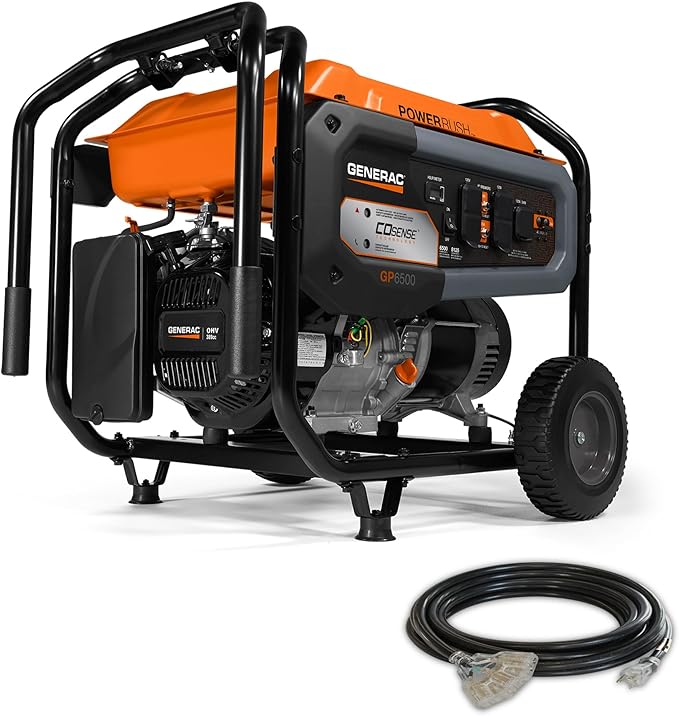
When you need backup power during a blackout, storm, or emergency, a portable generator can keep the essentials running without the cost of a permanently installed standby system. The Generac GP6500 7672 is a conventional gasoline-powered generator designed for homeowners, contractors, and other users who need substantial portable power.
With 6,500 running watts and 8,125 starting watts, a 389cc OHV engine, 120/240V output, COsense carbon monoxide protection, and a large fuel tank, the GP6500 has the capacity to handle many demanding loads. It is also a fairly large and heavy machine, so portability and noise are important considerations before buying.
There is another issue that buyers should know about in 2026. Certain Generac GP6500 units have been included in safety recalls, so checking the exact model and serial number is an important part of evaluating a used or previously purchased unit. More on that below.
Check Amazon Price Click Here
Generac GP6500 7672 Specifications
The following specifications are based on Generac’s documentation for the GP6500 models 7672-1 and 7672-2. Specifications can vary between model variants and production versions, so check the identification label on the individual generator before relying on any specification for a particular unit.
| Feature | Generac GP6500 7672 |
|---|---|
| Generator Type | Open-frame portable gasoline generator |
| Running Power | 6,500 watts |
| Starting Power | 8,125 watts |
| Engine | 389cc OHV |
| Fuel | Gasoline |
| Fuel Tank | 7.9 gallons |
| Runtime at 25% Load | Up to 16.5 hours |
| Runtime at 50% Load | Up to 11.5 hours |
| Voltage | 120/240V |
| Frequency | 60 Hz |
| Starting System | Recoil pull start |
| CO Protection | COsense |
| Voltage Regulation | Automatic Voltage Regulation (AVR) |
| Outlets | Two 120V 20A GFCI duplex outlets; one 120/240V 30A L14-30R twist-lock outlet |
| Wheels | 9.5-inch never-flat wheels |
| Frame | 1.25-inch steel-tube cradle |
| Weight | 172 pounds |
| Dimensions | 27.2 x 27 x 26.5 inches |
| Residential Warranty | 3-year limited |
| Commercial Warranty | 1-year limited |
Generac lists the 7672-1/7672-2 configuration as a 49-state model, with 6,500 rated running watts and 8,125 maximum starting watts. The generator also includes automatic voltage regulation, low-oil shutdown, a fuel gauge, hour meter, and recoil starting.
What Makes the Generac GP6500 Different?
The GP6500 is not an inverter generator and it is not a battery-powered power station. It is a traditional open-frame gasoline generator built around a relatively large engine and alternator.
That distinction matters.
The main reason to consider this type of generator is power capacity. At 6,500 running watts, the GP6500 can support considerably more equipment than many compact portable generators. The trade-off is that it is heavier, louder, and less convenient to move than a small inverter generator.
Generac also equips this model with PowerRush Advanced Technology, which the company says provides more than 40% additional starting capacity when an electric motor demands extra current. That does not mean the generator continuously produces more than its 6,500-watt rated output. The higher figure is available for starting loads.
For appliances with motors or compressors, that distinction can be important.
6,500 Running Watts and 8,125 Starting Watts: What Can It Power?
The GP6500’s 6,500 running-watt rating gives you a substantial amount of available power, but you still need to calculate your loads before connecting appliances.
A refrigerator, freezer, sump pump, furnace blower, lights, television, internet equipment, and several smaller appliances may fit comfortably within the generator’s capacity when managed correctly. Larger appliances such as central air conditioning, electric water heaters, electric dryers, ovens, or well pumps can consume a significant portion of the available capacity.
The important number isn’t simply the wattage printed on each appliance. Motors can require considerably more power when starting than when running.
This is where the GP6500’s 8,125-watt starting capacity and PowerRush technology can be useful. The generator has additional short-term capacity for starting certain motor-driven loads while continuing to supply its rated 6,500 watts during normal operation.
However, you should not assume that the GP6500 can start every large appliance simply because it has 8,125 starting watts. Actual starting requirements vary by appliance, motor design, temperature, condition, and other connected loads.
For a home backup setup, calculate the running and starting wattage of the appliances you actually intend to use.
Runtime and Fuel Capacity
Fuel capacity is one of the GP6500’s stronger practical features.
Generac’s specification sheet for the 7672-1 and 7672-2 lists a 7.9-gallon fuel tank, with an estimated runtime of up to 16.5 hours at 25% load and 11.5 hours at 50% load.
These figures should be treated as operating estimates rather than guarantees. Runtime changes depending on the electrical load, fuel condition, temperature, altitude, engine condition, and other operating factors.
For emergency backup, this is useful because you do not necessarily need to operate the generator at full capacity. If your essential household loads are relatively modest, reducing the electrical load can extend the time between refueling.
At the same time, gasoline storage becomes part of the backup-power plan. Anyone preparing for extended outages should think about safe fuel storage, fuel freshness, and the generator manufacturer’s storage recommendations rather than assuming one tank will last through a prolonged emergency.
COsense Carbon Monoxide Protection
One of the most important features of the GP6500 is COsense technology.
COsense monitors carbon monoxide around the generator and can alert users and shut down the generator when dangerous conditions are detected. Generac describes the system as protection against hazardous carbon monoxide.
That is a valuable safety feature, but it should never be treated as permission to operate the generator in an unsafe location.
A carbon monoxide shutdown system is an additional layer of protection, not a substitute for proper placement.
The CDC recommends operating portable generators outside and more than 20 feet from windows, doors, and vents. The generator should never be operated inside a home, garage, basement, or other enclosed or partially enclosed space.
You should also have working carbon monoxide detectors in the home, particularly near sleeping areas.
Important 2026 Safety and Recall Information
This is an important update that should be included in any current review of the Generac GP6500.
In April 2026, the U.S. Consumer Product Safety Commission announced a recall involving certain Generac portable generators because gasoline can leak from the carburetor when the generator is first filled with fuel. The recall affects specific model and serial-number ranges, including certain GP6500 units identified as G0076802 and G0076722. Approximately 149,400 generators were included in the recall, according to the CPSC.
The remedy is a repair through Generac/dealers for affected units. The CPSC advises consumers to check their model and serial number to determine whether their particular generator is included.
There was also an earlier Generac portable-generator recall concerning the folding handle. Certain GP6500 units were included because an unlocked handle could create a finger-crushing or amputation hazard while moving the generator.
Because recall coverage depends on the exact model and serial number, do not assume that every GP6500 is recalled or that every GP6500 is unaffected.
If you already own one of these generators, checking the serial number through Generac’s recall system is a sensible step before using or moving it.
Is the GP6500 Good for Home Backup?
The GP6500 can make sense as a portable emergency power source, but it should not be confused with a whole-house standby generator.
Its 6,500 running watts are enough for many essential household loads, provided you manage the electrical demand. You can prioritize necessities such as refrigeration, lighting, sump-pump operation, internet equipment, selected kitchen appliances, and other essential circuits.
What it cannot do is magically power an entire home regardless of the home’s electrical demand.
If you want to connect selected household circuits directly to the generator, a properly installed transfer switch or other code-compliant setup may be required. Electrical connections to a home’s wiring should be handled according to local electrical codes and by a qualified professional when required.
Generac lists the GP6500 as compatible with its HomeLink manual transfer switch system.
For many homeowners, the best way to use a generator this size is to decide before an outage which circuits and appliances are essential.
What About Sensitive Electronics?
The GP6500 uses automatic voltage regulation, which helps control voltage as electrical loads change.
However, it is still a conventional open-frame generator rather than an inverter generator.
That distinction can matter if your priority is supplying particularly sensitive electronics. Computers, networking equipment, televisions, medical electronics, and other sensitive devices may benefit from a power source specifically designed to provide very stable, clean electrical output.
If sensitive electronics are part of your emergency-power plan, check the requirements of those devices and compare them with the generator’s specifications rather than assuming every portable generator produces the same type of power.
A UPS or appropriate surge/power-conditioning equipment can also be worth considering for sensitive electronics.
Build Quality and Portability
At approximately 172 pounds, the GP6500 is not a lightweight generator.
That’s worth emphasizing because the word “portable” can be misleading. You can move the generator around a property using its wheels and folding handle, but it is not something most people will want to lift into a vehicle by themselves.
Generac uses a 1.25-inch steel-tube cradle and 9.5-inch never-flat wheels. The handle folds down for storage, while the frame is designed for the kind of use expected from a larger conventional generator.
For a homeowner who stores the generator in one location and rolls it into position when necessary, the weight may not be a major problem.
For camping, frequent transportation, or situations where one person needs to load and unload the generator regularly, the size becomes a much bigger consideration.
Noise: What Should You Expect?
The original version of this article was too vague about noise.
The GP6500 is an open-frame conventional generator, so buyers should not expect the quiet operation associated with many enclosed inverter generators.
Generac’s documentation for this model does not provide a standard manufacturer-rated decibel figure in the specification sheet. Because generator noise changes with load, distance, surroundings, and measurement method, a single number without a standardized testing method would not tell the whole story.
In practical terms, this is better suited to situations where substantial power is more important than silent operation.
If you live in a densely populated neighborhood, frequently camp in noise-sensitive areas, or expect to run the generator close to living spaces, compare its open-frame design with quieter inverter alternatives before buying.
Maintenance and Ease of Use
The GP6500 keeps its controls relatively straightforward.
The generator includes an hour meter for tracking maintenance intervals and a low-oil shutdown system designed to protect the engine if the oil level becomes too low. The 389cc OHV engine uses splash lubrication.
It also uses a recoil pull-start system on the 7672-1/7672-2 configuration, rather than the electric start found on some other GP6500 variants.
Routine maintenance remains important even if you only expect to use the generator a few times a year.
Before storm season, it is worth checking the oil, fuel system, air filter, spark plug, battery-powered CO detectors in the home, extension cords, and general condition of the generator.
A generator that has been sitting unused for months is not much help if it will not start when the power goes out.
Safety Tips for Using the GP6500
The GP6500’s safety features do not eliminate the basic hazards associated with gasoline engines and portable generators.
Follow these rules whenever you use it:
- Operate the generator outdoors only.
- Keep it at least 20 feet from windows, doors, and vents.
- Point the exhaust away from the house and occupied areas.
- Never operate it inside a garage, basement, shed, crawlspace, or enclosed area.
- Keep the generator dry and follow the manufacturer’s instructions for wet-weather operation.
- Use properly rated outdoor extension cords when connecting appliances.
- Never connect a portable generator directly to household wiring unless the system is designed and installed for generator connection.
- Keep gasoline away from ignition sources and store it according to applicable safety requirements.
- Allow the engine to cool before refueling.
- Keep children and pets away from the running generator.
- Check the generator’s model and serial number for applicable recalls.
- Keep battery-powered or battery-backup carbon monoxide detectors operating inside the home.
The CDC and CPSC continue to emphasize outdoor operation at least 20 feet from the home because portable generators can produce dangerous levels of carbon monoxide.
Best Uses for the Generac GP6500
The GP6500 makes the most sense in situations where you need substantial portable power rather than maximum portability.
Emergency Home Backup
This is one of its most practical applications. It can provide power for selected essential appliances during an outage, assuming their combined running and starting requirements stay within the generator’s limits.
Construction and Job Sites
The large engine, steel frame, 120/240V output, and substantial wattage make the GP6500 suitable for many tools and equipment used in construction or property maintenance.
Workshops and Outdoor Projects
If you need to operate power tools away from a standard electrical connection, 6,500 running watts gives you considerably more flexibility than smaller portable generators.
Remote Properties
Cabins, rural properties, and other locations without dependable grid power can benefit from the generator’s long runtime and relatively large fuel tank.
Who Should Consider the GP6500?
The GP6500 is worth considering if you want:
- 6,500 running watts from a conventional portable generator
- 8,125 starting watts for demanding motor loads
- 120/240V output
- A large gasoline tank
- COsense carbon monoxide protection
- A rugged steel frame
- Never-flat wheels
- A built-in hour meter
- Low-oil shutdown
- A generator that can handle both emergency and job-site applications
It is particularly suited to buyers who prioritize power capacity and runtime over low weight and quiet operation.
Who Should Look at Another Type of Generator?
The GP6500 may not be the best match if you need:
- Very quiet operation
- A lightweight generator for frequent transportation
- Battery-only operation
- Built-in Wi-Fi or advanced remote monitoring
- A compact generator for basic electronics and a few small appliances
- The cleanest possible power for sensitive electronics
- An automatic standby system that starts when the utility power fails
In those cases, an inverter generator, battery power station, or permanently installed standby generator may be a better category to investigate.
Generac GP6500 Pros and Cons
Pros
- 6,500 running watts provides substantial portable power.
- 8,125 starting watts helps with motor-driven appliances and tools.
- PowerRush technology provides additional starting capacity.
- COsense adds carbon monoxide monitoring and automatic shutdown protection.
- 7.9-gallon tank provides long potential runtime.
- 120/240V output increases flexibility for compatible equipment.
- Steel-tube frame is built for demanding use.
- Never-flat wheels make moving a 172-pound generator easier.
- Hour meter and low-oil shutdown simplify ownership and maintenance.
- 3-year residential warranty is listed for the 7672-1/7672-2 configuration.
Cons
- 172 pounds makes it heavy compared with smaller portable generators.
- The open-frame design is not ideal for noise-sensitive environments.
- It runs on gasoline only.
- Recoil starting requires manual pulling on the 7672-1/7672-2 configuration.
- It is not a whole-house automatic standby generator.
- Buyers should carefully consider electrical load requirements before connecting appliances.
- Certain GP6500 model/serial combinations have been affected by safety recalls, making a recall check especially important for 2026 buyers.
Final Verdict: Is the Generac GP6500 Worth Considering in 2026?
The Generac GP6500 7672 remains a substantial portable generator for buyers who need more power than compact emergency generators can provide.
Its combination of 6,500 running watts, 8,125 starting watts, a 389cc OHV engine, 120/240V output, COsense protection, a large fuel tank, and rugged steel frame gives it the basic characteristics many homeowners and professionals look for in a high-capacity portable generator.
But the GP6500 is not the right choice for everyone.
It is heavy, open-frame, gasoline-powered, and louder than many inverter-style alternatives. It also requires proper load management if you plan to use it for home backup.
Most importantly, anyone considering a GP6500 in 2026 should check the exact model and serial number against Generac’s current recall information. Certain GP6500 units were included in the April 2026 fuel-leak recall, while earlier GP6500 units were also affected by a handle-related safety recall.
If the particular unit is not affected by an applicable recall, its power capacity and long runtime can make it a practical option for emergency backup, job sites, workshops, and other applications where dependable portable electricity is more important than compact size or quiet operation.
Check Amazon Price Click Here
Frequently Asked Questions
How many watts does the Generac GP6500 produce?
The GP6500 is rated at 6,500 running watts and 8,125 starting watts. The running-watt rating is the important figure for the continuous electrical load, while the higher starting-watt rating provides additional capacity for starting motors and compressors.
How long will the Generac GP6500 run on a full tank?
Generac’s specification for the 7672-1/7672-2 configuration lists up to 16.5 hours at 25% load and 11.5 hours at 50% load. Actual runtime varies depending on the electrical load and operating conditions.
Can the Generac GP6500 power a house?
It can provide backup power for selected household circuits and appliances when the total electrical demand is within its capacity. It is not an automatic whole-house standby generator. A proper transfer-switch installation may be necessary for connecting selected home circuits.
Can I run the GP6500 in my garage?
No. A portable gasoline generator should never be operated inside a garage, even if the garage door is open. The CDC recommends operating portable generators outdoors and more than 20 feet from doors, windows, and vents.
Does the Generac GP6500 have CO protection?
Yes. The GP6500 7672 documentation lists COsense technology, which monitors carbon monoxide and provides alert and shutdown protection. It should be considered an additional safety feature, not a replacement for proper generator placement.
Is the Generac GP6500 an inverter generator?
No. The GP6500 is a conventional open-frame portable generator. Buyers who specifically need the characteristics of an inverter generator should compare models in that category instead.
Is the Generac GP6500 quiet?
It is not designed as a quiet, enclosed inverter generator. Because Generac’s documentation does not provide a standardized decibel rating for this model, it is better to think of the GP6500 as a traditional open-frame generator where power capacity is a bigger priority than silent operation.
Are Generac GP6500 generators being recalled in 2026?
Certain GP6500 units are included in the April 2026 Generac portable-generator recall for a potential fuel leak from the carburetor. The recall applies only to specific model and serial-number ranges, so owners should check their individual generator rather than assuming every GP6500 is affected.
What is the Generac GP6500 7672 warranty?
Generac’s documentation for models 7672-1 and 7672-2 lists a 3-year limited residential warranty and 1-year limited commercial warranty.
Bottom Line
The Generac GP6500 is best understood as a high-capacity conventional portable generator, not a portable power station or a replacement for an automatic standby system.
Its 6,500 running watts, 8,125 starting watts, large fuel capacity, 120/240V output, COsense protection, and heavy-duty frame give it plenty of capability for emergency backup and demanding outdoor work.
The biggest considerations are its weight, open-frame design, gasoline operation, noise, and the need to manage electrical loads carefully.
For 2026, the recall check is also essential. If you are buying one, especially a previously owned or older unit, verify the exact model and serial number before putting it into service.