As an Amazon Associate I earn from qualifying purchases.
A good 2,000-watt solar power station can do much more than charge phones and laptops. In 2026, this class of portable power station has become a practical option for camping, RV travel, remote work, emergency backup, and short-term power outages.
The important thing is not to look at the 2,000-watt rating alone. A power station’s output tells you how much power it can deliver at once, while its battery capacity, measured in watt-hours (Wh), determines how long your devices can run.
For this guide, I focused on models that offer around 2,000 watts or more of continuous AC output and looked at the features that matter most in everyday use: battery capacity, solar charging, recharge speed, portability, expandability, and the types of appliances each unit can realistically handle.
Quick Comparison: Best 2000-Watt Solar Power Stations
| Power Station | Battery Capacity | Continuous AC Output | Solar Input | Expandable |
|---|---|---|---|---|
| Dabbsson DBS1000Pro | 1,024Wh | 2,000W | 1,200W | Yes, up to 10,240Wh |
| OUPES Mega 1 | 1,024Wh | 2,000W | 800W | Yes, up to 5,120Wh |
| Jackery Explorer 2000 v2 | 2,042Wh | 2,200W | 400W | No |
| AFERIY P210 | 2,048Wh | 2,400W | 500W | No |
| BLUETTI AC70 | 768Wh | 1,000W | 500W | No |
Important: The BLUETTI AC70 is included as a compact alternative rather than a true 2,000W-class power station. Its inverter is rated at 1,000W, although its Power Lifting mode can reach 2,000W with certain resistive loads.
Dabbsson DBS1000Pro: High Solar Input in a Compact 2,000W Station
Check Amazon Price Click Here!
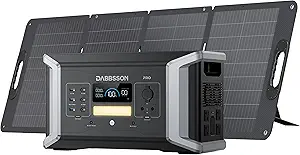
The Dabbsson DBS1000Pro is an interesting choice if you want strong output and fast solar charging without immediately moving to a much larger 2kWh power station.
It has a 1,024Wh battery and 2,000W of continuous AC output, with up to 4,000W of surge power. Dabbsson also lists a Power Boost mode that can reach 3,000W for certain applications. The battery uses semi-solid-state LiFePO4 chemistry and is rated for 4,500 cycles to 80% capacity.
One of the biggest advantages is the 1,200W maximum solar input. That’s unusually high for a station with a 1kWh battery, so the DBS1000Pro can take advantage of a substantial solar array and replenish its relatively small battery quickly when conditions are good.
The unit weighs about 34.4 pounds, making it considerably easier to move than many 2kWh stations.
Its capacity can also be expanded substantially. Dabbsson lists configurations reaching up to 10,240Wh, although the exact configuration requires additional batteries and equipment.
Best for
- Camping and RV use
- Emergency electronics
- Users who prioritize fast solar charging
- Buyers who want expandable storage
- Running appliances that require around 2,000W of continuous power
One thing to consider
The 1,024Wh battery is the limiting factor. The DBS1000Pro can deliver 2,000W, but a high-power appliance can drain a 1kWh battery quickly.
For example, a hypothetical 1,500W load running continuously would consume roughly 1,500Wh in one hour before accounting for inverter losses. That’s why battery capacity matters just as much as output power.
OUPES Mega 1: Fast Charging and Expandable Storage
Check Amazon Price Click Here!
The OUPES Mega 1 takes a similar approach to the Dabbsson but offers a different balance of charging speed, expansion, and portability.
It has a 1,024Wh LiFePO4 battery and 2,000W of continuous AC output, with a 4,500W surge rating. OUPES says the battery is rated for more than 3,500 cycles to 80% capacity.
Where the Mega 1 becomes particularly interesting is charging. It supports up to 1,400W of AC input and 800W of solar input, with a maximum combined AC and solar input of 2,200W.
That gives users several ways to recharge depending on the situation.
At 27.8 pounds, the Mega 1 is also relatively easy to move for a 2,000W-class station. It has four AC outlets, USB-A ports, 100W USB-C ports, DC outputs, Wi-Fi, Bluetooth, and app control.
The battery can be expanded to 5,120Wh with additional B2 batteries.
Best for
- Camping and RV trips
- Backup power for essential devices
- Users who want expansion
- Fast AC charging
- Buyers who want a lighter 2,000W-class unit
One thing to consider
Like the DBS1000Pro, the standard Mega 1 has only about 1kWh of stored energy. If your primary goal is keeping a refrigerator or other appliance running for many hours, a 2kWh station may make more sense.
Jackery Explorer 2000 v2: Large Battery in a Relatively Portable Package
Check Amazon Price Click Here!
The Jackery Explorer 2000 v2 takes a different approach from the Dabbsson and OUPES. Instead of prioritizing a very high solar input or large expansion system, it provides a much larger built-in battery.
The Explorer 2000 v2 has a 2,042Wh LiFePO4 battery and 2,200W of continuous AC output. Jackery’s current specifications list a pure sine wave inverter, approximately 39.5 pounds of weight, and a battery cycle life of 4,000 cycles with at least 70% capacity remaining.
The larger battery is useful for applications where runtime matters more than maximum solar charging speed.
For example, if you are using a refrigerator, router, lights, phones, and laptops during an outage, having approximately 2kWh of stored energy gives you considerably more breathing room than a 1,024Wh power station.
The downside is the solar input. Jackery’s current specifications list up to 400W of solar input, which is much lower than the 800W or 1,200W supported by some competitors.
That doesn’t make it a poor solar generator. It simply means the Explorer 2000 v2 is better suited to buyers who value built-in battery capacity and portability rather than extremely fast solar replenishment.
Best for
- Home emergency backup
- RV users
- Camping
- Refrigerators and essential electronics
- Buyers who want around 2kWh of built-in capacity
One thing to consider
If you plan to rely heavily on solar charging while off-grid, the 400W maximum solar input deserves careful consideration.
AFERIY P210: 2,400W Output With a 2,048Wh Battery
Check Amazon Price Click Here!
The AFERIY P210 moves beyond the 2,000W mark and offers a useful combination of battery capacity and output for demanding appliances.
It features a 2,048Wh LiFePO4 battery and 2,400W of continuous pure sine wave AC output. AFERIY lists a 4,800W peak capability and a battery management system designed to provide protection against overcurrent, overvoltage, overload, overcharge, over-discharge, and short circuits.
The P210 supports up to 1,100W of AC charging and 500W of solar input. When AC and solar charging are combined, the maximum input can reach 1,600W. AFERIY lists an approximately two-hour AC recharge time and around 1.7 hours using AC plus solar under suitable conditions.
Another useful feature is its UPS functionality, with a transfer time listed at less than 10 milliseconds. That can make the P210 useful for electronics that need uninterrupted backup during a power outage.
At around 48.5 pounds, however, this is not a lightweight camping power station. It’s better suited to home backup, RVs, workshops, and situations where the unit doesn’t need to be carried long distances.
Best for
- Home backup
- RVs and off-grid use
- Refrigerators and larger appliances
- Power tools
- Users who want more than 2,000W of output
One thing to consider
The P210 has a large battery and high AC output, but its 500W solar input is relatively modest compared with some newer competitors.
BLUETTI AC70: A Smaller Alternative for Portability
Check Amazon Price Click Here!
The BLUETTI AC70 does not technically belong in the same output category as the other models in this guide, but it is worth mentioning because some shoppers searching for a “2,000W solar generator” are actually looking for something smaller and easier to carry.
The AC70 has a 768Wh battery and a 1,000W pure sine wave inverter. Its Power Lifting mode can reach up to 2,000W for certain resistive loads, such as some heating appliances, but that does not make it a 2,000W continuous-output power station.
That distinction is important.
If portability is more important than running high-wattage appliances for extended periods, the AC70 can make sense for camping, road trips, laptops, lights, cameras, small appliances, and other lower-power equipment.
Best for
- Solo camping
- Van life
- Photography equipment
- Laptops and electronics
- Users who want a smaller and lighter power station
One thing to consider
If you specifically need a power station capable of delivering 2,000W continuously, choose one of the larger models instead.
2000W vs. 2000Wh: What’s the Difference?
This is one of the most important things to understand before buying a solar generator.
Watts (W) describe power output.
Watt-hours (Wh) describe stored energy.
A power station rated at 2,000W can theoretically deliver up to 2,000W of continuous AC power, assuming the appliance is within its specifications.
A 2,000Wh battery, on the other hand, stores substantially more energy than a 1,000Wh battery.
For example, consider a simplified 500W load:
2,000Wh ÷ 500W = 4 hours
In the real world, usable runtime will be lower because of inverter losses, battery management, the appliance’s actual consumption, and other factors.
This is why you should never assume that a 2,000W power station automatically provides long runtime.
A 1,024Wh station can deliver 2,000W, but at a sustained high load its battery will be depleted much faster than a 2,048Wh model.
What Can a 2000-Watt Solar Generator Run?
A 2,000W-class portable power station can handle many common appliances, but the actual result depends on both the appliance’s running wattage and its startup surge.
Refrigerator
A modern refrigerator may use relatively little power while the compressor is off, but its compressor can require significantly more power when starting.
This is why surge capability matters.
A station with 4,000W or more of surge capacity can provide more headroom for appliances with demanding startup loads.
Microwave
Many countertop microwaves draw roughly 1,000W or more.
A 2,000W-class station can generally handle short microwave cycles, assuming the actual input remains within the station’s output rating.
Coffee Maker
Coffee makers, electric kettles, toaster ovens, and similar heating appliances can consume a lot of power.
A 2,000W station is generally much better suited to these loads than a smaller 500W or 1,000W unit.
CPAP Machine
A portable power station can be useful for CPAP backup during an outage or while camping.
However, runtime varies considerably depending on the machine, pressure settings, heated humidifier, heated tubing, and whether those heating features are enabled.
For longer overnight use, battery capacity is usually more important than simply having a high wattage rating.
Power Tools
Drills, circular saws, grinders, and other corded tools can have significant startup demands.
A station with higher surge capacity can be more suitable for tools with electric motors.
Air Conditioners
This is where expectations need to be realistic.
A 2,000W-class station may run a smaller portable or window air conditioner if its running and startup requirements are within the power station’s specifications.
That does not mean it can run a central HVAC system.
How Long Will a 2000Wh Power Station Last?
There isn’t one fixed answer because every appliance consumes energy differently.
A simple estimate is:
Runtime ≈ Battery capacity × efficiency ÷ appliance wattage
For example, assume a 2,048Wh power station and a hypothetical 500W continuous load with 85% usable efficiency:
2,048 × 0.85 ÷ 500 ≈ 3.5 hours
That’s an estimate, not a guaranteed runtime.
A refrigerator may last much longer than this because its compressor cycles on and off instead of drawing its maximum wattage continuously.
A 1,500W heater, on the other hand, can consume the battery much faster.
This is why advertised runtime figures should always be viewed in the context of the actual appliance.
What to Look for in a 2000-Watt Solar Power Station
1. Battery Capacity
For occasional electronics and short trips, around 1,000Wh can be enough.
For home backup, refrigerators, CPAP machines, and longer off-grid use, approximately 2,000Wh provides considerably more flexibility.
2. Continuous Output
Don’t confuse peak or surge power with continuous output.
A station advertised as having a 4,000W peak does not necessarily deliver 4,000W continuously.
Look for the continuous AC output rating first.
3. Surge Capacity
Motors and compressors can briefly require more electricity when starting.
A higher surge rating can help with refrigerators, pumps, compressors, and some power tools.
4. Solar Input
This specification is easy to overlook.
A 2,000Wh battery paired with only a small solar input can take considerably longer to recharge from sunlight.
The models in this guide range from 400W of solar input on the Jackery Explorer 2000 v2 to 1,200W on the Dabbsson DBS1000Pro.
5. Battery Chemistry
LiFePO4 batteries have become common in this category because of their combination of longevity, stability, and cycle life.
All of the main models discussed here use LiFePO4-based batteries.
6. Expandability
If you expect your power requirements to increase, an expandable system can be more practical than replacing the entire power station later.
The Dabbsson DBS1000Pro can be expanded substantially, while the OUPES Mega 1 can reach up to 5,120Wh with additional batteries.
7. Weight
A 2kWh power station is not truly lightweight.
If you frequently move it between a house, RV, vehicle, and campsite, check the weight before buying.
A difference of 10 or 20 pounds can become very noticeable when carrying the unit without wheels.
2000W Solar Generators vs. Newer 2kWh Power Stations
The 2026 market has also moved beyond the strict 2,000W category.
For example, the BLUETTI Elite 200 V2 provides 2,073.6Wh of capacity and 2,600W of AC output, with up to 3,900W in its power-lifting mode. BLUETTI also lists 6,000+ cycles to 80% capacity for the battery.
The EcoFlow DELTA 2 Max is another example, with 2,048Wh, 2,400W of AC output, up to 4,800W of surge power, and up to 1,000W of solar input.
This matters because shoppers shouldn’t automatically reject a model simply because its output is slightly above 2,000W.
In practice, the 2,000W category now includes many stations in the 2,000W–2,600W range, especially when the goal is home backup rather than strict adherence to a number in the product name.
Are 2000-Watt Solar Generators Good for Home Backup?
Yes, but they should be viewed as essential-load backup, not whole-house generators.
A properly sized power station can keep important devices operating during an outage, including:
- Refrigerator
- Internet modem and router
- Phones
- Laptops
- LED lights
- CPAP equipment
- Small medical electronics
- Some kitchen appliances
- Selected power tools
The key is deciding which appliances actually need backup.
A 2,000W-class station is not intended to replace a permanently installed whole-home standby generator for central air conditioning, electric water heaters, electric ranges, or other very large loads.
For longer outages, solar panels can also help extend runtime, but solar production depends on panel size, sunlight, orientation, weather, temperature, and the power station’s maximum solar input.
Safety Tips for Using a Solar Power Station
Portable power stations are simpler to use than gasoline generators because they don’t produce combustion exhaust while operating. However, the battery and inverter still require proper handling.
Keep the unit within its specified temperature range
Avoid leaving a power station in an extremely hot vehicle or exposing it to conditions outside the manufacturer’s operating specifications.
Use compatible solar panels
Check the station’s maximum solar voltage, current, and wattage before connecting panels.
More solar-panel wattage is not automatically better if it exceeds the station’s input limits.
Don’t cover ventilation openings
Power stations can generate heat while charging or delivering high output.
Keep vents unobstructed and follow the manufacturer’s instructions for placement.
Store the battery properly
If you will not use the station for several months, follow the manufacturer’s recommended storage charge level and periodic recharge schedule.
Don’t assume pass-through charging is the same as a UPS
Some power stations offer UPS or EPS functionality, but the transfer time and operating limitations vary between models.
If you’re using the station for a sensitive computer, networking system, medical device, or other critical equipment, check the manufacturer’s specifications before relying on it as backup power.
Which Size Should You Buy?
The right capacity depends on how you plan to use the station.
Around 1,000Wh
Choose this size if you mainly need:
- Phones
- Tablets
- Laptops
- Lights
- Cameras
- Small electronics
- Short camping trips
The Dabbsson DBS1000Pro and OUPES Mega 1 fit this general category while providing 2,000W of AC output.
Around 2,000Wh
This is a better fit for:
- Refrigerators
- Longer outages
- RV use
- CPAP machines
- Multiple electronics
- Larger appliances
- Extended off-grid stays
The Jackery Explorer 2000 v2 and AFERIY P210 are examples of stations in this range.
Above 2,000Wh
Consider moving into the larger category if you need:
- Longer outage coverage
- More appliance runtime
- Greater solar storage
- Expansion batteries
- Higher continuous loads
At this point, models such as the BLUETTI Elite 200 V2 and EcoFlow DELTA 2 Max become relevant alternatives.
Frequently Asked Questions
Is a 2000W solar generator enough to run a refrigerator?
In many cases, yes. A 2,000W-class power station can generally handle the running load of a household refrigerator, provided its startup surge is within the station’s capabilities. Actual runtime depends on refrigerator efficiency, compressor cycling, battery capacity, and other loads connected at the same time.
How long will a 2000Wh power station run a refrigerator?
There is no universal runtime. Refrigerator compressors cycle on and off, so the average consumption is much lower than the refrigerator’s maximum running wattage. A 2,000Wh station can potentially provide many hours of refrigerator backup, but real runtime depends on the appliance and operating conditions.
Can a 2000W solar generator run a microwave?
Usually, yes, if the microwave’s actual electrical input is below the station’s continuous output rating and the startup demand remains within its surge capability. Microwave use also drains the battery relatively quickly, so these units are better for short cooking cycles than continuous high-power heating.
Is 2000W enough for an RV?
For many RV applications, yes. A 2,000W-class power station can handle numerous RV essentials, but whether it can run an RV air conditioner, microwave, coffee maker, or other large appliance depends on each appliance’s running and startup requirements.
Can a 2000W power station run a space heater?
It may be able to run a typical electric space heater, but this is one of the fastest ways to drain a battery. A 1,500W heater can consume a large portion of a 2,000Wh battery in only a few hours, even before accounting for conversion losses.
Are solar generators safe to use indoors?
Portable battery power stations do not produce gasoline-engine exhaust, making them fundamentally different from fuel-burning generators. However, users should still follow the manufacturer’s instructions regarding ventilation, charging, temperature, electrical loads, and placement.
Is a 2000W solar generator the same as a 2000Wh power station?
No. 2,000W refers to output power, while 2,000Wh refers to stored energy. A station can have 1,024Wh of battery capacity and still deliver 2,000W of AC power.
Final Thoughts
The best 2000-watt solar power station in 2026 depends heavily on what you need it to do.
The Dabbsson DBS1000Pro is built around a relatively compact 1,024Wh battery, 2,000W output, and an unusually high 1,200W solar input.
The OUPES Mega 1 follows a similar 1kWh/2,000W formula while adding expandable capacity and up to 800W of solar input.
The Jackery Explorer 2000 v2 makes more sense for shoppers who prefer a larger built-in 2,042Wh battery in a relatively portable package, although its solar input is limited to 400W.
The AFERIY P210 offers even more AC output at 2,400W alongside a 2,048Wh battery, making it a stronger fit for demanding appliances and home backup.
And if portability is the priority, the BLUETTI AC70 remains worth considering—but remember that its standard AC output is 1,000W, not 2,000W.
For 2026 buyers, the biggest mistake is focusing only on the number printed on the front of the box. Look at watt-hours, continuous watts, surge watts, solar input, battery chemistry, recharge speed, weight, and expansion options together.
A properly matched power station can be an extremely useful source of quiet backup energy for an outage, RV, campsite, workshop, or remote setup. The right model is the one whose battery capacity and output actually match the appliances you expect to use.