As an Amazon Associate I earn from qualifying purchases.
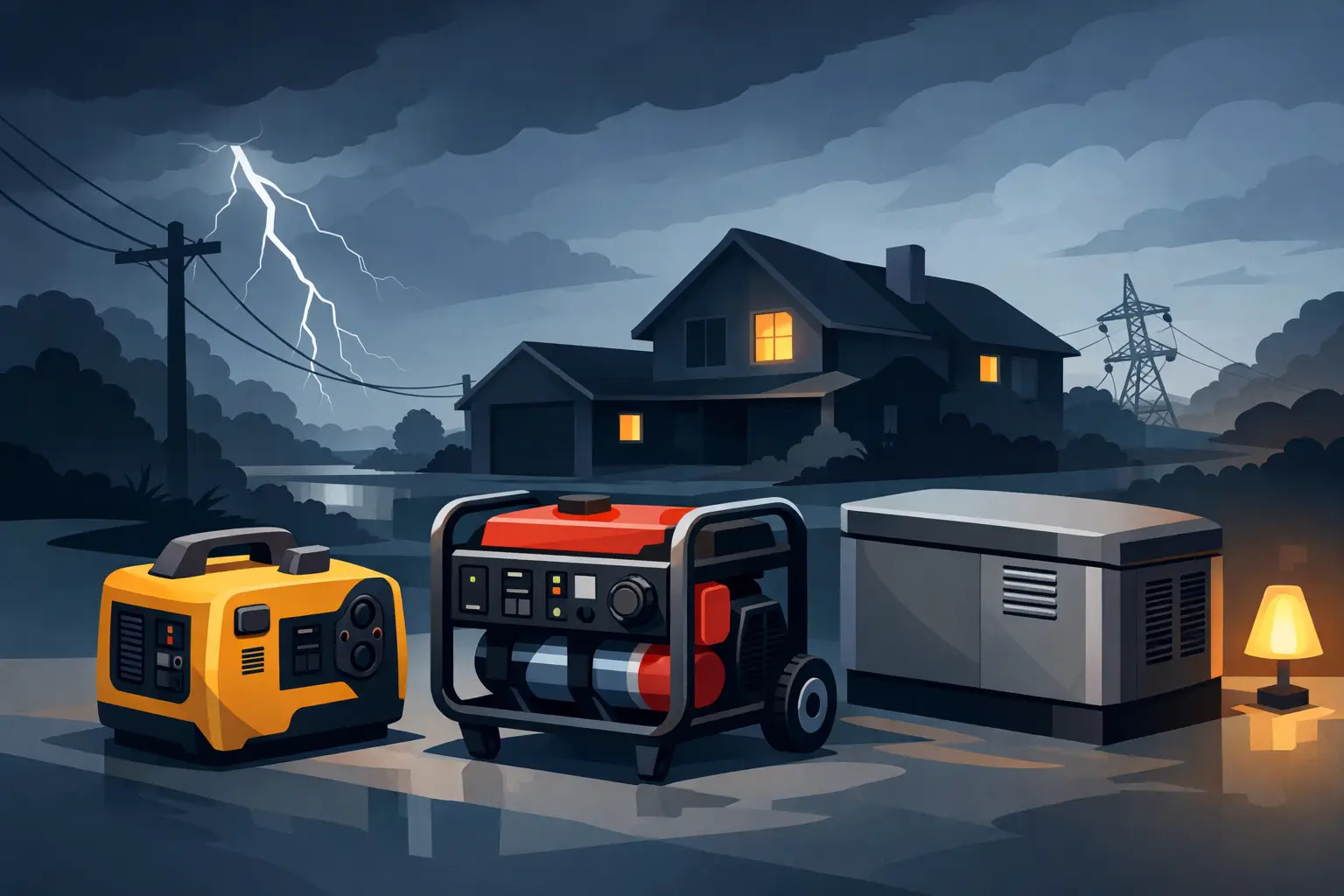
Power outages can turn a normal day into a serious inconvenience, especially when you depend on electricity for refrigeration, heating, cooling, communications, or other essential equipment. A portable generator can provide useful backup power during outages, while also serving as a practical power source for RV trips, camping, outdoor work, and job sites.
The right generator depends less on the biggest wattage number on the box and more on how much power you actually need, which fuel is available to you, how long you expect to run it, and whether you need 120V or 120/240V output.
This guide focuses on portable generators ranging from compact inverter models for essential loads and RV use to high-output dual- and tri-fuel generators designed for demanding backup-power applications. The models below cover gasoline, dual-fuel, and tri-fuel options so you can compare different approaches to portable emergency power.
Emergency Power Generators
| Generator | Best For | Amazon |
|---|---|---|
| Westinghouse 14,500 Peak Watt Tri-Fuel Portable Generator | High-demand backup power | Check Amazon Price |
| Westinghouse 12,500 Watt Dual Fuel Portable Generator | Large emergency loads | Check Amazon Price |
| WEN DF680iX 6,800-Watt Dual Fuel Inverter Generator | Quieter home and RV backup | Check Amazon Price |
| Westinghouse 13,500 Peak Watt Dual Fuel Portable Generator | High-output dual-fuel backup | Check Amazon Price |
| ERAYAK 4500P Inverter Generator | RVs, camping, and essential loads | Check Amazon Price |
Detailed Product Breakdown
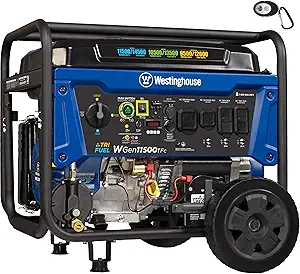
Westinghouse 14,500 Peak Watt Tri-Fuel Portable Generator
A 14,500-watt-class tri-fuel generator is aimed at homeowners who need substantial portable power and want more than one fuel option. Depending on the exact model, gasoline typically provides the highest output, while propane and natural gas provide additional flexibility when gasoline is difficult to obtain.
For high-demand home backup, the important point is not simply the peak wattage. You also need to consider the generator’s rated running watts, the starting demand of appliances, and whether the electrical system is connected using an appropriate transfer switch or other approved transfer equipment.
- Fuel: Gasoline, propane, and natural gas
- Gasoline output: Up to 14,500 peak watts and 11,500 running watts on applicable models
- Starting: Electric start on applicable models
- Best for: High-demand backup power, large appliances, and demanding outdoor applications
- Key advantage: Three fuel choices provide flexibility during extended outages
Why it stands out: A tri-fuel generator can be particularly useful for homeowners who want the option of using gasoline, stored propane, or an available natural-gas supply. Always check the output ratings for each fuel because maximum wattage can change when switching fuels.
Westinghouse 12,500 Watt Dual Fuel Portable Generator
This Westinghouse dual-fuel generator is designed for users who need considerably more output than a compact inverter generator can provide. A model in this class can be useful for emergency loads, larger appliances, tools, and some RV applications when the electrical requirements match the generator’s available output.
On gasoline, the commonly listed configuration provides up to 12,500 peak watts and 9,500 running watts. Propane output is lower, so fuel selection should be considered when calculating the loads you plan to operate.
- Fuel: Gasoline and propane
- Peak output: Up to 12,500 watts on gasoline
- Running output: Up to 9,500 watts on gasoline
- Starting: Electric start, with remote-start capability on applicable configurations
- Best for: Large emergency loads and demanding portable power
- Key advantage: High output with the option to use propane
Why it stands out: This type of generator makes sense for users who want substantial backup capacity without moving to a much larger stationary standby generator. Before connecting appliances, compare both their running watts and starting watts with the generator’s ratings.
WEN DF680iX 6,800-Watt Dual Fuel Inverter Generator
The WEN DF680iX takes a different approach from the large open-frame generators in this list. It combines dual-fuel operation with inverter technology, making it a practical choice when cleaner power, lower noise, and portability matter.
The generator produces up to 6,800 surge watts and 5,100 rated watts on gasoline. On propane, it provides up to 6,000 surge watts and 4,500 rated watts. WEN lists a noise level of about 64 decibels at quarter load, along with a 2.9-gallon gasoline tank that can provide up to 6.1 hours of runtime at half load. The manufacturer also lists up to 9 hours of half-load runtime when using a 20-pound LPG tank.
- Gasoline output: 6,800 surge watts / 5,100 rated watts
- Propane output: 6,000 surge watts / 4,500 rated watts
- Engine: 224cc
- Fuel: Gasoline or propane
- Starting: Electric start with recoil backup
- Noise: About 64 dB at quarter load
- Best for: RVs, camping, quieter backup power, and essential household loads
- Key advantage: Inverter technology combined with dual-fuel flexibility
The DF680iX also uses WEN’s CO Watchdog system and fuel-shutoff feature. Its inverter output is designed for sensitive electronics, with the manufacturer reporting total harmonic distortion below 1.2% at full load.
Why it stands out: If you do not need the massive output of a 12,000- or 14,000-watt generator, this model offers a useful middle ground between high-output portable generators and smaller camping-focused units.
Westinghouse 13,500 Peak Watt Dual Fuel Portable Generator
The Westinghouse 13,500-watt dual-fuel generator is positioned for users who want high portable output without moving to a tri-fuel configuration. Current listings for this model identify 13,500 peak watts and 10,500 continuous watts, along with dual-fuel operation and a listed runtime of up to 19 hours under the manufacturer’s specified conditions.
- Peak output: 13,500 watts
- Running output: 10,500 watts
- Fuel: Gasoline and propane
- Starting: Push-button/electric start
- Listed runtime: Up to 19 hours under specified conditions
- Noise rating: About 74 dB
- Best for: High-demand emergency backup and outdoor work
- Key advantage: High output without requiring three fuel types
The large output makes this type of generator more appropriate for substantial loads than a compact inverter generator. However, maximum runtime depends heavily on electrical demand, fuel type, and operating conditions.
Why it stands out: For shoppers who want a high-output portable generator and prefer the simplicity of gasoline and propane, this model offers a straightforward alternative to a tri-fuel unit.
ERAYAK 4500P 4,500-Watt Portable Inverter Generator
The ERAYAK 4500P is the smallest generator in this group and is aimed at a different type of user. Instead of trying to power a large number of household circuits, it is designed around 120V essential loads, RV use, camping, outdoor activities, and smaller backup applications.
The current 4500P specifications list 4,500 peak watts and 3,500 running watts from gasoline. ERAYAK lists a 2.25-gallon fuel tank, up to 8 hours of runtime depending on load, approximately 60.5 dB of operating noise, and a weight of about 55 pounds.
- Peak output: 4,500 watts
- Running output: 3,500 watts
- Voltage: 120V
- Fuel: Gasoline
- Tank: 2.25 gallons
- Runtime: Up to about 8 hours depending on load
- Starting: Recoil start
- Noise: About 60.5 dB
- Best for: RVs, camping, outdoor work, and selected home essentials
- Key advantage: Compact inverter design with 30A RV-oriented output
The 4500P also provides inverter-generated power with low reported total harmonic distortion. Its 120V design means it should not be treated as a substitute for a larger 120/240V generator when you need to operate 240V equipment or connect to a home’s transfer-switch setup that requires 120/240V output.
Why it stands out: The ERAYAK makes more sense for someone who values portability and relatively low operating noise than for someone trying to run an entire house during a major outage.
How to Choose the Right Emergency Generator
The right generator depends on the appliances you need to run, how those appliances start, the fuel available to you, and the type of electrical connection you need.
1. Calculate Your Actual Power Requirements
Start by listing the appliances and equipment you expect to use at the same time.
Add their running watts, then account for the highest starting or surge demand from equipment such as refrigerators, freezers, pumps, air conditioners, furnaces, and power tools.
The generator’s rated running output needs to cover the continuous load, while its peak output needs to accommodate starting demand.
Do not assume that a generator with a large peak-wattage number can automatically run every appliance in a house at once.
2. Consider the Fuel Options
Fuel flexibility can become especially valuable during a prolonged outage.
- Gasoline: Usually provides strong output and is widely available, but it requires proper storage and handling.
- Propane: Can be stored for longer periods and gives you an alternative when gasoline is unavailable.
- Natural gas: Can be convenient for homes with an appropriate natural-gas supply, but the generator must be designed and configured for it.
Remember that a dual- or tri-fuel generator may produce different wattage depending on which fuel you use.
3. Compare Runtime at a Specific Load
Advertised maximum runtime can be misleading if you do not know the load used to achieve it.
A generator that runs for many hours at a light load may consume fuel much faster when powering an air conditioner, pump, heater, refrigerator, or other high-demand equipment.
When comparing models, look for runtime information tied to a stated load whenever possible.
4. Decide Whether You Need an Inverter Generator
Inverter generators can be attractive when lower noise, portability, and cleaner electrical output are priorities.
They are especially useful for RVs, camping, electronics, and residential areas where generator noise can become an issue.
Traditional high-output portable generators, however, can provide substantially more power for the money and may be a better choice when your priority is running larger household loads.
5. Check the Starting System
Electric start can be convenient during an emergency, particularly when the generator is larger or more difficult to start manually.
Some models also include remote start, while smaller generators may rely on recoil starting.
Do not assume that every electric-start generator has remote-start capability. Check the exact model’s specifications before buying.
6. Pay Attention to Noise
Noise matters if you plan to use a generator near your home, RV, neighbors, or a campground.
Do not judge noise only by labels such as “quiet.” Look for an actual decibel rating and, when possible, the load at which that measurement was taken.
For example, the WEN DF680iX is listed at approximately 64 dB at quarter load, while the ERAYAK 4500P is listed at approximately 60.5 dB. These measurements are not directly interchangeable unless the testing conditions are comparable.
7. Check Voltage and Connection Requirements
This is particularly important for home backup.
A compact 120V generator is not equivalent to a 120/240V generator. Before purchasing, check whether the equipment you need to power requires 120V or 240V and whether your planned connection method is compatible.
For home electrical-panel connections, use equipment and installation methods permitted by local requirements and the generator manufacturer’s instructions. A portable generator should never be connected to a home’s electrical system through an unsafe improvised connection.
8. Think About Portability
A generator’s wattage usually affects its size and weight.
A 4,500-watt inverter generator may be practical for an RV or camping trip, while a 13,500- or 14,500-watt portable generator can require significantly more space and effort to move.
Wheels, handles, a telescoping handle, and overall weight are worth considering if you expect to reposition the generator frequently.
Which Generator Is Best for Which Situation?
There is no single best emergency generator for every household.
Best for High-Demand Backup
The Westinghouse 14,500-watt tri-fuel generator is the strongest fit for shoppers who prioritize output and fuel flexibility. It is especially attractive when having gasoline, propane, and natural gas available is more important than keeping the generator compact.
Best High-Output Dual-Fuel Option
The Westinghouse 13,500-watt dual-fuel generator is a better match for someone who wants high portable output but does not need three fuel choices.
Best for Quieter Backup and RV Use
The WEN DF680iX offers a useful combination of inverter technology, dual-fuel operation, electric start, and lower noise than many traditional open-frame generators.
Best Compact Option for RVs and Essential Loads
The ERAYAK 4500P makes more sense when portability, 120V power, and lower operating noise are more important than running multiple high-demand household circuits.
Final Thoughts
Choosing an emergency generator is mainly a matter of matching the generator to the loads you actually need to run.
For demanding home backup, the high-output Westinghouse models provide substantially more capacity than the smaller inverter generators. A tri-fuel model adds natural-gas flexibility, while a dual-fuel model can offer a simpler balance between gasoline and propane.
The WEN DF680iX is a more compact middle-ground option for users who want inverter power, dual-fuel capability, and lower noise. The ERAYAK 4500P is better suited to 120V essential loads, RV use, camping, and situations where portability matters more than maximum output.
Before buying, compare running watts, starting watts, fuel-specific output, runtime, noise, voltage, outlet configuration, and starting method. Most importantly, make sure the generator’s actual output matches the equipment you plan to operate rather than choosing a model solely because it has the highest peak-wattage number.
For home backup, also consider how the generator will be connected and whether you need a transfer switch or another approved method for supplying selected household circuits. The generator itself is only one part of a safe and practical backup-power system.