As an Amazon Associate I earn from qualifying purchases.
When you need backup power for a home, choosing the right generator starts with understanding the difference between a diesel standby generator and a portable dual-fuel or tri-fuel generator.
Diesel standby generators are designed for permanent installation and are built around long-duration backup power, automatic operation, and heavy-duty engines. They can be especially attractive for larger homes, rural properties, workshops, and locations where extended outages are a realistic concern.
However, diesel is not automatically the best fuel for every homeowner. Many residential standby systems use natural gas or propane, while portable generators can offer considerably more flexibility at a lower entry cost.
That distinction matters when comparing generators in 2026.
In this guide, we’ll look at what makes a good home diesel standby generator, explain the important differences between permanent and portable backup systems, and review several gas, propane, and tri-fuel generators that can serve as alternatives.
Important: The Amazon products included in this article are not diesel generators. They are natural gas, propane, gasoline, dual-fuel, or tri-fuel models. They are included as alternatives for homeowners who want flexible backup power without choosing a dedicated diesel standby system.
Quick Comparison: Diesel Standby vs. Fuel-Flexible Alternatives
| Generator | Type | Fuel | Best For | Automatic Standby? |
|---|---|---|---|---|
| Generac Guardian 10kW | Home standby | Natural gas / propane | Essential circuits and residential backup | Yes |
| Champion 8.5-kW | Home standby | Natural gas / propane | Essential home loads | Yes |
| Westinghouse 14,500W | Portable | Gas / propane / natural gas | High-output flexible backup | No |
| Westinghouse 12,500W | Portable | Gas / propane | Large-load portable backup | No |
| WEN 14,500W | Portable | Gas / propane / natural gas | Flexible emergency backup | No |
Are Diesel Standby Generators Good for Homes?
Yes, but they are a specialized choice.
A properly installed diesel standby generator can provide dependable backup power for extended outages. Diesel engines are well established in commercial and industrial power applications, and stationary diesel generators are available in larger power ranges than many residential air-cooled systems.
Generac’s current residential and light-commercial diesel lineup includes Protector Series models starting at 15 kW and extending through 20 kW, 30 kW, and much larger outputs. Its 15 kW and 20 kW diesel models are specifically listed as 1800-rpm standby generators.
For homeowners, however, there are several tradeoffs.
Diesel systems can require more planning for fuel storage, installation, maintenance, and local code compliance. They are also usually more expensive than smaller natural-gas or propane standby systems.
For that reason, the right question isn’t simply:
“Is diesel the best generator fuel?”
A better question is:
“Does a diesel standby generator make sense for my home’s power requirements and outage conditions?”
Diesel Standby Generator vs. Portable Generator
This is the most important distinction in this guide.
Permanent Standby Generators
A permanent standby generator is installed outside the home and connected to the home’s electrical system through an automatic transfer switch (ATS).
When utility power fails, the ATS detects the outage and transfers the home’s electrical load to the generator. When utility power returns, the system transfers the load back to the utility and the generator shuts down after its cooldown period.
The biggest advantage is convenience.
You don’t have to go outside during a storm, move a generator into position, connect extension cords, or manually start the engine.
Portable Generators
Portable generators are different.
Even large models such as the Westinghouse 14,500-watt tri-fuel generator and WEN 14,500-watt tri-fuel generator are still portable machines.
They can be connected to a home’s electrical system through an appropriately installed transfer switch or inlet arrangement, but they do not become permanent automatic standby generators simply because they are transfer-switch ready.
That distinction should be clear before you buy.
Best Generators and Backup Power Options for 2026
1. Generac Guardian 10kW Home Generator
Best for: Automatic residential backup on natural gas or propane
Check the Generac Guardian 10kW on Amazon
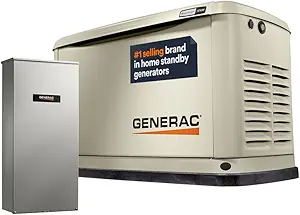
The Generac Guardian 10kW is a true home standby generator, making it fundamentally different from the portable generators later in this guide.
The Amazon-listed package includes the generator, transfer switch, and Wi-Fi monitoring. It produces 10,000 watts and uses natural gas or propane rather than diesel.
Key Features
- 10,000 watts of standby power
- Natural gas or propane fuel
- Automatic transfer capability
- Mobile Link Wi-Fi monitoring
- 100-amp, 16-circuit transfer switch in the listed package
- Less than 5% harmonic distortion
- G-Force engine
- 5-year limited warranty
- Designed for permanent outdoor installation
One of the strongest advantages is the automatic operation. The generator is designed to detect a utility outage, start automatically, and provide backup power without requiring the homeowner to be present.
The Mobile Link connectivity is also useful if you travel frequently or have a second home because you can monitor generator status remotely.
The Important Limitation
This is not a diesel generator.
If diesel is a requirement for your property, this isn’t the correct fuel type. But if your priority is automatic backup power and you already have access to natural gas or propane, the Guardian is much closer to what most homeowners mean when they search for a residential standby generator.
2. Champion Power Equipment 8.5-kW Home Standby Generator
Best for: Essential home circuits
Check the Champion 8.5-kW Standby Generator on Amazon
The Champion 8.5-kW is another genuine stationary home standby generator, but it is designed more around essential loads than very large whole-home electrical demand.
The model linked here provides 8,500 watts on propane and 7,500 watts on natural gas. It includes a 50-amp, 10-circuit automatic transfer switch.
Key Features
- 8,500 watts on propane
- 7,500 watts on natural gas
- 24-volt starting system
- Automatic transfer switch
- 10-circuit, 50-amp ATS
- Less than 5% THD
- 59.5 dBA operating noise rating
- 439cc OHV engine
- Weekly self-diagnostic testing
- Outdoor-rated enclosure
Champion states that its starting system is designed to operate in temperatures as low as -22°F, making cold-weather starting an important consideration for northern climates.
This generator makes more sense for homeowners who want automatic backup for essential equipment rather than attempting to operate every high-demand appliance in the house simultaneously.
Again, it is not diesel.
3. Westinghouse 14,500-Watt Tri-Fuel Generator
Best for: High-output portable backup with three fuel choices
Check the Westinghouse 14,500W Tri-Fuel Generator on Amazon
If automatic standby operation isn’t your primary requirement, a large tri-fuel portable generator can be an interesting alternative.
The Westinghouse WGen11500TFc produces up to 14,500 peak watts and 11,500 running watts on gasoline. Output changes when operating on propane or natural gas. The listed figures are:
- Gasoline: 14,500 peak / 11,500 running watts
- Propane: 13,500 peak / 10,500 running watts
- Natural gas: 12,000 peak / 9,500 running watts
It uses a 550cc four-stroke OHV engine and a 9.5-gallon gasoline tank. Westinghouse lists up to 19 hours of gasoline runtime under its stated test conditions.
Key Features
- Tri-fuel operation
- Gasoline, propane, or natural gas
- Electric start
- Remote start key fob
- L14-30R and 14-50R outlets
- Transfer-switch ready
- GFCI outlets
- Low-oil shutdown
- Less than 5% THD
- VFT digital data center
- 3-year limited warranty
The major advantage is fuel flexibility.
If gasoline becomes difficult to obtain during a prolonged emergency, having propane or natural gas available can provide another way to operate the generator.
What It Isn’t
This is a portable generator, not a diesel standby generator.
It does not automatically take over the home when utility power fails. A proper installation is required if you want to connect it to a home’s electrical system.
4. Westinghouse 12,500-Watt Dual-Fuel Generator
Best for: Large portable backup without tri-fuel capability
Check the Westinghouse 12,500W Dual-Fuel Generator on Amazon
The Westinghouse WGen9500DF is another portable option.
It produces up to 12,500 peak watts and 9,500 running watts and operates on gasoline or propane. The 457cc four-stroke OHV engine uses a 6.6-gallon fuel tank and is rated for up to 12 hours of gasoline runtime under the manufacturer’s stated conditions.
Key Features
- 12,500 peak watts
- 9,500 running watts
- Gasoline or propane
- Electric start
- Remote start key fob
- Transfer-switch-ready outlets
- L14-30R 30-amp outlet
- 14-50R 50-amp outlet
- VFT digital display
- Automatic low-oil shutdown
- GFCI outlets
- 3-year limited warranty
This model can make sense when you want substantial portable power but don’t need natural-gas capability.
Like the Westinghouse tri-fuel model, it should not be described as a residential automatic standby generator.
5. WEN 14,500-Watt Tri-Fuel Generator
Best for: Flexible high-output portable backup
Check the WEN 14,500W Tri-Fuel Generator on Amazon
The WEN TF-1450X is another high-output tri-fuel option.
It produces up to 14,500 surge watts and 11,500 running watts on gasoline. On propane, the output is rated at 12,500 surge watts and 10,300 running watts, while natural gas output is rated at 10,500 surge watts and 8,750 running watts.
Key Features
- 14,500 surge watts on gasoline
- 11,500 running watts on gasoline
- Tri-fuel operation
- 120V/240V output
- Electric start
- CO Watchdog shutdown sensor
- NEMA L14-30R outlet
- NEMA 14-50R outlet
- Natural gas quick-connect adapter
- LPG connection hose
- 8.2-gallon fuel tank
- Up to 12 hours of half-load gasoline runtime
- 3-year limited warranty
The CO shutdown system is an important safety feature, but it does not replace proper outdoor operation and safe placement.
Never operate a gasoline, propane, or natural-gas portable generator inside a garage, basement, crawl space, or other enclosed area.
What About a True Diesel Standby Generator?
If diesel is specifically what you want, the five Amazon products above should not be presented as diesel options.
A better place to start is with a purpose-built stationary diesel generator.
Generac’s Protector Series currently includes diesel standby models such as 15 kW, 20 kW, and 30 kW configurations, with larger models available as well. Generac describes these diesel systems for residential and light-commercial applications.
For example, the current Generac 15 kW diesel model is an 1800-rpm standby generator designed to restore power automatically during an outage.
A 30 kW diesel Protector model is also available, including extended-tank configurations for applications where longer fuel autonomy is important.
These are substantially different machines from the portable generators sold through the Amazon links in this article.
How Much Generator Power Does a Home Need?
There is no reliable rule that says a particular home size automatically requires a certain generator size.
A 2,000-square-foot house with electric heating, a well pump, electric water heater, central air conditioning, and an electric range may require more generator capacity than a larger house with gas appliances.
Instead, calculate the loads you actually want to operate simultaneously.
Consider:
- Central air conditioning
- Furnace or heat pump
- Refrigerator
- Freezer
- Well pump
- Sump pump
- Water heater
- Electric range
- Microwave
- Washing machine
- Clothes dryer
- Garage door opener
- Lighting
- Internet equipment
- Security system
- Medical equipment
- Pool equipment
- EV charger
Starting loads are also important.
Motors and compressors can temporarily require substantially more power when they start. This is why choosing a generator based only on the total running wattage can result in an undersized system.
Cummins similarly recommends considering heating, cooling, pumps, kitchen appliances, laundry, garage equipment, and other household loads when sizing a home standby generator.
Diesel vs. Natural Gas vs. Propane
Diesel
Diesel can make sense when:
- You need a larger stationary generator
- Long-duration backup is important
- You prefer a heavy-duty diesel engine
- Natural gas is unavailable
- Your property can accommodate appropriate diesel fuel storage
- You are comfortable with professional installation and maintenance
The downside is that diesel systems can involve more planning and expense.
Natural Gas
Natural gas is convenient for homes already connected to a reliable utility gas supply.
You don’t need to maintain a large gasoline tank, and a permanently installed standby generator can operate automatically.
However, natural-gas availability can become an issue during certain disasters depending on local infrastructure.
Propane
Propane provides another practical option for homes without natural gas.
A sufficiently sized propane tank can provide fuel storage on the property, but the actual runtime depends on generator load, tank size, temperature, and other factors.
Tri-Fuel
Tri-fuel generators provide gasoline, propane, and natural gas options.
The tradeoff is that they are generally portable rather than true automatic standby systems.
Automatic Transfer Switch: Why It Matters
If you want the generator to operate automatically, the automatic transfer switch is one of the most important components in the installation.
The ATS monitors the utility supply.
When utility power fails, it disconnects the home’s electrical system from the utility and transfers the appropriate loads to the generator.
When utility power returns, the ATS switches the home back to utility power and allows the generator to shut down after its normal cooldown sequence.
This prevents dangerous backfeeding and eliminates the need for the homeowner to manually connect the generator during an outage.
A portable generator can also be connected to a home through an appropriately designed transfer-switch system, but the generator itself does not become a permanently installed automatic standby generator.
Diesel Standby Generator Installation
A permanent diesel standby generator is not a typical DIY weekend project.
Installation may involve:
- Generator placement
- Concrete or approved mounting surface
- Fuel storage and fuel connections
- Electrical connection
- Automatic transfer switch
- Exhaust clearance
- Local permits
- Electrical-code compliance
- Fuel-code compliance
- Startup and commissioning
Local requirements vary significantly, so the installation should be handled by qualified professionals familiar with standby-generator systems.
Cummins likewise recommends working with an authorized dealer for sizing and installation of its home standby systems.
Maintenance Requirements
A standby generator is only useful if it starts when you need it.
Maintenance should generally include:
- Checking engine oil
- Replacing oil according to the manufacturer’s schedule
- Inspecting air and fuel filters
- Checking the starting battery
- Inspecting electrical connections
- Checking fuel systems
- Running scheduled exercise cycles
- Inspecting the enclosure
- Checking for leaks
- Testing the transfer system
- Following the manufacturer’s service intervals
Diesel systems may also require attention to fuel quality and storage conditions.
Always follow the maintenance schedule for the specific generator rather than relying on a generic interval.
Safety Tips for Home Generator Use
Carbon monoxide is one of the most serious hazards associated with fuel-burning generators.
Portable generators should always operate outdoors and away from doors, windows, and other openings where exhaust could enter the home.
Never operate a portable generator inside:
- A garage
- Basement
- Crawl space
- Shed
- Enclosed patio
- Other enclosed or partially enclosed areas
CO sensors are useful safety features, but they are not a substitute for proper placement.
For permanently installed generators, follow the manufacturer’s clearance and exhaust requirements and comply with local building and electrical codes.
Which Type of Generator Should You Choose?
Choose a Diesel Standby Generator If:
- You specifically want diesel fuel
- You need a permanent installation
- You expect extended outages
- You need higher-capacity backup power
- Your property is suitable for diesel fuel storage
- You are prepared for professional installation and maintenance
Choose a Natural Gas or Propane Standby Generator If:
- You want automatic backup
- You don’t want to refuel manually
- Your home has a suitable natural-gas or propane supply
- You want a simpler residential standby installation
The Generac Guardian 10kW and Champion 8.5-kW models linked above fit this category, not the diesel category.
Choose a Large Portable Tri-Fuel Generator If:
- You want maximum fuel flexibility
- Portability matters
- You don’t need automatic startup
- You want to use gasoline, propane, or natural gas
- You are willing to handle the connection and startup process
The Westinghouse 14,500W and WEN 14,500W models are examples of this category.
Final Verdict: Best Diesel Standby Generators for 2026
A diesel standby generator can be an excellent solution for homeowners who need a permanent, heavy-duty backup power system, particularly on larger properties or in areas where long outages are common.
But diesel isn’t the only answer.
For many U.S. homeowners, a natural-gas or propane standby generator can provide the convenience of automatic startup without the additional fuel-storage considerations associated with diesel.
For homeowners who want maximum fuel flexibility and don’t mind manual operation, a large tri-fuel portable generator can be a practical alternative.
The most important thing is to match the generator type to your actual needs.
If automatic backup is the priority, focus on a properly installed standby system with an appropriate automatic transfer switch.
If fuel flexibility is more important, consider a tri-fuel portable model.
And if you specifically want diesel, look at purpose-built stationary diesel systems such as the Generac Protector Series rather than assuming a large portable tri-fuel generator is equivalent.
Before buying, calculate your home’s actual electrical loads, account for motor starting requirements, verify local installation requirements, and get professional advice when necessary.
The right generator isn’t necessarily the one with the highest wattage. It’s the one that can safely provide the power your home needs for as long as you need it.