As an Amazon Associate I earn from qualifying purchases.
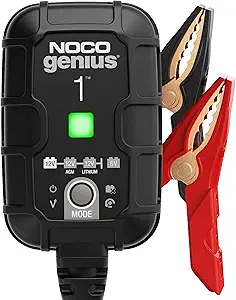
If your generator uses an electric starter, a dead battery can leave you without backup power even when the engine, fuel, and generator itself are ready to go. That is why keeping the starting battery properly charged matters, especially if the generator spends most of its time sitting unused.
For long-term storage, however, you do not necessarily want a basic charger that continuously pushes current into the battery. A smart battery maintainer or automatic float charger is usually a better choice because it can reduce or regulate charging once the battery reaches the appropriate state.
In this guide, I’ve compared several popular options for generator battery maintenance, including compact 12V maintainers and more versatile smart chargers. I’ve also included what to look for based on battery type, capacity, charging current, and how often you use your generator.
Best Generator Battery Maintainers for 2026
| Battery Maintainer | Voltage | Output | Best For |
|---|---|---|---|
| NOCO GENIUS1 | 6V/12V | 1A | Versatility and smart charging |
| MOTOPOWER MP00205A | 12V | 800mA | Affordable 12V maintenance |
| FOVAL Automatic Charger | 12V | 1A | Compact generator setups |
| NEXPEAK NC175 | 6V/12V | 1.75A | LCD monitoring and diagnostics |
| Battery Tender Junior | 12V | 750mA | Small lead-acid generator batteries |
The important thing to remember is that these chargers are not interchangeable for every generator. Check the battery voltage, chemistry, amp-hour rating, and your generator manufacturer’s charging requirements before connecting one.
What Is the Best Battery Maintainer for a Generator?
For many small 12V generator batteries, the NOCO GENIUS1 is one of the most versatile choices because it supports 6V and 12V batteries and both lead-acid and lithium chemistries. NOCO rates it at 1A and lists compatibility with flooded, gel, maintenance-free, EFB, AGM, and lithium batteries.
For a small 12V lead-acid battery where you mainly want simple long-term maintenance, the Battery Tender Junior is another option. Its current output is 750mA, and the manufacturer specifies it for 12V lead-acid, AGM, GEL, and sealed maintenance-free batteries from 3Ah to 30Ah.
If your generator has a larger battery or your owner’s manual permits a higher charging current, a more powerful model such as the NOCO GENIUS5 can make more sense. It provides up to 5A and is designed for 6V and 12V lead-acid and lithium batteries.
The right choice ultimately depends on the battery rather than simply choosing the charger with the highest amperage.
Trickle Charger vs. Battery Maintainer: What’s the Difference?
The terms are often used interchangeably, but there is an important practical difference.
A traditional trickle charger supplies a small amount of current continuously. Older designs could potentially overcharge a battery if left connected for too long.
A modern battery maintainer monitors battery condition and adjusts its charging behavior. Once the battery reaches the appropriate level, it can switch to a maintenance or float state rather than continuing to charge at the same rate.
For a generator that may sit unused for weeks or months, an automatic battery maintainer is generally more appropriate than a basic constant-current trickle charger.
This is especially important for standby and seasonal generators because the goal isn’t to charge the battery as quickly as possible. The goal is to keep it in a healthy state while the generator is waiting for its next use.
Why Generator Batteries Lose Charge During Storage
A generator can be completely unused and still have a battery that gradually loses charge.
Lead-acid batteries naturally discharge over time. Some generators may also have small electrical loads associated with their control systems, monitoring equipment, or other electronics.
If the battery remains partially discharged for a long period, sulfation can reduce its usable capacity. Once the battery becomes severely degraded, a maintainer may not be able to restore it.
That is why battery maintenance should be part of your generator storage routine rather than something you think about only after the generator fails to start.
Some generator manufacturers specifically recommend using a trickle charger or battery maintainer during storage. For example, Champion’s current documentation for certain battery-start generators recommends maintaining the battery during storage and specifies a maximum charging rate of 1.5 amps for those models.
Always follow the charging instructions for your specific generator.
Best Generator Battery Maintainers for 2026
1. NOCO GENIUS1 1A Smart Battery Charger
Check Amazon Price Click Here
Brand: NOCO
Voltage: 6V/12V
Output: 1A
Battery Chemistry: Lead-acid and lithium
Best for: Versatile smart maintenance
The NOCO GENIUS1 is one of the most flexible choices in this group because it isn’t limited to a single battery voltage or chemistry.
NOCO specifies the GENIUS1 for 6V and 12V batteries and lists compatibility with flooded, gel, maintenance-free, EFB, AGM, and lithium batteries. It also includes protection against reverse polarity, short circuits, overheating, and overcharging.
Another useful feature is its temperature monitoring. The charger can adjust its charging behavior based on temperature, which can be helpful when a generator is stored in an area where temperatures fluctuate.
The GENIUS1 is rated at 1A, so it isn’t designed to rapidly recharge a large, deeply discharged battery. NOCO’s own charging-time information illustrates this difference: a 40Ah battery at 50% discharge can take about 30 hours with a GENIUS1.
That isn’t necessarily a disadvantage for storage. A battery maintainer is primarily intended to keep a battery ready rather than quickly recharge a large battery after it has gone completely flat.
Best for: Generator owners who want one compact charger that can handle different battery types.
2. MOTOPOWER MP00205A 12V 800mA Battery Charger
Check Amazon Price Click Here
Brand: MOTOPOWER
Voltage: 12V
Output: 800mA
Battery Chemistry: Lead-acid
Best for: Budget-conscious 12V battery maintenance
The MOTOPOWER MP00205A is a straightforward option for owners who have a conventional 12V lead-acid battery.
MOTOPOWER describes this model as a charger, maintainer, and desulfator for 12V lead-acid batteries, including flooded, AGM, and gel batteries. It also incorporates reverse-polarity, short-circuit, and overcharge protection.
The 800mA output makes it more suitable for maintaining a relatively small generator battery than for quickly recovering a large automotive-style battery.
One useful feature is that the charger enters a maintenance state after the charging cycle rather than continuously delivering its maximum output. MOTOPOWER also lists a 24-hour timer as part of its charging protection system.
If your generator manufacturer recommends a charging rate below 1A, this type of low-output maintainer can be worth considering. However, the generator’s owner’s manual should always take priority.
Best for: Small 12V lead-acid generator batteries and users looking for a simple automatic maintainer.
3. FOVAL Automatic 12V 1000mA Battery Charger
Check Amazon Price Click Here
Brand: FOVAL
Voltage: 12V
Output: 1A
Best for: Compact 12V battery maintenance
The FOVAL Automatic Battery Charger is designed around the same basic idea as other low-current smart maintainers: charge the battery, monitor its condition, and transition into a maintenance state when appropriate.
Its 1A output makes it better suited to battery maintenance than fast charging. That’s useful for a generator that spends most of the year sitting in storage.
The compact design can also be convenient when the battery compartment has limited space. The original FOVAL specification identifies the unit as a 12V/1000mA charger with overcharge protection.
One limitation is that you should not assume compatibility with every battery chemistry simply because the charger is advertised as a 12V maintainer. Check the exact model’s specifications before using it with lithium batteries.
Best for: Small 12V lead-acid generator batteries where compact size and simple maintenance are priorities.
4. NEXPEAK NC175 1.75-Amp Battery Charger
Check Amazon Price Click Here
Brand: NEXPEAK
Voltage: 6V/12V
Output: 1.75A
Best for: Users who want charging information and more output
The NEXPEAK NC175 takes a more feature-focused approach than the basic low-current maintainers in this list.
NEXPEAK’s documentation identifies the NC175 as a 6V/12V, 1.75A battery charger and trickle charger.
The higher output can be useful if you occasionally need to recharge a battery rather than simply keep an already-charged battery maintained.
The model is also designed around a multi-stage charging process and includes a display for monitoring charging information.
However, the extra charging capacity isn’t automatically better for a generator. Some generator manufacturers specify relatively low charging limits, so check the owner’s manual before connecting a 1.75A charger.
If your generator specifically limits charging to 1.5A, for example, this model would not be an appropriate choice unless the manufacturer explicitly permits it.
Best for: Owners who want more charging capability and a display while staying in the compact charger category.
5. Battery Tender Junior 12V 750mA Charger and Maintainer
Check Amazon Price Click Here
Brand: Battery Tender
Voltage: 12V
Output: 750mA
Battery Chemistry: Lead-acid
Best for: Long-term maintenance of small 12V batteries
The Battery Tender Junior has been designed specifically around maintaining smaller batteries during long periods of storage.
The current version provides 750mA and uses a four-stage charging process: initialization, bulk charging, absorption, and float maintenance. Battery Tender specifies compatibility with 12V lead-acid, AGM, GEL, and sealed maintenance-free batteries from 3Ah to 30Ah.
It also includes spark-proof connection technology, reverse-polarity protection, short-circuit protection, and a 5-year limited warranty.
For a small generator with a compatible lead-acid battery, its relatively low output is not necessarily a drawback. In fact, that’s exactly what makes it suitable for long-term maintenance.
The important limitation is battery chemistry. The standard Junior should not be treated as a lithium-compatible charger. Battery Tender does offer a separate Junior Multi-Chemistry model for lead-acid and LiFePO4 batteries.
Best for: Small 12V lead-acid generator batteries that spend long periods in storage.
Generator Battery Maintainer Comparison
| Model | Voltage | Output | Battery Type | Main Advantage | Best Use |
|---|---|---|---|---|---|
| NOCO GENIUS1 | 6V/12V | 1A | Lead-acid/Lithium | Multi-chemistry support | Versatile maintenance |
| MOTOPOWER MP00205A | 12V | 800mA | Lead-acid | Automatic maintenance and desulfation | Small 12V batteries |
| FOVAL 1000mA | 12V | 1A | Check model specifications | Compact design | Basic storage maintenance |
| NEXPEAK NC175 | 6V/12V | 1.75A | Check current model specifications | Higher output and display | Charging + maintenance |
| Battery Tender Junior | 12V | 750mA | Lead-acid | Four-stage maintenance | Long-term storage |
How Much Amperage Does a Generator Battery Charger Need?
This is one of the most important questions to answer before buying a battery maintainer.
More amps does not automatically mean better battery maintenance.
For example, a 750mA or 1A maintainer can be perfectly adequate for a small generator battery that is already charged. A larger charger may make more sense when the battery has greater capacity and the generator manufacturer permits the higher charging rate.
As a general starting point:
- 750mA–1A: Good for maintaining many smaller 12V starting batteries.
- 1A–1.5A: Useful when the generator manufacturer allows this range and the battery needs somewhat faster recovery.
- Around 2A or more: Better suited to larger batteries or faster charging, but only when the generator and battery specifications permit it.
- 5A and higher: Potentially useful for larger batteries, but not automatically appropriate for a generator’s built-in charging system.
For example, NOCO’s GENIUS5 provides 5A and can maintain larger batteries, but that doesn’t mean you should connect a 5A charger to every generator.
The generator manufacturer’s maximum charging current should always win over a generic amperage recommendation.
What Type of Battery Does Your Generator Use?
Before purchasing a maintainer, identify the battery chemistry.
Lead-Acid Batteries
Traditional lead-acid batteries are common in generator applications. They may be flooded, sealed maintenance-free, AGM, or GEL.
A compatible automatic maintainer can keep these batteries charged during periods of inactivity.
AGM Batteries
AGM batteries are a type of lead-acid battery, but they use an absorbed electrolyte rather than a conventional liquid electrolyte.
Your charger should specifically support AGM if the generator uses one.
The NOCO GENIUS1, for example, lists AGM compatibility.
Lithium Batteries
Some newer generators use lithium-based starting batteries.
Do not assume that a charger designed for a 12V lead-acid battery is suitable for lithium. The charging profile can be different.
If your generator uses lithium, choose a charger that specifically lists the appropriate lithium chemistry.
The NOCO GENIUS1 supports lithium batteries, while the standard Battery Tender Junior is designed for lead-acid chemistry.
Can You Leave a Battery Maintainer Connected to a Generator?
Many modern smart battery maintainers are designed for long-term connection, but there are several conditions.
First, make sure the charger is designed for maintenance or float operation.
Second, verify that the battery chemistry is supported.
Third, check your generator’s owner’s manual for instructions regarding battery charging during storage.
Some generator manufacturers specifically recommend using a battery maintainer during storage, but the acceptable charging current can vary by model.
Also consider where the generator is stored. If the charger is being used in a damp or exposed environment, the charger’s environmental rating and installation instructions matter.
A maintainer should never be used as an excuse to ignore a damaged, leaking, swollen, or otherwise defective battery.
How to Use a Battery Maintainer With a Generator
The exact procedure depends on the generator, but the basic process is straightforward.
1. Check the generator manual
Confirm the battery voltage, chemistry, charging requirements, and maximum permitted charging current.
2. Inspect the battery
Look for corrosion, damaged cables, leaks, swelling, or other visible problems.
Do not connect a charger to a battery that appears physically damaged.
3. Confirm the charger settings
Make sure the charger is set to the correct voltage and battery chemistry before connecting it.
4. Connect the charger correctly
Follow the charger manufacturer’s instructions for connecting the positive and negative leads.
5. Connect AC power
Once the battery connections are secure, connect the charger to its AC supply according to the manufacturer’s instructions.
6. Check the indicator
Make sure the charger indicates that charging or maintenance is occurring normally.
7. Disconnect before using the generator
Remove the charger from the generator before starting or operating the generator unless the generator manufacturer specifically provides instructions for simultaneous operation.
What Features Matter Most in a Generator Battery Maintainer?
You don’t need every feature advertised on a battery charger. Focus on the ones that actually matter for your generator.
Automatic Maintenance Mode
This is one of the most useful features for long-term storage because the charger can transition from charging to maintenance rather than continuously delivering maximum current.
Reverse Polarity Protection
This helps prevent damage if the charging leads are connected incorrectly.
Overcharge Protection
A smart charger should regulate the charging process rather than continuously applying its maximum output.
Battery Chemistry Compatibility
Make sure the charger explicitly supports your battery type.
Temperature Monitoring
Temperature compensation can be useful when the charger is used in locations with significant temperature changes. NOCO, for example, incorporates temperature-related charging control in its GENIUS series.
Ring Terminals
Ring-terminal connections can be convenient for a generator that will be maintained regularly because they can remain attached to the battery while the charger itself is disconnected when the generator is needed.
What Size Generator Batteries Can These Chargers Handle?
Battery capacity matters just as much as voltage.
A 12V battery isn’t necessarily the same as another 12V battery. One could have a much greater amp-hour capacity than another.
The Battery Tender Junior, for example, is specified for 12V batteries from 3Ah to 30Ah.
The NOCO GENIUS1 is specified for charging batteries up to 30Ah while its maintenance capability extends to all battery sizes according to NOCO’s specifications.
This is why simply searching for a “12V generator charger” isn’t enough.
Before buying, check:
- Battery voltage
- Battery chemistry
- Amp-hour capacity
- Manufacturer charging-current limit
- Whether the generator has a built-in charging circuit
- Whether the charger will be permanently connected
Do You Need a Battery Maintainer for a Portable Generator?
Not necessarily.
If your portable generator uses a manual recoil starter, there may be no starting battery to maintain.
If it has an electric start and you use it frequently, the battery may stay adequately charged through normal use and the generator’s charging system.
A maintainer becomes more useful when the generator:
- Sits unused for months
- Is reserved for emergency power
- Is stored between storm seasons
- Has an electric-start system
- Uses a battery that slowly loses charge
- Is part of an RV or seasonal setup
For an emergency generator, maintaining the battery before storm season is particularly important because the generator may sit untouched until you actually need it.
Battery Maintainer Safety Tips
A battery charger should not be treated as a completely hands-off device simply because it is automatic.
Follow these precautions:
- Use the charger only with a compatible battery chemistry.
- Follow the generator manufacturer’s maximum charging-current specification.
- Inspect the battery before charging.
- Keep battery connections clean and secure.
- Use the charger according to its environmental and temperature ratings.
- Keep flooded lead-acid batteries in an appropriately ventilated area.
- Do not charge a visibly damaged or swollen battery.
- Disconnect the charger before operating the generator unless the manufacturer specifically says otherwise.
- Keep the charger and cables away from hot engine components.
- Follow both the generator and charger owner’s manuals.
When Should You Replace the Generator Battery Instead?
A battery maintainer is designed to maintain a healthy battery. It isn’t a guaranteed solution for a battery that has reached the end of its service life.
If the generator battery repeatedly loses charge soon after being disconnected from the charger, struggles to crank the engine, or fails a battery test, the battery may need to be replaced.
Similarly, if a battery has been deeply discharged for an extended period, a charger may not be able to restore its original capacity.
A maintainer is most effective when it prevents a healthy battery from spending long periods in a discharged state.
Frequently Asked Questions
Is a trickle charger good for a generator battery?
Yes, provided the charger is compatible with the generator’s battery and is designed for long-term maintenance. For extended storage, a modern automatic battery maintainer or float charger is generally preferable to an old-style constant-current trickle charger.
What is the best charger for a 12V generator battery?
There is no single charger that is correct for every 12V generator battery. The NOCO GENIUS1 is a versatile option because it supports 6V and 12V lead-acid and lithium batteries, while the Battery Tender Junior is designed for smaller 12V lead-acid batteries.
Can I leave a battery maintainer connected all winter?
A properly designed automatic maintainer can be used for long-term storage, but you should verify compatibility with the battery and follow the generator manufacturer’s instructions. The charger should have an appropriate maintenance or float mode rather than continuously applying maximum current.
Is 1 amp enough to maintain a generator battery?
For many smaller 12V batteries, 1A can be sufficient for maintenance when the battery is already charged. However, battery capacity and the generator manufacturer’s charging specifications determine whether that output is appropriate.
Can I use a car battery charger on a generator battery?
You can use a charger designed for the generator’s battery voltage and chemistry, but you should also check the generator manufacturer’s maximum charging-current specification. A high-output automotive charger isn’t automatically appropriate for a smaller generator battery.
Can I use a Battery Tender Junior on a lithium generator battery?
The standard Battery Tender Junior is designed for 12V lead-acid, AGM, GEL, and sealed maintenance-free batteries. It should not be confused with Battery Tender’s separate Multi-Chemistry Junior, which supports LiFePO4 as well.
Does a battery maintainer prevent sulfation?
Keeping a compatible lead-acid battery properly charged can help reduce the conditions that contribute to sulfation. However, a maintainer cannot guarantee that an old or damaged battery will remain healthy, and it should not be viewed as a repair for severe battery deterioration.
Can a battery maintainer overcharge a generator battery?
A properly functioning smart maintainer is designed to regulate charging and transition into a maintenance state. Nevertheless, the charger must be compatible with the battery and used according to its instructions.
Final Thoughts
A generator can have a perfectly good engine and still fail when you need it because its starting battery has been neglected.
For generators that spend long periods in storage, a smart battery maintainer can be a simple way to keep the starting battery in better condition between uses. The key is choosing a charger that matches the battery rather than simply choosing the highest-amperage model.
The NOCO GENIUS1 stands out for its combination of 6V/12V support and compatibility with both lead-acid and lithium batteries.
The MOTOPOWER MP00205A and FOVAL 1A charger are compact alternatives for compatible 12V batteries, while the NEXPEAK NC175 offers more charging output and monitoring features.
For a small 12V lead-acid battery, the Battery Tender Junior remains a straightforward long-term maintenance option, with a 750mA output and four-stage charging system.
Before connecting any of them, check your generator manual for the required battery type and maximum charging current. That one step is more important than choosing a charger based solely on brand, price, or amperage.
If your generator is your emergency backup, don’t wait until the next power outage to discover that the starter battery is dead. A properly maintained battery is one less thing to worry about when you actually need the generator.