As an Amazon Associate I earn from qualifying purchases.
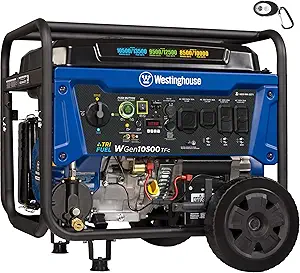
A portable generator can be a valuable backup during a long power outage, but choosing the right one involves more than looking at the biggest wattage number on the box. Fuel flexibility, starting power, runtime, noise, outlet configuration, safety features, and the way you plan to connect it to your home all matter.
The Westinghouse WGen10500TFc is built for buyers who need substantial portable power without committing to a permanently installed standby generator. It can operate on gasoline, propane, or natural gas, produces up to 13,500 peak watts and 10,500 running watts on gasoline, and includes electric, remote, and recoil starting.
For 2026, it remains an interesting option for homeowners dealing with frequent outages, contractors who need substantial jobsite power, and buyers who want multiple fuel choices in one generator.
But it isn’t perfect. The WGen10500TFc is heavy, relatively loud compared with inverter generators, and its published THD is up to 23%, so buyers with particularly sensitive equipment should understand that limitation before purchasing. Westinghouse also lists the model as not RV Ready, despite its 120/240V 14-50R receptacle.
Check Amazon Price: Click Here
Westinghouse WGen10500TFc Specifications
| Feature | WGen10500TFc |
|---|---|
| Generator type | Open-frame portable generator |
| Fuel types | Gasoline, propane, natural gas |
| Gasoline peak power | 13,500 watts |
| Gasoline running power | 10,500 watts |
| Propane peak power | 12,500 watts |
| Propane running power | 9,500 watts |
| Natural gas peak power | 10,000 watts |
| Natural gas running power | 8,500 watts |
| Engine | 500cc 4-stroke OHV |
| Fuel tank | 9.5 gallons |
| Gasoline runtime | Up to 19 hours at 25% load |
| Propane runtime | Up to 7 hours at 50% load with a 20-lb. tank |
| Starting system | Electric, remote, recoil |
| Noise level | As low as 74 dBA |
| Voltage | 120/240V |
| THD | ≤23% |
| CO protection | CO sensor with automatic shutdown |
| Warranty | 3-year limited residential warranty |
| Dry weight | 230 lb. |
| Dimensions | 27.2 x 26.1 x 26.5 inches |
These specifications are based on Westinghouse’s current product information.
What Makes the WGen10500TFc Different?
The biggest reason to consider this generator is its combination of high output and tri-fuel capability.
A typical portable generator may leave you dependent on gasoline or propane. The WGen10500TFc gives you three choices. You can use gasoline when you need maximum output, propane when you want a convenient stored fuel option, or natural gas when your home has an appropriate supply connection.
That flexibility can become particularly useful during extended outages because fuel availability can change. Having more than one option gives you another way to keep the generator operating when one fuel source becomes inconvenient or unavailable.
The tradeoff is that the generator itself is large and heavy. At 230 pounds dry, this is not the type of portable generator most people will casually load into an SUV and carry around.
Power Output: Is 10,500 Running Watts Enough?
For many homes, 10,500 running watts is a substantial amount of portable power.
On gasoline, the WGen10500TFc produces:
- 13,500 peak watts
- 10,500 running watts
Propane output drops to:
- 12,500 peak watts
- 9,500 running watts
Natural gas produces:
- 10,000 peak watts
- 8,500 running watts
The difference matters because appliances with electric motors can require considerably more power when they start than they use once they’re running. The extra starting capacity can help with loads such as refrigerators, sump pumps, well pumps, freezers, and some HVAC systems.
However, don’t interpret 10,500 running watts as a guarantee that the generator will run every appliance in every house simultaneously.
Central air conditioning is the biggest example. The actual requirement depends on the HVAC system’s running amperage, startup demand, and whether it has a soft-start system. Before relying on this generator for central AC, check the equipment’s electrical specifications rather than assuming the generator’s peak wattage will be enough.
Tri-Fuel Operation: Gasoline, Propane, and Natural Gas
The tri-fuel system is one of the strongest reasons to look at the WGen10500TFc.
Gasoline
Gasoline provides the generator’s highest rated output and is convenient when you need maximum available power.
The 9.5-gallon tank can provide up to 19 hours at 25% load or about 9.5 hours at 50% load, according to Westinghouse.
Actual runtime depends on the electrical load, fuel condition, temperature, and operating conditions.
Propane
Propane is useful for emergency preparedness because it can be stored for longer periods than gasoline when properly handled.
Westinghouse lists approximately 7 hours of runtime at 50% load using a 20-pound propane tank. Propane also produces less of the fuel-storage concerns associated with keeping gasoline around for long periods.
The tradeoff is lower output compared with gasoline.
Natural Gas
Natural gas can be particularly attractive for homeowners who already have a suitable natural gas connection.
The WGen10500TFc is rated for 10,000 peak watts and 8,500 running watts on natural gas.
The advantage is that you’re not relying on a portable gasoline tank or propane cylinder while the utility gas supply remains available.
However, natural gas isn’t automatically available during every emergency. A utility outage or damaged gas infrastructure can affect supply, and the installation needs to meet the manufacturer’s requirements and local codes.
Runtime: What Can You Actually Expect?
Runtime claims for generators can be misleading when they’re presented without the load percentage.
The WGen10500TFc’s 19-hour gasoline runtime is specified at only 25% load. At 50% load, Westinghouse lists approximately 9.5 hours.
That’s an important distinction.
If you’re only running a refrigerator, a few lights, internet equipment, and other essential loads, fuel consumption may be relatively modest. If you’re running several large appliances or an HVAC system, runtime will be substantially shorter.
For emergency planning, it’s better to think of the 19-hour figure as a light-load maximum rather than a realistic expectation for running a heavily loaded house all day.
Starting the WGen10500TFc
Westinghouse gives you three starting methods:
- Push-button electric start
- Remote key-fob start
- Recoil start
The remote start is especially useful when the generator is positioned outside and you don’t want to walk over to the control panel every time you need to start or stop it.
The recoil starter provides a manual backup if the electric-start system or battery isn’t available.
The generator also has an automatic choke and a battery system designed to support electric starting.
Outlet Configuration
The outlet panel is designed for both ordinary appliances and higher-capacity connections.
The WGen10500TFc includes:
- Two 120V 20A GFCI duplex outlets
- One 120/240V L14-30R twist-lock outlet
- One 120/240V 14-50R outlet
- Two USB ports
- Smart Switch connection
- Digital VFT data display
The display provides information such as voltage, frequency, and operating hours, making it easier to monitor the generator and keep track of maintenance.
The 14-50R outlet is useful for high-capacity connections, but there’s an important detail that shouldn’t be overlooked: Westinghouse lists the WGen10500TFc as not RV Ready. Therefore, simply seeing a 14-50R outlet doesn’t mean every 50A RV setup is automatically compatible.
Home Backup and Transfer Switch Connection
The WGen10500TFc is designed to be transfer-switch ready, which makes it suitable for home backup applications when connected correctly.
That does not mean you should connect it directly to a household wall outlet or improvise a connection to your electrical panel.
A proper home installation may require a transfer switch, inlet, compatible wiring, breakers, and work performed according to local electrical requirements. If you’re planning to power selected circuits or a larger portion of the home through the electrical panel, consult a qualified electrician.
This is especially important with a generator this powerful because improper backfeeding can create a serious electrical hazard.
Safety Features
The WGen10500TFc includes several useful safety systems.
Carbon Monoxide Sensor
The built-in CO sensor monitors carbon monoxide levels and can automatically shut down the generator when dangerous accumulation is detected.
This is an important layer of protection, but it does not make indoor operation safe.
The generator should always be operated outdoors in a properly ventilated location and positioned away from doors, windows, and other openings where exhaust could enter the building.
Never operate it inside a home, garage, basement, or other enclosed or partially enclosed area.
Automatic Low-Oil Shutdown
The generator also includes automatic low-oil shutdown protection. This helps protect the engine when the oil level becomes too low.
It should not replace checking the oil level as part of your normal maintenance routine.
GFCI Protection
The household receptacles are GFCI protected, adding another layer of electrical protection for connected equipment and users.
Noise Level: This Isn’t a Quiet Generator
One of the most important things missing from the original article was a realistic discussion of noise.
Westinghouse lists the WGen10500TFc at as low as 74 dBA. The manufacturer has also stated that the model is not considered a quiet generator.
That’s not surprising for a large open-frame generator with a 500cc engine.
If you plan to operate the generator near living areas, neighbors, or a campsite where noise is a major concern, an inverter generator may be worth considering instead.
For emergency home backup, however, some buyers may be willing to accept the noise in exchange for the higher output and three fuel options.
THD and Sensitive Electronics
Another specification worth understanding is total harmonic distortion (THD).
Westinghouse lists the WGen10500TFc at ≤23% THD.
The manufacturer has stated that the generator can be used with many common household electronics, while recommending that users check the requirements of particularly sensitive equipment. Westinghouse specifically advises caution with medical equipment.
This is one area where the WGen10500TFc differs from some modern inverter generators.
If your priority is extremely clean power for sensitive electronics, don’t choose a generator based only on its wattage. Look at the generator’s power-delivery technology and THD specification as well.
Engine and Build Quality
The WGen10500TFc uses a 500cc 4-stroke OHV engine with a cast iron sleeve. Westinghouse designed the engine for heavy-duty portable operation, while the generator includes an automatic low-oil shutdown and maintenance information through the digital display.
The open-frame design also makes the generator easier to service than many fully enclosed models.
The downside is size. At 230 pounds dry, this generator is better thought of as a portable home-backup unit with wheels than something genuinely lightweight.
If you need to move it over uneven ground, stairs, gravel, or into a truck, having another person available is a good idea.
Setup and What’s Included
The WGen10500TFc requires some initial assembly and preparation before operation.
Westinghouse lists accessories including:
- Engine oil
- Oil funnel
- Spark plug wrench
- Remote key fob
- Propane regulator and hose
- Battery float charger
The generator is also functionally tested at the factory, so Westinghouse notes that a small amount of residual oil or fuel odor may be present when the unit arrives.
Before the first real emergency, it is worth completing the setup, checking the oil, testing each starting method, and familiarizing yourself with the fuel selector and control panel.
A generator that has never been tested until the middle of a storm is not really an emergency-ready generator.
Maintenance
Like any gasoline-powered portable generator, the WGen10500TFc needs regular maintenance.
The maintenance schedule includes oil changes, air-filter service, spark-plug inspection, spark-arrestor maintenance, and other periodic checks. Westinghouse recommends following the owner’s manual rather than waiting until the generator develops a problem.
If the generator is being kept specifically for emergency use, periodic test runs are also worthwhile. This lets you identify a weak battery, fuel issue, starting problem, or other maintenance concern before a real outage occurs.
Westinghouse WGen10500TFc Pros and Cons
Pros
- 13,500 peak watts on gasoline
- 10,500 running watts on gasoline
- Tri-fuel operation
- 9,500 running watts on propane
- 8,500 running watts on natural gas
- Remote, electric, and recoil starting
- 9.5-gallon gasoline tank
- Up to 19 hours at 25% gasoline load
- CO sensor with automatic shutdown
- GFCI household outlets
- 120/240V 50A outlet
- Transfer-switch ready
- Digital VFT display
- 3-year residential limited warranty
Cons
- Heavy at 230 pounds
- Noise level is as low as 74 dBA
- Not an inverter generator
- THD is specified at ≤23%
- Output decreases when using propane or natural gas
- Not officially listed as RV Ready
- Requires proper electrical installation for home-panel connection
- Large footprint compared with smaller portable generators
The combination of strong customer feedback and the manufacturer’s specifications makes the model appealing for high-output backup use, but current buyer feedback also reinforces that weight and noise are worth considering.
Who Is the WGen10500TFc Best For?
The WGen10500TFc makes the most sense for someone who wants substantial portable backup power and multiple fuel choices.
It can be a good fit for:
- Homeowners who experience frequent power outages
- Homes that need more than a small 3,000–5,000-watt generator can provide
- Buyers with access to natural gas
- People who want gasoline and propane as backup fuel options
- Contractors who need high-output portable power
- Emergency preparedness setups where fuel flexibility matters
Its 120/240V output and transfer-switch-ready design also make it relevant to homeowners planning a properly installed connection to selected household circuits.
Who Should Consider Something Else?
The WGen10500TFc isn’t necessarily the right choice for everyone.
You may want a different generator if:
You prioritize quiet operation. At up to 74 dBA, this isn’t designed to compete with quiet inverter generators.
You need something easy to transport. A 230-pound dry weight makes this a substantial machine.
You specifically need an RV-ready generator. Westinghouse currently lists the WGen10500TFc as not RV Ready.
You need very low THD. The published ≤23% THD specification makes it worth looking at an inverter generator if clean power is a primary requirement.
You want automatic standby operation. This is a portable generator, not a permanently installed standby generator that automatically detects a utility outage and starts itself.
Is the Westinghouse WGen10500TFc Worth It in 2026?
The Westinghouse WGen10500TFc remains a substantial portable generator for 2026, particularly if your priorities are power capacity and fuel flexibility.
Its biggest advantage is the combination of 13,500 peak watts, 10,500 running watts, and tri-fuel operation. You aren’t limited to gasoline, and the generator can work with propane or natural gas when those options make more sense.
At the same time, the compromises are clear.
This isn’t a lightweight generator. It isn’t a quiet inverter. It isn’t officially RV Ready. And its ≤23% THD specification means buyers with particularly sensitive equipment should pay attention to their equipment’s power requirements.
For a homeowner who wants a high-output portable generator primarily for emergency backup, those tradeoffs may be acceptable. For someone shopping for quiet camping power or very clean inverter-style electricity, a different type of generator may make more sense.
Check Amazon Price: Click Here
Final Verdict
The Westinghouse WGen10500TFc is a powerful tri-fuel portable generator designed around flexibility rather than portability or quiet operation.
Its 13,500 peak watts and 10,500 running watts on gasoline give it enough capacity for serious backup applications, while propane and natural gas provide alternatives when gasoline isn’t the preferred fuel. Remote and electric starting, CO protection, GFCI outlets, a digital data display, and transfer-switch readiness add useful features for emergency home use.
The important thing is to understand what you’re buying. At 230 pounds and up to 74 dBA, it is a large open-frame generator. Its ≤23% THD specification also separates it from inverter models designed around cleaner power delivery.
For buyers who need a high-output tri-fuel generator for home backup, jobsite use, or emergency preparedness, the WGen10500TFc deserves a close look in 2026.