As an Amazon Associate I earn from qualifying purchases.
When the power goes out, having a generator that can run on more than one fuel can make a big difference. A dual fuel generator gives you the option to use gasoline or propane, so you are not completely dependent on one fuel source.
That flexibility is useful for more than emergency home backup. Depending on the model, a dual fuel generator can also power an RV, refrigerator, sump pump, lights, tools, appliances, and other equipment when you are camping, working remotely, or dealing with an extended outage.
For 2026, there are more dual fuel generators to choose from than ever, but they are not all designed for the same job. Some are compact inverter generators built for RVs and electronics, while larger open-frame models provide substantially more power for home backup.
The key is to look beyond the headline wattage and compare running watts, starting watts, fuel type, inverter technology, runtime, noise, outlets, portability, and safety features.
Best Dual Fuel Generators in 2026
| Model | Type | Gasoline Output | Propane Output | Best For |
|---|---|---|---|---|
| WEN DF360iX | Inverter | 3,600 peak / 2,900 rated W | 3,500 peak / 2,600 rated W | RVs, camping, light backup |
| Westinghouse WGen9500DF | Conventional | 12,500 peak / 9,500 rated W | 11,200 peak / 8,500 rated W | Home backup |
| Westinghouse iGen4000DFc | Inverter | Up to 4,000W class | Dual fuel | Quiet backup and electronics |
| Champion 201531 4500W | Inverter | 4,500W maximum | Dual fuel | RVs and quieter operation |
| WEN DF5600X | Conventional | 5,600 peak / 4,500 rated W | 5,000 peak / 4,050 rated W | Mid-size home backup |
Note: Generator output, runtime, availability, and pricing can vary by configuration and fuel. Always check the manufacturer’s current specifications before purchasing.
Why Choose a Dual Fuel Generator?
The main reason to buy a dual fuel generator is simple: you have two fuel options.
Gasoline is convenient because it is widely available and generally provides higher output from the same generator. However, gasoline requires more careful storage because it can degrade over time.
Propane is different. A properly stored propane cylinder can remain usable for much longer than stored gasoline, making propane particularly useful for emergency preparedness. The trade-off is that many dual fuel generators produce less power when operating on propane.
That difference matters when you are calculating how many appliances you can run simultaneously.
For example, a generator might produce 5,600 starting watts and 4,500 running watts on gasoline, but only 5,000 starting watts and 4,050 running watts on propane. That is exactly the case with the WEN DF5600X.
Having both options allows you to use gasoline when maximum output is important and switch to propane when long-term fuel storage or availability is the bigger concern.
Dual Fuel vs. Inverter Dual Fuel Generators
Not every dual fuel generator is an inverter generator.
A traditional portable generator can provide a lot of power at a relatively affordable price, making this type especially useful for home backup and demanding tools.
An inverter generator, on the other hand, is generally designed to provide cleaner electrical power and can adjust engine speed according to the load. This can make inverter models attractive for RVs, camping, electronics, and situations where lower noise is important.
The trade-off is usually power and price. A large conventional generator may deliver 9,000 or more running watts, while a portable inverter may deliver only a few thousand watts.
For that reason, do not automatically assume that an inverter generator is better simply because it is newer or quieter. The right design depends on what you actually need to power.
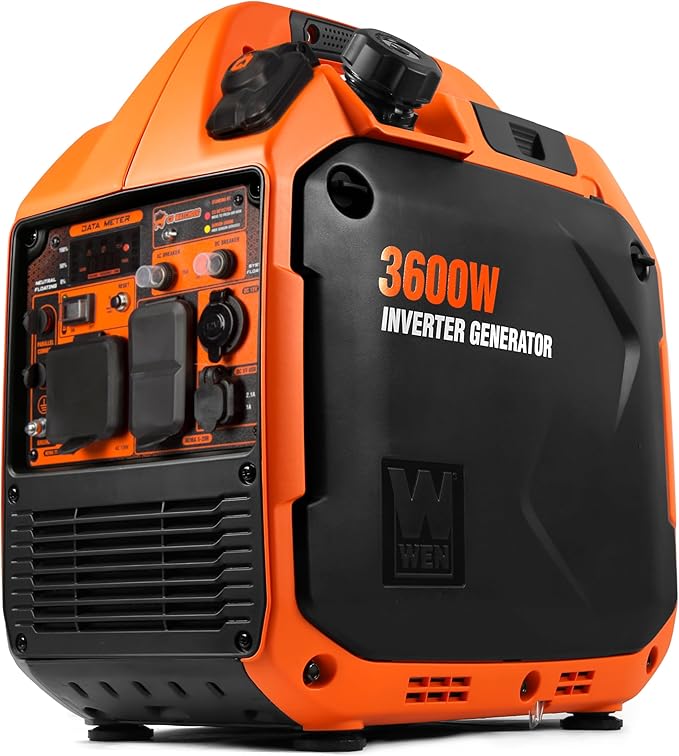
WEN DF360iX 3600-Watt Dual Fuel Inverter Generator
The WEN DF360iX is aimed at buyers who want the flexibility of gasoline and propane without moving into the size of a large open-frame generator.
On gasoline, WEN lists 3,600 surge watts and 2,900 rated watts. On propane, the generator provides up to 3,500 surge watts and 2,600 rated watts. It also uses inverter technology to provide cleaner power for electronics such as laptops, tablets, and smartphones.
One of its biggest advantages is portability. WEN designed this model for applications such as camping, hunting, tailgating, RV use, and backup power.
The generator includes a TT-30R RV receptacle, making it particularly relevant to RV owners. It also has a CO Watchdog shutdown sensor, fuel shutoff, USB ports, and parallel capability.
Why consider the WEN DF360iX?
- Dual-fuel gasoline and propane operation
- Inverter technology
- 3,600 peak watts on gasoline
- 2,900 rated watts on gasoline
- 3,500 peak watts on propane
- 2,600 rated watts on propane
- RV-ready TT-30R outlet
- CO shutdown sensor
- Fuel shutoff
- Parallel capability
- Three-year limited warranty
The main limitation is its rated output. At 2,900 running watts on gasoline, it is not intended to replace a high-output home backup generator.
For an RV, campsite, tailgate, or essential electronics, however, its combination of portability, dual-fuel operation, and inverter power makes much more sense.
Westinghouse WGen9500DF Dual Fuel Generator
If your priority is significantly more power for home backup, the Westinghouse WGen9500DF is in a completely different class from the smaller inverter generators.
Westinghouse lists 12,500 peak watts and 9,500 rated watts on gasoline, with 11,200 peak watts and 8,500 rated watts when running on propane. It is designed for home backup and is transfer-switch ready.
That extra capacity makes a major difference when several high-demand appliances need to operate at the same time.
Instead of thinking about this generator as a camping unit, think of it as a portable home-backup machine for essential household circuits.
It also includes electric start and remote starting functionality, making operation more convenient when the generator is stored outside and needs to be started during a storm or outage.
Why consider the Westinghouse WGen9500DF?
- 12,500 peak watts on gasoline
- 9,500 rated watts on gasoline
- 11,200 peak watts on propane
- 8,500 rated watts on propane
- Dual-fuel operation
- Electric and remote start
- Transfer-switch ready
- Designed for home backup
- Up to 12 hours of runtime at 25% load
- Substantial capacity for refrigerators, pumps, appliances, and other essential loads
The downside is size and noise compared with an enclosed inverter generator.
It is also important not to interpret “home backup” as meaning that every circuit in your house can automatically be powered. The actual loads you can operate depend on their wattage, starting requirements, the generator’s output, and how the generator is connected to the home’s electrical system.
A properly installed transfer switch or approved interlock should be handled according to local electrical requirements and, when applicable, by a qualified electrician.
Westinghouse iGen4000DFc Dual Fuel Inverter Generator
The Westinghouse iGen4000DFc belongs to the inverter side of the dual-fuel market, making it a better fit for people who want a balance between usable power and quieter operation.
Westinghouse’s current iGen lineup includes dual-fuel inverter models with CO sensors, while the iGen4000DFc documentation confirms its dual-fuel operation and fuel-selection system.
Compared with a large open-frame generator, an inverter model such as this is more appropriate when noise, portability, and cleaner electrical output are important considerations.
That can make it a practical choice for camping, RV use, backup electronics, refrigerators, lights, and other moderate loads.
What makes an inverter generator different?
An inverter generator does not simply produce power in the same way as a traditional open-frame portable generator.
Instead, the electricity is processed through the inverter system before being delivered to connected equipment. This allows manufacturers to design generators that can operate more efficiently at lower loads and generally produce a cleaner electrical output.
That is particularly useful for modern electronics.
However, the iGen4000DFc should not be treated as a replacement for a 9,000- or 10,000-watt home backup generator. If your priority is running central air conditioning, electric water heaters, large well pumps, or several major appliances simultaneously, a larger generator may be more appropriate.
Champion 4500W Dual Fuel Inverter Generator
The Champion 201531 4500W Dual Fuel Inverter is a strong option for buyers who want inverter technology without giving up the convenience of dual-fuel operation.
Champion identifies the 201531 as a 4,500-watt dual-fuel inverter. It uses a 149cc engine, includes its CO Shield automatic carbon monoxide shutoff system, and is rated at 64 dBA. Champion also states that it can run for up to 10 hours on gasoline or up to 25 hours using a 20-pound propane tank under its stated test conditions.
That propane runtime is particularly useful for RV owners and anyone who wants to reduce the number of times they have to refuel during an extended outdoor trip.
The generator can also be connected to another compatible unit with an optional parallel kit when more inverter power is needed.
Why consider the Champion 201531?
- 4,500-watt dual-fuel inverter
- Gasoline and propane operation
- CO Shield automatic shutdown
- 64 dBA rated noise level
- Up to 10 hours on gasoline
- Up to 25 hours with a 20-lb propane tank under specified conditions
- Parallel capability
- Three-year warranty
One important point is that maximum or starting watts should not be confused with continuous running watts. When planning an RV or home load, use the generator’s rated output and account for the starting surge of equipment such as air conditioners and pumps.
WEN DF5600X 5600-Watt Dual Fuel Portable Generator
The WEN DF5600X sits between compact inverter generators and much larger home-backup machines.
WEN rates it at 5,600 surge watts and 4,500 rated watts on gasoline. On propane, it produces 5,000 surge watts and 4,050 rated watts.
It uses a 224cc engine and includes electric start, a wheel kit, a 4.3-gallon gasoline tank, an RV-ready TT-30R outlet, and a transfer-switch-ready 120V L5-30R receptacle.
The built-in CO Watchdog sensor automatically shuts down the generator if dangerous carbon monoxide levels are detected.
Why consider the WEN DF5600X?
- 5,600 peak watts on gasoline
- 4,500 rated watts on gasoline
- 5,000 peak watts on propane
- 4,050 rated watts on propane
- 224cc engine
- Electric start
- CO Watchdog shutdown sensor
- RV-ready TT-30R outlet
- Transfer-switch-ready L5-30R outlet
- Wheel and handle kit
- Up to 12.5 hours of runtime at half load on gasoline
- Three-year warranty
This model makes sense for someone who needs more capacity than a small inverter generator but does not necessarily need a 9,000- or 10,000-watt home-backup machine.
It is also more practical for jobsite use and larger recreational loads than the WEN DF360iX.
How to Choose the Right Dual Fuel Generator
The best dual fuel generator depends on what you actually need to power.
1. Calculate your running watts
Running watts are the amount of electricity an appliance normally needs while operating.
Add together the running watts of the appliances you expect to use simultaneously.
For example, your emergency load might include:
- Refrigerator
- Freezer
- Several lights
- Wi-Fi router
- Television
- Sump pump
- Small microwave
- Phone and laptop chargers
The total continuous demand gives you a starting point for determining the generator size.
2. Account for starting watts
Some appliances need significantly more electricity when their motors start.
Refrigerators, freezers, sump pumps, well pumps, and air conditioners can have substantial starting requirements.
A generator that appears powerful enough based only on running watts may still struggle if the combined starting demand exceeds its surge capacity.
This is one of the biggest reasons to look at both running watts and starting watts instead of buying a generator based solely on the largest number printed on the box.
3. Decide whether you need an inverter generator
If you primarily need a generator for an RV, camping, electronics, or quieter operation, an inverter model can be attractive.
If your main goal is powering multiple high-demand appliances during a home outage, a larger conventional generator may provide more power for the money.
4. Think about your fuel strategy
Gasoline and propane each have advantages.
Gasoline is usually easier to find and often provides the generator’s highest output.
Propane is convenient for long-term emergency storage and can be especially useful when gasoline is unavailable.
A dual-fuel generator lets you choose between them instead of committing to one fuel source.
5. Check the outlets
Do not buy a generator simply because its wattage looks sufficient.
Check whether it has the connections you actually need.
RV owners should look for an appropriate RV outlet such as a TT-30R when required.
For home backup, check whether the generator has the appropriate connection for your planned transfer switch or other approved connection method.
Larger generators may also offer 120/240V capability, which can be important for certain household loads.
6. Consider noise
Large open-frame generators generally produce more noise than enclosed inverter models.
If you are camping or staying near the generator for long periods, noise can become a major consideration.
For home emergency backup, however, many people may accept more noise in exchange for substantially higher power output.
7. Never overlook carbon monoxide safety
Every gasoline- or propane-powered portable generator produces carbon monoxide.
A CO sensor or automatic shutdown system is an important safety feature, but it does not make indoor operation safe.
Portable generators should be operated outdoors in a properly ventilated location and well away from doors, windows, vents, and other openings.
Never operate one inside a home, garage, basement, shed, or other enclosed space.
Always follow the safety distances and operating instructions in the owner’s manual.
Gasoline vs. Propane: Which Fuel Should You Use?
There is no universal answer because each fuel has a different advantage.
| Feature | Gasoline | Propane |
|---|---|---|
| Availability | Widely available | Depends on local supply |
| Storage | Requires careful storage | Long-term storage is easier |
| Generator output | Usually higher | Usually lower |
| Emergency use | Convenient when available | Useful when gas stations are unavailable |
| Fuel stability | Degrades over time | Stores for much longer |
| Best use | Maximum output and convenience | Emergency preparedness and long-term storage |
A dual-fuel generator is attractive precisely because you do not have to choose only one.
For example, you could use gasoline for normal operation when you want maximum output and keep propane cylinders available for longer outages.
Which Dual Fuel Generator Is Right for You?
If you need a compact generator for an RV, camping, or moderate backup loads, the WEN DF360iX is designed around portability, inverter power, and dual-fuel flexibility.
If your priority is substantially higher home-backup capacity, the Westinghouse WGen9500DF operates in a different power class and offers considerably more running wattage.
For buyers who want an inverter generator with dual-fuel capability and a strong RV/outdoor focus, the Champion 201531 4500W is worth considering.
The WEN DF5600X occupies a useful middle ground for people who need more power than a compact inverter generator but do not want to move all the way up to a large home-backup generator.
The Westinghouse iGen4000DFc is another option to consider if quieter inverter operation and cleaner electrical output are more important than maximum wattage.
The important thing is to match the generator to your actual electrical load rather than simply choosing the model with the biggest peak-wattage number.
Final Thoughts
Dual fuel generators have become a practical option for homeowners, RV owners, campers, and anyone who wants more flexibility during a power outage.
The biggest advantage is not necessarily extra power. It is having two ways to keep the generator running when fuel availability becomes a problem.
For smaller loads, an inverter model can offer quieter operation and cleaner power. For larger home-backup requirements, a conventional high-output generator can provide substantially more capacity.
Before buying, compare running watts, starting watts, gasoline and propane output, runtime, outlet configuration, transfer-switch compatibility, portability, noise, and CO safety features.
Most importantly, size the generator around the equipment you actually plan to operate. A properly matched dual fuel generator can provide useful backup power without paying for far more capacity than you need.