As an Amazon Associate I earn from qualifying purchases.
When welding work takes you away from a workshop, having access to electricity can become a problem. A portable welder generator solves that problem by combining a welding power source with an engine-driven generator, allowing you to weld and run selected tools without relying on utility power.
These machines are useful for farm repairs, construction, equipment maintenance, mobile welding, fabrication, and remote jobs where bringing a separate welder and generator would take up too much space.
However, not every machine marketed as a welder generator offers the same capabilities. A compact 120-amp unit can be useful for light repairs, while a 200-amp-plus engine-driven welder is better suited to heavier field work. You also need to consider duty cycle, auxiliary generator output, fuel type, weight, welding process, and whether the machine can supply power to tools while welding.
For 2026, the models below cover several different use cases, from compact portable machines to larger generator options that can power a separate welder.
Best Portable Welder Generators for 2026
| Product | Welding Output | Generator Output | Best For |
|---|---|---|---|
| zinnore Engine-Driven Welder Generator | Up to 130A | 2,000W | Light repairs |
| Tomahawk TWG210A | Up to 210A | 2,000W | Farm, construction and field welding |
| Tomahawk TWG120A | 120A | 2,000W rated / 2,200W max | Light-duty portable welding |
| ESAB Ruffian ES 150G EDW | Up to 150A | 4,000W continuous / 4,500W peak | Professional field repairs |
| WEN DF1100T | External welder required | 8,300W running / 11,000W surge on gasoline | High-output portable power |
The most important point is that the WEN DF1100T is not an integrated engine-driven welder. It belongs in this comparison as an alternative for users who already own a separate welding machine and need a larger portable generator.
What Is a Portable Welder Generator?
A portable welder generator, also called an engine-driven welder, combines an internal-combustion engine, welding power source, and auxiliary generator into one machine.
Instead of connecting a conventional welder to a wall outlet, the engine produces the electrical power required for welding. Many models also provide 120V or 240V AC outlets for tools, lights, grinders, compressors, and other equipment.
That makes an engine-driven welder particularly useful when working:
- On construction sites without utility power
- On farms and ranches
- In remote equipment repair
- On mobile welding trucks
- During field maintenance
- In areas affected by power outages
- At locations where transporting two separate machines is inconvenient
A true engine-driven welder should not be confused with an ordinary generator that happens to have enough wattage to run a separate welder. The integrated machines are designed specifically around welding loads and provide dedicated welding controls and output.
Why Engine-Driven Welders Are Useful for Mobile Work
The main advantage is consolidation.
Instead of carrying a generator and a welding machine separately, an engine-driven welder can provide both functions in a single package. Depending on the model, you may also be able to operate auxiliary tools while welding.
For mobile welders, this can reduce the amount of equipment that needs to be transported to the job.
Construction and Fabrication
Construction crews can use engine-driven welders for structural repairs, equipment maintenance, gates, brackets, frames, and other field fabrication work.
Farm and Ranch Repairs
Farmers and ranchers frequently need to repair gates, trailers, implements, fencing equipment, and machinery away from a workshop. A compact engine-driven welder can eliminate the need to bring equipment back to a shop.
Mobile Equipment Repair
A welding generator mounted on a truck or trailer can provide a self-contained power source for repairing machinery where it sits.
Emergency and Maintenance Work
A welding generator can also be useful when equipment needs to be repaired after storms, equipment failures, or other situations where utility power is unavailable.
Portable Welder Generator Reviews for 2026
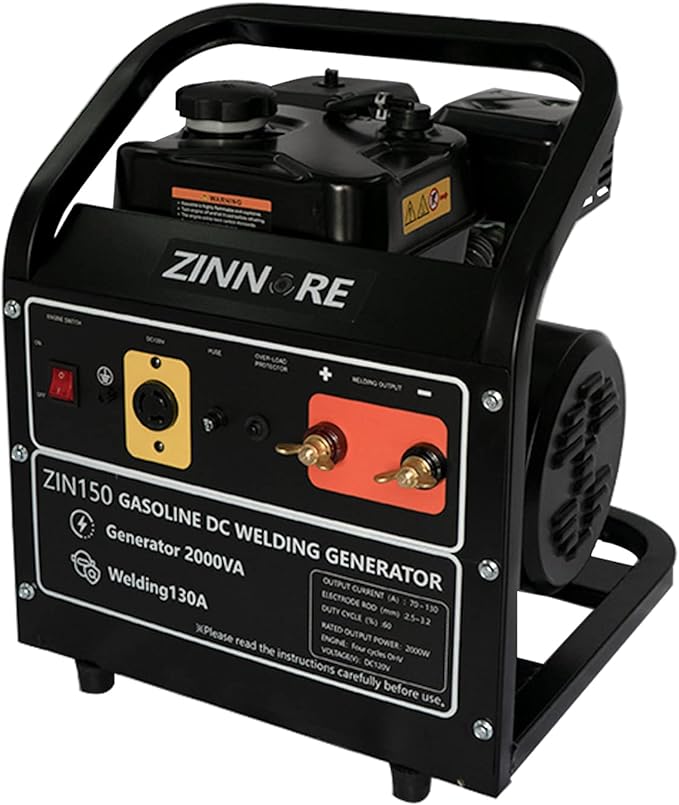
Engine Driven 2000W Welder Generator – zinnore
The zinnore engine-driven welder generator is aimed at buyers who need a compact machine for lighter welding and portable power applications.
The model is listed with 2,000 watts of generator output and up to 130 amps of stick welding capability, making it more appropriate for light repairs than heavy commercial welding.
Its compact format can make sense for occasional maintenance work where portability matters more than maximum welding output.
Key Features
- Up to 130A welding output
- 2,000W generator output
- Designed for portable field work
- Compact alternative to larger engine-driven welders
- Suitable for lighter repair and maintenance jobs
Who Should Consider It?
This type of machine makes more sense for a homeowner, hobbyist, farmer, or occasional repair user who does not need the amperage or auxiliary power of a full-size professional engine-driven welder.
If your typical jobs involve heavier plate, long welds, or demanding daily production work, moving up to a higher-amperage machine is worth considering.
Tomahawk Power TWG210A 15 HP 2,000W Welder Generator
The Tomahawk Power TWG210A is one of the more capable compact machines in this group.
It provides up to 210 amps of DC welding output, a 60% duty cycle, and 2,000 watts of generator power. Tomahawk also specifies that the machine can weld and operate electric tools at the same time.
The TWG210A is designed for Stick/MMA and TIG applications and uses a 15 HP engine. The manufacturer also lists support for electrodes ranging from 6010 through 7024.
Key Features
- Up to 210A welding output
- 60% duty cycle
- 2,000W generator output
- 15 HP engine
- Stick/MMA and TIG capability
- Inverter-based design
- Digital amperage display
- Wheel kit and handles
- Welding and auxiliary tool operation
Why the 210A Output Matters
The jump from a compact 120–130A machine to a 210A engine-driven welder provides considerably more flexibility for field repairs.
However, the maximum amperage should not be the only specification you consider. The 60% duty cycle means the machine’s maximum rated welding output cannot simply be treated as unlimited continuous production capacity.
For mobile repair work, farms, construction, and general maintenance, the TWG210A offers a useful balance between welding capability and portability.
Tomahawk Power TWG120A 2,200W Welder Generator
ORDER NOW AT AMAZON
The Tomahawk TWG120A is a smaller alternative for users who do not need 200 amps of welding output.
The machine combines a 120A welder with a 7 HP gasoline engine and provides up to 2,200 watts of generator output, with 2,000 watts listed as rated power.
That makes it better suited to light-duty welding, farm repairs, maintenance work, and portable projects rather than demanding structural or production welding.
Key Features
- 120A welding output
- 2,200W maximum generator output
- 2,000W rated generator output
- 7 HP gasoline engine
- Portable wheel kit
- 120V auxiliary outlets
- Designed for Stick welding applications
Who Is It For?
The TWG120A can make sense when portability and price are more important than maximum welding capacity.
For occasional repairs involving smaller materials, there is little reason to carry a much larger machine if you do not need its additional amperage.
On the other hand, anyone expecting to perform heavier welding on a regular basis should look toward the 150A–210A class instead.
ESAB Ruffian ES 150G EDW
The ESAB Ruffian ES 150G EDW takes a step up in capability and is one of the most interesting options in this group for professional field work.
ESAB rates the machine at 150 amps at a 60% duty cycle and 115 amps at 100% duty cycle. It uses a 14 HP Kohler Command PRO engine and provides up to 4.5 kW of peak generator power and 4 kW of continuous power.
The machine provides both 120V and 240V outlets and is designed to operate tools while welding. ESAB specifically lists grinders, circular saws, lights, air compressors, and some light-duty plasma cutters and MIG/TIG equipment among possible auxiliary loads.
Key Features
- 150A maximum welding output
- 150A at 60% duty cycle
- 115A at 100% duty cycle
- 4.5 kW peak generator output
- 4 kW continuous generator output
- 14 HP Kohler engine
- 120V and 240V outlets
- Adjustable arc force
- Thermal protection
- Digital display
- Engine-hour meter
- Weather-resistant IP23S housing
- Approximately 248 lb with wheels and handles
Why the Ruffian Stands Out
The Ruffian offers more auxiliary generator capacity than the smaller 2,000W Tomahawk machines while remaining substantially lighter than many full-size professional engine-driven welders.
That makes it attractive for users who need a combination of welding and jobsite power but still have to move the machine around a truck, trailer, or work area.
Its 150A welding output also gives it more headroom than a 120A compact unit, while the 4 kW continuous generator capacity makes the machine useful beyond welding alone.
WEN DF1100T 11,000W Dual-Fuel Generator
The WEN DF1100T is different from the other machines in this article.
It is not an engine-driven welder with an integrated welding system. Instead, it is a large dual-fuel portable generator intended to supply electricity to external equipment.
That distinction matters.
If you already own a conventional electric welder and need a portable power source capable of supplying substantial wattage, the DF1100T may be worth considering.
The generator provides 8,300 running watts and 11,000 surge watts on gasoline, while LPG operation is rated at 7,500 running watts and 9,500 surge watts. It also provides 120V/240V output.
Key Features
- 11,000W gasoline surge output
- 8,300W gasoline running output
- 9,500W LPG surge output
- 7,500W LPG running output
- Dual-fuel gasoline/propane operation
- 120V/240V output
- 457cc engine
- 6.6-gallon fuel tank
- Approximately 214 lb
- Electric-start configuration
Important Limitation
Do not buy the DF1100T expecting it to function like a Tomahawk or ESAB engine-driven welder.
You still need a compatible external welding machine, cables, and the appropriate electrical setup.
Its advantage is generator capacity, not integrated welding functionality.
Portable Welder Generator Comparison
| Model | Welding Output | Generator Output | Engine | Best Use |
|---|---|---|---|---|
| zinnore | Up to 130A | 2,000W | Gas | Light repairs |
| Tomahawk TWG120A | 120A | 2,000W rated | 7 HP gas | Hobby and light maintenance |
| Tomahawk TWG210A | 210A | 2,000W | 15 HP gas | Field repairs and construction |
| ESAB Ruffian ES 150G | 150A | 4,000W continuous | 14 HP Kohler | Professional mobile work |
| WEN DF1100T | External welder | 8,300W running gas | 457cc gas/LPG | High-output portable power |
The numbers illustrate why there is no single machine that is ideal for every user.
A 120A machine prioritizes portability and lighter work. A 210A unit provides more welding headroom, while the ESAB offers a useful combination of welding output and higher auxiliary generator capacity.
The WEN belongs to a different category because its primary job is supplying power to external equipment.
How to Choose the Right Portable Welder Generator
Before buying an engine-driven welder, look beyond the advertised maximum amperage.
1. Welding Amperage
Welding amperage is one of the first specifications to check.
For light repairs, a 120A–150A machine may be sufficient. More demanding equipment repair, construction, and general field welding can justify a machine in the 200A-plus range.
Your electrode size, material thickness, welding process, and expected workload should determine the amperage you need.
Buying the largest machine available is not automatically better. A larger engine-driven welder generally means more weight, higher cost, and more equipment to transport.
2. Duty Cycle
Duty cycle tells you how long a welder can operate at a particular output during a defined period.
For example, a machine rated at 60% duty cycle at a particular amperage can operate at that rated output for six minutes in a ten-minute period under the conditions specified by the manufacturer.
This is why a 210A machine with a 60% duty cycle should not automatically be compared with a machine capable of maintaining a lower amperage at 100% duty cycle.
For professional work, always check the complete duty-cycle specification rather than relying only on the maximum amperage.
3. CC vs. CV Output
If you primarily use Stick welding, constant-current output is important.
If you plan to use MIG or flux-core equipment with a wire feeder, you need to determine whether the engine-driven welder provides the appropriate constant-voltage (CV) output.
Not every compact welder generator supports the same welding processes.
Before buying, verify that the machine is compatible with the welding equipment and process you actually plan to use.
4. Auxiliary Generator Power
The generator side of the machine determines what other equipment you can operate.
You may want to power:
- Angle grinders
- Drills
- Lights
- Saws
- Battery chargers
- Compressors
- Plasma cutters
- Additional welding equipment
Always distinguish between starting watts and running watts.
A generator may advertise a high peak output but have considerably less continuous capacity.
5. Simultaneous Welding and Tool Operation
This is an important feature for mobile work.
Some engine-driven welders are designed to provide auxiliary power while welding. That can allow a worker to weld and operate a grinder or other tool without stopping to switch equipment.
The actual available auxiliary power can depend on the machine and operating conditions, so check the manufacturer’s specifications before assuming full generator output is available during welding.
6. Weight and Portability
A machine can be called “portable” without being easy to move.
Compact machines can be moved around a jobsite with wheels and handles, while larger professional engine-driven welders may require a truck, trailer, lift, or permanent mounting.
Before purchasing, consider:
- Machine weight
- Wheel design
- Handle placement
- Overall dimensions
- Truck payload
- Trailer capacity
- Lifting points
- Storage requirements
The ESAB Ruffian, for example, weighs approximately 248 lb with wheels and handles, which is considerably easier to manage than many larger commercial engine-driven welders.
7. Fuel Type
Most portable welder generators in this category use gasoline, although larger commercial machines may use diesel.
Gasoline machines can be attractive for portability and initial cost.
Diesel models can make more sense for heavy commercial use where long operating hours, fuel efficiency, and fleet durability are priorities.
Dual-fuel generators offer another option, particularly when propane availability is important.
8. Power Quality
If you are going to connect electronics, battery chargers, or other sensitive equipment to the auxiliary outlets, look closely at the generator’s power-quality specifications.
Do not assume that every generator labeled “inverter” or every generator outlet is equally appropriate for sensitive electronics.
Check the manufacturer’s documentation for voltage regulation, waveform information, and total harmonic distortion when those specifications matter to your equipment.
Portable Welder Generator Safety
Engine-driven welders combine welding electricity, hot metal, fuel, and an internal-combustion engine. Safe operation is therefore essential.
Never operate the engine in an enclosed area
Gasoline-powered machines produce carbon monoxide. Use them outdoors and keep exhaust away from doors, windows, vents, and other openings.
Follow the owner’s manual
Electrical connections, grounding, fuel handling, maintenance intervals, and operating procedures vary between machines.
Protect yourself from welding hazards
Use appropriate welding PPE, including a properly rated welding helmet, gloves, protective clothing, and suitable eye and hearing protection for the surrounding work.
Keep fuel away from heat and sparks
Allow the engine and equipment to cool as required before refueling and follow the manufacturer’s fuel-storage instructions.
Inspect welding cables
Damaged leads, loose connections, or worn insulation can create shock, arc-flash, or fire hazards.
Be careful with auxiliary outlets
Do not overload the generator. Check the running and starting requirements of connected tools and equipment.
Maintenance Tips for Engine-Driven Welders
Routine maintenance can have a major effect on reliability.
Follow the manufacturer’s maintenance schedule for:
- Engine oil
- Air filter
- Spark plug on gasoline engines
- Fuel system
- Battery and charging system
- Cooling system
- Electrical connections
- Welding cables and connectors
- Generator outlets
- Tires and wheels
- Engine-hour service intervals
Fuel storage deserves particular attention. If the machine sits unused for long periods, follow the manufacturer’s recommendations for fuel stabilization and storage.
Keeping the machine clean also helps you identify oil leaks, damaged cables, loose hardware, and other problems before they become major failures.
Welder Generator vs. Separate Welder and Generator
For many mobile users, the decision comes down to one question:
Should you buy an integrated engine-driven welder or use a conventional welder with a separate generator?
An integrated engine-driven welder is attractive when welding is a major part of the job.
You get:
- Welding output
- Auxiliary generator power
- One engine
- One fuel system
- One machine to transport
A separate generator and welder may be more flexible when you already own a welding machine or need substantially more generator capacity than an integrated welder provides.
The WEN DF1100T illustrates this approach. It offers substantially more generator capacity than the compact integrated welders in this article, but you must supply the welding equipment separately.
Which Type of Portable Welder Generator Do You Need?
For occasional light repairs
A 120A–150A compact machine can be sufficient for basic maintenance, small fabrication projects, farm repairs, and similar jobs.
For general field welding
A machine around 200A provides considerably more flexibility for equipment repairs and heavier field work.
For welding plus more auxiliary power
A model such as the ESAB Ruffian can make sense when generator capability is important in addition to welding.
For maximum portable generator power
A conventional high-output generator such as the WEN DF1100T may be worth considering if you already have a separate electric welder.
Frequently Asked Questions
Can a portable welder generator run power tools?
Yes. Many engine-driven welders provide auxiliary AC outlets for tools such as grinders, drills, lights, and other equipment. However, the available power depends on the model and whether you are welding at the same time.
Is a 120A welder enough for field repairs?
It can be enough for lighter maintenance and repair work, but the answer depends on material thickness, electrode size, welding process, and required duty cycle. Heavier field work may justify a 150A or 200A-plus machine.
What is the advantage of an engine-driven welder?
The biggest advantage is having welding capability and auxiliary electrical power in one self-contained machine. That is particularly useful when working away from utility power.
Can a generator run a separate welder?
Yes, provided the generator has sufficient continuous and starting capacity and the electrical output is compatible with the welding equipment. Always follow the welder and generator manufacturer’s requirements.
Is more welding amperage always better?
No. Higher amperage can provide additional capacity, but larger machines are usually heavier and more expensive. Choose the machine according to your actual welding requirements.
Can you weld and use tools at the same time?
Some engine-driven welders are specifically designed for simultaneous welding and auxiliary power. Check the manufacturer’s specifications to determine how much auxiliary power remains available during welding.
What is the difference between a welder generator and a regular generator?
A welder generator has an integrated welding power source designed for arc welding. A regular generator primarily produces AC electrical power and normally requires a separate welding machine.
Final Thoughts on Portable Welder Generators in 2026
The best portable welder generator depends less on the biggest number on the specification sheet and more on how you actually plan to use the machine.
For lighter work, a compact 120A–150A unit can provide useful welding capability without the size of a commercial engine-driven welder. If your work involves heavier field repairs, moving into the 200A class provides additional capacity.
The ESAB Ruffian ES 150G offers an interesting middle ground with 150A welding output and substantially more auxiliary generator capacity than the smaller 2,000W machines.
The Tomahawk TWG210A is another practical option for users who want higher welding output in a relatively compact package, with up to 210A, a 60% duty cycle, and 2,000W of auxiliary power.
If your priority is high-output portable electricity rather than an integrated welding machine, the WEN DF1100T is a different type of solution. Its 8,300W running and 11,000W surge gasoline ratings make it considerably more focused on generator duty than the compact welder-generator models above.
Before buying, compare the welding amperage, duty cycle, CC/CV capability, generator output, simultaneous-use capability, fuel type, weight, and maintenance requirements. Choosing based on those specifications will give you a much clearer idea of whether a compact welder generator or a larger professional engine-driven machine fits your work.