As an Amazon Associate I earn from qualifying purchases.
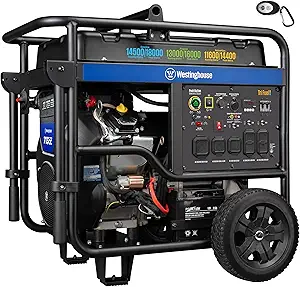
The Westinghouse WGen14500TFc is a large open-frame portable generator designed for homeowners, contractors, and RV users who need substantially more power than a typical 5,000- or 8,000-watt generator can provide. It runs on gasoline, propane, or natural gas and offers different power levels depending on the fuel being used.
With gasoline, the generator produces 14,500 running watts and 18,000 starting watts. Its output drops to 13,000 running watts on propane and 11,600 running watts on natural gas. That difference is important if you plan to connect the generator to your home’s natural gas supply.
The WGen14500TFc is built around a 713cc V-Twin engine and includes electric and remote starting, a 50-amp receptacle, transfer-switch and interlock compatibility, a CO sensor, and less than 5% total harmonic distortion. It is a substantial machine, though, weighing 348.3 pounds dry, so its “portable” designation should be understood in the context of a large wheeled generator rather than something you can easily load into a vehicle by yourself.
Westinghouse WGen14500TFc Specifications
| Specification | Westinghouse WGen14500TFc |
|---|---|
| Generator Type | Open-frame portable |
| Fuel Types | Gasoline, propane, natural gas |
| Gasoline Output | 14,500 running / 18,000 starting watts |
| Propane Output | 13,000 running / 16,000 starting watts |
| Natural Gas Output | 11,600 running / 14,400 starting watts |
| Engine | 713cc OHV V-Twin |
| Fuel Tank | 10.5 gallons |
| Gasoline Runtime | Up to 16 hours at 25% load |
| Gasoline Runtime at 50% Load | Up to 9 hours |
| Start System | Electric and remote start |
| Recoil Start | No |
| Voltage | 120/240V |
| THD | Less than 5% |
| 50A Outlet | Yes |
| Transfer Switch Ready | Yes |
| Interlock Kit Ready | Yes |
| CO Sensor | Yes |
| Noise Level | As low as 74 dBA |
| Weight | 348.3 lbs |
| Dimensions | 30.3 × 34.9 × 34.3 inches |
| Residential Warranty | 3-year limited |
| CARB Compliant | No |
Specifications can vary by operating conditions, and runtime depends heavily on electrical load and fuel type. The manufacturer currently lists the WGen14500TFc as EPA compliant but not CARB compliant.
Key Features of the WGen14500TFc
Tri-Fuel Operation
The biggest reason to consider the WGen14500TFc is its ability to use three fuel sources: gasoline, propane, and natural gas.
That flexibility can be useful during a prolonged outage because you are not limited to one type of fuel. Gasoline is convenient when you need the generator’s maximum rated output, propane can be stored for emergencies, and natural gas can provide a practical option for homes that already have an appropriate gas connection.
One detail that is easy to overlook, however, is that the generator does not produce the same wattage on all three fuels.
Gasoline provides the highest output at 14,500 running watts and 18,000 starting watts. On propane, the ratings are 13,000 running watts and 16,000 starting watts. Natural gas provides 11,600 running watts and 14,400 starting watts.
That means someone planning to use natural gas for home backup should size the electrical load around the natural-gas output rather than the 14,500-watt gasoline rating.
14,500 Running Watts and 18,000 Starting Watts
The gasoline rating of 14,500 running watts puts the WGen14500TFc in a much higher power class than many conventional portable generators.
The distinction between running watts and starting watts matters here. Running watts describe the continuous electrical load the generator is designed to support, while starting watts provide additional short-term capacity for equipment with high startup demands.
That can be particularly useful for appliances and equipment with motors, such as central air-conditioning systems, well pumps, sump pumps, refrigerators, and other equipment that may require additional power when starting.
Still, 14,500 watts does not automatically mean that every appliance in every home can run at the same time. Your actual electrical demand, motor startup requirements, fuel source, and transfer equipment all matter.
For natural-gas operation, the lower 11,600-watt running rating should be the number you use when planning your loads.
50-Amp Outlet and Home Backup Capability
The WGen14500TFc includes a 120/240V 14-50R 50-amp outlet along with a 120/240V L14-30R 30-amp outlet. Westinghouse also lists the generator as transfer-switch and interlock-kit ready.
This makes the generator particularly interesting for residential backup applications.
Instead of relying only on individual extension cords, a properly installed transfer switch or compatible interlock system can allow selected household circuits to be powered from the generator.
The important word here is “properly.” The generator does not automatically provide whole-house power simply because it has a 50-amp outlet. The home’s electrical panel, transfer equipment, generator inlet, wiring, and connected loads all have to be appropriate for the installation.
If you are planning a permanent connection to your home’s electrical system, have the work performed according to local electrical requirements by a qualified professional.
Runtime Depends on Load
The WGen14500TFc has a 10.5-gallon fuel tank, but it is important not to judge its runtime from a single headline number.
Westinghouse lists up to 16 hours at 25% load on gasoline, while its specifications also list approximately 9 hours at 50% load. As the electrical load increases, fuel consumption increases as well.
This is a more useful way to look at generator runtime than simply saying that the unit runs for a certain number of hours.
For a long outage, the actual runtime you experience will depend on which appliances are running, how frequently larger loads cycle on and off, and which fuel you are using.
Electric and Remote Start
The WGen14500TFc uses electric starting and also includes a remote-start key fob.
That is convenient during an outage because you do not necessarily have to stand directly beside the generator to start it.
However, there is no recoil starter on this model. Westinghouse lists the starter type as electric and remote, with recoil start listed as unavailable.
For emergency preparedness, it is therefore worth keeping the starting battery maintained and making sure the generator is periodically checked rather than waiting until the next blackout to discover a starting problem.
Low THD for Electronics
The WGen14500TFc is rated at less than 5% total harmonic distortion.
Westinghouse specifically describes this as suitable for powering sensitive electronics such as computers, phones, and televisions.
That does not mean every electronic device is immune to generator-related problems, but the low-THD specification is useful for households that expect to keep modern electronics operating during an outage.
The generator also uses copper windings, according to the manufacturer’s specifications.
CO Sensor and Generator Safety
The WGen14500TFc includes a carbon monoxide sensor with a shutdown feature.
That is an important safety feature, but it should never be treated as permission to operate the generator indoors, in a garage, or close to the house.
The CDC recommends operating portable generators outdoors and at least 20 feet from windows, doors, and vents. The exhaust should be directed away from the home.
A working CO alarm inside the home is also recommended.
Generator placement also matters during bad weather. Follow the manufacturer’s instructions concerning rain, snow, electrical connections, and wet conditions rather than assuming that a covered patio or carport is automatically safe.
What Can the WGen14500TFc Power?
A generator this size is designed for considerably more than basic emergency loads.
Depending on their individual wattage requirements and startup demands, potential loads can include:
- Central air-conditioning systems
- Refrigerators and freezers
- Well pumps
- Sump pumps
- Electric water heaters
- Lighting
- Televisions and computers
- Microwaves
- Kitchen appliances
- Garage equipment
- Power tools
The exact combination depends on the electrical requirements of your home.
For example, an air conditioner may draw significantly more power during startup than it does after the compressor is running. The same principle applies to pumps and other motor-driven equipment.
That is why a load calculation is more useful than simply adding the wattage printed on a few appliances and assuming the generator will handle everything.
Gasoline vs. Propane vs. Natural Gas
The three fuel choices are one of the strongest reasons to consider this generator, but each option has tradeoffs.
Gasoline
Gasoline provides the WGen14500TFc’s highest rated output:
14,500 running watts / 18,000 starting watts.
If maximum output is the priority, gasoline is the fuel associated with the generator’s highest power rating.
The downside is that gasoline requires appropriate storage and management, particularly if you are preparing for an outage that could last several days.
Propane
Propane provides:
13,000 running watts / 16,000 starting watts.
It gives you another fuel option when gasoline is unavailable and can be useful as part of an emergency fuel-storage plan.
The available runtime depends on the tank size and electrical load.
Natural Gas
Natural gas provides:
11,600 running watts / 14,400 starting watts.
The lower output compared with gasoline is the key point to remember. If you plan to connect the generator to your home’s natural gas supply, calculate your expected electrical demand using the natural-gas rating rather than the gasoline rating.
For homeowners who already have an appropriate natural-gas connection, this can nevertheless be an attractive option for extended outages because the fuel source does not depend on storing multiple gasoline cans.
Real-World Uses
Home Backup
This is arguably the most obvious application for the WGen14500TFc.
Its high output and 50-amp connection make it suitable for homeowners who want to power substantial household loads during an outage, provided the electrical installation and generator sizing are appropriate.
Job Sites
The large engine and high continuous output can also make the generator useful for construction and other locations where several power tools or high-demand electrical loads may be operating.
The tradeoff is its size and weight. At 348.3 pounds dry, this is not a generator most people will want to move frequently over rough terrain.
RV and Outdoor Use
Westinghouse lists the WGen14500TFc as RV-ready, so it can be considered for larger RV power requirements.
However, buyers should keep its 348.3-pound weight and open-frame design in mind. This is a very different type of generator from a compact inverter model intended for easy transport.
Events and Large Outdoor Loads
The high output can also be useful for outdoor events, work areas, or other situations requiring several electrical loads.
Noise should be considered, though. Westinghouse lists operating volume as low as 74 dBA, so this is not a quiet inverter generator designed primarily for noise-sensitive environments.
What to Consider Before Buying the WGen14500TFc
The WGen14500TFc has impressive output, but there are several reasons someone might choose a different generator.
It Is Heavy
At 348.3 pounds dry, the WGen14500TFc is a large machine. The included wheels and handles make movement easier, but its weight still matters when positioning it or transporting it.
It Is Not a Quiet Generator
The advertised noise level is as low as 74 dBA. That is worth considering if the generator will operate close to living areas or neighbors.
Natural Gas Produces Less Power
If natural gas is your preferred fuel, remember that the rated output drops to 11,600 running watts.
That is still substantial power, but it is considerably lower than the 14,500-watt gasoline rating.
There Is No Recoil Starter
The generator relies on electric and remote starting rather than providing a recoil backup. Keeping the battery maintained is therefore part of sensible emergency preparation.
It Is Not CARB Compliant
Westinghouse currently lists the WGen14500TFc as EPA compliant but not CARB compliant.
That is particularly important for buyers in California, who should verify applicable requirements before purchasing.
Maintenance and Storage
A large generator is only useful during an outage if it starts when you need it.
The basic maintenance areas include engine oil, air filtration, spark plug condition, battery condition, fuel-system care, and general inspection.
Rather than relying on a generic maintenance schedule copied from another generator, use the WGen14500TFc owner’s manual for the exact service intervals and procedures.
Before storing the generator for an extended period, follow Westinghouse’s recommended fuel-storage procedure. Depending on the storage period and fuel being used, this can involve fuel stabilization or draining procedures, along with battery maintenance.
It is also worth running the generator periodically under appropriate conditions so you can identify starting or operating problems before an actual emergency.
WGen14500TFc vs. a Standby Generator
One of the more interesting aspects of the WGen14500TFc is that it sits between a conventional portable generator and a permanently installed standby generator.
You get substantial output and the ability to use gasoline, propane, or natural gas, but you still have to position the generator outside and connect it properly when backup power is required.
A permanently installed standby generator can start automatically when the utility power fails, while the WGen14500TFc is still a portable generator that requires a more hands-on setup.
For someone who wants flexibility and high output without installing a permanent standby unit, that distinction can be important.
Is the Westinghouse WGen14500TFc Worth Considering in 2026?
The WGen14500TFc makes the most sense for buyers who specifically need high output and want the flexibility of three fuel sources.
Its strongest specifications are straightforward: 14,500 running watts and 18,000 starting watts on gasoline, 13,000/16,000 watts on propane, and 11,600/14,400 watts on natural gas. It also provides a 50-amp outlet, transfer-switch and interlock compatibility, remote and electric starting, low-THD output, and a CO shutdown system.
The tradeoffs are equally important. It weighs more than 348 pounds, it is not designed to be a quiet generator, it has no recoil starter, its natural-gas output is lower than its gasoline output, and Westinghouse lists it as not CARB compliant.
That makes the WGen14500TFc less about finding the smallest or simplest generator and more about having a large amount of available power with multiple fuel options.
Final Thoughts
The Westinghouse WGen14500TFc is a high-output tri-fuel portable generator aimed at buyers who need more capacity than a typical portable unit can provide.
Its 14,500 running watts on gasoline, 18,000 starting watts, 713cc V-Twin engine, 50-amp outlet, low-THD output, and support for gasoline, propane, and natural gas give it a broad range of potential uses.
At the same time, its 348.3-pound weight, open-frame design, noise level, lack of recoil starting, lower natural-gas output, and lack of CARB compliance are details that should be considered before buying.
For residential backup, the most important step is to determine your actual electrical loads before deciding whether 14,500 watts—or 11,600 watts on natural gas—is enough. If you plan to connect it to your home’s electrical system, use properly rated transfer or interlock equipment and follow local electrical requirements.
For buyers who need substantial portable power and want the option to switch between gasoline, propane, and natural gas, the WGen14500TFc is a model worth putting on the comparison list in 2026.