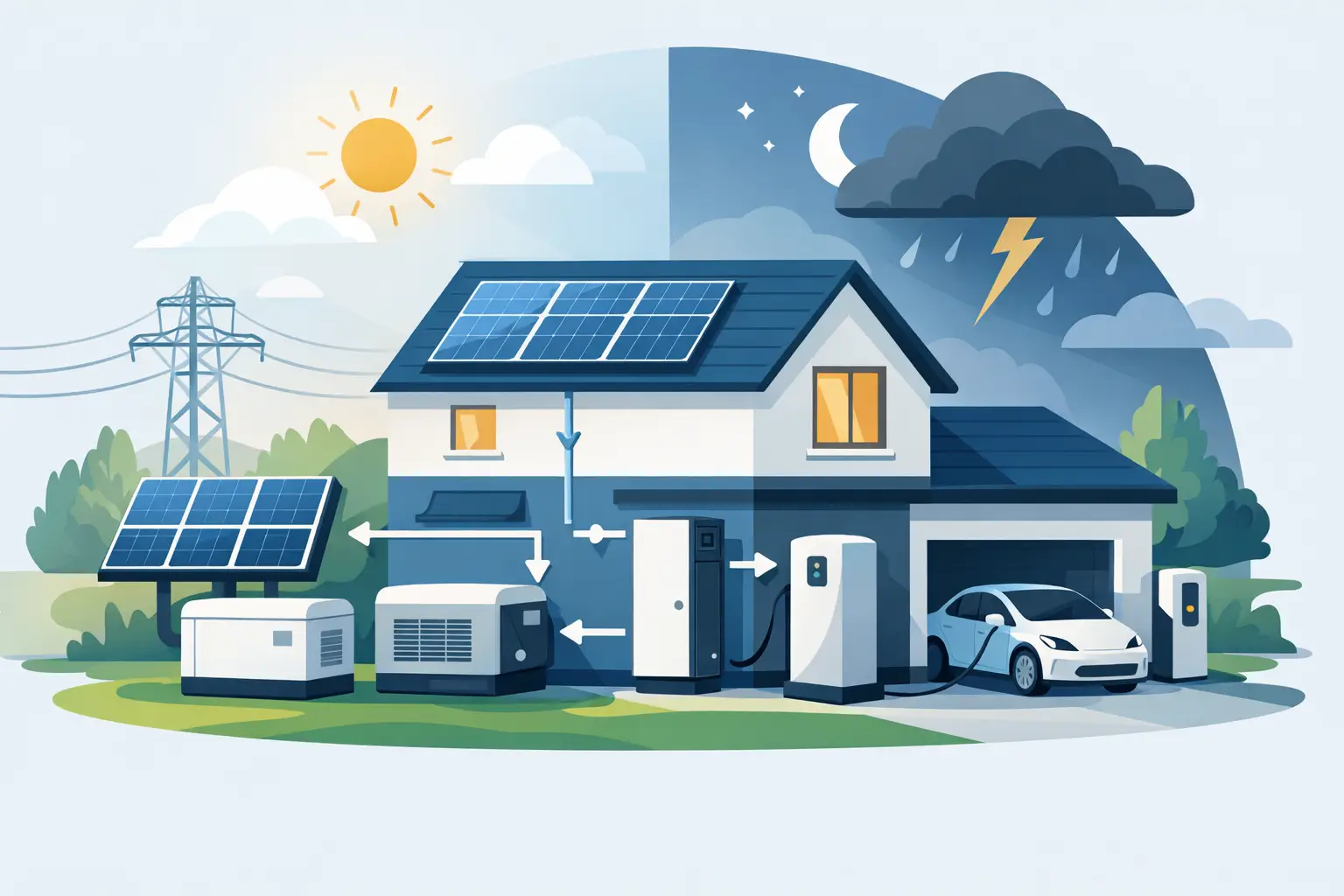
When the power drops in the middle of a storm, most homeowners find out quickly whether they planned for a few essentials or for the whole house. That distinction matters. Whole home backup power solutions are designed to keep your home functioning as a home, not just as a place with one live extension cord and a powered refrigerator.
For some buyers, that means a standby generator that starts automatically within seconds. For others, it means a
portable generator with a transfer switch, or a battery system that can carry key loads quietly for several hours. The right choice depends on what you want to run, how often outages happen, how much automation you expect, and how much installation work you are comfortable with.
What whole home backup power solutions actually cover
A lot of products are marketed as “home backup,” but that can mean very different things. A small inverter generator might keep a fridge, freezer, and a few lights going. That is useful backup power, but it is not the same as supporting central air, an electric water heater, a well pump, kitchen circuits, laundry equipment, and multiple rooms at once.
True whole home backup power solutions are built around load management. In plain terms, they are sized and installed to support either your entire electrical panel or a carefully selected set of large and small circuits that let the house operate normally. In larger homes, even a whole-home system may use smart load shedding to prioritize critical appliances when demand spikes.
That is why shopping by wattage alone can lead to a bad decision. A unit may look powerful on paper, but startup surges from HVAC systems, sump pumps, and well pumps can change the picture fast.
The three main types of whole home backup power solutions
Standby generators
For most homeowners who want the closest thing to automatic, utility-style backup, standby generators are the standard choice. These systems are permanently installed outside the home and connected to a transfer switch. When utility power fails, the system senses the outage, starts the generator, and transfers the load automatically.
The big advantage is convenience. You do not need to wheel anything out, refuel it in the rain, or manually connect cords. Standby units usually run on natural gas or propane, which also removes the short runtime problem that portable gasoline generators often have.
The trade-off is cost. Equipment, transfer switch hardware, gas connection work, pad installation, and electrical labor make standby systems the most expensive option upfront. They also need regular maintenance, and natural gas performance can vary slightly under extreme demand events depending on local utility conditions.
Portable generators with transfer equipment
A portable generator can be part of a practical home backup setup if it is matched with
the right inlet, interlock kit, or transfer switch. For buyers trying to control costs, this route often offers strong value. You can power selected circuits, and with larger portable models, some homes can cover a substantial portion of daily needs.
That said, portable systems ask more from the owner. You need to store fuel safely, move the unit into position, start it manually unless you have an electric-start model, and monitor refueling intervals. Noise is usually higher than with a battery system and often higher than with a quality standby unit.
This option works best for homeowners who can tolerate a more hands-on process and who do not need fully automatic backup.
Battery backup systems
Battery systems appeal to buyers who want quiet operation, no engine maintenance, and no on-site fuel combustion. They are especially attractive in areas with short outages, time-of-use rate concerns, or solar integration goals.
The catch is scale. Running a few essential circuits from batteries is realistic. Running an entire large home, especially one with electric heat, central AC, or heavy appliance demand, gets expensive quickly. Battery backup can absolutely be part of whole home backup power solutions, but the price and capacity requirements rise fast as you move from “critical loads” to “whole panel” performance.
For some households, a hybrid setup makes more sense than going all-in on batteries alone. A battery can cover short outages instantly and quietly, while a generator handles longer duration events.
How to size a system without guessing
The most common buying mistake is confusing running watts with real household demand. A whole-home decision should start with your actual loads, not with a marketing label.
First, identify what must run during an outage. Refrigeration, HVAC, medical equipment, internet, lighting, sump pumps, well pumps, and cooking appliances usually top the list. Then separate those from nice-to-have loads like a second AC unit, laundry, or workshop tools.
Next, account for starting watts. Motors and compressors pull more power at startup than during normal operation. That brief surge is often what determines whether a generator handles the load cleanly or stalls under pressure.
You also need to look at fuel type and runtime expectations. A generator that meets your wattage target but requires frequent gasoline refills may not fit your backup plan if outages in your area commonly last a day or more.
For many homeowners, the best path is not sizing for every single appliance at once. It is choosing a system that covers your real outage priorities and uses load management for less critical items.
Fuel choice changes the ownership experience
Fuel is not just a spec. It changes storage, runtime, maintenance, and day-to-day practicality.
Natural gas is often the easiest fuel for standby systems if your home already has service. It supports long-duration operation without refueling, which is a major advantage during extended outages. Propane also works well, stores longer than gasoline, and is common in rural areas where natural gas lines are not available.
Gasoline is accessible and familiar, but it is less ideal for long-term emergency storage unless you manage fuel rotation carefully. Diesel offers strong efficiency and durability in some applications, though it is more common in larger or commercial-style systems than in average suburban homes.
There is no universal winner here. A suburban home with natural gas service has different options than a rural property with a well pump and no gas line.
Installation and safety matter as much as the generator itself
A powerful generator is only part of the system. The switchgear, inlet configuration, grounding approach, and code-compliant installation determine whether the setup is safe and usable when you need it most.
Backfeeding a home through a dryer outlet is not a backup strategy. It is dangerous and can put utility workers, your equipment, and your home at risk. Proper transfer equipment isolates your home from the grid during generator use and allows selected circuits or the whole panel to be powered correctly.
Placement matters too. Portable and standby generators both require proper outdoor clearance for exhaust and cooling. Carbon monoxide risk is serious, and every homeowner should treat it that way. If you are considering a portable generator as part of your backup plan, think beyond power output and include safe placement, weather protection, cord routing, and startup procedure.
Which setup fits which homeowner?
If your priority is automatic operation and minimal hassle, a standby generator is usually the strongest fit. It costs more, but it delivers the least friction during an actual outage.
If your priority is affordability and you are comfortable with a manual process, a portable generator connected through proper transfer equipment can be a smart middle ground. This is often the most practical option for homeowners who want strong backup capability without committing to a full standby install.
If your priority is quiet backup, low maintenance, and possible solar pairing, battery storage deserves a close look. Just be realistic about what you want to run and for how long.
Some buyers will also benefit from a layered approach. For example, a battery system can support sensitive electronics and overnight essentials, while a generator covers HVAC, pumps, and long outage duration. That kind of setup is not right for every budget, but it solves more real-world problems than either system alone in certain homes.
What to compare before you buy
Before you commit, compare systems based on usable output, surge handling, fuel source, runtime, transfer method, noise, maintenance schedule, and service support. Warranty matters, but so does parts availability and installer quality.
This is also where honest guidance matters more than brand hype. A generator that looks oversized may still be a poor match if fuel logistics are weak, the outlet configuration is wrong, or your panel setup requires additional work. At TopGeneratorsOnline, that is the kind of detail worth paying attention to because it affects ownership long after the initial purchase.
The best backup setup is not the one with the highest wattage or the flashiest feature list. It is the one that keeps your specific home safe, functional, and manageable when the grid stops doing its job. If you start with your loads, your outage patterns, and your tolerance for manual setup, the right solution becomes much easier to spot.