As an Amazon Associate I earn from qualifying purchases.
A good 4500 watt generator can be a practical middle ground when you need more power than a small camping generator but do not want the size, fuel consumption, and weight of a large portable unit.
For RV owners, a generator in this class can provide enough capacity for many common camping loads, including an RV air conditioner, refrigerator, lights, electronics, and smaller appliances when the total electrical demand is managed carefully. For homeowners, these generators are better suited to essential-load backup than whole-house power. They can also be useful for tailgating, outdoor events, emergency power, and jobs around the property.
The important detail is that not every generator marketed around 4,500 watts produces the same amount of continuous power. Some models deliver 4,500 starting watts but considerably less running wattage, while others exceed 4,500 peak watts and are better described as 5,000-watt generators.
For this 2026 guide, I focused on portable inverter generators and dual-fuel models that make sense for RV, outdoor, and emergency-power applications. I also separated verified specifications from claims that should not be treated as confirmed data.
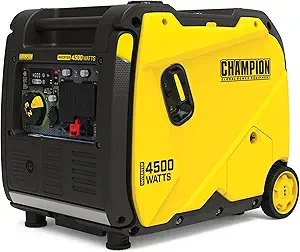
1. Champion Power Equipment 4500-Watt Inverter Generator
Check the Champion 4500W generator on Amazon
The Champion Power Equipment 4500-watt inverter is a straightforward gasoline option for buyers who want RV-ready power, inverter technology, and a relatively simple setup.
The current Champion 201318 specification lists 4,500 starting watts and 3,500 running watts, rather than the 3,650 running watts shown in the older version of this article. It uses a 212cc four-stroke engine, has a 2.25-gallon gasoline tank, and is rated at 61 dBA. Champion lists up to 14 hours of runtime at 25% load.
Key specifications
- Starting watts: 4,500W
- Running watts: 3,500W
- Engine: 212cc four-stroke
- Fuel: Gasoline
- Fuel tank: 2.25 gallons
- Runtime: Up to 14 hours at 25% load
- Noise rating: 61 dBA
- Voltage: 120V
- RV outlet: 120V 30A TT-30R
- Inverter: Enclosed
- THD: Less than 3%
- Start type: Recoil
- Parallel capable: Yes
- CO protection: CO Shield
- Warranty: 3-year limited warranty with lifetime technical support
- Weight: 92.2 lb
The generator also includes an IntelliGauge with power meter, Economy Mode, low-oil shutdown, covered outlets, wheels, and a fold-down handle.
Why choose the Champion 4500W?
This model makes sense if you want a gasoline-only inverter generator with an RV-ready 30A outlet and do not need dual-fuel capability.
One important correction from the previous version of this article is weight. The current Champion 201318 specification is 92.2 pounds, not 75 pounds. It is also a recoil-start model rather than an electric-start generator.
For electronics, Champion specifies inverter output with less than 3% THD. That makes it a better fit for laptops, televisions, chargers, and other sensitive electronics than a conventional open-frame generator without regulated inverter output.
2. WEN DF451i 4500-Watt Dual-Fuel Inverter Generator
Check the WEN DF451i on Amazon
The WEN DF451i is one of the more interesting choices if you want a genuine 4500-watt dual-fuel inverter generator.
It can operate on gasoline or propane, giving RV owners and homeowners more flexibility during an extended outage. WEN rates the unit at 4,500 surge watts and 3,500 rated watts on gasoline. On propane, it produces 4,500 surge watts and 3,150 running watts.
Key specifications
- Gasoline starting watts: 4,500W
- Gasoline running watts: 3,500W
- Propane starting watts: 4,500W
- Propane running watts: 3,150W
- Engine: 212cc four-stroke OHV
- Fuel: Gasoline and propane
- Fuel tank: 2.2 gallons
- Runtime: About 8.5 hours on gasoline and 9 hours on a 20-lb propane tank at half load
- Noise rating: 58 dBA at 25% load from 22 feet
- Start: Keyless electric start with recoil backup
- RV outlet: 120V NEMA TT-30R
- Parallel capable: Yes
- CO protection: CO shutoff system
- Digital display: Yes
- Warranty: 3-year limited warranty
- Weight: About 100 lb
The DF451i also uses Auto Fuel Selection Technology, which can automatically switch from propane to gasoline to extend operation. WEN lists its inverter output as suitable for sensitive electronics.
Why choose the WEN DF451i?
The main attraction is fuel flexibility.
If gasoline becomes difficult to obtain during a power outage, propane gives you another option. For RV owners, propane can also be convenient because many campers already carry propane for cooking and other appliances.
The 58 dBA rating is another advantage for camping, although noise specifications should always be compared carefully because manufacturers do not necessarily test at identical distances and loads.
3. Westinghouse iGen5000DFc Dual-Fuel Inverter Generator
Check the Westinghouse iGen5000DFc on Amazon
The Westinghouse iGen5000DFc deserves a place in a 4500-watt buying guide even though its gasoline output is actually higher than 4,500 watts.
This is one of the most important corrections to the original article.
The iGen5000DFc produces 5,000 peak watts and 3,900 running watts on gasoline, while propane output is rated at 4,500 peak watts and 3,500 running watts. In other words, it is better described as a 5,000-watt-class generator that overlaps the 4,500-watt category.
Key specifications
- Gasoline peak watts: 5,000W
- Gasoline running watts: 3,900W
- Propane peak watts: 4,500W
- Propane running watts: 3,500W
- Engine: 224cc OHV four-stroke
- Fuel: Gasoline and propane
- Gasoline tank: 3.4 gallons
- Gasoline runtime: Up to 18 hours at 25% load
- Propane runtime: Up to 22 hours at 25% load
- Noise rating: As low as 52 dBA
- Start: Electric, remote, and recoil
- RV outlet: 120V TT-30R
- THD: ≤3%
- CO protection: Automatic CO shutdown
- Parallel capable: Yes
- Weight: 105.8 lb
- Warranty: 3-year limited residential warranty
The generator also includes a telescoping handle, never-flat wheels, an LED data center, Economy Mode, USB ports, automatic low-oil shutdown, and a wireless remote.
Why choose the Westinghouse iGen5000DFc?
If your priority is more usable running capacity, the Westinghouse has an advantage over many traditional 4500-watt models.
The additional running wattage can be useful when several appliances are operating at the same time. The larger fuel tank also helps explain its long gasoline runtime.
However, there is an important limitation: this is a 120V generator. It should not be treated as a substitute for a 240V generator simply because its peak output reaches 5,000 watts. A 120V generator cannot power equipment that specifically requires 240V output.
4. ERAYAK 4500W Portable Inverter Generator
Check the ERAYAK 4500W generator on Amazon
The ERAYAK 4500W generator can be attractive to shoppers looking for a lower-cost inverter generator, but this is one product where it is important not to confuse estimated specifications with manufacturer-verified specifications.
The previous version of this guide listed approximate engine size, fuel capacity, runtime, noise, and running wattage as though they were confirmed specifications. That information has been removed here rather than presenting estimates as facts.
What to check before buying
When considering an ERAYAK 4500W listing, check the current Amazon product page for:
- Starting wattage
- Rated/running wattage
- Engine displacement
- Fuel tank capacity
- Published runtime and test load
- Noise rating and test distance
- Total harmonic distortion
- CO detection or automatic shutdown
- RV-ready TT-30R outlet
- Parallel capability
- Warranty and customer support
- Current model number
Why consider an ERAYAK?
The main reason to consider this type of generator is value.
However, when buying a generator for emergency use, the lowest purchase price should not be the only consideration. A generator may remain unused for months and then become extremely important during a storm or outage. Warranty coverage, parts availability, safety systems, and documented specifications are therefore worth considering alongside price.
If the current listing does not clearly document an important specification, treat that as a reason to investigate further rather than assuming the number.
5. AMERISUN 4500W Gas Inverter Generator
Check the AMERISUN 4500W generator on Amazon
The AMERISUN 4500W is another budget-oriented option, but the same rule applies: do not rely on generic specifications from similar generators.
The earlier version of this article estimated its engine size, fuel tank, runtime, noise level, and running wattage. Those estimates have been removed because a buying guide should distinguish between published specifications and assumptions based on similar products.
What to verify before ordering
Check the current Amazon listing for:
- Peak/starting watts
- Rated/running watts
- Engine displacement
- Gasoline capacity
- Runtime at a stated load
- Noise rating
- THD
- CO shutdown system
- Outlet configuration
- RV compatibility
- Parallel capability
- Warranty
- Replacement parts and support
Why consider the AMERISUN?
The appeal is straightforward: buyers who need portable gasoline power may find it useful if the current model offers the right combination of output and price.
But if you are purchasing a generator primarily for emergency backup, documented specifications and support should carry more weight than a small difference in purchase price.
4500 Watt Generator Comparison for 2026
| Generator | Fuel | Starting Watts | Running Watts | Engine | Runtime | Noise | RV Ready | Start |
|---|---|---|---|---|---|---|---|---|
| Champion 4500W Inverter | Gas | 4,500W | 3,500W | 212cc | Up to 14 hr @ 25% load | 61 dBA | Yes | Recoil |
| WEN DF451i | Gas/Propane | 4,500W | 3,500W gas / 3,150W propane | 212cc | 8.5 hr gas / 9 hr propane @ 50% | 58 dBA @ 25% | Yes | Electric/Recoil |
| Westinghouse iGen5000DFc | Gas/Propane | 5,000W gas / 4,500W propane | 3,900W gas / 3,500W propane | 224cc | Up to 18 hr gas / 22 hr propane @ 25% | As low as 52 dBA | Yes | Electric/Remote/Recoil |
| ERAYAK 4500W | Gas | Verify listing | Verify listing | Verify listing | Verify listing | Verify listing | Verify listing | Verify listing |
| AMERISUN 4500W | Gas | Verify listing | Verify listing | Verify listing | Verify listing | Verify listing | Verify listing | Verify listing |
The Champion specifications above come from Champion’s current product documentation; WEN’s figures come from the current DF451i product information; and Westinghouse’s figures come from the current iGen5000DFc specifications.
How to Choose the Right 4500 Watt Generator in 2026
1. Look at Running Watts First
One of the easiest mistakes is to focus only on the large number printed in the product name.
Starting watts are the temporary extra watts available when an appliance with a motor starts. Running watts, also called rated watts, are the amount of power the generator can continuously provide.
For example, the Champion produces 4,500 starting watts but 3,500 running watts. The WEN produces 3,500 running watts on gasoline and 3,150 on propane.
Before buying, add up the running wattage of the appliances you expect to use and then account for motor-starting requirements.
2. Decide Between Gasoline and Dual Fuel
Gasoline-only generators are generally straightforward and can be lighter.
Dual-fuel generators add propane as another fuel source. That can be particularly useful during long power outages because you can keep propane cylinders stored for emergency use.
The WEN DF451i and Westinghouse iGen5000DFc both support gasoline and propane.
Remember that propane usually produces slightly less running power than gasoline on these models.
3. Make Sure the Generator Is Actually RV Ready
If you are buying a generator for an RV, look for a 120V TT-30R 30-amp RV outlet.
This is different from simply having a household 120V outlet.
The Champion, WEN, and Westinghouse models discussed above include an RV-ready outlet.
You should also check your RV’s electrical requirements and the starting demand of its air conditioner.
4. Don’t Compare Noise Ratings Without Checking the Test Conditions
A generator advertised at 52 dBA is not automatically 6 or 10 dBA quieter in real-world use than another generator advertised at 58 or 61 dBA.
The measurement distance, electrical load, environment, and test method matter.
For example, WEN specifies 58 dBA at 25% load from 22 feet, while Champion specifies 61 dBA for its 4500W inverter. Westinghouse lists 52 dBA for the iGen5000DFc, but the conditions are not presented in exactly the same way.
For RV camping, noise matters, but it should be evaluated alongside output, fuel economy, weight, and actual campsite requirements.
5. Inverter Technology Is Important for Electronics
An inverter generator is generally a better choice when you plan to power sensitive electronics such as:
- Laptops
- Televisions
- Smartphones and chargers
- Networking equipment
- Modern refrigerators
- Battery chargers
- Other electronic devices
The Champion and Westinghouse models publish THD specifications of less than or equal to 3%, while WEN specifically markets the DF451i as producing clean power for sensitive electronics.
Still, always verify the specifications of the exact generator model you are buying.
6. Consider Portability Carefully
A generator producing around 4,500 watts is not necessarily lightweight.
The Champion 201318 weighs 92.2 pounds, the WEN DF451i weighs about 100 pounds, and the Westinghouse iGen5000DFc weighs 105.8 pounds.
If you expect to move the generator frequently, look for:
- Wheels
- Telescoping handles
- Fold-down handles
- Balanced carrying points
- A compact enclosure
For RV use, portability becomes particularly important because the generator may need to be unloaded and positioned at every campsite.
7. Understand What a 4500 Watt Generator Can Actually Power
A generator in this class can be useful for essential loads, but it does not automatically mean you can power everything in your house.
Depending on the individual wattage requirements, you may be able to operate combinations of:
- Refrigerator
- Freezer
- Lights
- Television
- Internet equipment
- Small kitchen appliances
- Battery chargers
- Sump pump
- Selected heating or cooling equipment
Large electric water heaters, electric dryers, central air-conditioning systems, large well pumps, and other high-demand equipment can exceed the generator’s available capacity.
Always calculate the actual electrical load rather than assuming a 4,500-watt rating will cover your entire home.
4500 Watt Generator Safety
A carbon monoxide shutdown system is an important safety feature, but it does not make a portable generator safe to use inside a house, garage, basement, RV, or other enclosed space.
Portable generators must be operated outdoors and positioned so exhaust cannot enter occupied areas. Champion specifically warns that CO Shield is not a substitute for safe operation and says generators should be used outdoors and away from occupied buildings.
Follow these basic rules:
- Never operate a gasoline or propane generator indoors.
- Never run one inside an attached garage.
- Keep exhaust away from doors, windows, and vents.
- Follow the clearance requirements in the owner’s manual.
- Keep the generator dry and protected from direct precipitation as specified by the manufacturer.
- Allow the engine to cool before refueling.
- Never connect a portable generator directly to a home’s electrical wiring through a wall outlet.
- Use a properly installed transfer switch or other approved connection method when connecting generator power to a home’s electrical system.
- Keep fuel stored according to local regulations and manufacturer instructions.
Which 4500 Watt Generator Makes Sense for Different Buyers?
| Buyer | Model to Consider | Main Reason |
|---|---|---|
| Gasoline-only RV user | Champion 4500W | 120V 30A RV outlet and inverter power |
| Dual-fuel RV owner | WEN DF451i | Gasoline/propane flexibility and electric start |
| Higher-output buyer | Westinghouse iGen5000DFc | 3,900W running output on gasoline |
| Budget-focused buyer | ERAYAK 4500W | Check current listing for value and verified specifications |
| Simple budget option | AMERISUN 4500W | Verify current specifications and warranty before purchase |
| Emergency essential-load backup | Champion, WEN, or Westinghouse | Established specifications and safety features |
4500 Watt Generator FAQ
Is a 4500 watt generator enough to run an RV AC?
It can be, depending on the RV air conditioner’s running and startup requirements and what other appliances are operating at the same time. A generator’s running wattage matters more than its peak number once the equipment is operating. Always check the air conditioner’s actual electrical requirements before purchasing.
What can a 4500 watt generator run during a power outage?
A properly sized 4500-watt-class generator can handle many essential household loads, such as a refrigerator, freezer, lights, electronics, and selected smaller appliances. Whether it can run a pump, air conditioner, or other motor-driven appliance depends on that equipment’s starting and running wattage.
Is a 4500 watt generator better than a 5000 watt generator?
Not necessarily. Compare the running wattage, fuel type, noise, weight, outlets, safety features, and runtime. The Westinghouse iGen5000DFc, for example, produces 5,000 peak and 3,900 running watts on gasoline, while several 4500-watt-class generators provide around 3,500 running watts.
Are inverter generators safe for sensitive electronics?
Inverter generators are generally designed to produce cleaner, more stable electrical output than traditional open-frame generators. However, check the manufacturer’s published THD specification for the exact model you are considering.
Can I use a 4500 watt generator inside my garage?
No. Never operate a portable gasoline or propane generator inside a garage, even if the garage door is open. Carbon monoxide can build up quickly and can be fatal. Use the generator outdoors and follow the manufacturer’s placement instructions.
Can a 4500 watt generator power a whole house?
Usually not. A generator in this class is better considered an essential-load backup generator. Whole-house power typically requires a much larger generator and an appropriate electrical installation.
Can a 4500 watt generator run a 240V appliance?
Not unless the specific generator provides the required 240V output. Wattage alone does not determine voltage capability. The Westinghouse iGen5000DFc, for example, is a 120V generator and does not provide 240V output.
Final Takeaways: Best 4500 Watt Generators for 2026
The best generator depends on what you actually need rather than simply choosing the model with the biggest number on the label.
The Champion 4500W Inverter is a straightforward gasoline option with a 120V 30A RV outlet, inverter output, CO Shield, and a 3,500-watt running capacity.
The WEN DF451i is particularly interesting for shoppers who want dual-fuel operation, electric starting, an RV-ready outlet, and relatively quiet operation.
The Westinghouse iGen5000DFc moves into a higher-output class, with 3,900 running watts on gasoline, dual-fuel capability, remote start, RV compatibility, and a long published runtime.
For the ERAYAK and AMERISUN models, the safest approach is to verify the exact current Amazon listing rather than relying on estimated specifications.
Before ordering any 4500 watt generator, check five things first:
- Running watts, not just starting watts.
- Voltage and outlet configuration for your equipment.
- Fuel type and expected runtime.
- CO safety system and published operating instructions.
- Warranty, support, and availability of replacement parts.
Finally, remember that a portable generator is an outdoor engine-powered appliance. Even the best CO shutdown technology cannot replace proper placement and ventilation. Choose a generator based on your actual electrical loads, operate it exactly as instructed by the manufacturer, and use the available power conservatively.