As an Amazon Associate I earn from qualifying purchases.
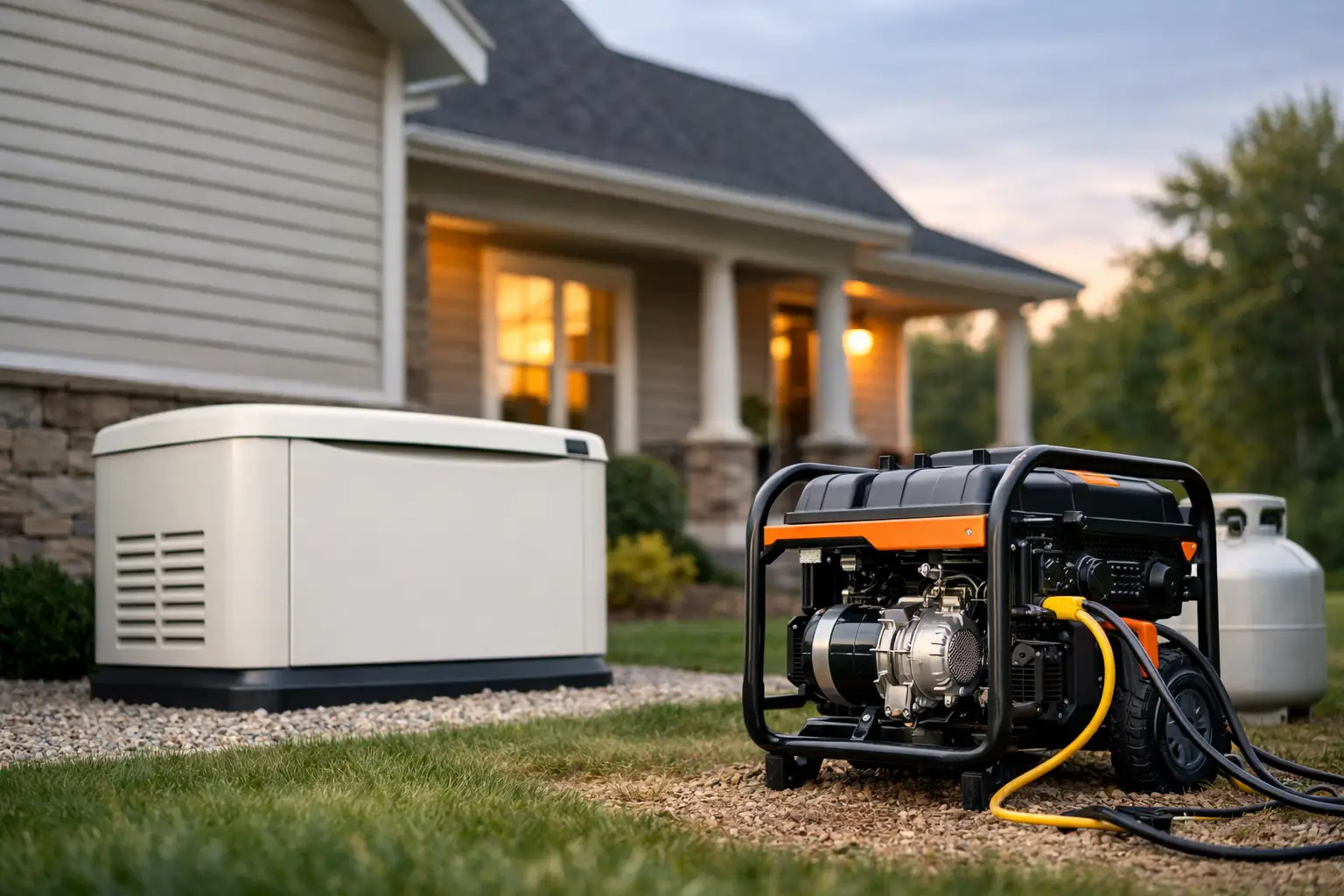
Power outages can last much longer than expected, especially after hurricanes, severe storms, winter weather, or other major disruptions. For homeowners who want more than a few hours of emergency power, a multi-fuel generator can provide an important advantage: the ability to choose between different fuel sources when one option is unavailable or inconvenient.
Depending on the model, a multi-fuel generator may operate on gasoline and propane, while tri-fuel generators add natural gas to the mix. That extra flexibility can be especially useful during extended outages because gasoline, propane, and natural gas each have different storage and availability advantages.
For 2026, high-output portable generators continue to be popular for home backup, RV use, workshops, job sites, and emergency preparedness. However, choosing the right model involves more than looking at the highest wattage number.
Below, I compare five multi-fuel generators and explain what to look for before buying one.
Multi-Fuel Generators at a Glance
| Model | Fuel Types | Best For | Starting Type |
|---|---|---|---|
| DuroMax XP13000HXT | Gasoline, Propane, Natural Gas | Whole-home backup and heavy-duty use | Electric, recoil, remote |
| Westinghouse 14500W Tri-Fuel | Gasoline, Propane, Natural Gas | High-output home backup | Electric/remote |
| WEN TF1450X | Gasoline, Propane, Natural Gas | Flexible emergency backup | Electric |
| Westinghouse 12500W Tri-Fuel | Gasoline, Propane, Natural Gas | Home, RV and emergency use | Electric/remote |
| Westinghouse 13500W Tri-Fuel | Gasoline, Propane, Natural Gas | Larger homes and job sites | Electric/remote |
Important: Generator output varies by fuel. Always size the generator according to the running and starting wattage available on the fuel you actually plan to use.
1. DuroMax XP13000HXT – High-Output Tri-Fuel Generator for Home Backup
Check Amazon Price Click Here!
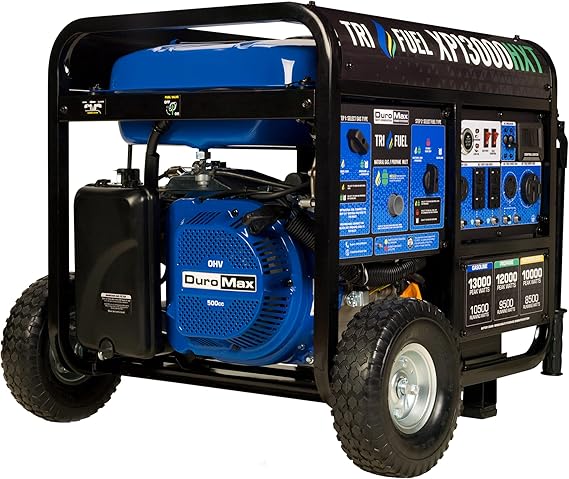
The DuroMax XP13000HXT remains one of the most capable portable tri-fuel generators for homeowners who want the flexibility of gasoline, propane, and natural gas.
Its 500cc OHV engine produces 13,000 peak watts and 10,500 running watts on gasoline. Output decreases when using other fuels, with 12,000 peak/9,500 running watts on propane and 11,000 peak/8,500 running watts on natural gas. That difference is important because a generator’s advertised maximum wattage does not represent the output available in every fuel mode.
The XP13000HXT also supports 120V and 240V operation, making it suitable for applications that require more than standard household receptacles. It includes electric start, recoil backup, and remote start capability.
Key Features
- Tri-fuel operation with gasoline, propane, and natural gas
- 13,000 peak and 10,500 running watts on gasoline
- 12,000 peak and 9,500 running watts on propane
- 11,000 peak and 8,500 running watts on natural gas
- 500cc 4-stroke OHV engine
- Electric, recoil, and remote starting
- CO Alert automatic shutdown technology
- 120V and 240V capability
- 50A outlet for higher-power applications
- Transfer-switch-ready design
DuroMax lists a natural gas requirement of 6.0–9.0 inches of water column and up to 225,000 BTU at full load, so homeowners planning to use natural gas should make sure their existing installation can support the generator.
Best For
Homeowners who want a high-output portable generator with three fuel options and the ability to connect it to a properly configured home backup system.
2. Westinghouse 14500W Tri-Fuel Generator – High Output for Larger Backup Loads
Check Amazon Price Click Here!
The Westinghouse 14500W tri-fuel generator is designed for buyers who want substantial portable power while retaining the option to use gasoline, propane, or natural gas.
The current Westinghouse 14,500-watt class provides 14,500 peak watts and 11,500 running watts on gasoline, with lower output available in propane and natural gas modes. The unit uses a large open-frame engine and is designed around 120V/240V operation.
One reason this type of generator is attractive for home backup is the combination of high running wattage and a 240V connection. That makes it possible to supply appropriately sized household circuits through a correctly installed transfer switch or interlock system.
Key Features
- Gasoline, propane, and natural gas operation
- Up to 14,500 peak watts
- Up to 11,500 running watts on gasoline
- 120V/240V operation
- Remote electric start
- Large fuel tank
- Digital information display
- Transfer-switch-ready connection
- Heavy-duty wheels and handles
- CO safety protection
Westinghouse’s current generator documentation also lists low harmonic distortion on applicable models, although buyers should check the exact model documentation before assuming a specific THD rating.
What to Consider
A generator this large is not designed to be carried around like a compact inverter generator. Weight, noise, fuel consumption, and storage space all become more important as output increases.
It also does not mean that every appliance in a home can run simultaneously. Large loads such as central air conditioning, electric water heaters, dryers, ovens, and well pumps can quickly consume available capacity.
Best For
Homeowners who need substantial portable backup power and have the electrical infrastructure necessary to use a high-output generator.
3. WEN TF1450X – Flexible Tri-Fuel Backup at a Competitive Price
Check Amazon Price Click Here!
The WEN TF1450X is another high-output tri-fuel generator worth considering in 2026. It is designed to run on gasoline, propane, or natural gas and supports both 120V and 240V operation.
WEN lists 14,500 surge watts and 11,500 running watts on gasoline, 12,500 surge and 10,300 running watts on propane, and 10,500 surge and 8,750 running watts on natural gas.
This makes the TF1450X particularly interesting for homeowners who want three fuel choices without moving into the much larger standby-generator category.
Key Features
- Gasoline, propane, and natural gas operation
- 14,500 peak watts on gasoline
- 11,500 running watts on gasoline
- 10,300 running watts on propane
- 8,750 running watts on natural gas
- 500cc 4-stroke OHV engine
- Electric start
- 120V/240V output
- Transfer-switch-ready design
- WEN Watchdog CO shutdown sensor
- 8.2-gallon fuel tank
- Wheel kit and handles
WEN states that the 8.2-gallon tank can provide up to 12 hours of runtime at half load, although actual runtime will vary with the load, fuel type, temperature, altitude, and operating conditions.
Why Tri-Fuel Matters
The biggest advantage here is not simply the wattage. It is having multiple ways to keep the generator running.
Gasoline can be convenient when it is readily available, propane is easier to store for extended periods, and natural gas can eliminate the need to continually refill a portable fuel tank when a suitable household gas connection is available.
Best For
Homeowners who want high output and three fuel choices while keeping the purchase relatively straightforward.
4. Westinghouse 12500W Tri-Fuel Generator – Flexible Power for Home and RV Use
Check Amazon Price Click Here!
The Westinghouse 12,500-watt tri-fuel generator provides a slightly smaller alternative to the largest models while still offering gasoline, propane, and natural gas capability.
The current WGen9500TFc produces 12,500 peak watts and 9,500 running watts on gasoline, 11,200 peak and 8,500 running watts on propane, and 9,500 peak and 7,500 running watts on natural gas.
It also includes a 50A outlet, 120V/240V capability, remote start, electric start, and a fuel gauge.
Key Features
- Tri-fuel operation
- Gasoline, propane, and natural gas
- 12,500 peak / 9,500 running watts on gasoline
- 11,200 peak / 8,500 running watts on propane
- 9,500 peak / 7,500 running watts on natural gas
- 6.6-gallon fuel tank
- Remote start
- Electric and recoil start
- 120V/240V output
- Transfer-switch-ready outlet
- CO sensor and automatic shutdown
- RV-ready 14-50R outlet
Westinghouse lists up to 12 hours of gasoline runtime under its specified test conditions, although actual runtime depends heavily on the connected load.
Best For
Homeowners, RV owners, and preparedness-minded buyers who want tri-fuel capability without moving all the way into the largest portable generator class.
5. Westinghouse 13500W Tri-Fuel Generator – A Strong Middle Ground for Home Backup
Check Amazon Price Click Here!
The Westinghouse 13,500-watt class generator offers a useful middle ground between the 12,500-watt and larger 14,500-watt models.
The current WGen10500TFc provides 13,500 peak watts and 10,500 running watts on gasoline, 12,500 peak and 9,500 running watts on propane, and 10,000 peak and 8,500 running watts on natural gas.
It has a 500cc 4-stroke OHV engine, remote start, electric start, recoil start, 120V/240V capability, and a 9.5-gallon gasoline tank.
Key Features
- Gasoline, propane, and natural gas
- 13,500 peak / 10,500 running watts on gasoline
- 12,500 peak / 9,500 running watts on propane
- 10,000 peak / 8,500 running watts on natural gas
- 500cc OHV engine
- Remote start key fob
- Electric and recoil start
- 9.5-gallon fuel tank
- 120V/240V operation
- 50A RV-ready outlet
- Transfer-switch-ready connection
- CO sensor with automatic shutdown
- GFCI outlets
Westinghouse lists up to 19 hours of runtime on gasoline under its specified conditions, making the large fuel tank one of the more useful features for extended outages.
Best For
Homeowners who want high-output tri-fuel capability, long gasoline runtime, and convenient remote starting without choosing the largest generator available.
Multi-Fuel vs. Dual-Fuel vs. Tri-Fuel Generators
The term “multi-fuel generator” covers several different configurations.
Dual-Fuel Generators
A dual-fuel generator typically operates on:
- Gasoline
- Propane
This is useful for homeowners who want an alternative to gasoline but do not have access to natural gas.
Tri-Fuel Generators
Tri-fuel generators add:
- Gasoline
- Propane
- Natural gas
The additional fuel source can be useful during extended outages because natural gas can be supplied continuously through an appropriate household connection.
However, natural gas generally produces less power than gasoline on the same generator. That is why buyers should always check the running wattage for each fuel rather than relying only on the model’s highest advertised wattage.
How to Choose a Multi-Fuel Generator in 2026
1. Calculate Your Actual Power Requirements
Do not choose a generator simply because it says 10,000, 12,000, or 14,000 watts.
Make a list of the appliances and systems you expect to operate during an outage.
For example:
- Refrigerator
- Freezer
- Sump pump
- Well pump
- Furnace blower
- Lights
- Internet equipment
- Television
- Microwave
- Central air conditioner
- Electric water heater
- Garage door opener
Then determine both the running watts and starting watts.
Motors and compressors can require substantially more power when they start. If the generator cannot handle that temporary surge, it may overload or shut down.
2. Size the Generator for the Fuel You Will Actually Use
This is one of the most important points when comparing tri-fuel generators.
A generator advertised at 13,000 or 14,500 watts does not necessarily deliver that amount continuously on natural gas.
For example, the DuroMax XP13000HXT is rated at 10,500 running watts on gasoline, 9,500 on propane, and 8,500 on natural gas.
If natural gas will be your primary fuel during an outage, use the natural-gas rating when determining whether the generator can handle your intended loads.
3. Check Whether You Need 120V or 240V Power
A generator with 120V/240V capability provides more flexibility for home backup.
This can matter for equipment such as:
- Well pumps
- Larger HVAC equipment
- Certain water heaters
- Workshop equipment
- Transfer switches
- Other 240V household circuits
However, having a 240V outlet does not automatically mean the generator can power every 240V appliance in your house. The generator’s continuous output and the electrical installation still determine what can safely operate.
4. Consider the Transfer Switch or Interlock
If you plan to connect a portable generator to your home’s electrical system, the installation needs to be designed correctly.
A generator should never be connected to a household electrical panel through an improvised connection or by backfeeding a wall outlet.
A properly installed transfer switch or approved interlock system can isolate the home from the utility grid while allowing selected circuits to receive generator power.
For a permanent home setup, have the electrical installation completed according to applicable local requirements by a qualified professional.
5. Pay Attention to CO Safety
Carbon monoxide is one of the biggest dangers associated with portable fuel-burning generators.
CO is colorless and odorless, and dangerous concentrations can build up quickly in enclosed or partially enclosed spaces.
Always operate a portable generator outdoors, well away from doors, windows, vents, and other openings.
CO shutdown technology is useful, but it does not make indoor generator operation safe.
The models in this comparison include CO monitoring or automatic shutdown features, but those features should be treated as an additional safety measure rather than a replacement for proper placement.
6. Think About Fuel Storage
Gasoline, propane, and natural gas each have different advantages.
Gasoline
Gasoline is widely available and usually provides the highest output on a portable generator.
The downside is that long-term storage requires proper fuel management.
Propane
Propane can be stored for longer periods in suitable containers and does not require the same type of fuel rotation as gasoline.
However, output is normally lower than gasoline, and you need enough propane capacity for the expected outage.
Natural Gas
Natural gas can be extremely convenient because the fuel comes through an existing utility connection rather than requiring portable tanks.
The tradeoff is that the generator depends on the availability and capacity of the household natural-gas system. The generator’s required gas pressure and BTU supply also need to be considered.
What About RV Use?
Several of these high-output generators include RV-ready connections, making them useful for travel trailers and larger RVs.
However, bigger does not always mean better for an RV.
A 13,000- or 14,000-watt open-frame generator can provide far more power than many RV owners need. It can also be heavy, loud, and cumbersome to transport.
If portability and noise are your priorities, an inverter generator may be a better category to investigate.
If your primary objective is powering a large RV with multiple high-demand appliances, a high-output portable generator may make more sense.
Are Multi-Fuel Generators Worth It?
For buyers who want flexibility during long power outages, a multi-fuel generator can make practical sense.
The main benefit is not simply having a larger engine. It is having multiple fuel options when circumstances change.
Gasoline may be easiest to use under normal conditions. Propane provides another stored fuel source, while natural gas can offer continuous fuel availability when the household connection remains operational.
The tradeoff is that tri-fuel generators are generally large, heavy, and louder than compact inverter generators. They also require more planning when connecting them to a home’s electrical system.
For that reason, the best generator depends on how you expect to use it rather than simply choosing the model with the highest peak-watt number.
Final Thoughts
The best multi-fuel generator for your home depends on the amount of power you actually need, the fuels available to you, and how you plan to connect and operate the generator.
The DuroMax XP13000HXT provides three fuel options and up to 10,500 running watts on gasoline, while the WEN TF1450X offers similarly high output with gasoline, propane, and natural gas capability.
The Westinghouse models provide several different output levels, including the 12,500-watt and 13,500-watt classes, allowing buyers to choose based on their actual load requirements instead of automatically purchasing the largest available generator.
Before buying, compare the running watts on your preferred fuel, starting-watt requirements, 120V/240V capability, fuel capacity, CO protection, transfer-switch compatibility, physical size, and expected runtime.
Most importantly, don’t size a generator based only on its headline peak wattage. The running wattage available on the fuel you intend to use is the number that matters when you’re trying to keep essential equipment operating during a real outage.
With the right sizing and a properly installed electrical connection, a multi-fuel generator can provide a flexible backup-power solution for your home, RV, workshop, or emergency preparedness plan.