As an Amazon Associate I earn from qualifying purchases.
When you need electricity away from the grid, a solar generator can give you a practical way to keep essential devices running without gasoline, engine noise, or exhaust fumes. These systems combine a rechargeable battery power station with the ability to recharge from solar panels, making them useful for camping, RV travel, emergency preparedness, remote work, and off-grid applications.
The important thing is choosing the right size.
A small 88Wh power station may be enough for phones, lights, and other personal electronics, while a 2,000Wh-class unit can handle much larger loads such as refrigerators, CPAP machines, TVs, tools, and other essential appliances. However, capacity is only part of the equation. You also need to look at continuous output, surge power, solar input, battery chemistry, charging speed, and whether the system can be expanded later.
For 2026, the market has moved strongly toward larger LiFePO4 power stations and faster solar charging. At the same time, smaller lithium-ion models still make sense when portability is the priority.
Below are five solar backup generators from the original lineup, with their specifications and ideal uses updated for 2026.
Best Solar Backup Generators for 2026
| Solar Generator | Best For | Battery Capacity | AC Output |
|---|---|---|---|
| Jackery Solar Generator 300 | Portable electronics and camping | 293.8Wh | 300W |
| EF ECOFLOW DELTA 2 Max | Home emergency backup and off-grid power | 2048Wh | 2400W |
| MARBERO Portable Power Station 88Wh | Emergency kits and small electronics | 88.8Wh | Up to 100W depending on version |
| GRECELL Portable Power Station 300W | Camping and compact backup | 230.88Wh | 330W |
| EF ECOFLOW DELTA 2 + 220W Solar Panel | Off-grid use and solar charging | 1024Wh | 1800W |
What Is a Solar Generator?
A solar generator is essentially a portable battery system that can store electricity and recharge using solar panels.
Unlike a traditional gas generator, it doesn’t burn fuel to produce electricity. There is no gasoline engine, exhaust, or carbon monoxide produced by the power station itself. That makes battery-based solar generators particularly useful when you need backup power for electronics and appliances inside a home.
The term “solar generator” can be a little confusing because the battery does not actually generate electricity from sunlight by itself. The solar panels collect energy from the sun, and the power station stores that energy in its battery.
Most modern systems can also be charged from a wall outlet or a vehicle.
This gives you several ways to keep the battery ready:
- AC wall charging
- Solar panel charging
- 12V vehicle charging
- In some larger systems, additional battery expansion
For emergency preparedness, this flexibility is one of the biggest advantages of a portable power station.
How Much Solar Generator Capacity Do You Need?
Battery capacity is measured in watt-hours (Wh).
Think of watt-hours as the amount of energy the battery can store.
For example, a 1,000Wh power station theoretically has enough stored energy to supply a 100W device for about 10 hours. Real-world runtime will be lower because of inverter losses, conversion efficiency, battery management, and the actual power consumption of the device.
Power output is different.
A power station rated at 300W can generally handle devices whose total power requirements stay below its continuous output rating. A 2,400W unit can operate much larger loads.
This is why you should check both numbers before buying.
General capacity guide
Under 300Wh:
Best for phones, cameras, laptops, lights, small fans, and other electronics.
500–1,000Wh:
A useful middle ground for camping, RV trips, CPAP machines, home-office equipment, refrigerators for limited periods, and emergency essentials.
1,000–2,000Wh:
Better suited to extended outages, larger appliances, RV use, and more demanding off-grid applications.
2,000Wh and above:
Designed for users who need substantially more stored energy, higher output, or expandable backup capacity.
Remember that battery capacity does not tell you exactly how long an appliance will run. A refrigerator, for example, cycles on and off rather than consuming its maximum rated wattage continuously.
Jackery Solar Generator 300
Best for Portable Lightweight Needs
Check Amazon Price Click Here!
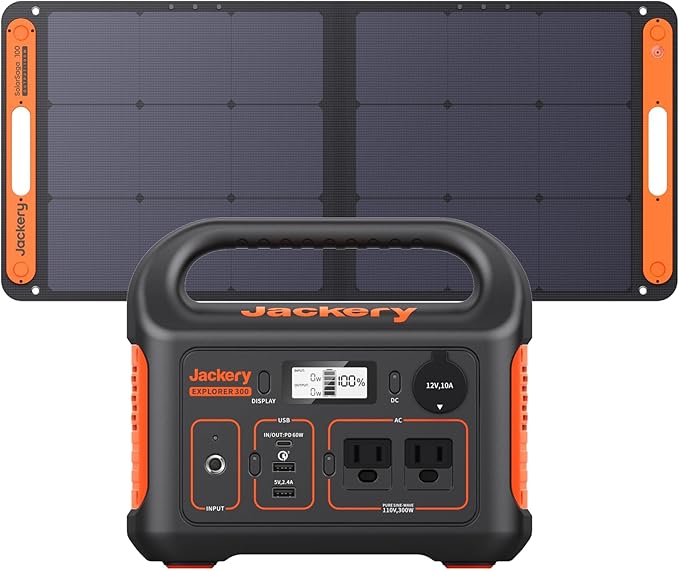
The Jackery Explorer 300 remains a practical option for buyers who want a compact power station without carrying a large battery around.
Jackery lists the Explorer 300 at approximately 293.8Wh of capacity and 300W of continuous AC output, with a pure sine wave inverter. The current specifications also identify it as an NCM lithium-ion battery system rather than a LiFePO4 model.
That distinction matters in 2026 because many newer mid-size power stations now use LiFePO4 batteries with substantially longer cycle-life ratings. The Explorer 300 is therefore better viewed as a lightweight portable power station rather than a long-term high-capacity home backup system.
Key Specifications
- Battery Capacity: Approximately 293.8Wh
- AC Output: 300W
- Surge Output: 500W
- Battery Chemistry: Lithium-ion NCM
- USB-C: 60W Power Delivery
- AC Outlets: 2
- Charging Options: AC, solar, and vehicle
- Weight: Approximately 7.1 pounds
- Best For: Camping, travel, electronics, and emergency essentials
The Explorer 300 can handle devices such as laptops, phones, lights, cameras, portable fans, and other small electronics. Jackery also provides a pure sine wave inverter, which is preferable when powering sensitive electronics.
One advantage is portability. At roughly seven pounds, it is significantly easier to move than the larger 1,000Wh-plus power stations now common in the market.
The trade-off is straightforward: 293Wh is not a lot of stored energy.
It can be an excellent companion for a weekend camping trip, but it isn’t the model I would choose if your primary goal is running a refrigerator throughout a long power outage.
Best Use Cases
The Jackery 300 makes the most sense for:
- Camping
- Road trips
- Laptop charging
- Smartphones and tablets
- Cameras and drones
- LED lighting
- Portable fans
- Small emergency loads
If portability matters more than long runtime, this remains a useful compact option.
EF ECOFLOW DELTA 2 Max
Best for High-Capacity Emergency and Off-Grid Backup
Check Amazon Price Click Here!
The EF ECOFLOW DELTA 2 Max is in a completely different class from the smaller power stations on this list.
It provides 2,048Wh of battery capacity and 2,400W of AC output, giving you enough power for substantially larger appliances and longer runtimes. EcoFlow uses an LFP battery and lists a cycle life of approximately 3,000 cycles to more than 80% capacity.
The unit can also accept up to 1,000W of solar input when using its dual solar-input configuration, giving it a major advantage for people who plan to recharge primarily from solar energy.
Key Specifications
- Battery Capacity: 2048Wh
- Battery Chemistry: LiFePO4 (LFP)
- AC Output: 2400W
- Surge Output: Up to 4800W
- Solar Input: Up to 1000W
- AC Charging: Up to 1800W
- Expandable: Supports additional EcoFlow batteries
- Connectivity: Wi-Fi and Bluetooth
- Weight: Approximately 50 pounds
- Best For: Home backup, RVs, workshops, and off-grid applications
One of the DELTA 2 Max’s strongest features is charging speed.
EcoFlow states that the system can reach 80% charge in approximately 43 minutes when AC and solar charging are combined under the specified conditions. AC-only charging can also reach 80% in about 53 minutes.
That is particularly useful during an emergency when you don’t have much time to prepare.
What Can the DELTA 2 Max Power?
Depending on actual wattage and startup requirements, the DELTA 2 Max can support equipment such as:
- Refrigerators
- Freezers
- CPAP machines
- TVs
- Wi-Fi routers
- Laptops
- Lights
- Fans
- Power tools
- Small kitchen appliances
- Certain portable air conditioners
However, don’t confuse a 2,048Wh power station with an unlimited whole-home generator.
It can provide substantial emergency power for essential circuits and appliances, but runtime depends heavily on what you connect to it. Running a refrigerator, lights, router, and CPAP is very different from trying to operate central air conditioning, electric water heating, an electric range, and other high-demand appliances simultaneously.
For larger home backup requirements, an expandable system or a permanently installed battery backup solution may make more sense.
Why It Works for Off-Grid Use
The combination of LFP battery chemistry, high AC output, expandable capacity, and strong solar input makes the DELTA 2 Max much more suitable for extended off-grid use than the smaller units in this guide.
It is also large enough to serve as a serious emergency power source while remaining portable enough for RVs, workshops, cabins, and other locations where a permanently installed battery system isn’t practical.
MARBERO Portable Power Station 88Wh
Best for Emergency Kits and Basic Electronics
Check Amazon Price Click Here!
If you only need enough backup power for small electronics, a large 1,000Wh power station may be unnecessary.
The MARBERO 88Wh Portable Power Station is designed for exactly that situation.
The current MARBERO specifications list an 88.8Wh lithium-ion battery, multiple USB and AC outputs, and a compact design intended for travel, camping, and emergency use. Depending on the version, the AC output can be rated at up to 80W continuous with a 120W peak.
Key Specifications
- Battery Capacity: 88.8Wh
- Battery Type: Lithium-ion
- AC Output: Up to 80W continuous on the applicable version
- Peak Output: Up to 120W
- USB-A: Multiple outputs
- USB-C: Available
- Recharge Options: AC, vehicle, and compatible solar panel
- Weight: Approximately 2.3–3.2 pounds depending on version
- Best For: Emergency kits, phones, lights, and small electronics
This is not a replacement for a high-capacity home backup battery.
Instead, think of it as a portable emergency power bank with AC capability.
It can be particularly useful in an emergency kit because it is small enough to keep in a closet, vehicle, backpack, or camping bin.
MARBERO also sells versions bundled with solar panels, giving buyers a simple way to recharge the battery when an electrical outlet isn’t available.
What Can It Power?
This type of power station is appropriate for:
- Smartphones
- Tablets
- Small cameras
- LED lights
- Small fans
- GPS devices
- Portable electronics
- Some low-power laptops
Before connecting an appliance, always check its actual wattage against the power station’s continuous output rating.
The biggest advantage here is portability. The biggest limitation is battery capacity.
For a multi-day outage, you will probably want something considerably larger.
GRECELL Portable Power Station 300W
Best Compact Option for Camping and Travel
Check Amazon Price Click Here!
The GRECELL Portable Power Station provides a little more capacity and output than the Jackery 300 while remaining compact enough for camping and road trips.
The current model is listed with a 230.88Wh battery, 330W continuous output, and 600W peak output. GRECELL also specifies a pure sine wave AC output and multiple USB connections.
Key Specifications
- Battery Capacity: 230.88Wh
- AC Output: 330W
- Peak Output: 600W
- USB-C PD: Up to 60W
- USB-A: Multiple fast-charging ports
- AC Outlet: 1
- Solar Charging: Supported
- Car Charging: Supported
- Best For: Camping, travel, emergency lighting, and electronics
The 330W continuous rating gives the GRECELL a little more output headroom than a typical 300W-class power station.
GRECELL says the unit can charge from a wall outlet, solar panel, or vehicle. Its current product page also lists support for powering devices such as laptops, phones, lights, fans, projectors, and some mini refrigerators, provided their rated consumption stays within the unit’s output limit.
Solar Charging
Solar charging is one of the reasons to consider a compact power station like this.
GRECELL lists a maximum solar input of 45W for the current T300S configuration. A compatible solar panel can therefore extend your usable energy when you’re away from the grid, although actual charging time depends heavily on sunlight, panel orientation, temperature, and other conditions.
That makes it useful for camping and travel, but buyers should have realistic expectations.
A 40W solar panel isn’t going to replenish hundreds of watt-hours instantly. Solar charging works best when you treat the panel as a way to gradually replenish the battery throughout the day.
EF ECOFLOW DELTA 2 + 220W Solar Panel
Best All-in-One Option for Off-Grid Applications
Check Amazon Price Click Here!
The EF ECOFLOW DELTA 2 with a 220W solar panel is a more substantial system for buyers who want a power station and solar charging capability in one package.
With a 1,024Wh battery and 1,800W AC output, the DELTA 2 occupies a useful middle ground between compact camping batteries and much larger home backup systems.
Its LFP battery chemistry is also a major advantage for frequent use because LiFePO4 batteries are designed for substantially more charge cycles than many older lithium-ion power stations.
Key Features
- Battery Capacity: 1024Wh
- Battery Chemistry: LiFePO4
- AC Output: 1800W
- Solar Panel: 220W included in the listed bundle
- Expandable: Yes, with compatible EcoFlow batteries
- Best For: Emergency backup, RV use, camping, and off-grid workstations
The included solar panel is particularly useful for buyers who don’t already own compatible panels.
Instead of purchasing a power station now and figuring out solar compatibility later, the bundle provides a more straightforward starting point.
Who Should Consider It?
The DELTA 2 makes sense for someone who needs more than a 300Wh portable power station but doesn’t necessarily need a 2,000Wh system.
It can be useful for:
- Refrigerators during outages
- CPAP machines
- Home-office equipment
- Wi-Fi equipment
- TVs
- Fans
- Lights
- Laptops
- Camping equipment
- RV appliances within its power limits
As with every portable power station, the actual runtime depends on the load.
A 50W device and a 1,200W appliance will consume the battery at dramatically different rates.
For buyers planning to use solar regularly, the ability to expand the system can also be more valuable than simply buying a larger battery on day one.
How Long Will a Solar Generator Run Your Appliances?
One of the most common mistakes when buying a portable power station is assuming that the advertised watt-hour capacity translates directly into usable runtime.
It doesn’t.
For a rough estimate, you can use:
Runtime ≈ Battery Capacity × 0.85 ÷ Device Wattage
The 0.85 figure is only a rough allowance for losses and should not be treated as a guarantee.
For example, a 1,024Wh power station connected to a device consuming 100W might provide approximately:
1,024 × 0.85 ÷ 100 = 8.7 hours
Actual runtime can be higher or lower depending on the equipment and operating conditions.
Devices with compressors or motors can also have startup surges that are much higher than their normal running wattage.
This is particularly important with:
- Refrigerators
- Freezers
- Pumps
- Power tools
- Air conditioners
- Compressors
Always check both the running wattage and startup requirements before purchasing.
Solar Input Matters More Than Many Buyers Realize
Battery capacity tells you how much energy you can store.
Solar input tells you how quickly you can put energy back into the battery.
This becomes extremely important for off-grid living.
A 2,000Wh power station with insufficient solar input may eventually run out of energy if your daily consumption exceeds what the panels can replace.
For example, if you use 1,500Wh every day but your solar setup only replenishes 500Wh under your actual conditions, the battery will eventually be depleted.
This is why serious off-grid users should look at:
- Maximum solar input
- Number of MPPT inputs
- Compatible panel voltage
- Compatible panel wattage
- Expected sunlight
- Panel orientation
- Seasonal solar availability
The DELTA 2 Max is particularly interesting in this respect because EcoFlow lists up to 1,000W of solar input through its dual solar-input configuration.
Solar Generator vs. Gas Generator
A solar generator and a conventional fuel generator serve different purposes.
Solar Generator Advantages
- No gasoline required
- No exhaust from the battery power station
- Quiet operation
- Can be used indoors for appropriate loads
- Low routine maintenance
- Can recharge from solar panels
- Useful for electronics
- Easy to store for emergencies
Gas Generator Advantages
- Can continue producing electricity as long as fuel is available
- Better suited to some extremely high continuous loads
- Refueling is generally much faster than solar charging
- Useful when solar conditions are poor for extended periods
For emergency preparedness, some households may find value in having both technologies available.
A battery power station can handle electronics, refrigeration, lighting, communications, and other essential loads quietly, while a conventional generator can provide longer-duration high-output power when fuel is available.
What to Look for in a Solar Backup Generator in 2026
Before buying, don’t focus only on the advertised wattage.
Look at these specifications instead.
1. Battery Capacity
More Wh means more stored energy.
For occasional camping, a few hundred Wh may be enough. For serious emergency backup, 1,000Wh or more is often much more practical.
2. Continuous AC Output
This determines how much power you can draw from the inverter under normal operation.
A higher peak rating doesn’t compensate for a low continuous rating.
3. Surge Capacity
Some appliances require extra power when their motors start.
Check the surge rating if you plan to operate refrigerators, freezers, pumps, compressors, or power tools.
4. Battery Chemistry
LiFePO4 batteries have become increasingly common in newer power stations because they generally offer much longer cycle life than traditional NCM lithium-ion batteries.
The Jackery Explorer 300, for example, still uses NCM lithium-ion chemistry, while the DELTA 2 Max uses LFP.
5. Solar Input
A large battery paired with a very small solar input can be frustrating for long-term off-grid use.
Check how many watts of solar the power station can actually accept.
6. Expandability
If your electricity requirements may increase later, an expandable system can be more practical than replacing the entire power station.
7. Weight
A 2,000Wh power station can provide significantly more energy, but it can also weigh around 50 pounds or more.
That may be fine for home backup but inconvenient for backpacking.
8. Port Selection
Think about the equipment you actually own.
USB-C is particularly useful for modern laptops and mobile devices, while AC outlets are necessary for conventional household appliances.
Which Solar Generator Size Is Right for You?
If your primary goal is phone and small-device backup, an 88Wh-class system such as the MARBERO can be sufficient.
If you want portable power for camping, travel, cameras, laptops, and lights, the Jackery 300 or GRECELL 330W class makes more sense.
If you need emergency power for a refrigerator, CPAP, networking equipment, and multiple household essentials, moving into the 1,000Wh range is considerably more practical.
If you need higher output and longer runtime for home backup, RVs, workshops, or serious off-grid use, the DELTA 2 Max’s 2,048Wh capacity and 2,400W output provide a much larger operating range.
The key is not buying the biggest power station you can afford.
It’s buying one that matches your actual electrical load.
Final Thoughts
The best solar backup generator for 2026 depends on what you need to keep running.
The MARBERO 88Wh is aimed at buyers who want something extremely compact for phones, lights, and small electronics.
The GRECELL 330W and Jackery Solar Generator 300 are better suited to camping, travel, laptops, cameras, and other portable equipment where size and weight matter.
The EF ECOFLOW DELTA 2 + 220W Solar Panel provides a more substantial 1,024Wh platform for emergency backup, RV use, and off-grid workstations.
For significantly higher power requirements, the EF ECOFLOW DELTA 2 Max stands apart with 2,048Wh of LFP storage, 2,400W of AC output, expandable battery capacity, and up to 1,000W of solar input.
The biggest lesson is simple: don’t choose a solar generator based only on its peak wattage or advertised capacity.
Consider the appliances you actually need to run, how many hours you need them operating, and how much solar energy you can realistically collect each day.
That approach will help you avoid paying for a system that is either too small to handle your needs or unnecessarily large for the way you intend to use it.
Frequently Asked Questions
Can a solar generator power a house?
A portable solar generator can provide backup electricity for selected appliances and essential devices, but a small portable power station should not automatically be considered a whole-house backup system. Large expandable systems can support more substantial home loads, especially when connected to appropriate transfer equipment by a qualified professional.
How many watts should a solar generator have?
It depends on the appliances you plan to operate simultaneously. Small electronics may need only a few hundred watts, while refrigerators, power tools, heaters, and other appliances can require substantially more. Always check continuous and startup wattage before choosing a unit.
Are solar generators safe indoors?
Battery power stations do not produce combustion exhaust or carbon monoxide like gasoline generators. However, you should still follow the manufacturer’s instructions regarding ventilation, operating temperature, charging, moisture, and electrical loads.
Can a solar generator run a refrigerator?
Yes, many appropriately sized power stations can run a refrigerator, but runtime varies considerably. The refrigerator’s actual energy consumption and startup surge are more important than simply looking at its advertised wattage. A larger battery provides substantially more runtime.
Are LiFePO4 batteries better for solar generators?
LiFePO4 batteries are popular in newer power stations because they generally provide a much longer cycle life than many traditional lithium-ion NCM batteries. They are particularly attractive for people who expect to recharge and use their power station frequently.
Can you use a solar generator without solar panels?
Yes. Most portable power stations can be charged from a standard wall outlet, and many can also be charged from a vehicle. Solar panels become especially useful when you’re camping, traveling, or preparing for a prolonged outage where grid electricity isn’t available.
How long does a solar generator last?
Battery lifespan depends on chemistry, usage, storage conditions, charging habits, and the specific model. Some newer LiFePO4 power stations are designed for thousands of cycles, while smaller NCM systems may have considerably lower cycle-life ratings.
Is a solar generator worth it for power outages?
For many households, a portable power station can be useful for keeping essential electronics, communication equipment, lights, medical devices, and selected appliances operating during an outage. The right capacity depends on how long the outage may last and which appliances you consider essential.