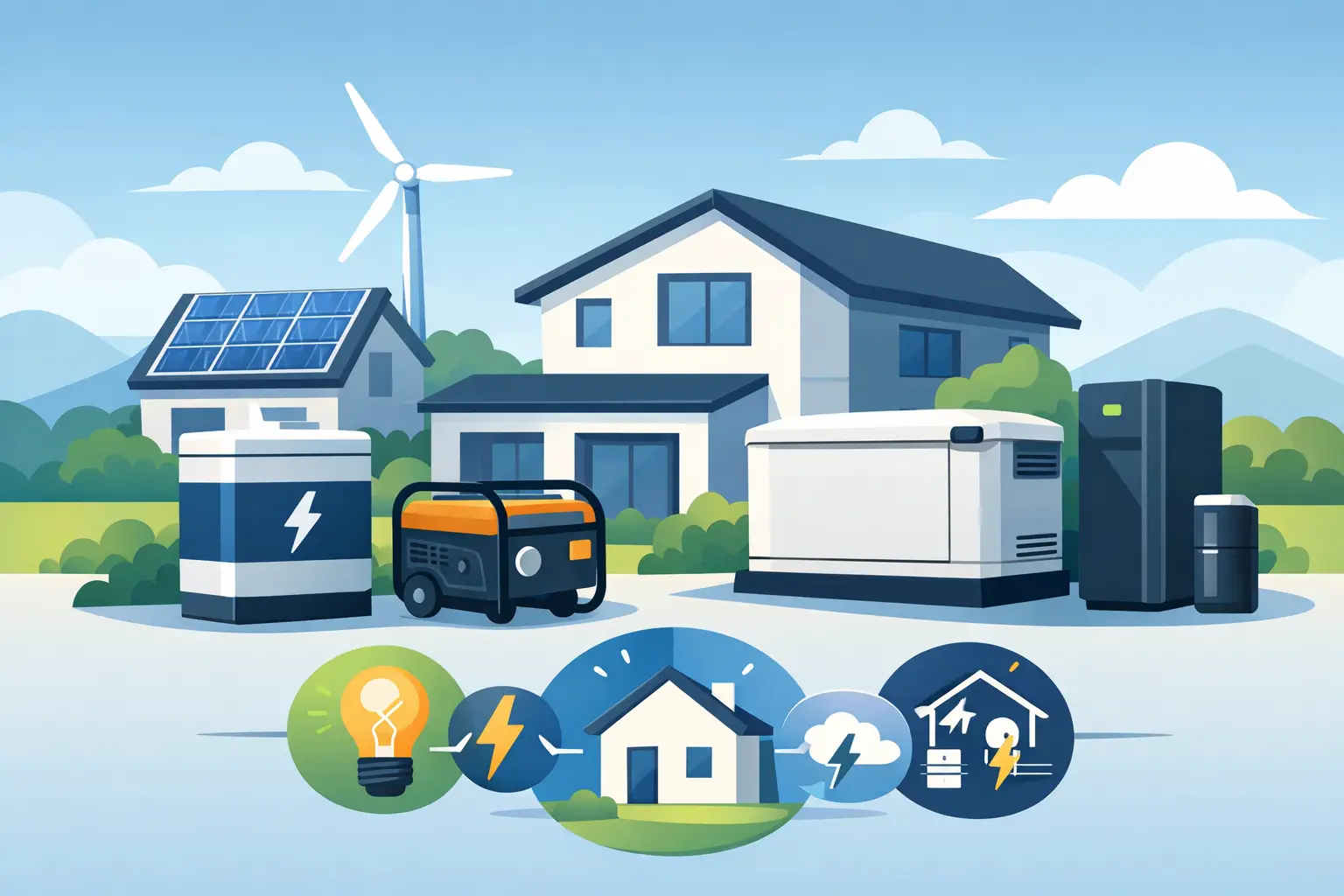
When the power drops in the middle of dinner or during a summer storm, most homeowners ask the same question a little too late: what will actually keep the house running, and for how long? The best power backup options for home depend less on marketing labels and more on what you need to power, how often outages happen, and how much setup you can realistically handle.
Some households only need to keep the fridge cold, phones charged, and a few lights on for several hours. Others want central AC, a well pump, medical equipment, internet, and kitchen circuits available for days. Those are very different backup power jobs, and choosing the wrong category can leave you with either too little capacity or a system that costs far more than you need.
Understanding power backup options for home
The main choices fall into four groups: portable generators, inverter generators, whole-house standby generators, and battery backup systems. There is no single winner for every home. Each option makes sense in a specific mix of budget, convenience, noise tolerance, fuel access, and outage frequency.
A good starting point is to separate essential loads from comfort loads. Essential loads usually include refrigeration, a few lights, internet equipment, phone charging, a furnace blower, sump pump, or medical devices. Comfort loads are things like electric water heaters, central air conditioning, ovens, and clothes dryers. The more comfort loads you want to run, the more expensive your backup solution becomes.
Portable generators
Portable generators are still the most common entry point for residential backup power because they offer strong output for the price. For many homeowners, a portable unit in the 5,000 to 10,000 running watt range can cover the basics and sometimes much more, especially when connected through a transfer switch or interlock kit.
Their biggest advantage is value. Dollar for dollar, they often deliver more usable wattage than battery systems, and they can keep running as long as you have fuel. That matters during multi-day outages when batteries eventually need recharging. They are also flexible. The same generator may support emergency home use, jobsite tools, or occasional outdoor power needs.
The trade-offs are equally clear. Most portable generators are louder than other backup options, they require manual setup, and they must never be used indoors or in a garage because of carbon monoxide risk. Fuel storage is another factor. Gasoline is easy to find but less stable for long-term storage, while propane stores better but may reduce output on some models.
Inverter generators
Inverter generators are technically a subset of portable generators, but they deserve separate attention because they solve a different problem. They are generally quieter, more fuel-efficient under variable loads, and safer for sensitive electronics like laptops, routers, and modern appliances with control boards.
For smaller backup needs, an inverter generator can be an excellent fit. If your goal is to keep a refrigerator, freezer, modem, phones, lights, and maybe a portable heater or small window AC running, a quality inverter model can do that with less noise and less fuel burn than a traditional open-frame unit.
The limitation is output. While larger inverter generators exist, they usually cost more per watt than conventional portable models. If you are trying to start large central AC systems or multiple heavy loads at once, the price gap becomes harder to ignore.
Whole-house standby generators
If you want backup power that starts automatically when the grid fails, a standby generator is the premium choice. These systems are installed permanently outside the home, usually run on natural gas or propane, and connect through an automatic transfer switch. When utility power goes out, the generator detects the loss and starts within seconds.
That convenience is the main selling point. You do not have to roll a unit out of the garage, refill fuel in bad weather, or manage extension cords. For homes in storm-prone areas, households with medical needs, or owners who travel often, that automatic operation can justify the higher cost.
Standby units also support larger loads more comfortably than most portable options. Depending on sizing, they can run major circuits or even most of the home. But installation cost is substantial, and that is where many buyers underestimate the total investment. Equipment cost is only part of the picture. Site prep, electrical work, gas plumbing, permits, and ongoing maintenance all matter.
This option makes the most sense when outages are frequent or high-stakes. If your area sees one short outage every year or two, a standby system may be hard to justify financially. If outages are common, lengthy, or disruptive to health and property, it becomes easier to defend.
Battery backup systems
Battery backup systems, often paired with solar but not always, appeal to homeowners who want quiet operation, no fuel handling, and minimal maintenance. These systems can keep selected circuits running with no engine noise, no exhaust, and nearly instant switchover depending on the setup.
For short outages, batteries are extremely convenient. They work well for electronics, lighting, refrigeration, communication equipment, and other moderate loads. They are also attractive in neighborhoods where generator noise is a concern or where fuel storage is inconvenient.
The challenge is duration and heavy-load support. A battery system can be excellent for a few critical circuits, but whole-home backup for long outages gets expensive quickly. Air conditioning, electric heat, and other high-demand appliances can drain stored energy fast. Without solar input or another charging source, your runtime is fixed by battery capacity.
That does not make batteries a poor choice. It just means they need to be matched carefully to the loads. For some homes, a battery system is the cleanest answer for brief outages. For others, it is better as part of a hybrid setup rather than a complete replacement for a generator.
How to choose between home backup power options
The most practical way to choose is to work backward from your outage plan, not forward from a product category. Start with the loads you truly need. Add up running watts and pay attention to starting watts for equipment with motors, such as refrigerators, pumps, and air conditioners. A system that looks sufficient on paper can still struggle if startup surges are ignored.
Next, think about runtime. A small battery unit may handle your internet and fridge for part of a day, while a portable generator with enough fuel could cover several days. If your outages are usually two to four hours, batteries become more appealing. If they often last overnight or longer, fuel-based generation usually offers better staying power for the money.
You should also consider how hands-on you want to be. Portable and inverter generators need manual setup, regular exercise, proper fuel management, and safe connection methods. Standby systems reduce the effort but increase upfront cost. Battery systems sit at the easy end of ownership, but capacity limits still need honest evaluation.
Connection and safety matter as much as wattage
Many homeowners focus on generator size and overlook the connection plan. That is a mistake. Running extension cords through doors may work for a few temporary loads, but it is not the best long-term strategy for most homes. A transfer switch or interlock kit gives you a safer, more organized way to power selected circuits.
You also need to account for outlet type, cord compatibility, and whether the generator neutral bonding setup fits your intended connection method. This is one of those details that can confuse first-time buyers, and it matters. A generator that looks perfect on paper can become frustrating if it does not match your electrical setup or accessory requirements.
Carbon monoxide safety is non-negotiable with any fuel-burning generator. Portable units belong outdoors, away from doors, windows, and vents. Refueling should happen only after proper shutdown and cooling. If you are not comfortable with those routines, that is another reason to look harder at standby or battery systems.
Which option fits which homeowner?
If you want the lowest-cost path to meaningful emergency power, a portable generator is usually the best fit. If quiet operation and clean power for smaller essentials matter more than maximum output, an inverter generator is often the better buy. If you want automatic protection with minimal manual effort, a standby generator is the strongest option. If your outages are short and you value silence, low maintenance, and indoor-friendly energy storage, batteries deserve serious consideration.
For many buyers, the smartest answer is not choosing the most powerful system. It is choosing the one you will actually maintain, fuel, test, and use correctly when the lights go out. That is where a practical site like TopGeneratorsOnline can help narrow the field, but the final decision still comes down to your home, your outage pattern, and the loads you are not willing to lose.
A good backup power plan should feel boring once it is in place. That is the goal. When the next outage hits, you should not be improvising – you should already know exactly what turns on, what stays off, and how long your setup can carry the house.