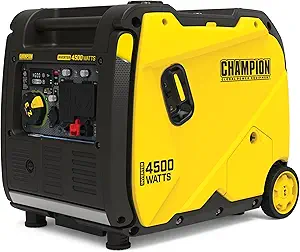
A 4500-watt inverter generator can be a practical middle ground when a small camping generator is not powerful enough, but a large conventional generator is more than you need. This size is popular with RV owners, campers, homeowners preparing for outages, and anyone who needs portable power for appliances, tools, or outdoor equipment.
One important detail is often overlooked when shopping for a generator: 4,500 watts usually refers to starting or peak power, not the amount of power the generator can continuously produce. Most models in this category provide somewhere around 3,500 watts of continuous power. That distinction matters when you are calculating whether a generator can handle a refrigerator, portable air conditioner, microwave, power tools, or several smaller appliances at the same time.
Inverter technology is another reason these generators are popular. Instead of producing electricity in the same way as a traditional open-frame generator, an inverter generator uses an electronic inverter system to deliver stable AC power. Many models also use an economy mode that lowers engine speed when electrical demand decreases, which can reduce fuel consumption and operating noise.
For 2026, the market includes gasoline-only and dual-fuel models, RV-ready outlets, CO shutoff systems, parallel capability, digital displays, and lighter enclosed designs. Below, I compare five 4500-watt-class inverter generators and explain what their specifications mean in everyday use.
4500-Watt Inverter Generator Comparison
| Generator | Peak/Starting Power | Running/Rated Power | Fuel | Noise | Runtime | Weight |
|---|---|---|---|---|---|---|
| Champion 4500W Inverter | 4,500W | 3,500W | Gasoline | 61 dBA | Up to 14 hrs at 25% load | 92.2 lb |
| Aceup Energy 4500W | 4,500W | 3,600W | Gasoline | Varies | Up to about 10 hrs* | Varies |
| AMERISUN 4500W | 4,450–4,500W* | 3,600–3,680W* | Gasoline | Up to 76 dBA* | About 11 hrs at 50% load* | About 70 lb* |
| WEN DF451i | 4,500W gasoline | 3,500W gasoline | Gasoline/Propane | 58 dBA | 8.5 hrs at 50% load on gasoline | 100 lb |
| ERAYAK 4500W | 4,500W | 3,500W | Gasoline or propane, depending on version | About 58–60.5 dBA | Varies by version/load | About 54–55 lb |
*Specifications vary by model/version, so buyers should confirm the exact model listed before purchasing.
The most important point in this table is that none of these generators should be treated as a continuous 4,500-watt power source. Their actual rated output is generally closer to 3,500–3,680 watts.
Why Choose a 4500-Watt Inverter Generator?
A generator in this power class can make sense when you need more capacity than a compact 2,000- or 3,000-watt inverter generator but still want something portable.
A 4500-watt-class inverter generator can potentially handle combinations such as:
- A refrigerator and freezer
- Several lights
- A television and internet equipment
- Chargers and computers
- A microwave, depending on the remaining load
- Power tools
- A portable air conditioner, if its startup and running requirements are within the generator’s capacity
- Many RV electrical loads through a compatible 30-amp connection
The key is to calculate running watts and starting watts rather than simply adding the advertised peak wattage.
For example, a refrigerator may use relatively little electricity once running but require substantially more power when its compressor starts. The same principle applies to air conditioners, pumps, compressors, and some power tools.
That is why having 4,500 starting watts does not mean you can continuously operate 4,500 watts of equipment.
What Does 4500 Watts Actually Mean?
Generator manufacturers normally advertise two power figures.
Starting or surge watts represent the temporary power available for equipment that requires extra electricity when its motor starts.
Running or rated watts represent the power the generator is designed to provide continuously under the manufacturer’s specified conditions.
For example, the Champion 201318 produces 4,500 starting watts and 3,500 running watts. Champion also specifies a 120V output, a 30A-class RV receptacle, 61 dBA noise at its stated measurement conditions, and up to 14 hours of runtime at 25% load.
The WEN DF451i follows a similar pattern. On gasoline it provides 4,500 surge watts and 3,500 rated watts. On propane, its rated output drops to 3,150 watts, with 4,050 watts of surge power according to the manufacturer’s specifications.
This is one of the most important specifications to check before buying.
1. Champion Power Equipment 4500-Watt Inverter Generator
Check the Champion 4500W Generator on Amazon
The Champion 4500-watt inverter generator is designed for buyers who want a relatively straightforward gasoline-powered unit with RV capability, quiet operation, and built-in monitoring features.
The current Champion 201318 specification lists 4,500 starting watts and 3,500 running watts. It uses a 212cc engine and provides a 120V 30A-class TT-30R RV receptacle along with a 120V household outlet. Champion rates the generator at 61 dBA and up to 14 hours of runtime at 25% load.
It also includes CO Shield, which monitors carbon monoxide and automatically shuts down the engine when elevated CO levels are detected. The system is an additional safety feature, but it does not make indoor operation safe. Generators should still be operated outdoors and positioned away from doors, windows, and vents.
Another useful feature is the Intelligauge with power meter. It can display information such as voltage, frequency, runtime, and power output.
Champion 4500W highlights
- 4,500 starting watts
- 3,500 running watts
- 212cc engine
- Gasoline powered
- 61 dBA noise rating
- Up to 14 hours at 25% load
- RV-ready TT-30R outlet
- CO Shield automatic shutdown
- Economy mode
- Parallel capability
- 92.2-pound product weight
- 3-year limited warranty
This is a relatively heavy generator, so it makes more sense for users who will move it occasionally rather than carry it frequently.
2. Aceup Energy 4500 Watt Inverter Generator
Check the Aceup Energy 4500W Generator on Amazon
The Aceup Energy 4500-watt inverter generator is another option in the gasoline-powered segment. The manufacturer’s manual lists 4,500 watts of peak power and 3,600 watts of rated power, making its continuous output slightly higher than the 3,500-watt rating found on several competing models.
The generator is designed as an open-frame inverter model, so buyers should not automatically assume that it will be as quiet as an enclosed inverter generator.
This distinction matters because the word “inverter” describes the electrical technology, not necessarily how quiet the physical generator will be.
For buyers considering this model, the most important questions are the exact noise specification, current availability, warranty support, and the particular version being sold. Product listings can change, so those details should be confirmed before ordering.
Aceup Energy 4500W highlights
- 4,500 peak watts
- 3,600 rated watts
- 120V output
- Gasoline powered
- Inverter technology
- 30A-class output
- Parallel capability
- Economy mode
- Digital operating information on applicable versions
Its higher rated output makes it worth considering if your load calculation is close to the 3,500-watt range, but the open-frame design makes noise an important consideration.
3. AMERISUN 4500W Inverter Generator
Check the AMERISUN 4500W Generator on Amazon
AMERISUN has several 4500-watt-class inverter generators, and this is an area where buyers need to pay attention to the exact model number.
For example, the AM5040-W specification lists 4,450 watts of surge power and 3,680 watts of rated power, a 2.7-gallon fuel tank, parallel capability, and an 11-hour runtime at 50% load. However, its listed noise level is 76 dB at 7 meters, which puts it in a very different category from the quieter enclosed generators in this comparison.
AMERISUN also sells an AL5040C version with CO protection and a different configuration. That model is rated at 4,500 starting watts and 3,600 running watts.
Therefore, the original article’s description of the AMERISUN as simply a lightweight portable option was too broad.
AMERISUN 4500W highlights
- Approximately 4,450–4,500 peak watts depending on model
- Approximately 3,600–3,680 rated watts depending on model
- Gasoline powered
- 30A output
- Parallel capability
- Economy mode on applicable models
- Digital voltage/frequency/runtime display
- CO protection on applicable versions
The main consideration here is noise. If quiet operation is one of your highest priorities for camping or residential use, check the exact model’s dBA specification before buying.
4. WEN DF451i 4500-Watt Dual-Fuel Inverter Generator
Check the WEN DF451i on Amazon
The WEN DF451i is one of the more versatile options in this group because it can operate on gasoline or propane.
On gasoline, WEN rates it at 4,500 surge watts and 3,500 rated watts. On propane, it produces 4,050 surge watts and 3,150 rated watts. That reduction in output when using propane is important to understand before connecting high-demand appliances.
WEN rates the generator at 58 dBA at 25% load from 22 feet, which is considerably quieter than many open-frame generators. The manufacturer also lists a 2.2-gallon gasoline tank and up to 8.5 hours of half-load runtime on gasoline or approximately 9 hours using a 20-pound propane tank under its specified conditions.
The DF451i includes electric start with recoil backup, a 30A RV-ready TT-30R receptacle, household outlets, USB connections, ECO mode, low-oil protection, overload protection, and parallel capability.
Another useful feature is WEN’s fuel shutoff system, which allows fuel remaining in the carburetor to be consumed before shutdown. This can help reduce stale-fuel-related maintenance issues.
WEN DF451i highlights
- 4,500 surge / 3,500 rated watts on gasoline
- 4,050 surge / 3,150 rated watts on propane
- Dual-fuel operation
- 58 dBA at 25% load from 22 feet
- 2.2-gallon gasoline tank
- Electric start with recoil backup
- RV-ready TT-30R outlet
- ECO mode
- Fuel shutoff
- Parallel capability
- 100-pound weight
- 3-year limited warranty
For buyers who want propane flexibility without moving to a much larger generator, the DF451i deserves close attention.
5. ERAYAK 4500W Portable Inverter Generator
Check the ERAYAK 4500W Generator on Amazon
ERAYAK currently offers several 4500-watt-class inverter configurations, including gasoline-only and dual-fuel versions. This makes the model number particularly important when comparing listings.
The gasoline 4500P version is rated at 4,500 peak watts and 3,500 running watts, with a 2.25-gallon fuel tank, 30A L5-30R outlet, two 120V household outlets, USB-A and USB-C connections, ECO mode, and parallel capability. ERAYAK lists the gasoline-only model at approximately 54–55 pounds.
The newer dual-fuel versions provide 4,500 peak watts and 3,500 running watts on gasoline, while propane output is lower at 4,050 peak watts and 3,150 running watts. ERAYAK lists approximately 58 dBA at 23 feet for the dual-fuel configuration.
That relatively low weight is one of the biggest differences compared with heavier models such as the Champion and WEN.
ERAYAK 4500W highlights
- 4,500 peak watts
- 3,500 running watts on gasoline
- Dual-fuel versions available
- Approximately 54–55 pounds
- 30A output
- ECO mode
- Parallel capability
- USB-A and USB-C on current configurations
- Low-oil and overload protection
- RV-oriented design
For people who regularly transport their generator, weight can be just as important as the wattage rating.
How Quiet Is a 4500-Watt Inverter Generator?
Noise is one of the biggest differences between generators that look similar on paper.
The advertised dBA number should always be read together with the measurement distance and load condition.
For example, WEN lists 58 dBA at 25% load and 22 feet for the DF451i, while Champion lists 61 dBA for its 4500W inverter.
By comparison, the AMERISUN AM5040-W lists 76 dB at 7 meters.
That difference can be significant in an RV campground, residential neighborhood, or campsite.
Also remember that a generator generally becomes louder as its electrical load increases. An advertised low-noise rating should not be interpreted as the generator remaining at that sound level under maximum output.
What Can a 4500-Watt Inverter Generator Run?
A 4500-watt-class generator can be useful for essential household loads, camping equipment, and RV appliances, but the actual combination depends on the starting and running requirements of each device.
Possible loads include:
| Appliance or Equipment | Typical Consideration |
|---|---|
| Refrigerator | Usually manageable, but compressor startup matters |
| Freezer | Similar startup consideration |
| TV | Low electrical demand |
| Laptop | Low electrical demand |
| Wi-Fi router | Low electrical demand |
| Lights | Generally low demand with LED bulbs |
| Microwave | Higher load; calculate with other appliances |
| Portable AC | Check both running and startup requirements |
| Power tools | Motor startup can increase demand |
| Coffee maker | Often a relatively high continuous load |
| RV air conditioner | Check startup requirements carefully |
Do not assume that all of these can operate simultaneously. Add the running watts of the devices you expect to use together and leave enough capacity for equipment with significant startup demand.
Are 4500-Watt Inverter Generators Good for RVs?
Many are specifically designed with RV users in mind.
A 30A RV-ready outlet, usually a TT-30R connection, can make connecting compatible RV equipment more convenient. However, the generator’s 3,500-watt continuous output still limits how many high-demand appliances can operate simultaneously.
For example, an RV air conditioner can consume a substantial amount of power, especially during compressor startup. Running the air conditioner together with a microwave, coffee maker, electric heater, or other high-wattage appliance can overload a generator even if the generator is advertised as a 4,500-watt model.
Before buying, check your RV’s electrical requirements and the generator’s rated output rather than relying only on the peak wattage.
Gasoline vs. Dual Fuel
Gasoline is convenient because it is widely available and generally provides the highest rated output on many dual-fuel inverter generators.
Propane adds flexibility. A stored propane cylinder can be useful when gasoline is difficult to obtain or when you want an alternative fuel for emergency preparedness.
The tradeoff is that propane often produces less power than gasoline.
The WEN DF451i is a good example: its gasoline rating is 3,500 running watts, while its propane rating is 3,150 running watts.
ERAYAK’s current dual-fuel models show a similar pattern, with 3,500 running watts on gasoline and 3,150 watts on propane.
If you plan to run close to the generator’s maximum continuous capacity, gasoline may therefore provide more usable output.
Inverter Technology and Sensitive Electronics
Inverter generators are often chosen for electronics because their electrical output is designed to be more stable than the output of many conventional generators.
Champion specifies less than 3% THD for its 4500W inverter, while WEN reports less than 1.2% THD at full load for the DF451i.
That makes these generators suitable for many common electronics such as laptops, televisions, routers, chargers, and other consumer equipment.
However, do not treat an inverter generator as automatically appropriate for every sensitive or life-supporting device. For medical equipment or other critical loads, follow the equipment manufacturer’s power requirements and recommendations.
Generator Safety in 2026
A portable generator should always be operated outside in a well-ventilated area.
Never run one inside a house, garage, basement, shed, RV, or other enclosed or partially enclosed space. Carbon monoxide is colorless and odorless, and generator exhaust can become dangerous very quickly.
CO shutoff systems such as Champion’s CO Shield are useful safety features, but they are not a replacement for correct generator placement. Champion’s documentation specifically warns that CO Shield is not a substitute for an indoor carbon monoxide alarm or safe outdoor operation.
Before operating a generator:
- Read the owner’s manual.
- Keep the generator outdoors.
- Keep exhaust directed away from occupied areas.
- Keep doors, windows, and vents away from the exhaust.
- Never connect a portable generator directly to household wiring unless the installation uses an appropriate transfer switch or other code-compliant connection method.
- Use properly rated extension cords.
- Do not overload the generator.
- Allow the generator to cool before refueling.
- Maintain the generator according to the manufacturer’s schedule.
- Use a carbon monoxide alarm inside the home as an additional safety measure.
What to Look for When Buying a 4500-Watt Inverter Generator
1. Running watts
This should be one of the first specifications you check. A generator advertised as 4,500 watts may only provide around 3,500 watts continuously.
2. Starting watts
Check this number if you plan to power refrigerators, air conditioners, pumps, compressors, or power tools.
3. Noise rating
If you are camping or using the generator near your home, compare dBA ratings carefully. Also check the manufacturer’s measurement distance and load condition.
4. Fuel type
Gasoline-only generators are straightforward. Dual-fuel generators provide another option when propane availability is important.
5. RV connection
If you own an RV, look for a compatible 30A RV outlet rather than assuming that any 4500-watt generator will connect directly.
6. Weight and wheels
A 100-pound generator may be manageable around a home but inconvenient for frequent transport. If portability is a priority, a lighter enclosed design can make a major difference.
7. CO protection
A CO detection and automatic shutdown system is an important safety feature, but proper outdoor operation remains essential.
8. Parallel capability
Parallel capability allows compatible inverter generators to be connected to increase available power. Always use the manufacturer’s approved equipment and follow its instructions.
9. Warranty and support
A generator is an engine-powered machine, so access to replacement parts, technical support, and warranty service matters just as much as the initial purchase price.
Final Thoughts
A 4500-watt inverter generator can be a useful choice when you need portable power for an RV, campsite, outdoor project, or essential household loads during an outage.
The most important thing to remember is that 4,500 watts is usually the peak or starting figure. In this category, continuous output is commonly closer to 3,500 watts. That distinction should be part of your buying decision from the beginning.
The Champion provides a gasoline-only configuration with 4,500 starting watts, 3,500 running watts, 61 dBA operation, RV-ready output, and CO Shield. The WEN DF451i adds dual-fuel flexibility and a 58 dBA rating under its specified test conditions, while its propane output is lower than its gasoline rating. ERAYAK stands out for its much lighter current 4500W designs, while AMERISUN offers several configurations that should be distinguished by model because their output and noise specifications vary.
Before ordering, compare the exact model number, running watts, starting watts, fuel type, noise rating, RV outlet, weight, CO protection, and current manufacturer specifications. Generator models and Amazon listings can change, so the specifications for the exact version you purchase should always take priority over a generic product title.