When you need dependable electricity away from the grid, during a power outage, or on a job site, a portable generator can make a major difference. In 2026, shoppers have more fuel choices than ever, but there is an important distinction between diesel generators, dual-fuel generators, and tri-fuel generators.
Portable diesel generators are still attractive for heavy-duty and long-duration applications because diesel engines are commonly designed for demanding workloads. However, the consumer market has shifted heavily toward gasoline-powered dual-fuel and tri-fuel generators. These models can run on gasoline and propane, or gasoline, propane, and natural gas, giving homeowners more flexibility when fuel availability becomes an issue.
The right generator depends on what you actually need to power. A compact inverter generator may be a better choice for an RV or campsite, while a 10,000- to 15,000-watt conventional generator is more appropriate for major household loads, construction equipment, or larger backup-power requirements.
Below, we’ll look at several portable diesel and multi-fuel options, explain the differences between them, and cover the most important factors to consider before buying one in 2026.
Best Portable Diesel and Multi-Fuel Generators in 2026
| Model | Fuel Type | Best For |
|---|---|---|
| Westinghouse 12500 Watt Dual Fuel | Gasoline / Propane | High-output home backup |
| Westinghouse 14500 Peak Watt Tri-Fuel | Gasoline / Propane / Natural Gas | Large home and heavy-duty backup |
| Champion 4000-Watt RV Ready Inverter | Gasoline | RVs, camping, and smaller loads |
| WEN DF1100X 11,000-Watt Dual Fuel | Gasoline / Propane | Home backup and job sites |
| Futchoy 196CC Diesel Generator | Diesel | Small-scale diesel applications |
The original affiliate links are retained below for the products already included in this article:
- Westinghouse 12500 Watt Dual Fuel — Amazon Link
- Westinghouse 14500 Peak Watt Tri-Fuel — Amazon Link
- Champion 4000-Watt RV Ready Inverter — Amazon Link
- WEN 11,000-Watt Dual Fuel Portable — Amazon Link
- Futchoy 196CC Diesel Engine Generator — Amazon Link
Diesel vs. Dual-Fuel vs. Tri-Fuel Generators
Before choosing a generator, it helps to understand what these fuel categories actually mean.
Portable Diesel Generators
Diesel generators are designed around diesel-fueled engines and are often chosen for construction, agricultural, commercial, industrial, and extended-use applications.
One of their main advantages is the durability associated with many diesel engine designs. Diesel can also be practical for users who already operate diesel equipment and maintain an established fuel supply.
The downside is that portable diesel generators tend to be heavier, more expensive, and less common in the consumer market than gasoline-powered generators.
For that reason, someone searching specifically for a portable diesel generator in 2026 should pay close attention to current availability, parts support, warranty coverage, and the generator’s actual intended duty cycle rather than assuming that any diesel model is automatically the better option.
Dual-Fuel Generators
A dual-fuel generator normally operates on gasoline or propane.
This is one of the most useful configurations for residential emergency power because gasoline provides convenient high-output operation while propane can be stored for much longer periods when handled correctly.
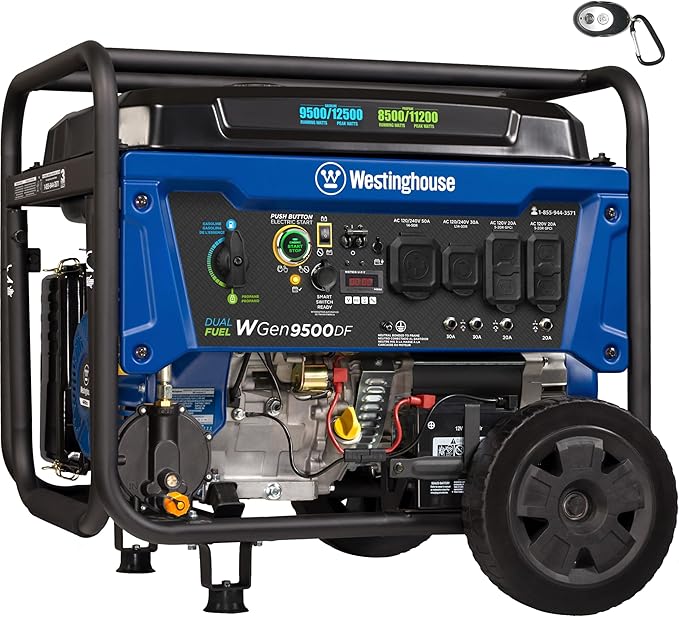
The Westinghouse WGen12500DF is a good example. It produces up to 12,500 peak watts and 9,500 running watts on gasoline, while propane output is lower at 11,200 peak and 8,500 running watts.
Tri-Fuel Generators
Tri-fuel generators add natural gas to gasoline and propane.
This can be particularly useful for homeowners who have a natural gas connection. During a long outage, natural gas can eliminate the need to store large quantities of gasoline or propane, although availability can still depend on the local utility infrastructure.
Tri-fuel generators are also becoming more common in the high-output portable generator market, making them an important alternative to diesel for residential backup.
1. Westinghouse 12500 Watt Dual Fuel Generator
Buy the Westinghouse 12500 Watt Dual Fuel on Amazon
The Westinghouse WGen12500DF is designed for buyers who need substantially more power than a typical camping or RV generator can provide.
It produces up to 12,500 peak watts and 9,500 running watts on gasoline. When operating on propane, output drops to 11,200 peak watts and 8,500 running watts. That difference is important when calculating the loads you expect to run during an outage.
The generator uses a 457cc engine and includes electric start with remote-start capability. It also provides a 50-amp outlet and a transfer-switch-ready connection, making it more suitable for larger residential backup applications than small portable generators.
The 6.6-gallon gasoline tank can provide extended operation at lighter loads, but published runtime figures should always be considered in relation to the actual load. A generator running several high-draw appliances will consume fuel much faster than one powering only a refrigerator, lights, internet equipment, and a few other essentials.
What makes it useful
- Gasoline and propane flexibility
- Up to 12,500 peak watts on gasoline
- 9,500 running watts on gasoline
- Remote electric start
- 120/240V capability
- 50-amp outlet
- Transfer-switch-ready connection
- Suitable for substantial home backup loads
What to consider
This is a large open-frame generator, not a quiet inverter generator. It is also heavy, so the wheels and handles are important for moving it around.
It should be viewed as a high-output backup generator, not as a convenient camping generator.
2. Westinghouse 14500 Peak Watt Tri-Fuel Generator
Buy the Westinghouse 14500 Peak Watt Tri-Fuel on Amazon
If you want a high-output generator with three fuel options, the Westinghouse 14500 Peak Watt Tri-Fuel is in a different class from compact RV generators.
The tri-fuel configuration allows operation with gasoline, propane, or natural gas, giving homeowners more options during an extended outage.
Westinghouse’s current 14500 platform includes high-output models built around large-displacement engines and designed for major residential loads, job sites, and other demanding applications. The related WGen14500DF dual-fuel model, for example, produces up to 14,500 running watts and 18,000 peak watts on gasoline.
The key advantage of a tri-fuel configuration is not necessarily higher wattage. It is fuel flexibility.
If gasoline becomes difficult to obtain after a storm, propane can provide another option. If your property has natural gas service, that may offer another way to operate the generator without relying entirely on stored liquid fuel.
What makes it useful
- Gasoline, propane, and natural gas capability
- Very high power output
- 120/240V operation
- Suitable for large residential loads
- Useful for extended emergency situations
- Better fuel flexibility than a conventional gasoline-only generator
What to consider
A generator in this power class is large and heavy. It is not intended to be carried like an inverter generator.
You should also have a clear plan for connecting a generator of this size to your home. A proper transfer switch or approved interlock setup should be installed according to local electrical requirements by a qualified professional.
3. Champion 4000-Watt RV Ready Inverter Generator
Buy the Champion 4000-Watt RV Ready Inverter on Amazon
The Champion 4000-watt inverter generator serves a completely different purpose from the large Westinghouse models.
Rather than trying to power an entire house, this type of generator is better suited to RVs, camping, tailgating, outdoor projects, and essential household loads.
Champion’s 4000-watt inverter platform produces up to 4,000 starting watts and 3,000 running watts. The manufacturer lists operation at approximately 64 dBA from 23 feet and up to 10 hours of runtime under the specified light-load conditions. It also includes CO Shield carbon-monoxide protection and parallel capability with a compatible unit.
The inverter design is another important difference. It produces cleaner electrical power than many conventional open-frame generators, making it more appropriate for electronics such as laptops, televisions, chargers, and other sensitive equipment.
What makes it useful
- Compact compared with high-output generators
- Inverter technology
- 4,000 starting watts
- 3,000 running watts
- RV-ready outlet
- CO Shield carbon monoxide protection
- Parallel capability
- Around 64 dBA
- Useful for camping and RV applications
What to consider
This is not the generator to choose if your primary goal is whole-house backup.
Champion itself positions the 4000-watt inverter for camping, RV use, tailgating, and basic backup rather than emergency whole-home backup.
4. WEN DF1100X 11,000-Watt Dual Fuel Generator
Buy the WEN 11,000-Watt Dual Fuel Generator on Amazon
The WEN DF1100X is a high-output dual-fuel generator designed for homeowners, workshops, job sites, and emergency backup.
On gasoline, WEN lists 11,000 surge watts and 8,300 running watts. On propane, it produces up to 9,500 surge watts and 7,500 running watts.
The generator uses a 457cc four-stroke OHV engine and includes electric start. Its control panel provides several types of connections, including 120V household outlets, a 120V twist-lock outlet, and a 120/240V 50-amp receptacle.
It also includes WEN’s Watchdog CO shutdown sensor, which automatically shuts the generator down if dangerous carbon monoxide levels are detected.
What makes it useful
- Gasoline and propane operation
- 11,000 surge watts on gasoline
- 8,300 running watts on gasoline
- 120/240V output
- Electric start
- CO Watchdog protection
- 50-amp receptacle
- Wheel and handle kit
What to consider
Like other large open-frame generators, the DF1100X is substantially heavier and louder than an inverter generator.
It makes more sense for home backup, workshops, farms, and job sites than for quiet camping.
5. Futchoy 196CC Diesel Engine Generator
Buy the Futchoy 196CC Diesel Engine Generator on Amazon
The Futchoy 196CC diesel model is included here because it was part of the original product selection, but it should be evaluated differently from the larger Westinghouse and WEN generators.
Listings for the Futchoy 196cc diesel platform identify it as a small single-cylinder diesel engine application, with some listings showing approximately 2,200 watts of generator output. Because product listings and configurations can vary, buyers should verify the exact model number, rated wattage, voltage, runtime, certifications, and included equipment before ordering.
This is especially important with lesser-known generator brands. A low purchase price is not enough by itself. Replacement parts, warranty support, technical documentation, and local service can become much more important if the generator is expected to provide emergency power.
What makes it useful
- Diesel-powered design
- Compact compared with larger diesel machines
- Potentially useful for smaller off-grid applications
- Diesel fuel rather than gasoline or propane
What to consider
This is not directly comparable to a 10,000- or 14,000-watt residential backup generator.
Before purchasing, verify the exact specifications for the particular listing and make sure the available output is sufficient for the equipment you intend to operate.
Diesel Generators vs. Multi-Fuel Generators
The biggest mistake buyers can make is choosing a fuel type before figuring out how the generator will actually be used.
Diesel may make sense when:
- You expect long operating periods.
- You already use diesel equipment.
- You need a generator for a work site or agricultural application.
- Engine durability and heavy-duty operation are priorities.
- You have an established diesel fuel supply.
- You are operating in a remote location.
Dual-fuel may make more sense when:
- You want gasoline and propane flexibility.
- The generator is primarily for home emergencies.
- You want to keep propane available for extended outages.
- You need a high-output portable generator.
- You do not have natural gas service.
Tri-fuel may make more sense when:
- Your home has natural gas service.
- You want three fuel options.
- Extended outages are a concern.
- You want to reduce dependence on stored gasoline.
- You need a high-output generator for residential backup.
The right choice is therefore less about which fuel is universally “best” and more about which fuel supply you can realistically maintain and access when you need the generator.
How Much Generator Power Do You Need?
Generator size should be based on running watts and starting watts, not just the largest number printed on the box.
Running watts describe the continuous electrical demand. Starting watts account for the temporary surge required by appliances and equipment with motors or compressors.
For example, a refrigerator may consume relatively little power after it starts but require considerably more power for a brief period during startup.
The same issue applies to:
- Central air conditioners
- Well pumps
- Sump pumps
- Freezers
- Power tools
- Air compressors
- Furnaces
- Large refrigerators
Make a list of the appliances you want to operate simultaneously and check their actual electrical requirements. Then account for starting loads rather than simply adding the running wattage.
A 4,000-watt inverter generator and a 12,500-watt conventional generator serve very different purposes.
Runtime: Don’t Compare Numbers Without Checking the Load
Generator manufacturers often advertise impressive maximum runtime figures, but runtime depends heavily on the load.
A generator operating at 25% load can run considerably longer than the same generator operating close to its maximum rated output.
For example, Westinghouse publishes extended runtime figures for its large generators under specified load conditions, while WEN lists its DF1100X at up to 8.5 hours at half load using its 6.6-gallon gasoline tank.
When comparing generators, always ask:
- What fuel was used?
- What load percentage was used?
- How large is the fuel tank?
- Is the runtime based on gasoline or propane?
- Is the figure from the manufacturer?
- What happens to runtime when operating near maximum output?
This gives you a much more realistic idea of how long the generator will operate during an actual outage.
Portability Is Relative
The word “portable” can be misleading when comparing generators.
A 48-pound inverter generator can realistically be moved by one person. A 200-plus-pound high-output generator may technically be portable because it has wheels, but you are not going to carry it into the backyard by yourself.
For larger generators, look for:
- Large wheels
- Folding or extended handles
- Solid frame construction
- Lifting points
- Balanced weight distribution
- Easy-access control panels
If the generator will remain in one location for most of its life, portability may matter much less than output, fuel capacity, serviceability, and electrical connections.
Inverter vs. Conventional Generator
Another important decision is whether you need an inverter generator.
Inverter generators
Inverter generators are usually better suited to:
- Camping
- RVs
- Electronics
- Quiet residential use
- Tailgating
- Smaller backup loads
The Champion 4000-watt inverter, for example, is designed around relatively quiet operation and clean electrical output for sensitive electronics.
Conventional generators
Conventional open-frame generators are generally more appropriate when the priority is:
- High wattage
- Construction
- Large appliances
- Pumps
- HVAC loads
- Workshop equipment
- Extended emergency backup
They are typically heavier and louder, but they can provide substantially more power than compact inverter models.
Generator Safety in 2026
Safety should be treated as part of choosing a generator, not as an afterthought.
Never operate a portable generator inside a home, garage, basement, shed, or other enclosed or partially enclosed area.
The U.S. Consumer Product Safety Commission recommends operating portable generators outdoors at least 20 feet from the home, with the exhaust directed away from the building.
Carbon monoxide is colorless and odorless, and a running portable generator can produce dangerous levels of CO very quickly.
Other important precautions include:
- Keep the generator dry and protected from direct rain according to the manufacturer’s instructions.
- Never connect a portable generator directly to a home’s electrical panel without an appropriate transfer switch or approved interlock system.
- Use properly rated extension cords.
- Allow the engine to cool before refueling.
- Keep gasoline and other fuels stored according to local safety requirements.
- Follow the owner’s manual for oil changes and maintenance.
- Keep children and pets away from the running generator.
- Install working carbon monoxide alarms inside the home.
A CO shutdown sensor is useful, but it should never be treated as permission to operate a generator indoors.
Can a Portable Generator Power Your Whole House?
Sometimes, but the answer depends on the home’s electrical loads.
A 10,000- to 15,000-watt generator can potentially handle a substantial portion of a home’s essential circuits, and in some homes it may handle most major loads when they are managed correctly.
That does not mean every appliance can run simultaneously.
Central air conditioning, electric water heaters, electric dryers, ovens, well pumps, refrigerators, freezers, and other large loads can quickly consume available capacity.
If you want to connect a portable generator to your home’s electrical system, work with a qualified electrician to determine the appropriate transfer equipment and circuits.
Which Type of Generator Is Right for You?
For long-duration diesel use
Look at a genuine portable diesel generator designed for the workload you expect. Diesel makes the most sense when the generator will be used heavily or when you already have diesel fuel and equipment.
For home emergency backup
A dual-fuel generator is often more practical because gasoline and propane give you two fuel options.
The Westinghouse WGen12500DF and WEN DF1100X are examples of the type of high-output dual-fuel generators that can handle substantially more load than a typical RV inverter.
For natural-gas flexibility
A tri-fuel generator provides another option by adding natural gas to gasoline and propane.
This can be particularly useful during long outages when maintaining a supply of liquid fuel becomes inconvenient.
For RVs and camping
A smaller inverter generator is generally more appropriate.
The Champion 4000-watt inverter is designed specifically around RV, camping, tailgating, and basic backup applications rather than whole-house power.
For job sites
Focus on rated wattage, durability, outlet configuration, fuel capacity, portability, and service support rather than simply buying the generator with the largest peak-watt number.
Final Thoughts
The portable generator market in 2026 is much more diverse than simply choosing between gasoline and diesel.
Diesel generators remain relevant for heavy-duty and extended-use applications, but the consumer market has increasingly shifted toward dual-fuel and tri-fuel generators because of their fuel flexibility.
For large residential backup, a high-output dual-fuel or tri-fuel generator can offer a practical combination of power and fuel availability. For an RV or campsite, a compact inverter generator makes considerably more sense. And for demanding job-site or off-grid work, a purpose-built diesel generator can still be a useful solution.
The most important step is to calculate your actual electrical loads before buying. Compare running watts, starting watts, fuel type, runtime at a stated load, noise, portability, outlet configuration, safety features, warranty, and service support.
In 2026, the best portable generator for you is not necessarily the one with the highest peak wattage. It is the one that provides enough continuous power for your essential loads, works with a fuel supply you can realistically maintain, and fits the environment where you plan to use it.