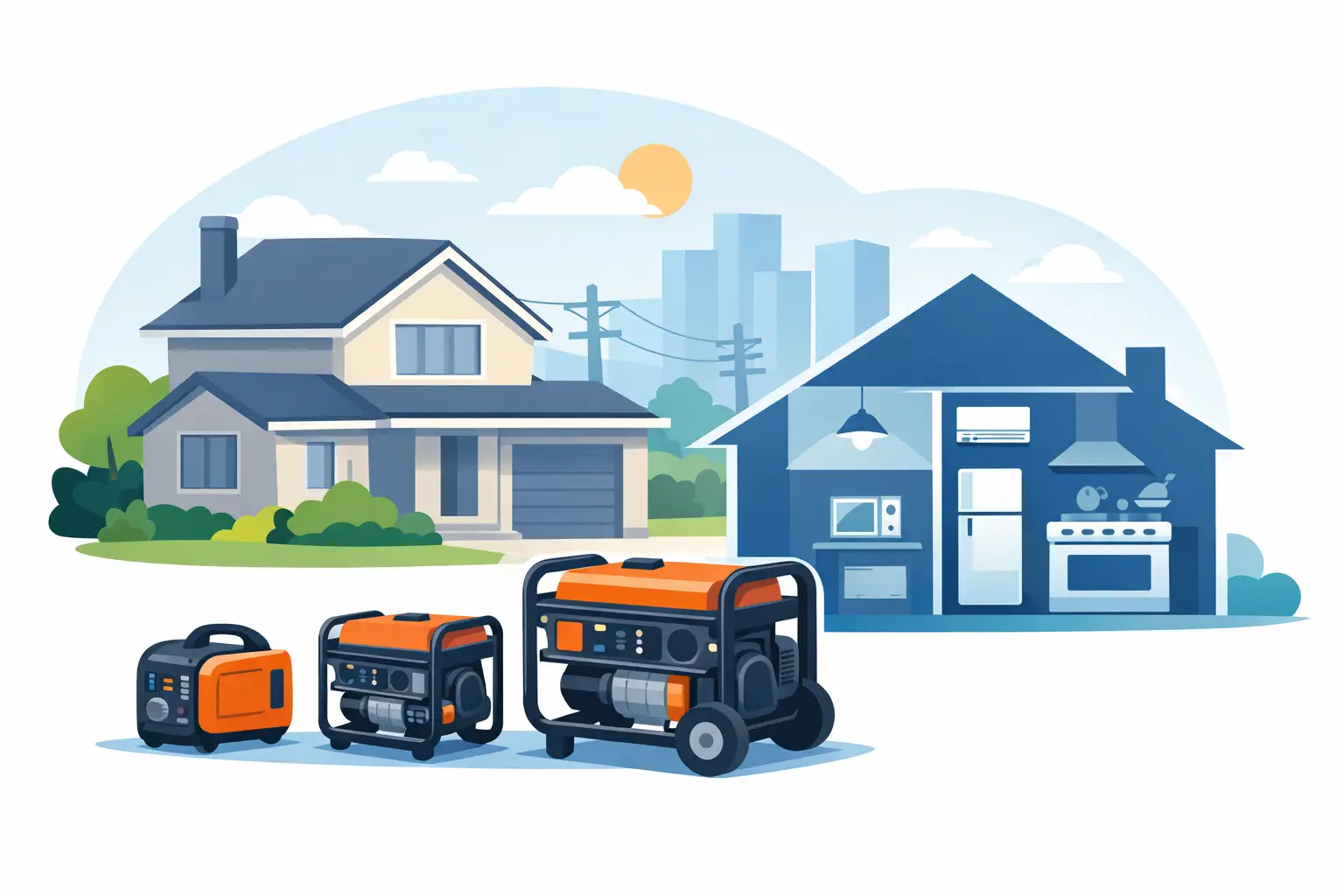
The wrong generator size usually shows up at the worst possible moment – when the power is out, the refrigerator is warming up, and the well pump or furnace will not start. If you are asking what size generator for house backup makes sense, the answer is not one number. It depends on what you need to run, how your home is wired, and whether you want basic survival power or near-whole-house coverage.
A lot of homeowners make the same mistake in opposite directions. Some buy too small and end up tripping overload protection every time a motor kicks on. Others overspend on a unit far larger than they actually need, then deal with higher fuel use, more noise, and a heavier machine than necessary. The goal is to match the generator to your real loads, not your worst guess.
https://amzn.to/4urlebD
What size generator for house backup depends on
The size question starts with watts. Every appliance or electrical load in your home needs a certain amount of power to run, and some items need extra power for a few seconds when they start. That extra demand is called starting watts or surge watts.
Lights, phone chargers, and TVs have fairly modest and predictable power needs. Motors are different. Refrigerators, freezers, sump pumps, air conditioners, furnace blowers, and well pumps often pull much more power at startup than they do once running. A generator that can handle the running load but not the startup surge may still fail when it matters.
That is why generator sizing is really about two numbers: your expected running watt total and your highest likely startup demand. You need enough capacity for both, with some breathing room.
Start with the appliances you actually need
Before comparing models, separate your home loads into three groups. First are essentials, such as the refrigerator, freezer, some lights, internet equipment, phone charging, and either a furnace blower or a few space heaters depending on your setup. Second are comfort items, such as a microwave, washing machine, or television. Third are heavy loads, such as central air, electric water heaters, dryers, ovens, or large well pumps.
Most homeowners do not need every circuit powered during an outage. If your goal is emergency backup, you are usually sizing for the essentials plus a few convenience loads. If your goal is whole-home continuity, that pushes you toward a much larger standby generator.
As a practical example, a modest outage setup might include a refrigerator, a freezer, several LED lights, a Wi-Fi router, phone chargers, a TV, and a gas furnace blower. That kind of load often lands somewhere in the 3,000 to 5,000 running watt range, though startup surges can push the required generator size higher.
If you add a sump pump or well pump, the requirement can jump quickly. If you want to run central AC, you may move from portable-generator territory into a larger portable, inverter, or
standby solution.
Typical home generator size ranges
For most homes, there is no single magic number, but there are useful ranges.
A 2,000 to 3,500 watt generator is typically enough for very limited backup. Think refrigerator, lights, internet, and small electronics, but with careful load management. This can work for apartment-style needs or very basic emergency use, though it usually will not support multiple motor-driven appliances at once.
A 4,000 to 7,500 watt generator covers what many homeowners consider practical backup. This range can often handle a refrigerator, freezer, lights, a furnace blower, microwave, and some outlets, depending on startup loads and how carefully you manage usage. For many households, this is the sweet spot for
portable home backup.
An 8,000 to 12,500 watt generator is where more serious portable backup begins. This range may support a well pump, sump pump, larger kitchen loads, or small central air systems in some cases. It is also common for homes using a manual transfer switch to power a larger set of selected circuits.
Once you get into the 14,000 watt and up range, you are often looking at standby generators or very large portables intended for broader home coverage. These systems can be appropriate if you want whole-house or near-whole-house operation, especially in larger homes with HVAC demands.
Running watts vs starting watts
This is where many buying decisions go wrong. Manufacturers may advertise peak output prominently, but your generator has to live in the real world. Running watts tell you what the machine can sustain. Starting watts tell you how much temporary surge it can handle.
If your refrigerator needs 700 running watts but 2,100 starting watts, that startup number matters. The same is true for pumps and air conditioning equipment. If several motor loads try to start at once, the generator may bog down or shut off.
A safe approach is to total the running watts of everything you expect to use at the same time, then account for the largest startup surge among those loads. In some cases, especially with multiple motor loads, you may want a bigger buffer than the bare minimum.
Portable generator or standby generator?
If you are deciding what size generator for house use during occasional outages, portable models are often the first place to look. They cost less upfront, give you flexibility, and work well when your goal is to power selected essentials. They do require manual setup, outdoor placement,
safe fueling, and usually a transfer switch or interlock if you want to connect to home circuits properly.
Standby generators are a different category. They are installed permanently, usually run on natural gas or propane, and can start automatically when utility power fails. They also come in larger sizes, which makes whole-house backup more realistic. The trade-off is cost. Purchase price, installation, permits, and electrical work all raise the investment substantially.
For many homeowners, the decision is less about absolute power and more about how you want to live during an outage. If you are comfortable managing a few circuits and prioritizing loads, a well-sized portable may be enough. If you want automatic operation and minimal disruption, standby starts to make sense.
Fuel type affects real-world sizing
Generator output is not just about the number on the box. Fuel type can change what you actually get.
Gasoline generators are common and widely available, but runtime depends on tank size and load. Dual-fuel and tri-fuel models add flexibility, yet they often produce slightly less power on propane or natural gas than on gasoline. That matters if you are sizing close to the edge.
For example, a generator rated at 9,000 running watts on gasoline may produce less on propane. If your load calculation already uses most of that capacity, the fuel choice becomes part of the sizing decision. This is one reason practical buyers leave some margin rather than shopping by the tightest possible watt estimate.
How to estimate your house needs with confidence
The best method is simple, even if it takes a little time. Make a list of the appliances and circuits you want during an outage. Check labels, manuals, or electrical ratings for wattage. If you only have amps and volts, multiply them to estimate watts. Then identify which items have motors or compressors and note their startup demands if available.
After that, build two scenarios. One should be your must-run outage plan, and the other should be your ideal comfort plan. This keeps you from buying emotionally instead of practically. Plenty of homeowners discover that their must-run setup fits a mid-size portable, while their comfort plan points to a larger unit or a future standby upgrade.
If exact startup watt data is hard to find, err on the safe side. That is especially true for pumps, HVAC equipment, and older appliances.
Common sizing examples for homeowners
A small home or townhouse using city water and gas heat may do well with a 4,000 to 6,500 watt generator for essentials. A suburban home with a sump pump, larger refrigerator, freezer, and more circuits often fits better in the 6,500 to 9,500 watt range.
A rural home with a well pump usually needs more planning. Even if everyday loads seem modest, the pump can change the equation fast. In those cases, 7,500 to 10,000 watts or more is often more realistic, depending on the pump and whether you also want to support heating or cooling equipment.
If central air conditioning is non-negotiable, your required size can rise sharply. Some smaller high-efficiency systems are manageable with larger portable units, but many homes will need a standby generator if full HVAC support is part of the plan.
Do not size a generator too close to the limit
A generator running at or near maximum output for long periods is usually not the sweet spot for reliability, fuel economy, or noise. Leaving reserve capacity helps with startup surges, future appliance changes, and simple day-to-day convenience during an outage.
That does not mean bigger is always better. Oversizing can increase fuel costs and purchase price without improving your actual experience. The better approach is balanced sizing: enough headroom to handle reality, but not so much that you pay for capacity you will never use.
For many buyers, that means choosing the next sensible size up once the load calculation is done. At TopGeneratorsOnline, that is often the difference between a generator that looks good on paper and one that feels easy to live with when the grid is down.
If you are still unsure, think less about square footage and more about the specific loads that keep your household safe and functional. The right generator size is the one that starts those loads reliably, runs them without strain, and gives you a little room to breathe when the outage lasts longer than expected.