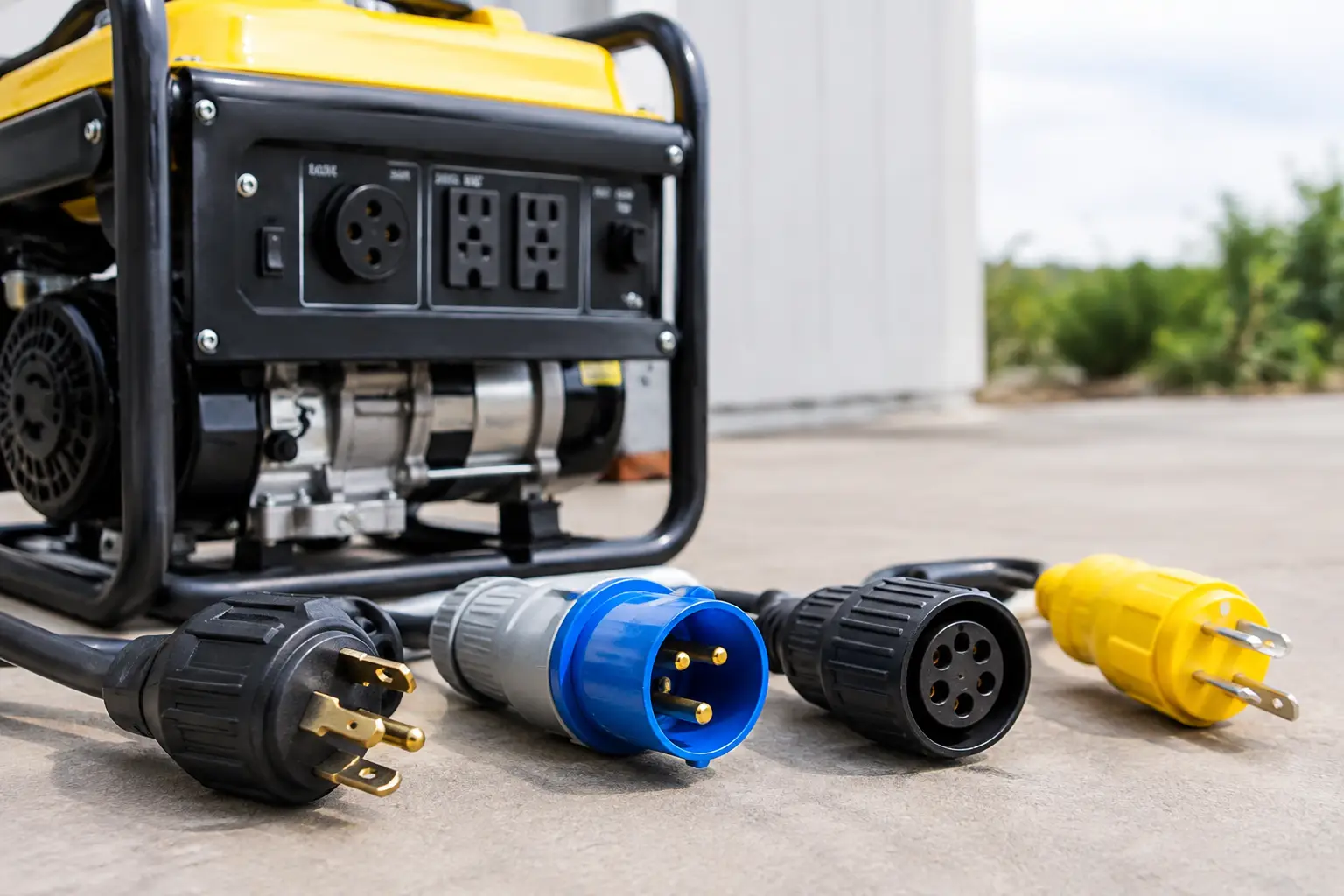
Choosing the right generator plug type is more important than simply finding an outlet that looks like it will fit your cord. The plug and receptacle determine the voltage, amperage, wiring configuration, and type of equipment you can safely connect.
You may need power for a refrigerator, well pump, RV air conditioner, sump pump, tools, or selected circuits in your home. In each case, the generator outlet needs to match the equipment and the way you plan to distribute the power.
The most common generator connections include 5-15R, 5-20R, TT-30R, L5-30R, L14-30R, 14-50R, and higher-capacity locking connectors such as the CS6364/CS6365 family.
The important thing is not just matching the shape. Before using an adapter or generator cord, check the voltage, amperage, wiring configuration, and grounding arrangement.
Need the right generator cord, plug, or adapter? → Browse Generator Cords, Plugs & Adapters on Amazon
Generator Plug Types at a Glance
The easiest way to understand common generator receptacles is to compare their basic electrical characteristics and typical applications.
| Generator Plug Type | Voltage | Amp Rating | Configuration | Common Use |
|---|---|---|---|---|
| 5-15R | 120V | 15A | Straight blade | Small appliances and household loads |
| 5-20R | 120V | 20A | Straight blade | Higher-current 120V equipment |
| TT-30R | 120V | 30A | Straight blade | RVs and travel trailers |
| L5-30R | 120V | 30A | Twist-lock | Jobsite and 120V equipment |
| L14-30R | 120/240V | 30A | Twist-lock, 4-wire | Home backup and transfer equipment |
| 14-50R | 120/240V | 50A | Straight blade, 4-wire | Larger generators and high-capacity connections |
| CS6364/CS6365 | 125/250V | 50A | California-style locking | Temporary power and large generators |
These ratings describe the connector configuration, not necessarily the amount of power your particular generator can produce. A generator’s continuous output, breaker ratings, wiring, and operating conditions still determine how much power is actually available.
For example, a 120V 30-amp connection has a nominal maximum of 3,600 watts, while a 120/240V 30-amp connection can theoretically provide up to 7,200 VA across both legs. That does not mean every 30-amp generator produces 7,200 watts.
How to Read a NEMA Generator Plug Number
Most common portable-generator connections use NEMA designations. Once you understand the basic code, identifying a plug becomes much easier.
The number and letters describe the connector configuration rather than simply telling you how much power it provides.
For example:
- L indicates a locking configuration.
- 30 indicates a 30-amp rating.
- 50 indicates a 50-amp rating.
- P means plug.
- R means receptacle.
So an L14-30P is the plug on the end of a compatible cord, while an L14-30R is the matching receptacle.
This distinction matters when shopping for generator cords. If your generator has an L14-30R outlet, you normally need an L14-30P on the generator end of the cord.
Do not identify a connector by appearance alone. Two outlets can have similar amperage ratings while using completely different voltage and wiring configurations.
Start With the Generator Outlet Label
Before buying a generator cord, adapter, or inlet box, look at the label next to the generator receptacle or check the owner’s manual.
Confirm:
- Voltage
- Amp rating
- NEMA configuration
- Number of conductors
- Whether the connection is straight-blade or locking
- Whether the generator provides 120V only or 120/240V output
The generator’s running-watt and starting-watt ratings are also important, but they are separate from the physical plug configuration.
For example, two generators may both have a 30-amp receptacle while having very different total power outputs. The connector does not magically increase the generator’s capacity.
Common Generator Plug Types and Their Uses
5-15R and 5-20R Household-Style Outlets
The familiar household-style receptacles found on many portable generators are usually 5-15R or 5-20R.
A 5-15R is a standard 120V, 15-amp receptacle. It can be used with common household plugs found on lamps, chargers, fans, small appliances, and many other devices.
A 5-20R is rated for 20 amps and may have a T-shaped slot. This allows it to accept compatible 20-amp plugs while also accepting standard 15-amp plugs.
These outlets are useful for smaller loads, but they are not necessarily the best option for connecting a generator to a home’s electrical panel.
If you are running an appliance directly from the generator, use an appropriate outdoor-rated extension cord with the correct conductor size and length for the load.
A long extension cord with conductors that are too small can create voltage drop and unnecessary heating. The heavier the load and the longer the cord, the more important proper cord sizing becomes.
TT-30R: The Standard 30-Amp RV Connection
The TT-30R is one of the most important generator receptacles for RV owners.
It is a 120V, 30-amp configuration designed for travel trailers and other RV applications. It is not a 240V outlet.
A generator with a TT-30R receptacle can connect to a 30-amp RV using the correct RV cord.
A 30-amp RV connection can support equipment such as an air conditioner, microwave, converter, refrigerator, and other RV loads, provided the generator has enough running and starting capacity.
Remember that the 30-amp rating describes the connection. Your generator still needs enough output to handle the combined loads, particularly when an air conditioner or other motor starts.
L5-30R: 30-Amp 120V Twist-Lock
The L5-30R is a 120V, 30-amp twist-lock receptacle.
Unlike a TT-30, the L5-30 uses a locking connection. The plug is inserted and twisted into position, helping prevent accidental disconnection when the cord is moved or the generator vibrates.
L5-30 connections are commonly found in temporary-power, jobsite, commercial, and other 120V applications.
The important distinction is that L5-30 is 120V only. It should not be treated as interchangeable with an L14-30 simply because both are rated at 30 amps.
L5-30 vs. TT-30
These two generator plug types are easy to confuse because both are commonly associated with 120V, 30-amp power.
The difference is the physical configuration and intended application.
| Feature | L5-30 | TT-30 |
|---|---|---|
| Voltage | 120V | 120V |
| Amperage | 30A | 30A |
| Locking | Yes | No |
| Typical use | Temporary/jobsite power | RVs and travel trailers |
| Configuration | Twist-lock | Straight blade |
They may require an adapter when connecting equipment designed for one configuration to a generator using the other. The adapter must be properly wired and rated for the application.
L14-30R: A Common Home Backup Generator Outlet
The L14-30R is one of the most recognizable generator receptacles for portable home backup systems.
It is a 30-amp, 120/240V, four-wire locking configuration. The four conductors consist of two hot legs, a neutral, and a ground.
That makes the L14-30 different from an L5-30 or TT-30, both of which are 120V configurations.
An L14-30R is commonly paired with a generator cord that connects to a properly installed exterior power inlet and transfer equipment.
For example, a portable generator may use an L14-30R outlet while a home has a 30-amp inlet connected to a manual transfer switch or approved panel interlock.
This arrangement can provide generator power to selected household circuits while keeping the home electrically isolated from the utility supply.
Typical essential loads may include:
- Refrigerator
- Freezer
- Furnace blower
- Sump pump
- Well pump
- Lighting
- Internet equipment
- Selected kitchen circuits
The exact combination depends on the generator’s output and the electrical system in the home.
An L14-30 connection does not automatically mean you can power every appliance in the house. Electric water heaters, electric ranges, central air conditioners, large pumps, and other high-demand equipment can quickly consume available generator capacity.
Setting up portable home backup? → Browse Generator Cords, Plugs & Adapters on Amazon
14-50R: 50-Amp 120/240V Connection
The NEMA 14-50R is a 50-amp, 125/250V straight-blade receptacle with four conductors.
It is commonly associated with larger portable generators, high-capacity power equipment, RV applications, and other installations requiring a 50-amp connection.
A 14-50 connection has two hot conductors, a neutral, and a ground. At the connector’s full rating, the theoretical maximum is 12,000 VA at 240V.
That does not mean a generator with a 14-50R receptacle necessarily produces 12,000 watts. The generator’s actual rated output remains the limiting factor.
For example, a generator could have a 14-50R receptacle but produce substantially less than 12,000 watts.
A 50-amp cord also needs to be correctly rated for the generator, connection, length, and intended installation.
CS6364 and CS6365: California-Style 50-Amp Connections
Some larger portable generators and temporary-power systems use California Standard-style locking connectors.
The CS6364 and CS6365 are part of a 50-amp, 125/250V connector family commonly used for temporary power distribution and larger generator applications.
The exact connector matters because CS6364 and CS6365 are not simply interchangeable names for the same component. In this family, CS6364 is used as the female connector while CS6365 is the matching male plug.
These connectors can be found on heavy-duty generator cords, temporary distribution equipment, construction applications, events, and larger power systems.
If your generator has a CS-style receptacle, check the exact designation before ordering a replacement cord. Do not assume that a 50-amp 14-50 cord will fit simply because both connections carry the same general voltage and amperage rating.
Generator Plug vs. Receptacle: What Do P and R Mean?
This is one of the easiest parts of generator terminology to overlook.
P means plug.
The plug is normally attached to the end of a cord.
R means receptacle.
The receptacle is the outlet into which the plug is inserted.
For example:
- L14-30P = plug
- L14-30R = receptacle
- 14-50P = plug
- 14-50R = receptacle
If your generator has an L14-30R outlet, the generator end of a compatible cord will normally be an L14-30P.
Checking this small detail before ordering a cord can save you from buying a connector that cannot physically connect to your generator.
Match the Generator Cord to the Entire Power Path
A generator cord is more than a cable with two plugs on the ends.
Every part of the connection needs to be compatible:
Generator → Cord → Inlet or Equipment → Transfer Equipment/Distribution
The plug configuration, voltage, amperage, conductor size, and grounding arrangement all need to work together.
For a home backup setup, a generator-to-inlet cord should be properly rated for the generator and inlet and intended for outdoor generator use.
The cord length also matters. Longer runs can increase voltage drop, especially when a high-current load is connected.
If you need a long extension cord for a substantial load, do not choose it based only on whether the plug fits. Check the manufacturer’s amp rating, conductor size, cord type, and maximum recommended length.
Never Use a Double-Male Cord to Power a House
A double-male cord is sometimes called a “suicide cord.” It has a male plug on both ends and is extremely dangerous for connecting a generator to a home’s wiring.
Never plug a generator into a household wall outlet to energize a home.
That practice can backfeed electrical power toward the utility grid and expose utility workers and other people to dangerous voltage. It can also damage electrical equipment and create a fire or shock hazard.
The proper approach is a correctly installed generator inlet connected to approved transfer equipment, such as a manual transfer switch or properly designed panel interlock.
If you are unsure how your home’s electrical system should be configured, have the work evaluated and installed by a qualified electrician.
Do You Need a Transfer Switch?
If you want to power selected household circuits through the home’s electrical panel, a transfer switch or approved interlock system is an important part of the installation.
The generator receptacle alone does not make a portable generator safe to connect to a house.
A typical setup may look like this:
Portable generator → generator cord → exterior inlet → transfer equipment → selected circuits
The transfer equipment is designed to prevent the generator from being connected to the utility supply at the same time.
This is different from plugging individual appliances directly into the generator with extension cords.
For a few basic loads, direct connection may be practical. For powering circuits through the home’s panel, the electrical installation needs to be designed for that purpose.
What About Neutral Bonding and GFCI Protection?
Generator connections can become more complicated when neutral bonding, GFCI protection, transfer equipment, and grounding are involved.
Some portable generators have a bonded neutral, while others are configured differently depending on the application. The correct arrangement depends on the generator, transfer equipment, electrical panel, and installation.
GFCI protection is especially important for outdoor power because it helps protect against electric shock. However, incompatible neutral and grounding arrangements can sometimes cause nuisance GFCI trips.
Do not bypass or disable a GFCI device simply because it keeps tripping.
Repeated tripping is a reason to stop and determine what is causing the problem.
For a home installation, an electrician can verify:
- Generator neutral configuration
- Transfer switch compatibility
- Panel and breaker configuration
- Grounding and bonding
- Inlet rating
- Cord rating
- Circuit loading
- Local electrical-code requirements
This is particularly important if the generator will power a well pump, sump pump, central HVAC system, or other equipment with significant starting current.
How to Choose the Right Generator Plug
The easiest approach is to start with the equipment you want to power rather than starting with the connector.
For Small Household Loads
A generator with 5-15R or 5-20R outlets can be appropriate for smaller 120V loads such as lights, chargers, fans, refrigerators, and other appliances.
For a 30-Amp RV
Look for a generator with a TT-30R outlet if your RV uses a standard 30-amp travel-trailer connection.
Some generators use a different 30-amp receptacle, such as an L5-30R, and may require a properly rated adapter.
For Portable Home Backup
An L14-30R is a common configuration for portable generators intended to connect to a home’s 120/240V electrical system through suitable transfer equipment.
For Larger Portable Generators
A 14-50R or a California-style 50-amp connector may be used on higher-capacity generators.
However, choose the connector based on the complete installation rather than assuming that the largest outlet is automatically the best option.
Generator Plug Types: Common Mistakes to Avoid
Several mistakes appear repeatedly when people shop for generator cords and adapters.
Choosing an Adapter Based Only on Shape
If an adapter physically fits but changes the electrical configuration incorrectly, it can create a dangerous situation.
Always verify voltage, amperage, wiring, and grounding.
Confusing TT-30 With L14-30
Both can be associated with 30-amp generator connections, but TT-30 is a 120V RV configuration while L14-30 is a 120/240V four-wire configuration.
Assuming a 14-50 Generator Produces 12,000 Watts
The receptacle may be rated for 50 amps at 125/250V, but the generator’s actual continuous output can be much lower.
Using an Undersized Extension Cord
A cord that is too small for the load can experience excessive voltage drop and heating.
Backfeeding a Home
Never use a double-male cord or a household receptacle to connect a generator to a home’s electrical system.
Ignoring Starting Watts
A refrigerator, well pump, furnace blower, air conditioner, and other motor-driven equipment can require substantially more power during startup than while running.
Assuming Every 30-Amp Outlet Is the Same
L5-30, TT-30, and L14-30 are different configurations. The amp rating alone does not make them interchangeable.
Frequently Asked Questions
What is the most common generator plug?
The answer depends on the generator and its intended use. 5-15R and 5-20R outlets are common for standard 120V loads, TT-30R is widely used for 30-amp RV connections, and L14-30R is common on portable generators designed for home backup connections.
Is a TT-30 plug 120V or 240V?
A TT-30 is a 120V, 30-amp RV connection. It is designed for travel trailers and other RV applications and should not be confused with a 120/240V four-wire connector such as L14-30 or 14-50.
What is the difference between L5-30 and L14-30?
Both are 30-amp locking configurations, but L5-30 is 120V while L14-30 is a four-wire 120/240V configuration. L14-30 is therefore commonly used for portable-generator home backup connections.
What is the difference between 14-50 and L14-30?
Both can provide 120/240V through four conductors, but the L14-30 is a 30-amp twist-lock configuration while the 14-50 is a 50-amp straight-blade configuration. The correct choice depends on the generator and the electrical equipment being connected.
What does the R mean in L14-30R?
The R means receptacle. It identifies the outlet rather than the plug. An L14-30P is the matching plug configuration used on a compatible cord.
Can I plug a generator directly into a wall outlet?
No. Do not use a household wall outlet to backfeed a home with a portable generator. Use properly installed transfer equipment and a generator inlet when connecting a generator to household circuits.
Can I use an adapter between different generator plugs?
Some adapters are designed for specific combinations, but an adapter should never be selected based solely on physical fit. Confirm the voltage, amperage, wiring configuration, grounding, and intended application before using one.
Does a bigger generator plug mean more generator power?
No. The receptacle rating and the generator’s actual output are separate specifications. A 50-amp receptacle does not mean the generator produces 12,000 watts.
Final Thoughts
Understanding generator plug types makes it much easier to choose the right cord, adapter, inlet, and transfer equipment.
The most important connections to recognize are 5-15R, 5-20R, TT-30R, L5-30R, L14-30R, 14-50R, and CS-style 50-amp connectors.
The key is to match the entire electrical path rather than choosing a connector based on appearance. Check voltage, amperage, wiring configuration, generator output, cord rating, and the equipment you intend to power.
For RV use, TT-30 is the familiar 30-amp 120V connection. For many portable home backup installations, L14-30 is a common 120/240V option. Larger generators may use 14-50 or California-style 50-amp connectors.
Most importantly, never use a double-male cord or attempt to backfeed a home’s electrical system through a wall outlet. A properly designed generator inlet and transfer system provides a much safer way to use portable generator power during an outage.
Ready to choose the right connection? → Browse Generator Cords, Plugs & Adapters on Amazon