As an Amazon Associate I earn from qualifying purchases.
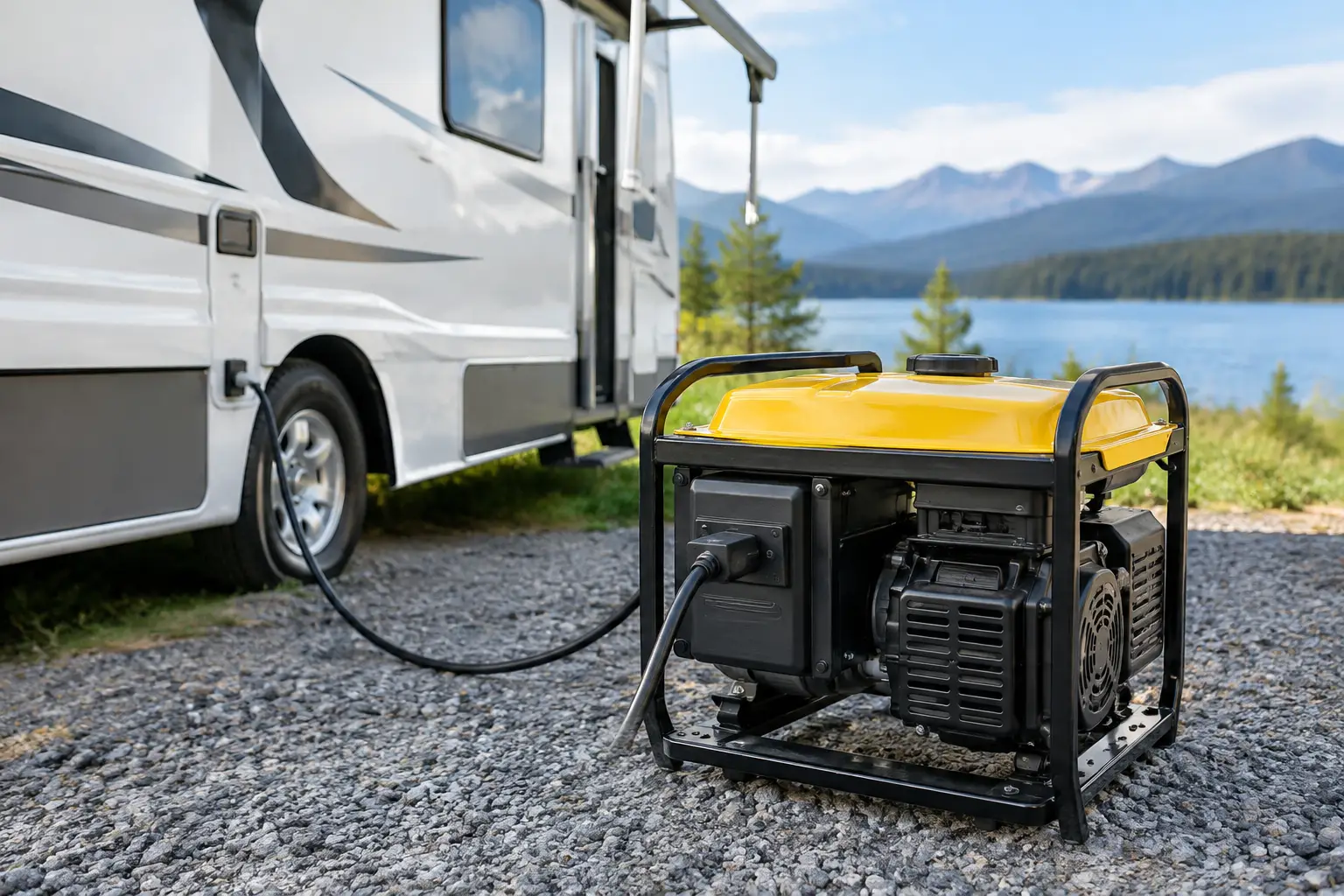
Boondocking gives you the freedom to camp away from RV hookups, crowded campgrounds, and noisy utility connections. But once you leave the electrical pedestal behind, having a dependable power source becomes much more important.
The best generator for boondocking depends on what you actually need to run. If your priorities are keeping a refrigerator cold, charging phones, running lights, using a coffee maker, and powering small electronics, a quiet 2,000-watt-class inverter generator may be enough. If you want to run a rooftop RV air conditioner, microwave, or several high-draw appliances, you will generally need substantially more starting and running power.
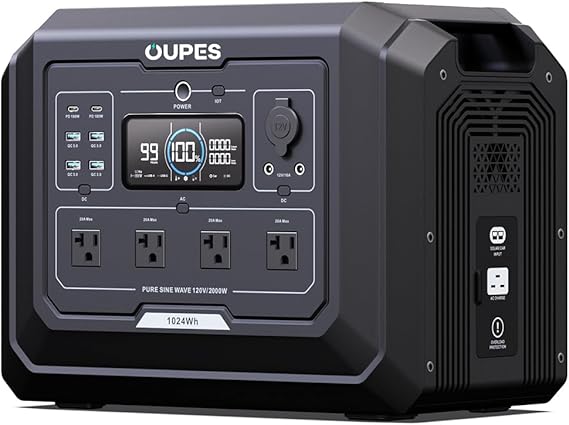
There is also another option: a portable power station such as the OUPES Mega 1. Unlike a gasoline generator, it produces no exhaust while operating and can be recharged from solar panels, making it particularly attractive for quiet campsites.
Below are five options worth considering for different types of boondocking in 2026.
Best Boondocking Generators and Power Stations for 2026
| Model | Power | Power Source | Weight | Best For |
|---|---|---|---|---|
| OUPES Mega 1 | 2,000W / 4,500W surge | LiFePO4 battery | 27.8 lb | Silent, solar-friendly camping |
| Honda EU2200i Companion | 1,800W rated / 2,200W max | Gasoline | 47.4 lb | Quiet everyday boondocking |
| Champion 4000W Inverter | 3,000W running / 4,000W starting | Gasoline | <49 lb | RV 30A power and portability |
| WEN GN5602X | 4,500W running / 5,600W starting | Gasoline | Heavy-duty portable | Higher-demand RV use |
| MaXpeedingrods 5500W | 5,000W running / 5,500W peak | Gasoline | 86 lb | High-output mobile power |
The specifications above are based on current manufacturer information where available.
1. OUPES Mega 1 Portable Power Station
Check Amazon Price Click Here!
If silence is your highest priority, the OUPES Mega 1 takes a very different approach to boondocking power. It is a portable power station rather than a gasoline generator, so there is no engine noise or exhaust while you are using it.
The current Mega 1 has a 1,024Wh LiFePO4 battery and a 2,000W pure sine wave inverter with 4,500W surge capability. It weighs about 27.8 pounds, making it considerably easier to move around a campsite than many gasoline generators.
OUPES Mega 1 specifications
- Battery: 1,024Wh LiFePO4
- AC output: 2,000W
- Surge output: 4,500W
- Solar input: Up to 800W
- Fast AC charging: Up to 1,400W
- Weight: 27.8 lb
- AC inverter: Pure sine wave
- Expansion: Up to 5.12kWh with compatible extra batteries
- USB-C: Up to 100W per port
The Mega 1 can also combine AC and solar charging, which is useful during longer off-grid stays. OUPES lists more than 3,500 battery cycles to 80% capacity for the LiFePO4 battery.
Who should choose the OUPES Mega 1?
It makes the most sense for campers who want quiet operation and do not want to carry gasoline. It can handle many everyday camping loads, including electronics, lighting, refrigeration and other moderate-demand appliances.
The important limitation is battery capacity. A 1,024Wh battery does not provide the same energy reserve as several gallons of gasoline. Running a high-wattage appliance continuously can drain it relatively quickly.
For extended boondocking, pairing the Mega 1 with adequate solar panels makes much more sense than treating it as a replacement for a large gasoline generator.
2. Honda EU2200i Companion
Check Amazon Price Click Here!
The Honda EU2200i Companion remains one of the most appealing choices for campers who value low noise, portability and proven inverter-generator performance.
One important correction from the older version of this article: the EU2200i Companion is rated at 1,800 watts, with 2,200 watts maximum output. Honda lists a 0.95-gallon fuel tank and up to 8.1 hours of runtime at 25% load.
Honda EU2200i Companion specifications
- Rated output: 1,800W
- Maximum output: 2,200W
- Fuel: Gasoline
- Fuel tank: 0.95 gallon
- Runtime: Up to 8.1 hours at 1/4 load
- Noise: 48 dBA at 1/4 load; 57 dBA at rated load
- Weight: 47.4 lb
- RV connection: 30A locking plug
- Parallel capable: Yes
- CO-MINDER: Yes
- Eco Throttle: Yes
Honda also lists Bluetooth capability through the My Generator app and parallel operation as standard features.
Why the Honda works well for boondocking
A 2,000-watt-class inverter generator is often a good match for campers who mainly need basic electrical power rather than continuous air conditioning.
The Honda’s relatively low noise level is especially valuable when camping around other people. It is also small enough to transport without requiring a large storage compartment.
However, its 1,800-watt rated output means you should not confuse it with a 4,000- or 5,000-watt RV generator. Before buying, calculate the starting and running requirements of the appliances you intend to use.
The EU2200i Companion can also be paired with another compatible Honda generator when more capacity is required.
3. Champion 4000-Watt Inverter Generator
Check Amazon Price Click Here!
For RV campers who want more output without jumping to a very large generator, the Champion 4000-Watt Inverter Generator offers a useful middle ground.
Champion’s model 100809 provides 4,000 starting watts and 3,000 running watts. It weighs less than 49 pounds and produces approximately 64 dBA at 23 feet.
Champion 4000W specifications
- Starting watts: 4,000W
- Running watts: 3,000W
- Fuel: Gasoline
- Noise: 64 dBA at 23 ft
- Weight: Less than 49 lb
- RV outlet: 120V 25A TT-30R
- Household outlet: 120V 20A
- THD: Less than 3%
- CO protection: CO Shield
- Parallel capable: Yes, with optional kit
- Runtime: Up to 10 hours
The TT-30R outlet makes this model particularly relevant to RV owners. Champion also says its optional parallel kit can connect two compatible 4000-watt inverters to increase available output.
Why choose the Champion?
The Champion sits in an interesting position between a lightweight 2,000-watt generator and a much larger portable unit.
It gives you more power for demanding RV appliances while remaining under 50 pounds. That combination can be useful when portability matters but a small generator does not provide enough capacity.
If your main objective is quiet overnight battery charging and small appliances, however, a smaller inverter generator may make more sense.
4. WEN GN5602X 5,600-Watt Portable Generator
Check Amazon Price Click Here!
The WEN GN5602X is designed for campers who need substantially more power than a compact inverter generator can provide.
It delivers 5,600 starting watts and 4,500 running watts from its 224cc gasoline engine. WEN also includes a 4.3-gallon fuel tank that can provide up to 12.5 hours of runtime at half load.
WEN GN5602X specifications
- Starting watts: 5,600W
- Running watts: 4,500W
- Engine: 224cc
- Fuel: Gasoline
- Fuel tank: 4.3 gallons
- Runtime: Up to 12.5 hours at 50% load
- Starting: Electric and recoil
- RV outlet: 120V 30A TT-30R
- Transfer switch outlet: 120V 30A L5-30R
- CO protection: WEN Watchdog
- Wheel kit: Included
WEN specifically describes the GN5602X as RV-ready and equipped with an electric start, making it a practical option for longer stays where higher electrical demand is expected.
Is the WEN too large for boondocking?
That depends on your RV and your power requirements.
If you are only charging phones and running lights, this much generator is unnecessary. But if you have a larger RV with several appliances or need more reserve capacity, the extra output can be worthwhile.
The tradeoff is portability. A generator in this class is considerably less convenient to move than a 40-50 pound inverter model.
5. MaXpeedingrods 5500W Inverter Generator
Check Amazon Price Click Here!
The MaXpeedingrods 5500W inverter generator targets users who want high portable output while still having inverter technology for cleaner electrical power.
The manufacturer lists 5,000 running watts and 5,500 starting watts, with a 223cc four-stroke engine and a 2.9-gallon fuel tank. It weighs approximately 86 pounds.
MaXpeedingrods 5500W specifications
- Running watts: 5,000W
- Starting watts: 5,500W
- Engine: 223cc OHV
- Fuel: Gasoline
- Fuel tank: 2.9 gallons
- Runtime: Up to 9.5 hours at 25% load
- Noise: 68 dBA at 23 ft
- Weight: 86 lb
- Starting: Electric and recoil
- THD: ≤3%
- CO protection: Automatic CO shutdown
- Eco mode: Yes
The manufacturer also specifies pure sine wave output and less than or equal to 3% THD, which is useful when powering electronics and other sensitive equipment.
Who is it for?
This is a better fit for the boondocker who needs high output and does not mind carrying a heavier machine.
At 86 pounds, it is not in the same portability class as the Honda or Champion. The benefit is substantially more available power for demanding loads.
How Much Generator Power Do You Need for Boondocking?
One of the biggest mistakes when shopping for an RV generator is focusing only on the advertised peak wattage.
You need to consider both running watts and starting watts.
Running watts are the continuous power a generator can supply. Starting watts are the temporary additional power available when appliances with motors or compressors start.
For example, a refrigerator, air conditioner or other motor-driven appliance can require significantly more power during startup than while running.
Basic boondocking loads
If your typical loads include:
- LED lights
- Phones and tablets
- Laptops
- TV
- Refrigerator
- Small fan
- Coffee maker
- Battery chargers
A 2,000-watt-class inverter generator or a 1,024Wh-class power station may be enough, depending on what you run simultaneously.
Higher-demand RV loads
If you want to operate:
- Rooftop air conditioner
- Microwave
- Coffee maker
- Refrigerator
- Multiple chargers
- Heating appliances
You need to pay much closer attention to generator capacity.
A generator in the 3,000-4,500 running-watt range gives you substantially more headroom than a compact 1,800-watt inverter.
For serious high-demand use, a 4,500-5,000W running generator provides even more reserve.
Can a 2,000-Watt Generator Run an RV Air Conditioner?
This is one of the most important questions for RV boondocking.
The answer is: sometimes, but you should not assume it will.
The actual requirement depends on the size and design of the air conditioner, its starting surge, ambient conditions and what other appliances are running at the same time.
A small generator may handle an efficient RV A/C under favorable conditions, while another unit may require considerably more starting power.
If running rooftop A/C is one of your main goals, look at the air conditioner’s actual electrical requirements before choosing your generator.
For many RV owners, moving up to the 3,000-4,500 running-watt class provides a more practical margin than trying to make a small 2,000-watt generator do everything.
Inverter Generator vs. Portable Power Station for Boondocking
These two technologies solve similar problems in very different ways.
Inverter generator
A gasoline inverter generator gives you:
- Long operating time as long as you have fuel
- High continuous output
- Fast refueling
- Strong performance for demanding appliances
- Useful RV outlets such as TT-30R on suitable models
The disadvantages are engine noise, exhaust, fuel storage and routine maintenance.
Portable power station
A power station such as the OUPES Mega 1 provides:
- Silent operation
- No exhaust while operating
- Solar charging capability
- Easy indoor storage
- USB and AC outputs
- No gasoline required during operation
The limitation is stored energy. A battery eventually needs to be recharged.
For short, quiet camping trips, a power station can be extremely convenient. For extended stays with heavy loads, a gasoline generator can provide much greater energy availability when fuel is accessible.
What to Look for in a Boondocking Generator
1. Running wattage
Do not choose a generator based solely on its highest advertised wattage.
Start by listing the appliances you actually expect to use simultaneously and add their running requirements.
2. Starting wattage
Motor-driven equipment can have a significantly higher starting demand.
This is particularly important for RV air conditioners, refrigerators, pumps and other compressor-based equipment.
3. Noise
Noise matters more when you are camping in remote areas or near other campers.
Inverter generators generally offer better noise control than traditional open-frame generators, especially when operating at lower loads.
The Honda EU2200i Companion, for example, is rated at 48 dBA at 25% load and 57 dBA at rated load.
4. Fuel efficiency
Eco or load-dependent operating modes can reduce fuel consumption when the generator does not need to operate at full capacity.
This is one reason inverter generators are attractive for overnight or low-load boondocking.
5. RV outlet
If you have a 30A RV, look for a generator with a compatible TT-30R outlet rather than assuming any portable generator will connect directly.
The Champion 100809 and WEN GN5602X both provide 30A RV-ready outlets.
6. CO protection
Carbon monoxide is a serious hazard associated with gasoline generators.
Modern portable generators may include automatic CO shutoff systems, but these systems should never be treated as permission to operate a generator in an enclosed space.
Safe Generator Use While Boondocking
Safety should come before convenience.
Never run a gasoline generator inside an RV, camper, tent, garage, vehicle or other enclosed or partially enclosed space.
Always follow the generator manufacturer’s instructions for outdoor placement, clearance and ventilation.
Keep the exhaust away from doors, windows, vents and other openings that could allow carbon monoxide to enter the RV.
A CO shutoff feature provides an additional layer of protection, but it does not replace proper generator placement.
For fuel-powered generators, use appropriate fuel containers and follow the manufacturer’s instructions for refueling and storage. Turn the generator off and allow it to cool before refueling.
It is also a good idea to check campground or public-land rules regarding generator hours. In many areas, quiet hours are strictly enforced.
Which Boondocking Power Option Makes the Most Sense?
There is no single generator that makes sense for every boondocking setup.
For silent, solar-friendly camping
OUPES Mega 1
The 1,024Wh LiFePO4 battery, 2,000W inverter and up to 800W solar input make it an attractive choice for campers who prioritize silence and fuel-free operation.
For compact gasoline power
Honda EU2200i Companion
The Honda is a strong fit for campers who want a relatively quiet, portable generator for everyday electrical loads. Its 1,800W rated output and 2,200W maximum output should be considered when planning your appliance load.
For a balance of portability and RV output
Champion 4000W Inverter
With 3,000 running watts, 4,000 starting watts, a TT-30R outlet and a weight under 49 pounds, it provides considerably more capacity than a small 2,000-watt-class generator without becoming extremely heavy.
For higher-demand RV power
WEN GN5602X
Its 4,500 running watts, 5,600 starting watts and 4.3-gallon fuel tank make it better suited to larger electrical loads and longer operating periods.
For high-output portable inverter power
MaXpeedingrods 5500W
With 5,000 running watts and 5,500 peak watts, this model is designed for users who need substantial power and can accept its 86-pound weight.
Final Thoughts: Choosing the Best Generator for Boondocking in 2026
The best generator for boondocking is not necessarily the one with the highest wattage.
For many campers, the sweet spot is a quiet inverter generator that is easy to carry and powerful enough for the appliances they actually use. The Honda EU2200i Companion fits that type of setup particularly well.
If you need a 30A RV connection and more available power, the Champion 4000W Inverter provides a useful step up while remaining relatively portable.
For larger electrical demands, the WEN GN5602X and MaXpeedingrods 5500W move into a higher-output category.
And if your priorities are silence, solar charging and avoiding gasoline altogether, the OUPES Mega 1 offers a completely different approach to off-grid power.
Before buying, make a simple list of the appliances you plan to run, check their running and starting requirements, and decide whether you prioritize quiet operation, fuel availability, battery capacity, portability, solar charging or maximum wattage.
That approach will help you choose a boondocking power system that fits your actual RV lifestyle instead of paying for capacity you may never use.