As an Amazon Associate I earn from qualifying purchases.
If you need portable power without carrying a large conventional generator, a compact inverter generator can be a practical solution for camping, RV trips, tailgating, small backup loads, and remote work.
The biggest advantage is not simply size. Inverter generators are designed to provide stable electrical output while adjusting engine speed to the load, which can help reduce noise and fuel consumption when demand is low.
However, compact does not mean unlimited power. A 1,800-watt generator and a 3,000-watt generator serve very different purposes. Before buying one, you need to look at running watts, starting watts, noise, weight, runtime, outlets, CO protection, and portability.
Below are five compact inverter generators from the original selection, followed by a practical guide to help you determine which type makes sense for your needs.
Compact Inverter Generators Compared
| Model | Starting Watts | Running Watts | Weight | Fuel | Best For |
|---|---|---|---|---|---|
| PowerSmart 2500W | 2,500W | 1,900W | 39 lb | Gasoline | Camping and light backup |
| AMERISUN 2500W | 2,500W | 1,900W | Approx. 40 lb | Gasoline | General portable use |
| ERAYAK 2400P | 2,400W | 1,800W | 42 lb | Gasoline | Quiet camping and electronics |
| Champion 4000W | 4,000W | 3,000W | 48.1 lb | Gasoline | RVs and higher loads |
| WEN 56360iX | 3,600W | 2,900W | 46 lb | Gasoline | RVs and medium-duty backup |
Specifications can vary by production version, operating conditions, and manufacturer updates. Always verify the current product listing before purchasing.
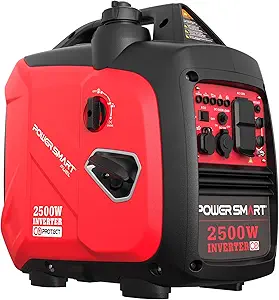
PowerSmart 2500W Inverter Generator
Check Amazon Price Click Here!
The PowerSmart 2500W Inverter Generator is one of the more compact choices in this group and is aimed at people who need portable power without moving a heavy generator.
The current HB5020C version produces 2,500 starting watts and 1,900 running watts. It weighs about 39 pounds, uses gasoline, and includes a built-in CO sensor with automatic shutdown. PowerSmart also lists parallel capability, allowing compatible units to be connected for additional output.
That 1,900-watt continuous rating is the number you should pay the most attention to. It gives you enough capacity for many basic camping and emergency loads, but it is not intended to run an entire house or several large appliances simultaneously.
For example, a refrigerator, lights, phone chargers, router, and a few small electronics can be reasonable loads, provided their combined running and startup requirements stay within the generator’s limits.
Product Highlights
- Starting power: 2,500 watts
- Running power: 1,900 watts
- Weight: About 39 pounds
- Fuel: Gasoline
- CO protection: Built-in automatic shutdown
- Runtime: Up to 11 hours at 25% load according to the manufacturer
- Parallel capable: Yes
- Best suited for: Camping, tailgating and light emergency backup
One detail worth noting is that PowerSmart presents different noise figures depending on the operating condition and measurement point. The manufacturer lists 56 dB in ECO mode but also lists 69 dB at 23 feet in its specifications, so I would not compare the 56 dB figure directly with another generator’s standardized 23-foot measurement.
AMERISUN 2500W Gas Inverter Generator
Check Amazon Price Click Here!
The AMERISUN 2500W Gas Inverter Generator fits the same general category as the PowerSmart: a compact gasoline generator intended for relatively modest electrical loads.
The original version of this article listed 2,500 peak watts and 1,900 running watts, making it important to focus on the continuous rating rather than the larger headline wattage.
For camping, tailgating, outdoor projects and basic emergency loads, this power class can make sense when portability matters more than maximum output.
One advantage of choosing a generator around this size is that it is easier to move and store than the 4,000-watt-class models. The tradeoff is straightforward: you have less capacity for appliances with high starting requirements.
Product Highlights
- Starting power: 2,500 watts
- Running power: 1,900 watts
- Fuel: Gasoline
- Portable design: Suitable for transport and storage
- Safety: CO protection should be verified on the current model/listing
- Best suited for: Camping, tailgating and smaller backup loads
If you’re comparing this model with another 2,500-watt inverter generator, pay particular attention to the running wattage, actual noise measurement, CO protection, warranty and available outlets rather than choosing based solely on peak watts.
ERAYAK 2400W Portable Inverter Generator
Check Amazon Price Click Here!
The ERAYAK 2400P is another compact gasoline inverter generator designed around portability and relatively low electrical demand.
The manufacturer’s current specifications list 2,400 peak watts and 1,800 running watts, with a weight of approximately 42 pounds and up to 10 hours of runtime depending on load and operating conditions. Its current product page describes operation around the mid-50 dB range rather than the 52.5 dB figure used in the older article.
The 1,800-watt running rating is especially important. This makes the generator more appropriate for smaller loads than for trying to power several high-demand appliances at once.
For camping, charging electronics, running lights, powering a router or operating other small equipment, its compact design can be useful.
If you are considering it for a CPAP machine or another medical device, check the requirements of the specific equipment and follow both manufacturers’ instructions. A generator’s inverter output should not be treated as a substitute for verifying compatibility with medical equipment.
Product Highlights
- Peak power: 2,400 watts
- Running power: 1,800 watts
- Weight: About 42 pounds
- Fuel: Gasoline
- Noise: Manufacturer currently lists about 55 dB in its product presentation
- Runtime: Up to 10 hours depending on load
- Best suited for: Camping, tailgating and smaller electronics loads
The ERAYAK is particularly interesting if your priority is keeping the generator relatively compact while staying above the 1,500-watt class.
Champion Power Equipment 4000W Inverter Generator
Check Amazon Price Click Here!
If your definition of “compact” allows you to move into the 4,000-watt class, the Champion Power Equipment 100809 4000W Inverter Generator gives you considerably more power without becoming a large open-frame generator.
The current model produces 4,000 starting watts and 3,000 running watts from its 149cc gasoline engine. It weighs 48.1 pounds, operates at 64 dBA from 23 feet, and can run for up to 10 hours at 25% load.
It also includes an RV-ready TT-30R outlet, a household 120V outlet, a 12V automotive-style outlet and parallel connections.
The CO Shield system automatically shuts down the engine when unsafe carbon monoxide accumulation is detected. Importantly, this is an additional safety feature, not permission to operate the generator inside a house, garage, RV or other enclosed area. Champion specifically states that generators must be operated outdoors and away from occupied buildings.
Another useful feature is parallel capability. With the appropriate kit, two compatible Champion inverter generators can be connected for additional output.
Product Highlights
- Starting power: 4,000 watts
- Running power: 3,000 watts
- Weight: 48.1 pounds
- Noise: 64 dBA at 23 feet
- Fuel: Gasoline
- Runtime: Up to 10 hours at 25% load
- RV outlet: 120V TT-30R
- CO protection: CO Shield automatic shutdown
- Parallel capable: Yes
- Best suited for: RV use, camping and larger portable loads
This model is considerably more capable than the 1,800–1,900-watt generators above, but that extra capacity also makes it less appropriate if your primary goal is carrying the smallest possible generator.
WEN 56360iX 3600-Watt Portable Inverter Generator
Check Amazon Price Click Here!
The WEN 56360iX occupies the middle ground between small 2,000-watt-class generators and larger portable inverter models.
Its 149cc engine produces 3,600 surge watts and 2,900 rated watts, while the generator weighs about 46 pounds. WEN lists a 1.6-gallon fuel tank and up to five hours of runtime at half load.
It also includes an RV-ready TT-30R outlet, two 120V receptacles, a 12V DC outlet and two USB ports.
For electronics, WEN specifies very low total harmonic distortion, with the output designed to provide clean electricity for devices such as laptops, tablets and smartphones.
The generator also includes CO Watchdog, automatic low-oil and low-fuel shutdown, overload protection and a fuel-shutoff function. The latter is useful when storing the generator because it allows remaining fuel in the carburetor to be consumed before shutdown.
Product Highlights
- Surge power: 3,600 watts
- Rated power: 2,900 watts
- Weight: 46 pounds
- Fuel: Gasoline
- Noise: 65 dB at quarter load
- Runtime: Up to 5 hours at half load
- RV outlet: TT-30R
- CO protection: CO Watchdog
- Fuel shutoff: Yes
- Parallel capability: Yes, with the appropriate WEN connection kit
- Best suited for: RV travel, camping and medium portable loads
If you need more continuous power than the PowerSmart or ERAYAK but don’t want to move into a much heavier generator, the WEN’s 2,900-watt rating makes it a different class of option.
What Makes a Compact Inverter Generator Different?
A conventional portable generator generally runs its engine at a fixed speed to produce electricity. An inverter generator uses electronic circuitry to create a cleaner and more controlled electrical output.
One practical benefit is that the engine can reduce its speed when the electrical demand is lower. That can reduce fuel consumption and noise under lighter loads.
This is one reason inverter generators have become popular for camping, tailgating, RV travel and portable backup power.
The important point is that “inverter” does not automatically mean “small.” Current 2026 buying guides include everything from approximately 2,000-watt portable models to much larger inverter generators.
For this article, the focus is on the more portable end of that range.
How Many Watts Do You Actually Need?
This is probably the most important question to answer before buying a compact generator.
Don’t select a generator based only on the advertised peak wattage.
Instead, determine:
- The running watts of each device.
- The starting watts required by equipment with motors or compressors.
- Which appliances may need to start at the same time.
- How much additional capacity you want as a safety margin.
For example, a refrigerator may consume considerably less electricity once it is running than it needs for a brief startup surge.
The same principle applies to pumps, compressors, some power tools and other motor-driven equipment.
A generator rated at 1,800 running watts should therefore not be treated as an 1,800-watt invitation to operate continuously at its maximum capacity.
A Practical Way to Think About the Five Generators
Around 1,800–1,900 running watts:
Good for smaller emergency loads, camping equipment, electronics, lights and selected appliances.
Around 2,900–3,000 running watts:
Provides substantially more headroom for RV equipment and multiple portable loads.
This is why the difference between the ERAYAK’s 1,800 running watts and Champion’s 3,000 running watts matters more than the difference between their peak wattage numbers.
Are Compact Inverter Generators Actually Quiet?
Compared with many traditional open-frame generators, inverter generators are generally designed with noise reduction in mind.
However, don’t compare noise numbers blindly.
A manufacturer may measure sound at a different distance, load or operating mode. For example, Champion specifies 64 dBA at 23 feet, while PowerSmart publishes different figures for ECO mode and its specification section.
The load also matters. An engine running at a light load can sound very different from the same generator working near its rated capacity.
If you plan to use your generator at a campground or around an RV, look for:
- A published noise measurement with a stated distance
- ECO or economy mode
- Enclosed inverter design
- A reasonable running-wattage margin
- Reviews that discuss real-world noise rather than just repeating the manufacturer’s headline number
Compact Inverter Generators for Camping
Camping is one of the clearest use cases for a small inverter generator.
You may need electricity for:
- LED lighting
- Phone and laptop charging
- A small refrigerator or cooler
- Fans
- A television
- Cooking accessories
- Battery chargers
- Other small appliances
In this situation, portability and noise may be more important than maximum wattage.
A generator weighing around 40 pounds can be considerably easier to load into a vehicle than a much larger conventional generator.
Still, campsite rules vary. Some campgrounds restrict generator operating hours or prohibit generators in certain areas, so check the rules for your destination before traveling.
Compact Inverter Generators for RVs
RV owners need to pay particular attention to the outlets and continuous wattage.
An RV-ready TT-30R outlet can make connecting compatible 120V RV equipment much more convenient. Both the Champion 4000W and WEN 56360iX include TT-30R outlets.
The bigger question is whether the generator has enough running and starting capacity for the RV appliances you actually intend to use.
An air conditioner, microwave, refrigerator and other equipment can quickly consume the capacity of a small generator.
If your RV has a high-demand air conditioner, calculate its startup requirement rather than assuming that any generator advertised as “RV ready” will run it.
Can You Use a Small Inverter Generator for Home Backup?
Yes, but think of it as portable backup for selected circuits or appliances, not whole-house backup.
A compact generator may be useful during an outage for things such as:
- Refrigerator
- Internet router
- Lights
- Phone chargers
- Small fans
- Television
- Selected kitchen appliances
It is not designed to power everything in a modern home simultaneously.
Central air conditioning, electric water heaters, electric ranges, well pumps and other high-demand equipment can require substantially more power.
For larger emergency backup needs, a properly installed standby generator or a larger portable generator may be more appropriate.
Carbon Monoxide Safety Is Non-Negotiable
Every gasoline generator in this category produces carbon monoxide.
CO is colorless and odorless, and generator exhaust can become dangerous quickly in enclosed or partially enclosed spaces.
Never operate a gasoline generator:
- Inside your home
- In a garage
- Inside an RV
- In a basement
- In an enclosed shed
- Near open windows or doors where exhaust can enter the building
A CO shutdown system such as Champion CO Shield or WEN CO Watchdog can provide an additional layer of protection, but it does not make indoor operation safe. Champion explicitly warns that its CO protection system does not replace safe generator operation.
Always follow the safety instructions supplied with the specific generator.
What to Look for When Buying a Compact Inverter Generator
1. Running Watts
This should be one of your first specifications to check.
Running watts determine how much electrical load the generator can continuously support.
2. Starting Watts
Starting watts matter when equipment contains motors or compressors.
A refrigerator that needs relatively little power once running can require considerably more power for a brief startup.
3. Weight
If you’re taking the generator camping or loading it into an SUV, every pound matters.
The models in this article range from roughly 39 to 48 pounds, which is considerably more portable than many larger generators.
4. Noise
Don’t look at the number alone.
Check the measurement distance and load condition.
5. Runtime
Runtime figures are normally tied to a specific load. A claim such as “10 hours” does not mean the generator will run for 10 hours at maximum output.
For example, Champion’s 10-hour figure is based on a 25% load, while WEN lists up to five hours at half load for the 56360iX.
6. CO Protection
A built-in CO sensor with automatic shutdown is an important safety feature to look for, but it never replaces correct outdoor operation.
7. Outlets
Think about what you’re actually connecting.
An RV owner may specifically need a TT-30R outlet. Someone charging electronics may care more about USB ports and standard household outlets.
8. Parallel Capability
Parallel capability can be useful if you want the option of adding another compatible inverter generator later.
Remember that the required parallel cable or kit may be sold separately.
9. Fuel Shutoff
Fuel shutoff can be particularly useful for people who don’t use their generator frequently. The WEN 56360iX, for example, uses fuel shutoff to reduce the amount of gasoline left in the carburetor during shutdown.
Compact vs. Larger Inverter Generators
The right size depends on the job.
| Generator Size | Typical Use |
|---|---|
| 1,000–1,500W | Electronics, lights and very small loads |
| 1,800–2,000W | Camping and basic emergency loads |
| 2,500–3,000W | Larger portable loads and some RV applications |
| 3,000–4,000W+ | More demanding RV and backup applications |
These are general categories rather than guarantees. Your actual appliance requirements should always determine the generator size.
Final Thoughts on Compact Inverter Generators in 2026
The right compact inverter generator for you depends less on the biggest number printed on the box and more on the running wattage, portability, noise, runtime, outlets and safety features that match your situation.
The PowerSmart and AMERISUN options remain in the lighter 2,500-watt class, while the ERAYAK focuses on compact 1,800-watt continuous output. The Champion and WEN move into a higher power class, making them more suitable when you need additional capacity for RV equipment or multiple portable loads.
Before purchasing, calculate the running and starting wattage of the appliances you actually intend to use. Then compare the generator’s continuous output, not just its peak number.
And regardless of which model you choose, always operate a gasoline generator outdoors and follow the manufacturer’s safety instructions.
That approach will help you choose a compact inverter generator that fits your actual power requirements instead of simply choosing the model with the largest wattage number.